






Speed Bleeder Size

Safety Car


Joined: Dec 2007
Posts: 3,616
Likes: 5
From: Sandhills of North Carolina

Because Speed Bleeders use sealant on the threads to keep air out, which the sealant can fail. Which is why they sell a bottle of their sealant so you can reapply it on the threads.
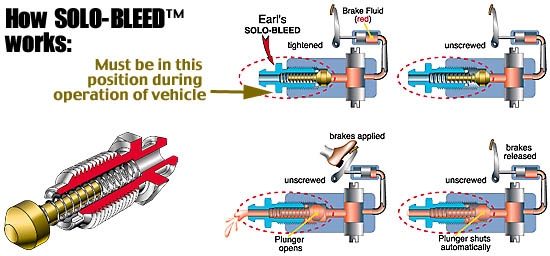
Earls use a plunger to keep air out. So, you don't have to worry about air getting in past the threads like can happen with Speed Bleeders.
I believe they are both around the same price, so might as well get the better design which is the Earl's.
Earl's:
Speed Bleeders:

Earls use a plunger to keep air out. So, you don't have to worry about air getting in past the threads like can happen with Speed Bleeders.
I believe they are both around the same price, so might as well get the better design which is the Earl's.
Earl's:
Speed Bleeders:
Interesting, I've never had any problems with mine. I really don't see any difference whether it's a ball or plunger though. Could have just been dirty fluid that kept the SB from sealing properly. Crud has a tendency to do that.

Pro


Joined: May 2008
Posts: 670
Likes: 55
Ok I have to ask the "dumb" question. Do "speed bleeders" mean you can bleed your brakes by yourself? If so do you have to have four and change the existing ones or just one and move from wheel to wheel? How do they shut off if you leave them in, do they just screw tight like the regular bleeder? Thanks, I want to get some of these. I have always just used a board against the seat and the pedal and then gone back and forth again and again to tighten loosen the bleeder. Learn something new every day here.
Safety Car
Joined: Dec 2007
Posts: 3,616
Likes: 5
From: Sandhills of North Carolina
Also, although it is a basically a one man operation it makes it easier if you have someone watching the fluid flow into the bag to tell you when the air stops coming out.
They are handy little devils no matter which brand you choose.
They are handy little devils no matter which brand you choose.
Safety Car
Joined: Dec 2007
Posts: 3,616
Likes: 5
From: Sandhills of North Carolina
How you going to do that and push the brake pedal at the same time? Have hose 9' long? Or go back and forth trying to see if there are bubbles in the line. I'm just sayin it's easier with two not that it has to be done that way.
Corvette Stories
The Best of Corvette for Corvette Enthusiasts

Top 10 Most Expensive Corvettes Ever Sold on Bring A Trailer
Brett Foote
10 Things Every Corvette Owner Needs (2026 Edition)
Michael S. Palmer
8 Most "Only Corvette Owners Understand" Quirks and Problems
Pouria Savadkouei
10 Reasons the C6 Z06 is Still A Performance Benchmark After 20 Years
Joe Kucinski
How Much Horsepower Every Corvette Engine "LOST" in 1972
Joe Kucinski
Top 10 DOs and DON'Ts for Protecting Your Convertible Top!
Michael S. Palmer
Top 10 Most Explosive Corvettes Ever Made: Power-to-Weight Ratio Ranked!
Joe Kucinski
150 hp to 1,250 hp: Every Corvette Generation Compared by the Specs That Matter
Joe Kucinski
8 Coolest Corvette Pace Cars (and Replicas) of All Time
Verdad Gallardo
Safety Car
Joined: Dec 2007
Posts: 3,616
Likes: 5
From: Sandhills of North Carolina
How do you know air isn't getting sucked in past the threads? I say it is past time to reseal the threads. Which is a pain as you have to clean them up and let dry. So, that means you have to get something to plug up the bleeder screw hole if you threw your old bleeder screws away.
I've just read enough of people saying they work fine, then start leaking later on, that I'd just buy Earl's. No worry about sealing up the threads.
What some guys say they do is just replace the speed bleeder screws every few years or everytime they flush the brake fluid and not worry about resealing the old ones.
Here is a review I read:
"Also, the Speed Bleeder screws rely on a sealant to keep air from being sucked into the system. This means that the bleeders must be annually (at least) removed and cleaned before new thread sealant (sold separately) can be re-applied."
http://octanereport.com/news/261/21/...ng-Screws.html
I've just read enough of people saying they work fine, then start leaking later on, that I'd just buy Earl's. No worry about sealing up the threads.
What some guys say they do is just replace the speed bleeder screws every few years or everytime they flush the brake fluid and not worry about resealing the old ones.
Here is a review I read:
"Also, the Speed Bleeder screws rely on a sealant to keep air from being sucked into the system. This means that the bleeders must be annually (at least) removed and cleaned before new thread sealant (sold separately) can be re-applied."
http://octanereport.com/news/261/21/...ng-Screws.html
Now Josh, lets put the rest of the review on there.
"But, at only $7 for a regular version and $15 for a CNC-machined stainless version, the Speed Bleeder screw is one of the cheapest one-man brake bleeding options out there. It may not be as effective as having another human’s labor at your disposal, but it’s easy to carry, easy to figure out and makes a perfect backup for when you’re at the track or just need to get something done quick and by yourself. It’s the perfect parking lot emergency brake bleeding option."
Safety Car
Joined: Dec 2007
Posts: 3,616
Likes: 5
From: Sandhills of North Carolina
After doing a little Googleing on the subject of sealant for these things, It seems that the usual cause for the sealant to start leaking is when people open the bleeder to far, like a turn or more or for some reason have to remove it completely. 1/4 turn is all it takes for fluid to come out in order to bleed the brake line. If it is turned very much more than that I can see why the sealant wouldn't last very long, nothing would. Maybe that is why some don't have any issues with them.

Safety Car

Joined: Jan 2004
Posts: 3,783
Likes: 15
From: Northern California
I use the Earl's Solo-Bleeds because I didn't like the Speed Bleeder's design.
Also, the original GM bleeder screws don't use sealant so, I'm not going to use anything that will gunk up the threads?!
Also, the original GM bleeder screws don't use sealant so, I'm not going to use anything that will gunk up the threads?!
