




second head gasget leaking

Thread Starter
Racer


Joined: Jul 2007
Posts: 462
Likes: 21
From: Kansas City Missouri
 second head gasget leaking
We finished rebuilding my painful project recently only to find anti-freeze in my oil again. We didn't see anything visually wrong with the head gaskets or the intake gaskets. I have attached pics of the heads, because you can see clearly which two cylinders were leaking. Looking at the gasket around this area, there seems to be nothing wrong with it at all. I put a straight edge on the brand new heads and they look straight. I have not done the same with the block, but figure the odds of that cast iron block being warped are pretty slim. Any thoughts on what could have caused the failure? Any suggestions on things to do when we put it back together again?


Melting Slicks

Joined: Nov 2008
Posts: 2,765
Likes: 5
Did you thoroughly clean the block deck surface till it shines and sparkles?
Clean enough to eat off of ?
Did you purchase new headbolts?
ARP or Fel-Pro?
Did you use a calibrated torque wrench(Snap On is my own personal choice)?
Did you follow the factory recommended torque sequence & specs?
Did you coat the head bolt threads with an approved sealer(RTV silicone no good).
Just a few thoughts of mine right now.
Clean enough to eat off of ?
Did you purchase new headbolts?
ARP or Fel-Pro?
Did you use a calibrated torque wrench(Snap On is my own personal choice)?
Did you follow the factory recommended torque sequence & specs?
Did you coat the head bolt threads with an approved sealer(RTV silicone no good).
Just a few thoughts of mine right now.

Le Mans Master

Joined: May 2004
Posts: 5,866
Likes: 60
From: Hellinois
Finalist 2020 C4 of the Year - Modified
Did you thoroughly clean the block deck surface till it shines and sparkles?
Clean enough to eat off of ?
Did you purchase new headbolts?
ARP or Fel-Pro?
Did you use a calibrated torque wrench(Snap On is my own personal choice)?
Did you follow the factory recommended torque sequence & specs?
Did you coat the head bolt threads with an approved sealer(RTV silicone no good).
Just a few thoughts of mine right now.
Clean enough to eat off of ?
Did you purchase new headbolts?
ARP or Fel-Pro?
Did you use a calibrated torque wrench(Snap On is my own personal choice)?
Did you follow the factory recommended torque sequence & specs?
Did you coat the head bolt threads with an approved sealer(RTV silicone no good).
Just a few thoughts of mine right now.
Once you get the block deck CLEAN, lay a straight edge across it & check in a whole bunch of different spots with a very thin feeler gauge.

Team Owner


Joined: Mar 2001
Posts: 54,124
Likes: 30
From: Cincinnati, Oh USA
Check the block for flatness and check the heads for flatness too. Next head gaskets should be teflon coated made by Fel-Pro, they last much longer than non coated and they seal much better than non coated.

Melting Slicks

Joined: Jan 2009
Posts: 3,482
Likes: 196
From: folsom california
on the first aluminum head cast iron block I ever did, before I installed the heads I went on the internet and read all I could about this (new to me ) technology. every single article I read stressed that every possible thing that could be done to allow for relative movement between the aluminum head and cast iron block must be done. At a minimum the block must be smoother than in the old cast iron head, steel shim gasket, cast iron block days (where their was little if any relative movement) and a teflon coated gasket was a necessity.
Pro

Joined: Feb 2010
Posts: 677
Likes: 3
From: Metairie LA
Make sure you use a good thread sealer. Damn near everyone of my head studs weeped coolant on my rebuild. That was a shocking first oil change. Resealed with Permatex thread sealant with Teflon - good to go.
Corvette Stories
The Best of Corvette for Corvette Enthusiasts

150 hp to 1,250 hp: Every Corvette Generation Compared by the Specs That Matter
Joe Kucinski
8 Coolest Corvette Pace Cars (and Replicas) of All Time
Verdad Gallardo
Top 10 Corvette Engines RANKED by Peak Torque (70+ Years of Muscle!)
Joe Kucinski
Corvette ZR1X Will Be Pacing the Indy 500, And Could Probably Race, Too!
Verdad Gallardo
Top 10 Corvettes Coming to Mecum Indy 2026!
Brett Foote
Top 10 C9 Corvette MUST-HAVES to Fix These C8 Generation Flaws!
Michael S. Palmer
10 Revolutionary 'Corvette Firsts' Most People Don't Know
Joe Kucinski
5 Reasons to Upgrade to an LS6-Powered Corvette; 5 Reasons to Stay LT2
Michael S. Palmer
2027 Corvette vs The World: Every C8 vs Its Closest Competitor
Joe Kucinski
Le Mans Master
Joined: Aug 2010
Posts: 9,272
Likes: 17


Safety Car

Joined: Aug 2008
Posts: 4,344
Likes: 48
From: San Marcos CA
I always use permatex form-a-gasket on headbolt threads-the sticky dark brown goo.
Another thing to consider is if the block has a hairline crack on the cylinder wall. I saw that once or twice- it could happen so get a real bright light and check for that just in case.
ON EDIT- I actually looked at the pics...straight edge the intake manifold. omg that's a lot of water!
Another thing to consider is if the block has a hairline crack on the cylinder wall. I saw that once or twice- it could happen so get a real bright light and check for that just in case.
ON EDIT- I actually looked at the pics...straight edge the intake manifold. omg that's a lot of water!
Thread Starter
Racer
Joined: Jul 2007
Posts: 462
Likes: 21
From: Kansas City Missouri
We installed the heads on the engine stand and the block looked beautiful. We used new bolts and Im pretty sure that we used a thread sealer. I asked my friend but he hasn't gotten back to me on that one yet. The intake and the heads seem to be straight and we did everything according to the book on sequence and torque specs. I suppose thats part of what makes this so frustrating. Thanks for all of the pointers though. I guess I just hate to put it all back together basically the same way and get the same results. I believe the gaskets you see were felpro, but Im not sure on the teflon coating. Im guessing not. If the heads and intake look good on the straight edge they wouldn't be warped enough to leak with a gasket would they? I wouldn't think so.

Melting Slicks
Joined: Aug 2008
Posts: 2,082
Likes: 50
From: Palmdale CA
This is what the Felpro teflon coated gaskets look like..

This is what the deck should look like when you get it cleaned
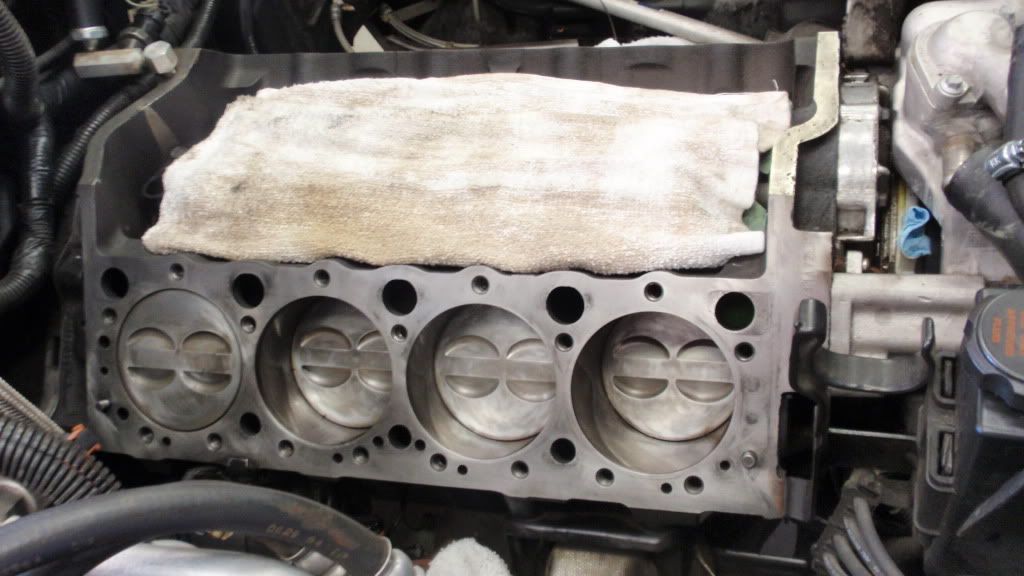
you need to use a high Quality 18-20in machinest ruler on edge, and Length wise, with a feeler gauge in order to check the deck for flatness.
This is what the deck should look like when you get it cleaned
you need to use a high Quality 18-20in machinest ruler on edge, and Length wise, with a feeler gauge in order to check the deck for flatness.
Le Mans Master
Joined: Aug 2010
Posts: 9,272
Likes: 17
an old school trick for chevy's intake manifolds that wont seal, use two gaskets on each side, extra sealer on each end, next was a different intake, and the last best was to hunt down a cast iron manifold, kinda out of the question these days, interesting some of the things you do .



Le Mans Master
Joined: May 2004
Posts: 5,866
Likes: 60
From: Hellinois
Finalist 2020 C4 of the Year - Modified
Depending on which head was on the bad side it is either 5&7 or 4&6 getting water. I think you can rule out a crack, that would just be one cylinder most likely. It still looks to me like false torque readings in those bolt holes, there's a lot of crap that builds up in the bottoms and your new bolts may be just a tad longer than the originals. Did the bolts come with washers? Are you using the washers? If not you definitely should, especially on aluminum heads. Also the lack of washers would extend the bolt further down into the hole compounding the false torque reading possibility.

Max G’s


Joined: Nov 2008
Posts: 2,751
Likes: 78
From: Monroe OH
NCM Sinkhole Donor
Since you have it apart again, before putting it back together, take both heads to a machine shop and have them checked for cracks and warpage. It's not bad money just to make sure. Also, don't want to seem too critical, but those head gaskets look like the cheap Fel Pros that AutoZone and other chain stores sell. Get the OEM head gasket sets from the dealer or GM Performance Parts. When I rebuilt mine over the winter, I was advised by a reputable builder to use the OEM gaskets. 