



Bare block search: Flat tappet vs. hydro roller
Thread Starter
Drifting


Joined: Apr 2011
Posts: 1,925
Likes: 441
From: Albuquerque NM
 Bare block search: Flat tappet vs. hydro roller
I've been entertaining the idea of doing an engine build. From my preliminary research on bare blocks, I've gathered that some blocks are meant for flat tappet cam setups and some are meant for hydraulic roller setups.
This is a little confusing; I thought that the only thing that determined a cam setup's demarcation as flat tappet or hydraulic roller was the type of lifter used with the cam.
How can certain blocks only fit certain types of lifters?
any clarification would be appreciated.
I hope the question is clear.
This is a little confusing; I thought that the only thing that determined a cam setup's demarcation as flat tappet or hydraulic roller was the type of lifter used with the cam.
How can certain blocks only fit certain types of lifters?
any clarification would be appreciated.
I hope the question is clear.

Tech Contributor
Joined: Oct 2008
Posts: 3,729
Likes: 190
From: Custer, WI
You can use a hyd roller cam in a flat tappet block if you use the "retro" style lifters with the link bars and if you use a special cam button. The retro lifters are very expensive, and its much easier to just find a roller block.
Most roller blocks are also 1 piece RMS, which is better. (all of them? Don't quote me)
I bought a 4 bolt main 350 1 piece rms roller block for $50.
Retro lifters would have cost me 500+
Most roller blocks are also 1 piece RMS, which is better. (all of them? Don't quote me)
I bought a 4 bolt main 350 1 piece rms roller block for $50.
Retro lifters would have cost me 500+

Le Mans Master


Joined: Mar 2002
Posts: 5,889
Likes: 2
From: Castro Valley Calif.
St. Jude Donor '03 thru '26
The question is a bit ambiguous, I think you're simply asking the diff between a roller block & a non roller block. In a nutshell, the roller block has a retainer (spider) to keep the lifters from spinning (flat tappet lifters spin freely). This issue is defeated by using retro fit roller lifters that employ connecting bars to keep them from spinning in their bore.
There are other differences to be sure (a rear main for one which cause some balancing concerns), but there's your lifter answer.
There are other differences to be sure (a rear main for one which cause some balancing concerns), but there's your lifter answer.

Le Mans Master
Joined: Feb 2005
Posts: 6,485
Likes: 566
From: Clearwater Florida
..... Gen 1 , 1956-86 two piece rear main seal small blocks were originally designed to be used with flat tappet cams and lifters ... However some enterprising camshaft manufacturers developed roller cams where the lifters were joined in pairs by a metal link to keep them aligned - roller to camshaft ... roller cams required a cam button on the front of the cam to limit fore and aft motion ...
..... Gen 2 , 1987-91 ( Corvettes ) one piece rear main seal blocks were cast with several bosses in the lifter valley to which a special flat metal spring could be bolted ... this spring located some figure eight castings that joined lifters in pairs to keep them aligned - roller to camshaft ... these blocks also had a machined surface on the front of the block to accommodate a thrust plate to limit fore and aft movement ...
..... Gen 3 , 1992-96 vette LT1 same roller cam provisions as Gen 2 , but lots of other major changes ... water jackets , timing cover , water pump and distributor drive for beginners ...
..... Thus , roller camshafts are available for any Chevy smallblock ... the earlier ones pre-'87 are referred to as retro-fit rollers
..... Gen 2 , 1987-91 ( Corvettes ) one piece rear main seal blocks were cast with several bosses in the lifter valley to which a special flat metal spring could be bolted ... this spring located some figure eight castings that joined lifters in pairs to keep them aligned - roller to camshaft ... these blocks also had a machined surface on the front of the block to accommodate a thrust plate to limit fore and aft movement ...
..... Gen 3 , 1992-96 vette LT1 same roller cam provisions as Gen 2 , but lots of other major changes ... water jackets , timing cover , water pump and distributor drive for beginners ...
..... Thus , roller camshafts are available for any Chevy smallblock ... the earlier ones pre-'87 are referred to as retro-fit rollers

Racer

Joined: Apr 2003
Posts: 426
Likes: 0
From: Detroit MI
They all can be made to use a roller cam and lifters.
The difference is using after market roller lifters with the connecting bar in a block without the factory provisions.

Factory uses a different method. These parts are a bit more affordable.
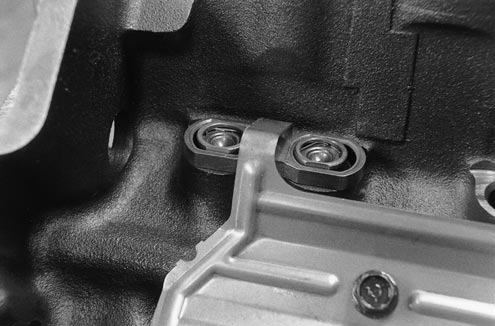
The difference is using after market roller lifters with the connecting bar in a block without the factory provisions.
Factory uses a different method. These parts are a bit more affordable.
Le Mans Master
Joined: Mar 2002
Posts: 5,889
Likes: 2
From: Castro Valley Calif.
St. Jude Donor '03 thru '26
These last two posts hit the nail right on the head..........great explanations 
The only thing I might add is using a non roller block would/should only be an option if you're going big CID with a factory 400........otherwise you're way ahead of the game with a later model block.
The only thing I might add is using a non roller block would/should only be an option if you're going big CID with a factory 400........otherwise you're way ahead of the game with a later model block.

Melting Slicks


Joined: Mar 2002
Posts: 3,108
Likes: 126
From: S.L.C. UT
..... Gen 1 , 1956-86 two piece rear main seal small blocks were originally designed to be used with flat tappet cams and lifters ... However some enterprising camshaft manufacturers developed roller cams where the lifters were joined in pairs by a metal link to keep them aligned - roller to camshaft ... roller cams required a cam button on the front of the cam to limit fore and aft motion ...
..... Gen 2 , 1987-91 ( Corvettes ) one piece rear main seal blocks were cast with several bosses in the lifter valley to which a special flat metal spring could be bolted ... this spring located some figure eight castings that joined lifters in pairs to keep them aligned - roller to camshaft ... these blocks also had a machined surface on the front of the block to accommodate a thrust plate to limit fore and aft movement ...
..... Gen 3 , 1992-96 vette LT1 same roller cam provisions as Gen 2 , but lots of other major changes ... water jackets , timing cover , water pump and distributor drive for beginners ...
..... Thus , roller camshafts are available for any Chevy smallblock ... the earlier ones pre-'87 are referred to as retro-fit rollers
..... Gen 2 , 1987-91 ( Corvettes ) one piece rear main seal blocks were cast with several bosses in the lifter valley to which a special flat metal spring could be bolted ... this spring located some figure eight castings that joined lifters in pairs to keep them aligned - roller to camshaft ... these blocks also had a machined surface on the front of the block to accommodate a thrust plate to limit fore and aft movement ...
..... Gen 3 , 1992-96 vette LT1 same roller cam provisions as Gen 2 , but lots of other major changes ... water jackets , timing cover , water pump and distributor drive for beginners ...
..... Thus , roller camshafts are available for any Chevy smallblock ... the earlier ones pre-'87 are referred to as retro-fit rollers
Thread Starter
Drifting
Joined: Apr 2011
Posts: 1,925
Likes: 441
From: Albuquerque NM
Thanks a lot for the answers. Makes a lot more sense.
Has a company ever offered a lifter with a ball bearing instead of a roller bearing? Wouldn't this allow the lifter to rotate? Just wondering...
Now the obvious question; which type of lifter is "better"? Do roller bearing lifters have specific applications? high rpm? longevity?
Has a company ever offered a lifter with a ball bearing instead of a roller bearing? Wouldn't this allow the lifter to rotate? Just wondering...
Now the obvious question; which type of lifter is "better"? Do roller bearing lifters have specific applications? high rpm? longevity?
Corvette Stories
The Best of Corvette for Corvette Enthusiasts

Top 10 Most Expensive Corvettes Ever Sold on Bring A Trailer
Brett Foote
10 Things Every Corvette Owner Needs (2026 Edition)
Michael S. Palmer
8 Most "Only Corvette Owners Understand" Quirks and Problems
Pouria Savadkouei
10 Reasons the C6 Z06 is Still A Performance Benchmark After 20 Years
Joe Kucinski
How Much Horsepower Every Corvette Engine "LOST" in 1972
Joe Kucinski
Top 10 DOs and DON'Ts for Protecting Your Convertible Top!
Michael S. Palmer
Top 10 Most Explosive Corvettes Ever Made: Power-to-Weight Ratio Ranked!
Joe Kucinski
150 hp to 1,250 hp: Every Corvette Generation Compared by the Specs That Matter
Joe Kucinski
8 Coolest Corvette Pace Cars (and Replicas) of All Time
Verdad Gallardo
Team Owner

Joined: Oct 2004
Posts: 81,241
Likes: 3,063
From: altered state
St. Jude Donor '05
hyd. roller probably the best.
They use either link bars or the hold down.
They do not spin, only the rollers(wheels) on the very end. They use needle bearings not ball bearings.
Flat tappet cams have a taper built into them so when the cam turns it lifts, and spins the lifter; roller cams do not.
You can get more power torque vacuum and manners with a roller cam.
If youre motor wont see much over 6000rpm or so often a hyd. roller is the way to go.
Worth the investment.
They use either link bars or the hold down.
They do not spin, only the rollers(wheels) on the very end. They use needle bearings not ball bearings.
Flat tappet cams have a taper built into them so when the cam turns it lifts, and spins the lifter; roller cams do not.
You can get more power torque vacuum and manners with a roller cam.
If youre motor wont see much over 6000rpm or so often a hyd. roller is the way to go.
Worth the investment.

Le Mans Master

Joined: Aug 2000
Posts: 8,838
Likes: 31
From: Australia

Burning Brakes

Joined: Sep 2008
Posts: 810
Likes: 58
From: Alva Florida
2 bolt mains will be fine for this application, unless he is spraying/turbo/procharging the motor. Anything under 500 hp/5000 rpms. I wouldn't sweat it.
Just make sure you get the factory roller block, and save $$$$ on parts.
The problem is....what if you want to make changes down the road. That is why you would want to exceed the 2 bolt block. Then, spalyed caps or 4 bolt w/ forged crank/pistons and I beam rods would be needed.
Also, I would recommend a little overkill on the induction. 5000 isn't much over the ability of the stock intake. Stealth ram would be a nice choice for that app and give you room to play a little. Mini-ram might be overkill, big mouth with good runners would be a minimun.
Good luck with your project.
Just make sure you get the factory roller block, and save $$$$ on parts.
The problem is....what if you want to make changes down the road. That is why you would want to exceed the 2 bolt block. Then, spalyed caps or 4 bolt w/ forged crank/pistons and I beam rods would be needed.
Also, I would recommend a little overkill on the induction. 5000 isn't much over the ability of the stock intake. Stealth ram would be a nice choice for that app and give you room to play a little. Mini-ram might be overkill, big mouth with good runners would be a minimun.
Good luck with your project.
