



Field Service Mode.
Thread Starter
Instructor


Joined: Dec 2004
Posts: 176
Likes: 0
From: Oakland CA
 Field Service Mode.
I'm chasing an issue in my 1988, automatic with Superram. About 130,000 miles. I replaced the injectors with Accel about four or five years ago due to a sticking stock injector. No apparent vacuum leaks and fuel pressure is good.
Often when I put it in gear immediately after starting the rpm will drop very low or stall. Also, sometimes at idle it will start surging. I replaced the IAC, tps and temperature sensor on the front of the manifold with no change. I have some friends at a smog shop so I had them run a pretest to see what kind of numbers at the tail pipe. The HC is fine, below limits. NOx is also below limit. The CO is about double the limit. I threw an O2 sensor in it just for fun because it was cheap enough with no change in the running issues.
So, now to the field service question. The problem doesn't show up when it's in that mode.
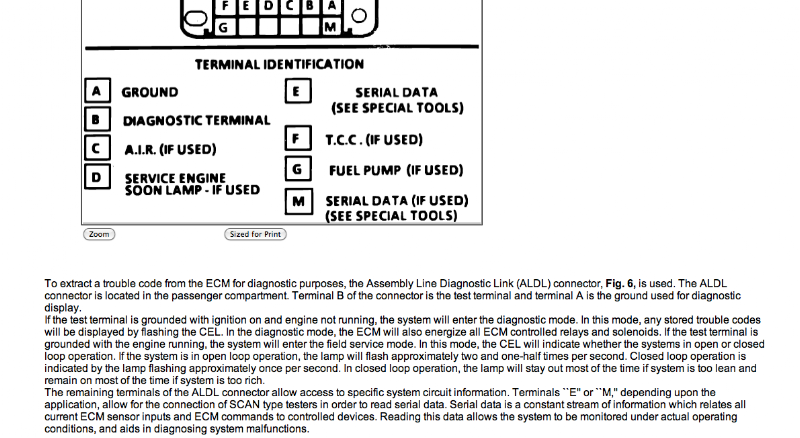
As you are probably aware, if you jump the A and B terminals on the ALDL while the engine is running, it will go into field service mode. The CEL will blink to indicate open or closed loop and while in closed loop the duration of the on and off pulses indicates O2 sensor reading. I recall the putting it into field service mode locks some settings like maybe ignition advance. I don't remember exactly what is effected in Field service mode.
Often when I put it in gear immediately after starting the rpm will drop very low or stall. Also, sometimes at idle it will start surging. I replaced the IAC, tps and temperature sensor on the front of the manifold with no change. I have some friends at a smog shop so I had them run a pretest to see what kind of numbers at the tail pipe. The HC is fine, below limits. NOx is also below limit. The CO is about double the limit. I threw an O2 sensor in it just for fun because it was cheap enough with no change in the running issues.
So, now to the field service question. The problem doesn't show up when it's in that mode.
As you are probably aware, if you jump the A and B terminals on the ALDL while the engine is running, it will go into field service mode. The CEL will blink to indicate open or closed loop and while in closed loop the duration of the on and off pulses indicates O2 sensor reading. I recall the putting it into field service mode locks some settings like maybe ignition advance. I don't remember exactly what is effected in Field service mode.
Safety Car


Joined: Apr 2011
Posts: 3,660
Likes: 22
I'm chasing an issue in my 1988, automatic with Superram. About 130,000 miles. I replaced the injectors with Accel about four or five years ago due to a sticking stock injector. No apparent vacuum leaks and fuel pressure is good.
Often when I put it in gear immediately after starting the rpm will drop very low or stall. Also, sometimes at idle it will start surging. I replaced the IAC, tps and temperature sensor on the front of the manifold with no change. I have some friends at a smog shop so I had them run a pretest to see what kind of numbers at the tail pipe. The HC is fine, below limits. NOx is also below limit. The CO is about double the limit. I threw an O2 sensor in it just for fun because it was cheap enough with no change in the running issues.
So, now to the field service question. The problem doesn't show up when it's in that mode.
As you are probably aware, if you jump the A and B terminals on the ALDL while the engine is running, it will go into field service mode. The CEL will blink to indicate open or closed loop and while in closed loop the duration of the on and off pulses indicates O2 sensor reading. I recall the putting it into field service mode locks some settings like maybe ignition advance. I don't remember exactly what is effected in Field service mode.
Often when I put it in gear immediately after starting the rpm will drop very low or stall. Also, sometimes at idle it will start surging. I replaced the IAC, tps and temperature sensor on the front of the manifold with no change. I have some friends at a smog shop so I had them run a pretest to see what kind of numbers at the tail pipe. The HC is fine, below limits. NOx is also below limit. The CO is about double the limit. I threw an O2 sensor in it just for fun because it was cheap enough with no change in the running issues.
So, now to the field service question. The problem doesn't show up when it's in that mode.
As you are probably aware, if you jump the A and B terminals on the ALDL while the engine is running, it will go into field service mode. The CEL will blink to indicate open or closed loop and while in closed loop the duration of the on and off pulses indicates O2 sensor reading. I recall the putting it into field service mode locks some settings like maybe ignition advance. I don't remember exactly what is effected in Field service mode.
Field service Mode?
WAZZAT........???????????????
The above process thats in bold is part of the problem...you DO NOT under any circumstances ground a running ECM.
The ALCL is designed for a scan tool to be plugged in and/or it can be used to see the "flash codes" that are stored in Memory...NOT running.
Ground the 2 pins by a jumper wire
(paper clip GM special tool part number BR 549) but ONLY turn key to RUN...never start or crank with the pins grounded.
No such animal as Field Service Mode.
There is Open Loop and there is Closed Loop.
Open loop is when the engine is cold and the o2 sensor has yet to warm up enough to react and generate voltage thats used as a signal to the ECM.
When the o2 sensor DOES finally transmit voltage thats called "closed loop" because the sensor is now an active participant in the ECM decision making process. Prior to CL operation the ECM runs off of cal-pak which amount to a pre-program used to specify basic engine operating parameters and guide the fuel system until real time info is delivered via o2, tps, temp and MAF.
The Cal-Pak also features whats refered to as a LHM...Limp Home Mode. This is basically just a shift back to the base open loop operation when the ECM has been over loaded with bad or faulty data from its sensor collection. The SES (service engine soon) light will remain ON when the ECM is tired of fighting bad data. It'll run fine, near normal Just not perfect and likely the emissions will be off just enough to fail a test or eventually foul the plugs and the problems snow-ball from there because you;re not sure whats cause and effect...
Did you 'set' the TPS to the correct voltage? 0.54v @ idle? Using a DVM?
Is the base timing set properly with the ECM grnd wire d/c near the booster?
FSM often refers to a Factory Service Manual.

Going thru a FSM will guide you thru the flow charts that can/will diagnose any possible condition and service code (DTC), trouble code, thats stored in the system.
Just a guess but there is EGR to look at, a.i.r. system check valves, manifold leaks, fuel pressure leak down time/pressure and regulator condition.
I'd clear the memory,. go for a drive of at least 3 minutes at freeway speeds at normal op temps and start over. THEN pull the codes and follow the info. Be warned, a MAF code don't mean the MAF is bad, same for O2...it means that there is something thats not in spec with that system or a related system. TPS issues are related to MAF like O2 related to EFI....actually there are a hundred relationships at various times during operation.
Thats why a FSM is priceless and proper diagnosis is virtually impossible without the flow-charts.
Other famous FSM definitions:
Factory Service Man
Factory Service Mess
Field Service Man
F'n Service Mess
Factory Substitute Manual
Pretty sure its just Factory Service Manaul...

Last edited by leesvet; Dec 13, 2011 at 12:06 PM.
Thread Starter
Instructor
Joined: Dec 2004
Posts: 176
Likes: 0
From: Oakland CA
I can't find the reference currently but there is a Field Service Mode and you do jump the terminals while it's running. Check this thread. Which appears to answer my question. The timing is locked at 8-10 degrees advanced.
A bunch of Camaro and Firebird owners have the answer? WTF?
A bunch of Camaro and Firebird owners have the answer? WTF?
Safety Car
Joined: Apr 2011
Posts: 3,660
Likes: 22
That thread was not written by Techs or Cert GM mechanics...just a bunch of guys that are paying a shop to figure out their issues.
Perhaps a Genuine GM Field Service Man will jump in here...
I see where there is a single reference to FS "mode"...it means nothing in the big picture. It does not mean that the ECM is doing anything special....other than displaying its memory.
I'm sorry, I looked at that thread and those guys have no clue what they are talking about.
All "field service mode" means is (if anything) reading flash codes. From everything that I read in the books, FSM is the same things as "Diagnostic Mode" and thats what is generally refered to when reading codes or jumping A&B terminals.
Thats what the FSM has to say regarding "entering Field service mode"...yes, there is the term but it simply means reading the codes displayed. They DO refer to this with engine running, but this WAS written 25-30 YEARS ago. Since this was written things have changed, running with A&B jumped is NOT the prefered method of reading the codes. There is no point in it and it places the system at unnecessary risk. The codes are there,. you do not see anything else with the engine running UNLESS you are connected to a SCAN-TOOL but that is an independent diagnostic system, not the flash code memory.
Those guys are thinking an ECM was bad because it displayed a code 12.....
AGAIN<
this is where and why a FSM is necessary. (manual)
Good luck with your car.
Perhaps a Genuine GM Field Service Man will jump in here...
I see where there is a single reference to FS "mode"...it means nothing in the big picture. It does not mean that the ECM is doing anything special....other than displaying its memory.
I'm sorry, I looked at that thread and those guys have no clue what they are talking about.
All "field service mode" means is (if anything) reading flash codes. From everything that I read in the books, FSM is the same things as "Diagnostic Mode" and thats what is generally refered to when reading codes or jumping A&B terminals.
Thats what the FSM has to say regarding "entering Field service mode"...yes, there is the term but it simply means reading the codes displayed. They DO refer to this with engine running, but this WAS written 25-30 YEARS ago. Since this was written things have changed, running with A&B jumped is NOT the prefered method of reading the codes. There is no point in it and it places the system at unnecessary risk. The codes are there,. you do not see anything else with the engine running UNLESS you are connected to a SCAN-TOOL but that is an independent diagnostic system, not the flash code memory.
Those guys are thinking an ECM was bad because it displayed a code 12.....
AGAIN<
this is where and why a FSM is necessary. (manual)
Good luck with your car.
Last edited by leesvet; Dec 13, 2011 at 06:13 PM.

Le Mans Master

Joined: Dec 2000
Posts: 7,839
Likes: 22
From: San Diego, Ca
Field Service Mode simply refers to how often the Check Engine Light Flashes with the engine running, Diagnostic Link grounded. The important part is once it's Closed Loop and it's off more than it's on, then it's lean; vice versa it's rich. You know yours is rich because the CO #'s are off the Chart. That usually means there's air pass the O2 that isn't coming through the MAF, so the ECM dumps a bunch of fuel it doesn't need because the O2 is sensing a lean condition. Hooking up a Scanner to monitor Block Learn while you do a few diagnostic tests helps you solve it, but suspect a vacuum leak or busted Check Valves at the Headers. You can check vacuum lines and clamp off the Check Valve hoses to see if fueling gets back to normal. You can aim some propane around the intake and Plenum and if the idle goes up, it's sucking air through a leaking gasket. Curiously, I think you mentioned that yours is dropping idle in gear. You should look at the Scan to make sure the Park/Neutral Switch is working. They usually stall when they don't, but the Load is still picked up by the ECM when you put it in gear and it dumps fuel.

Team Owner


Joined: Jan 2003
Posts: 20,316
Likes: 246
From: Summerland B.C. Canada
I see where there is a single reference to FS "mode"...it means nothing in the big picture. It does not mean that the ECM is doing anything special....other than displaying its memory.
I'm sorry, I looked at that thread and those guys have no clue what they are talking about.
All "field service mode" means is (if anything) reading flash codes. From everything that I read in the books, FSM is the same things as "Diagnostic Mode" and thats what is generally refered to when reading codes or jumping A&B terminals.
Thats what the FSM has to say regarding "entering Field service mode"...yes, there is the term but it simply means reading the codes displayed. They DO refer to this with engine running, but this WAS written 25-30 YEARS ago. Since this was written things have changed, running with A&B jumped is NOT the prefered method of reading the codes. There is no point in it and it places the system at unnecessary risk. The codes are there,. you do not see anything else with the engine running UNLESS you are connected to a SCAN-TOOL but that is an independent diagnostic system, not the flash code memory.
this is where and why a FSM is necessary. (manual)
.
I'm sorry, I looked at that thread and those guys have no clue what they are talking about.
All "field service mode" means is (if anything) reading flash codes. From everything that I read in the books, FSM is the same things as "Diagnostic Mode" and thats what is generally refered to when reading codes or jumping A&B terminals.
Thats what the FSM has to say regarding "entering Field service mode"...yes, there is the term but it simply means reading the codes displayed. They DO refer to this with engine running, but this WAS written 25-30 YEARS ago. Since this was written things have changed, running with A&B jumped is NOT the prefered method of reading the codes. There is no point in it and it places the system at unnecessary risk. The codes are there,. you do not see anything else with the engine running UNLESS you are connected to a SCAN-TOOL but that is an independent diagnostic system, not the flash code memory.
this is where and why a FSM is necessary. (manual)
.
http://members.shaw.ca/corvette86/No...it%20Check.pdf
Corvette Stories
The Best of Corvette for Corvette Enthusiasts

Top 10 Most Expensive Corvettes Ever Sold on Bring A Trailer
Brett Foote
10 Things Every Corvette Owner Needs (2026 Edition)
Michael S. Palmer
8 Most "Only Corvette Owners Understand" Quirks and Problems
Pouria Savadkouei
10 Reasons the C6 Z06 is Still A Performance Benchmark After 20 Years
Joe Kucinski
How Much Horsepower Every Corvette Engine "LOST" in 1972
Joe Kucinski
Top 10 DOs and DON'Ts for Protecting Your Convertible Top!
Michael S. Palmer
Top 10 Most Explosive Corvettes Ever Made: Power-to-Weight Ratio Ranked!
Joe Kucinski
150 hp to 1,250 hp: Every Corvette Generation Compared by the Specs That Matter
Joe Kucinski
8 Coolest Corvette Pace Cars (and Replicas) of All Time
Verdad Gallardo
Thread Starter
Instructor
Joined: Dec 2004
Posts: 176
Likes: 0
From: Oakland CA
That thread was not written by Techs or Cert GM mechanics...just a bunch of guys that are paying a shop to figure out their issues.
Perhaps a Genuine GM Field Service Man will jump in here...
I see where there is a single reference to FS "mode"...it means nothing in the big picture. It does not mean that the ECM is doing anything special....other than displaying its memory.
I'm sorry, I looked at that thread and those guys have no clue what they are talking about.
All "field service mode" means is (if anything) reading flash codes. From everything that I read in the books, FSM is the same things as "Diagnostic Mode" and thats what is generally refered to when reading codes or jumping A&B terminals.
Thats what the FSM has to say regarding "entering Field service mode"...yes, there is the term but it simply means reading the codes displayed. They DO refer to this with engine running, but this WAS written 25-30 YEARS ago. Since this was written things have changed, running with A&B jumped is NOT the prefered method of reading the codes. There is no point in it and it places the system at unnecessary risk. The codes are there,. you do not see anything else with the engine running UNLESS you are connected to a SCAN-TOOL but that is an independent diagnostic system, not the flash code memory.
Those guys are thinking an ECM was bad because it displayed a code 12.....
AGAIN<
this is where and why a FSM is necessary. (manual)
Good luck with your car.
Perhaps a Genuine GM Field Service Man will jump in here...
I see where there is a single reference to FS "mode"...it means nothing in the big picture. It does not mean that the ECM is doing anything special....other than displaying its memory.
I'm sorry, I looked at that thread and those guys have no clue what they are talking about.
All "field service mode" means is (if anything) reading flash codes. From everything that I read in the books, FSM is the same things as "Diagnostic Mode" and thats what is generally refered to when reading codes or jumping A&B terminals.
Thats what the FSM has to say regarding "entering Field service mode"...yes, there is the term but it simply means reading the codes displayed. They DO refer to this with engine running, but this WAS written 25-30 YEARS ago. Since this was written things have changed, running with A&B jumped is NOT the prefered method of reading the codes. There is no point in it and it places the system at unnecessary risk. The codes are there,. you do not see anything else with the engine running UNLESS you are connected to a SCAN-TOOL but that is an independent diagnostic system, not the flash code memory.
Those guys are thinking an ECM was bad because it displayed a code 12.....
AGAIN<
this is where and why a FSM is necessary. (manual)
Good luck with your car.
Thread Starter
Instructor
Joined: Dec 2004
Posts: 176
Likes: 0
From: Oakland CA
So far as an air leak, there is a possibility, I have the connector between the maf and throttle body taped up because of a tear that happened after the problem started. The tear actually occurred while looking for a leak.
Safety Car
Joined: Apr 2011
Posts: 3,660
Likes: 22
That "diagnostic mode" forces the ECM into "OPEN LOOP".
Normal function is "CLOSED LOOP".
Thats why running the eng is not necessary. You are looking at MEMORY in OPEN LOOP with A&B jumped. You CANNOT see real time data via flash codes.
A new problem will NOT be "saved" to memory if it were to happen while the ECM was in DIAGNOSTIC MODE.
If the problem is driving you crazy, D/C the MAF and drive in OL for the time being. Thats forcing OL operation and the system is designed to run that way as a back-up in case of major componant failure.
When the ECM is in OPEN LOOP it is operating off of a CAL-PAK thats a program in memory to provide basic operating parameters. Calibration Package.
When the ECM is in CLOSED LOOP it is attempting to operate with real time data from sensors and control device inputs that allow the ECM to make changes and adjustments as conditions change.This is thru the MEM-CAL. Memory-Calibration aka PROM/CHIP.
When you put it in DIAGNOSTICS you're not seeing what the sensors are doing NOW< you can see what they did before. ITs MEMORY. This portion of the memory is wiped by D/C the neg battery cable for 10 seconds.
TO see NOW/real time takes a SCAN-TOOL thats capable of displaying real time data and showing the entire ECMs "tune" and what sensors are inputing. There is a long list of items that are involved...inj pulse band width, IAC step counts, air temp, etc.
If you want to do that, There are a couple good scan tools available on FleaBay for under $250. thats the only way you can see what the ECM is seeing as it runs. Look for the OBD-I tool if you;re 93 or older.
Diagnostic Mode is just memory display. Its not tuning or even showing what tune parameters are. Cal-Pak is not adjustable. Proms (Mem-Cal) are able to change. Reflashed. A "tune"...new set or parameters for CL operation.
The basics are adjustable for OBD-I thru various generic PROMS. There is no point in changing PROMS or having a new "tune made" until all the mechanical issues are sorted out and properly fixed.
IF the engine does NOT run right in CL....but it USED TO run right in CL something changed.
Examples:
EGR is stuck or there is a vac leak, IAC leaking, bad inj, bad regulator...many possibilities. Even mechanical damage...bad lifter, cam lobe,. sticky valve. All kinds of things can cause codes, or not at all. Since it runs right in OL that tells us that its more of a sensor issue in fuel or air, not mechanical like a bad valve or lifter. Mechanical issues are there in CL or OL.
Thats why a FSM is useful. Flow Charts are priceless. The "trouble trees" are equally as useful and guide you thru ANY possible problem.
DIAGNOSTIC MODE will GUIDE you but it won;t tell you exactly what to repair. You have to know how to interpret the information. The FSM tells you how and what it takes to cause a particular code to set and reset.
Wish I could do more...but thats all I got.

Melting Slicks

Joined: Feb 2011
Posts: 2,322
Likes: 6
From: Los Altos CA
So...the Moats adapter I bought to connect the OBDI connector ('87) to my laptop has a switched 10K resistor...I think between the A & B terminals. This resistor controls whether you are in diagnostic mode...right?
I'm going to be OBDII soon, but have wondered about the role of the 10K resistor.
I'm going to be OBDII soon, but have wondered about the role of the 10K resistor.
Le Mans Master
Joined: Dec 2000
Posts: 7,839
Likes: 22
From: San Diego, Ca
Thanks for the reply. The park neutral switch sounds interesting. Where is it located? It wouldn't cause surging in neutral, would it?
So far as an air leak, there is a possibility, I have the connector between the maf and throttle body taped up because of a tear that happened after the problem started. The tear actually occurred while looking for a leak.
So far as an air leak, there is a possibility, I have the connector between the maf and throttle body taped up because of a tear that happened after the problem started. The tear actually occurred while looking for a leak.
Team Owner
Joined: Jan 2003
Posts: 20,316
Likes: 246
From: Summerland B.C. Canada
Engine off is diagnostic mode
Engine on is field service mode. SES flashes once per second for closed loop and every 2.5 seconds for open loop. The light will also tell you if your lean or rich by the length of time it's on. (info from FSM)


Drifting


Joined: Feb 2006
Posts: 1,423
Likes: 96
From: Magnolia Tx
The field service mode section of the service manual lists
1. Fixed spark advance
2. New codes can't be stored
3. Closed loop timer is bypassed
Where is your base timing set? CO means rich. Is it?
1. Fixed spark advance
2. New codes can't be stored
3. Closed loop timer is bypassed
Where is your base timing set? CO means rich. Is it?

Race Director

Joined: Apr 2002
Posts: 10,036
Likes: 346
From: Anaheim CA
Here are my comments in my disassembly of the ECM code in my '86 (similar up to '89):
Open is the normal running mode.
10K mode is the diagnostic mode that software scan tools use.
3.9K mode is Factory Test, which doesn't apply to us. It's a limited version of 10K mode, just displays different parameters.
Shorted is the "flash SES light" mode.
Since I was digging around in the code anyway, here's the output in Factory Test mode, just for fun:
Code:
      ; Check diagnostic mode status (read ALDL pin B voltage)
      ;
      ;    open = 5.0 VDC (10K pullup)
      ;     10K = 2.5 VDC
      ;    3.9K = 1.4 VDC
      ; shorted = 0   VDC
      ;
      ; If 0.8V < diagnostic voltage < 2V, set Factory Test (3.9K) mode
10K mode is the diagnostic mode that software scan tools use.
3.9K mode is Factory Test, which doesn't apply to us. It's a limited version of 10K mode, just displays different parameters.
Shorted is the "flash SES light" mode.
Since I was digging around in the code anyway, here's the output in Factory Test mode, just for fun:
Code:
***************************************************
* TEST TABLE
***************************************************
* Factory System test (ECM test)
*
* CALLS:  P4 transmit S3
*         ADC read Ignition voltage
*         P4 checksum
*         P4 ADC READ
*
* TABLE:  HARDWARE I/F: BOFFECU
*         PRP
*
* $FC72 - $FEA1
***************************************************
LFC72:  FDB L017B       ; ADC Channel 0, MAP2 (not used)
        FDB L017C       ; ADC Channel 1, Ignition voltage
        FDB L017D       ; ADC Channel 2, O2 sensor voltage
        FDB L017E       ; ADC Channel 3, MAP (not used)
        FDB L017F       ; ADC Channel 4, Coolant sensor, 4K
        FDB L0180       ; ADC Channel 5, TPS voltage
        FDB L0181       ; ADC Channel 6, Fuel pump voltage
        FDB L0182       ; ADC Channel 7, ALDL pin B voltage
        FDB L0183       ; ADC Channel 8, MAT Temp
        FDB L0184       ; ADC Channel 9, ESC
        FDB L0185       ; ADC Channel 10, MAF voltage
        FDB L0186       ; ADC Channel 11, 1/2 ADC Vref (no input pin for this channel)

        FDB L0187       ; 348 ohm Coolant temperature
        FDB L0188       ; 4K Coolant temperature

        FDB L0049       ; FMD inputs status byte 1

LFC82:  FDB LC000       ; EPROM ID ($25E5 = 9701)
        FDB LC002       ; Date Code ($0A55 = 2645)
        FDB LC004       ; Sequence Number ($0172 = 370)

        FDB L0173       ; IEEE EPROM checksum
        FDB L0175       ; Checksum for RAM L0000 to L002E

        FDB L4002       ; I/O port select register
        FDB L0047       ; ? mode byte
        FDB L0000       ; Major Loop Counter

LFC92:  FDB L3FC0       ; Distributor Reference Pulse period counter
        FDB L3FC2       ; Timer #1 (Input 5 - VSS)
        FDB L3FC4       ; Timer #2 (Input 6 - not used)
        FDB L3FC6       ; Counter #1 (Cumulative Pulses - not used)
        FDB L3FC8       ; Counter #2 Spark period (Spark Feedback, Input 3)
        FDB L3FCA       ; Counter #3 (16.384 KHz counter if Input 4 is low) (knock)
        FDB L3FE0       ; Counter #4 (Cumulative pulses on Input 5 - not used)
        FDB L3FF8       ; Timer #1A (Pulse Accumulator 1) - U9-40 VATS input
***************************************************
Thread Starter
Instructor
Joined: Dec 2004
Posts: 176
Likes: 0
From: Oakland CA
I set the base timing to 8 degrees btdc but I haven't checked it in at least a year. I'll try to do it today.

Drifting
Joined: Dec 2007
Posts: 1,647
Likes: 4
From: Argillite KY
As you are probably aware, if you jump the A and B terminals on the ALDL while the engine is running, it will go into field service mode.
Last edited by 1963SS; Dec 15, 2011 at 12:00 PM.
Melting Slicks
Joined: Aug 2003
Posts: 3,399
Likes: 394
From: Lakeville MI
Spark advance is fixed to 20 degrees.
This is why the surging is not present if Field Service Mode.
LC021: FDB 0057 ; Fixed S.A. For Diag, (20.04 Deg) (Val/2.844)
Your main spark table could likely use some tuning to promote better idle stability.
This is why the surging is not present if Field Service Mode.
LC021: FDB 0057 ; Fixed S.A. For Diag, (20.04 Deg) (Val/2.844)
Your main spark table could likely use some tuning to promote better idle stability.