


 I do have a pressure bleeder but found it messy. I also have a vacuum tool I got from Harbor Freight.

Master Cylinder problem?

Thread Starter
Instructor

Joined: Nov 2010
Posts: 172
Likes: 0
 Master Cylinder problem?
Drained the front calipers and replaced the front brake hoses with braided stainless Goodridge units. Turkey baster'd out the front cup on the master and added fresh dot4. Opened up the front passenger bleed valve and nothing. Pumped for a while and got more nothing. Pulled the bleed valve completely and stuck my finger over the hole and felt nothing. Am I missing something with regards to my 1990 composite master cylinder? Or perhaps perplexed by the ABS and some crucial step necessary to bleed properly? Is it a riddle, surrounded by an enigma, and shrouded in a mystery? Should I just go buy a new master cylinder? Is there a rebuild kit available? Thanks in advance-gd

Race Director


Joined: Apr 2009
Posts: 19,294
Likes: 2,753
From: Charlotte NC
Depending on how much air you have in the system...or allowed to get in the system while servicing it....along with the amount of fluid in it...you will not feel anything at the open hole in the caliper if you have a lot of air in the system. You can compress air...and if there is a lot of air in the system...and you only move the piston in the master cylinder an inch...it is doubtful that you would feel anything...due to the air compressing....once it is full of fluid and a little bit of air...that would be a totally different scenario.
If the system was allowed to go dry,,,then YES...there is a procedure to getting the air out of the ABS unit.
Without "kicking the hornets nest"...The factory manual offers two ways of bleeding the brakes. Manual bleeding by pressing on the brake pedal and then opening up the bleeder to let the air out...and then (the way I do it) pressure bleeding with a specific tool that forces fluid through the system and forces the air out. Gravity bleeding in this situation is NOT a method that is outlined in the service manual....and if you look at the lines at the ABS unit...they have high spots in them that can trap air if you are only using the fluid to move the air out. Like I wrote...I only pressure bleed brakes..so all other methods for me (even though they may work for some) are not the method I use.
DUB
If the system was allowed to go dry,,,then YES...there is a procedure to getting the air out of the ABS unit.
Without "kicking the hornets nest"...The factory manual offers two ways of bleeding the brakes. Manual bleeding by pressing on the brake pedal and then opening up the bleeder to let the air out...and then (the way I do it) pressure bleeding with a specific tool that forces fluid through the system and forces the air out. Gravity bleeding in this situation is NOT a method that is outlined in the service manual....and if you look at the lines at the ABS unit...they have high spots in them that can trap air if you are only using the fluid to move the air out. Like I wrote...I only pressure bleed brakes..so all other methods for me (even though they may work for some) are not the method I use.
DUB
Le Mans Master


Joined: Jan 2006
Posts: 5,620
Likes: 206
From: Orlando FL
If you had the hard lines open for a long time and they drained, as said you might have a ton of air in the lines. I usually cap the lines from whatever I take off till I'm ready to reinstall. Do you assemble same day or at a later time?
The other thought is to check the proportional valve in the master to make sure it did not shift to one side. On my master it is visible by removing a sensor on the side to see if actuator is high or low. If it did shift, it might not put pressure to the front lines. If you turn the key on and you have a brake light on the dash, that might be a indication.
The other thought is to check the proportional valve in the master to make sure it did not shift to one side. On my master it is visible by removing a sensor on the side to see if actuator is high or low. If it did shift, it might not put pressure to the front lines. If you turn the key on and you have a brake light on the dash, that might be a indication.
Le Mans Master
Joined: Jan 2006
Posts: 5,620
Likes: 206
From: Orlando FL
Thread Starter
Instructor
Joined: Nov 2010
Posts: 172
Likes: 0
Update:
Made my daughter come out and be my pedal-pumper. Still had no fluid at the caliper so I disconnected the front circuit at the master cylinder. Low and behold, no fluid at the master cylinder port. So I pulled the plug on the proportioning valve and it was jammed all the way forward. I manually pushed it back--it was tight and sludgy. Pushed the pedal and could hear the proportioning valve pop forward but still had no fluid coming out the front master cylinder brake line port. Pulled the master cylinder off the car and began disassembling and found that the secondary (front circuit) piston is stuck in the end of the bore. Not stuck like the FSM "knock gently on a piece of wood to remove the piston" but more like "beat the daylights out of the master cylinder on a 6x6 block of oak" and it's still stuck. New master cylinder is on its way. Just for the fun of it I tried 120psi air, long needlenose, and even more beating the bejeezus out of it and no luck. Thanks to all for the help.--GD
Made my daughter come out and be my pedal-pumper. Still had no fluid at the caliper so I disconnected the front circuit at the master cylinder. Low and behold, no fluid at the master cylinder port. So I pulled the plug on the proportioning valve and it was jammed all the way forward. I manually pushed it back--it was tight and sludgy. Pushed the pedal and could hear the proportioning valve pop forward but still had no fluid coming out the front master cylinder brake line port. Pulled the master cylinder off the car and began disassembling and found that the secondary (front circuit) piston is stuck in the end of the bore. Not stuck like the FSM "knock gently on a piece of wood to remove the piston" but more like "beat the daylights out of the master cylinder on a 6x6 block of oak" and it's still stuck. New master cylinder is on its way. Just for the fun of it I tried 120psi air, long needlenose, and even more beating the bejeezus out of it and no luck. Thanks to all for the help.--GD
Le Mans Master
Joined: Jan 2006
Posts: 5,620
Likes: 206
From: Orlando FL
Just wondering if your master has a screw in the side of it or a pin and possibly held in with some metal over it. If it does, those items have to be removed before the far pistons can be free.
Just asking
Just asking
Corvette Stories
The Best of Corvette for Corvette Enthusiasts

150 hp to 1,250 hp: Every Corvette Generation Compared by the Specs That Matter
Joe Kucinski
8 Coolest Corvette Pace Cars (and Replicas) of All Time
Verdad Gallardo
Top 10 Corvette Engines RANKED by Peak Torque (70+ Years of Muscle!)
Joe Kucinski
Corvette ZR1X Will Be Pacing the Indy 500, And Could Probably Race, Too!
Verdad Gallardo
Top 10 Corvettes Coming to Mecum Indy 2026!
Brett Foote
Top 10 C9 Corvette MUST-HAVES to Fix These C8 Generation Flaws!
Michael S. Palmer
10 Revolutionary 'Corvette Firsts' Most People Don't Know
Joe Kucinski
5 Reasons to Upgrade to an LS6-Powered Corvette; 5 Reasons to Stay LT2
Michael S. Palmer
2027 Corvette vs The World: Every C8 vs Its Closest Competitor
Joe Kucinski
Thread Starter
Instructor
Joined: Nov 2010
Posts: 172
Likes: 0
According to my factory service manual, mine has a "secondary piston retaining bolt" which I removed. It was a 10mm head bolt that necked down to a small pin at the bottom. It is located midway between the two reservoirs on the left side of master cylinder. If there's another pin somewhere let me know. Thanks GD
Thread Starter
Instructor
Joined: Nov 2010
Posts: 172
Likes: 0
Update to the update
Since I have nothing better to do before heading off to church I went out to the garage and beat on the poor defenseless matter cylinder some more. This time I had two partial coils of broken spring tumble out. Looks like perhaps the big spring on that front piston disintegrated at some point and I had enough piston stroke with no fluid in the cylinder to bottom the piston into the spring chunks and jam it there. Or the car is cursed. Or I am cursed, or some combination of all three. The car won't stop now but at least those stainless Goodridge lines look good!
Since I have nothing better to do before heading off to church I went out to the garage and beat on the poor defenseless matter cylinder some more. This time I had two partial coils of broken spring tumble out. Looks like perhaps the big spring on that front piston disintegrated at some point and I had enough piston stroke with no fluid in the cylinder to bottom the piston into the spring chunks and jam it there. Or the car is cursed. Or I am cursed, or some combination of all three. The car won't stop now but at least those stainless Goodridge lines look good!
Pro


Joined: Jan 2010
Posts: 533
Likes: 18
From: Boca Raton Florida
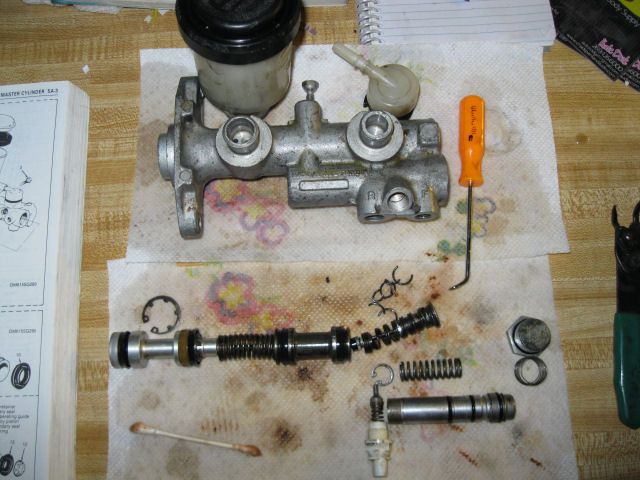
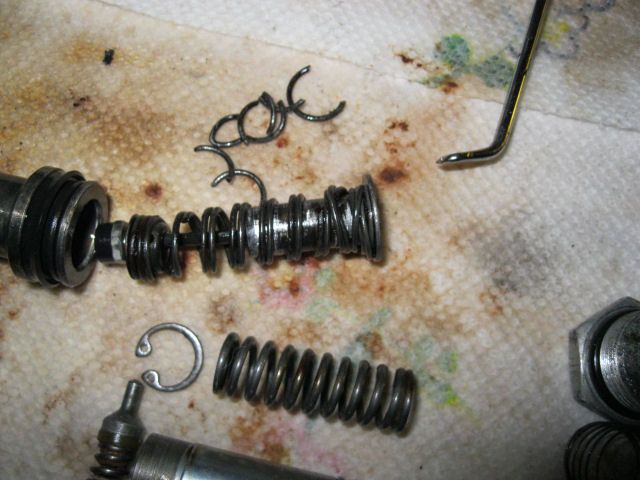
You are not the only one to have this problem. My front brakes locked up on a very gentle stop in November 2013. I had replaced the original master cylinder in 2008 so I wasn't expecting a catastrophic failure. Took the master cylinder apart to find this:
 -Dammm boy, what the heck you guys bee eat-en...