



first dyno pull

Team Owner


Joined: Aug 2004
Posts: 21,543
Likes: 3,216
From: Park City Utah

My box stock C6 (LS2) made 360 on the rollers. (400 CHP)
My box stock LT1 made 278. (300 CHP)
LS3 M6's typically put down ~390, and they're 436 crank.
http://forums.corvetteforum.com/1564418855-post10.html
http://forums.corvetteforum.com/1564419240-post11.html
I don't think 15% is accurate. I think it is what people want to use who want big numbers to talk about.
Either way, OP's builder saw 475 on an engine dyno...he didn't lose 100hp though his drive train. Something isn't working right at the moment.
My box stock LT1 made 278. (300 CHP)
LS3 M6's typically put down ~390, and they're 436 crank.
http://forums.corvetteforum.com/1564418855-post10.html
http://forums.corvetteforum.com/1564419240-post11.html
I don't think 15% is accurate. I think it is what people want to use who want big numbers to talk about.
Either way, OP's builder saw 475 on an engine dyno...he didn't lose 100hp though his drive train. Something isn't working right at the moment.
Last edited by Tom400CFI; May 14, 2014 at 11:23 PM.
Race Director


Joined: Feb 2002
Posts: 11,616
Likes: 1,055
From: Compound in the Grove, Ga.
2026 Corvette of the Year Finalist - Unmodified
2025 C4 of the Year Winner - Unmodified
2024 C4 of the Year Finalist - Unmodified
2020 C3 of the Year Finalist - Unmodified
2019 C4 of Year Finalist (performance mods)
2018 C4 of Year Finalist
2015 C4 of the Year Finalist
St. Jude Donor '16
I've been told to use Wheel HP / .85

Safety Car


Joined: Sep 2001
Posts: 4,157
Likes: 554
From: Glenbeulah Wi
Nice numbers!
As far as the power loss is concerned it all depends upon the combination of parts and how it was dynoed. Were the engine dyno numbers gross or net, I assume gross. The factory numbers are net. My BBC made a dyno verified 774 HP at the crank and made 636 at the wheels through an auto and 9 inch rear end.
A rough number that most people use is .85 for a manual and .80 for an auto. This just gets you an approximation.
As far as the power loss is concerned it all depends upon the combination of parts and how it was dynoed. Were the engine dyno numbers gross or net, I assume gross. The factory numbers are net. My BBC made a dyno verified 774 HP at the crank and made 636 at the wheels through an auto and 9 inch rear end.
A rough number that most people use is .85 for a manual and .80 for an auto. This just gets you an approximation.
Team Owner
Joined: Aug 2004
Posts: 21,543
Likes: 3,216
From: Park City Utah
Nice numbers!
As far as the power loss is concerned it all depends upon the combination of parts and how it was dynoed. Were the engine dyno numbers gross or net, I assume gross. The factory numbers are net. My BBC made a dyno verified 774 HP at the crank and made 636 at the wheels through an auto and 9 inch rear end.
As far as the power loss is concerned it all depends upon the combination of parts and how it was dynoed. Were the engine dyno numbers gross or net, I assume gross. The factory numbers are net. My BBC made a dyno verified 774 HP at the crank and made 636 at the wheels through an auto and 9 inch rear end.
 That is an EXCELLENT point, that I hadn't considered at all. If the engine was tested on a stand, no exhaust, no accessories...and I'd bet it was, then that is gross. And there will be a significant power loss when installed.
 Still, I thought that heard something break up on the top end, in that vid.

Burning Brakes

Joined: Dec 2006
Posts: 1,090
Likes: 80
From: Burleson Texas
Safety Car
Joined: Sep 2001
Posts: 4,157
Likes: 554
From: Glenbeulah Wi
-At the end of the run the engine does not go rich, it actually ends up near where it should be at around 12.5 to 1 AFR. It is actually lean before that with reading near 15 to 1 AFR. I would show this graph to TPIS and see if they can richen it up down low.
-The miss you encounter is probably valve float after 6250 RPM, this is way after your peak power and I would consider shifting earlier like 6100 RPM or changing your valve springs out for different set to try and control the valve float. In my opinion you are reving it too high, the power peak has occurred at 5500 RPM and the engine is on the backside of the curve by 6000 RPM.
-If an engine goes into miss on the dyno you will see your AFR go lean not rich. The O2 sensor is looking for unburned oxygen in the exhaust and a miss will dump all kinds of oxygen in the exhaust showing a lean condition if there is a miss. Looking at your dyno curve I see it going slightly richer which tells me you are not missing but you may be having valve float issues.
Team Owner
Joined: Aug 2004
Posts: 21,543
Likes: 3,216
From: Park City Utah

"Mini rams don't make any low end tq"

If you were losing spark, would that show as lean? Lack of combustion = oxygen in exhaust stream? IDK...haven't test that one before....
Corvette Stories
The Best of Corvette for Corvette Enthusiasts

Top 10 Most Expensive Corvettes Ever Sold on Bring A Trailer
Brett Foote
10 Things Every Corvette Owner Needs (2026 Edition)
Michael S. Palmer
8 Most "Only Corvette Owners Understand" Quirks and Problems
Pouria Savadkouei
10 Reasons the C6 Z06 is Still A Performance Benchmark After 20 Years
Joe Kucinski
How Much Horsepower Every Corvette Engine "LOST" in 1972
Joe Kucinski
Top 10 DOs and DON'Ts for Protecting Your Convertible Top!
Michael S. Palmer
Top 10 Most Explosive Corvettes Ever Made: Power-to-Weight Ratio Ranked!
Joe Kucinski
150 hp to 1,250 hp: Every Corvette Generation Compared by the Specs That Matter
Joe Kucinski
8 Coolest Corvette Pace Cars (and Replicas) of All Time
Verdad Gallardo
Thread Starter
Instructor

Joined: Nov 2009
Posts: 130
Likes: 0
From: Wentzville mo
If I was losing spark wouldn't it go rich because it's not burning the fuel?


Team Owner
Joined: Aug 2004
Posts: 21,543
Likes: 3,216
From: Park City Utah

Team Owner
Joined: Dec 2000
Posts: 90,675
Likes: 304
From: SE NY
Cruise-In II Veteran
As far as the power loss is concerned it all depends upon the combination of parts and how it was dynoed. Were the engine dyno numbers gross or net, I assume gross.
...or changing your valve springs out for different set to try and control the valve float.
In my opinion you are reving it too high, the power peak has occurred at 5500 RPM and the engine is on the backside of the curve by 6000 RPM.
This means shifting above peak HP in order to be higher up on the power curve after the up-shift.
Thread Starter
Instructor
Joined: Nov 2009
Posts: 130
Likes: 0
From: Wentzville mo
Nice numbers! As far as the power loss is concerned it all depends upon the combination of parts and how it was dynoed. Were the engine dyno numbers gross or net, I assume gross. The factory numbers are net. My BBC made a dyno verified 774 HP at the crank and made 636 at the wheels through an auto and 9 inch rear end. A rough number that most people use is .85 for a manual and .80 for an auto. This just gets you an approximation.

Melting Slicks


Joined: Apr 2007
Posts: 2,616
Likes: 111
The numbers are gross. I did not know that the manufactures were net. The guy at TPIS said it is common to have a 100hp loss. It is all coming together I think. The motor dynoed at 472tq, and I had 395 at the rear wheelS I am really happy with that. It looks like I just need to shift earlier. Now it is time for the 1/4 mile.

Here is the machine they used on my car AT TPIS; SUMMER OF 2012: They take the wheels off and put a load on the wheel hubs at different RPMS; not just go WOT.....I think it shows lower power numbers similar to a Mustang dyno vs. a DynoJet machine like the one at Pur Performance where you went.

Last edited by 856SPEED; May 16, 2014 at 07:36 AM.
Melting Slicks
Joined: Apr 2007
Posts: 2,616
Likes: 111
Here is what I started with:

this is hard to read I know, but this what TPIS hands you.....this is after the tune.....

Here is what I ended with; the 85 computer was taken to task; the best Jim could pull from it after several different pulls. I asked Jim at TPIS to shoot some video and he said he would while we were out, but that never happened.......Oh well........great guys though!

this is hard to read I know, but this what TPIS hands you.....this is after the tune.....
Here is what I ended with; the 85 computer was taken to task; the best Jim could pull from it after several different pulls. I asked Jim at TPIS to shoot some video and he said he would while we were out, but that never happened.......Oh well........great guys though!
Last edited by 856SPEED; May 16, 2014 at 07:51 AM.
Safety Car
Joined: Sep 2001
Posts: 4,157
Likes: 554
From: Glenbeulah Wi
What you have read is correct but to figure out where you should shift you need to determine the largest area under the curve. To do that you need to figure out your gear splits and determine if you shift at 6250 where will the next gear pick up (4200, 4600, 5000?) Once you know the split you can determine your ideal shift points from the dyno graph. In this case you can see that the power holds nicely to around 6200 and then it gets unstable (Valve float or ??) so I would shift by 6200 no matter what.
Pro

Joined: May 2008
Posts: 670
Likes: 55
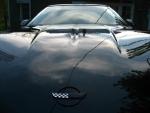
Really like the white paint and black wheels, nice! TPIS engine dyno numbers in all the articles I have read are always a little high, you didn't lose 100 hp in drive train loss. Case in point;http://www.gmhightechperformance.com..._motor_part_2/ A stock LT1 motor instead of making rated 300 hp made 340 on their dyno.
Melting Slicks
Joined: Apr 2007
Posts: 2,616
Likes: 111
The numbers are gross. I did not know that the manufactures were net. The guy at TPIS said it is common to have a 100hp loss. It is all coming together I think. The motor dynoed at 472tq, and I had 395 at the rear wheelS I am really happy with that. It looks like I just need to shift earlier. Now it is time for the 1/4 mile.