



Code 36 help

Racer


Joined: Apr 2011
Posts: 367
Likes: 7
From: Congupna Victoria

I went looking for the 1 second burnoff time and found it. I also found another parameter which is quite interesting:
LC69B: FCB 10 ; 1 Sec MAF BURNOFF TIME
LC69C: FCB 50 ; 5 SEC MAF BURNOFF DELAY FROM IGNITION OFF (LC221 is used instead of this)
LC221 is the 0.3 second delay I quoted earlier. I see a 5 second delay in the scope trace, so that does match up with this parameter and not LC221. I wonder why I put that note there...
There is a pullup resistor inside the ECM that is connected to 5 volts. When there is nothing coming out of the MAF the input goes to 5 volts. When the engine stops running the ECM turns off the fuel pump relay and the MAF power relay gets turned off also, as shown in the FSM diagram. It has to get turned on again for the burnoff but in the meantime the ECM is not getting a MAF signal, which is why the voltage goes up to 5 volts. I don't know why it was only 2.5 volts in my case. Maybe it was a poor ground connection. I put the ground clip on one of the TPS screws, which in retrospect might not have been the best choice.
LC69B: FCB 10 ; 1 Sec MAF BURNOFF TIME
LC69C: FCB 50 ; 5 SEC MAF BURNOFF DELAY FROM IGNITION OFF (LC221 is used instead of this)
LC221 is the 0.3 second delay I quoted earlier. I see a 5 second delay in the scope trace, so that does match up with this parameter and not LC221. I wonder why I put that note there...
There is a pullup resistor inside the ECM that is connected to 5 volts. When there is nothing coming out of the MAF the input goes to 5 volts. When the engine stops running the ECM turns off the fuel pump relay and the MAF power relay gets turned off also, as shown in the FSM diagram. It has to get turned on again for the burnoff but in the meantime the ECM is not getting a MAF signal, which is why the voltage goes up to 5 volts. I don't know why it was only 2.5 volts in my case. Maybe it was a poor ground connection. I put the ground clip on one of the TPS screws, which in retrospect might not have been the best choice.
Was I not seeing the output of the MAF?
Do you know what the terminology of "LC221" and "FCB10" etc means?
Last edited by puzzigully; Jan 3, 2015 at 02:40 AM.
Racer
Joined: Apr 2011
Posts: 367
Likes: 7
From: Congupna Victoria
Just an update.....
I actually saw the burn off take place.
It was only for a second or so.
But it actually happened.
Without being able to accurately time it, it looked like it was before it went to the 5volts I saw previously.
So now I'm really stumped :/
I actually saw the burn off take place.
It was only for a second or so.
But it actually happened.
Without being able to accurately time it, it looked like it was before it went to the 5volts I saw previously.
So now I'm really stumped :/
Racer
Joined: Apr 2011
Posts: 367
Likes: 7
From: Congupna Victoria
Turned it off, witnessed the burn off took place, then checked for codes.
NO CODE!!
Then restarted, drove it off the ramps, turned it off, checked codes
CODE 36!!!
This is driving me nuts!
So cleared all the codes again.
Idled it up again, turned it off, confirmed burn off took place
Checked codes, no code....
Will take it for a drive soon and then see if the code gets set again.
This I starting to look intermittent.....yikes!!!

Race Director


Joined: Apr 2002
Posts: 10,036
Likes: 346
From: Anaheim CA
LC221: L is label. It's a name for that parameter. C221 is a hexadecimal number that is the address in the EPROM where that the parameter resides. FCB is an assembler directive (tells the assembly language programming software what to do) and means Form Constant Byte. The 10 is the number that is stored in the EPROM. The program in the ECM uses this number to determine how long the burnoff should last. In this case 10 = 1.0 seconds (it's scaled by 10).
Last edited by Cliff Harris; Jun 11, 2015 at 10:33 PM. Reason: Clarified wording.
Race Director
Joined: Apr 2002
Posts: 10,036
Likes: 346
From: Anaheim CA
Racer
Joined: Apr 2011
Posts: 367
Likes: 7
From: Congupna Victoria
Appreciate all your help so far.
I've mapped fuel injection race cars before using dynes etc, so not intimidated by doing this.
I agree, I need to look a whole lot deeper than I currently can.
I know this has been covered previously, but it seems Moates is the go to guy for the cabling
And what's the best software to use in your opinion?
I'll do some searching on this forum to get some feedback from guys who use this stuff
Racer
Joined: Apr 2011
Posts: 367
Likes: 7
From: Congupna Victoria
Ok SPENT ALL WEEKEND AND I KNOW WHAT HAPPENS:
Clear codes by removal of negative cable
Reconnect negative cable.
Bridge A and B terminals of diagnostic plug
Turn ignition to "run"
Confirm code 1-2 is repeated at least 7 times
Satisfied no codes in ECM
Return ignition to "off"
Unbridge A and B terminals
Start engine.
Let run for 10 minutes, water temp 220, easily into closed loop mode.
Stop engine
Physically see the burn off take place
Bridge A and B terminals of diagnostic plug
Turn ignition to "run"
Confirm code 1-2 is repeated at least 7 times.
Satisfied no codes in ECM
Return ignition to "off"
Unbridge A and B terminals
Start engine
"SERVICE ENGINE SOON" Light comes on!
Stop engine
Bridge A and B terminals of diagnostic plug
Turn ignition to "run"
Confirm code 3-6 is displayed.
This is crazy.......
Code 36 is being generated while the engine is running!!!
Any clues!!
Clear codes by removal of negative cable
Reconnect negative cable.
Bridge A and B terminals of diagnostic plug
Turn ignition to "run"
Confirm code 1-2 is repeated at least 7 times
Satisfied no codes in ECM
Return ignition to "off"
Unbridge A and B terminals
Start engine.
Let run for 10 minutes, water temp 220, easily into closed loop mode.
Stop engine
Physically see the burn off take place
Bridge A and B terminals of diagnostic plug
Turn ignition to "run"
Confirm code 1-2 is repeated at least 7 times.
Satisfied no codes in ECM
Return ignition to "off"
Unbridge A and B terminals
Start engine
"SERVICE ENGINE SOON" Light comes on!
Stop engine
Bridge A and B terminals of diagnostic plug
Turn ignition to "run"
Confirm code 3-6 is displayed.
This is crazy.......
Code 36 is being generated while the engine is running!!!
Any clues!!
Race Director
Joined: Apr 2002
Posts: 10,036
Likes: 346
From: Anaheim CA
The ECM stays alive for about 10 seconds after the ignition is turned off to do the MAF burnoff and reset the IAC motor.
Corvette Stories
The Best of Corvette for Corvette Enthusiasts

Top 10 Most Expensive Corvettes Ever Sold on Bring A Trailer
Brett Foote
10 Things Every Corvette Owner Needs (2026 Edition)
Michael S. Palmer
8 Most "Only Corvette Owners Understand" Quirks and Problems
Pouria Savadkouei
10 Reasons the C6 Z06 is Still A Performance Benchmark After 20 Years
Joe Kucinski
How Much Horsepower Every Corvette Engine "LOST" in 1972
Joe Kucinski
Top 10 DOs and DON'Ts for Protecting Your Convertible Top!
Michael S. Palmer
Top 10 Most Explosive Corvettes Ever Made: Power-to-Weight Ratio Ranked!
Joe Kucinski
150 hp to 1,250 hp: Every Corvette Generation Compared by the Specs That Matter
Joe Kucinski
8 Coolest Corvette Pace Cars (and Replicas) of All Time
Verdad Gallardo
Racer
Joined: Apr 2011
Posts: 367
Likes: 7
From: Congupna Victoria
Yes, but after the maf does the burn off, then I test to see there's no codes.
No codes shown.
But start the car again, SES comes on!
And the code that's there is 36!
How can that happen?
Racer
Joined: Apr 2011
Posts: 367
Likes: 7
From: Congupna Victoria
After checking no codes before starting engine, start engine..... SES comes on, then upon checking code36 is present.
Seems as though it's getting thrown as the engine is running.
Done this several times now.
Even swapped relays....same result.
Cannot let this beat me....
Have read issues may be related to relay resistances....
I'm guessing I'm really going to need to see what the ECM is seeing to really know?
Racer
Joined: Apr 2011
Posts: 367
Likes: 7
From: Congupna Victoria
Just confirmed this is happening again.
After checking no codes before starting engine, start engine..... SES comes on, then upon checking code36 is present.
Seems as though it's getting thrown as the engine is running.
Done this several times now.
Even swapped relays....same result.
Cannot let this beat me....
Have read issues may be related to relay resistances....
I'm guessing I'm really going to need to see what the ECM is seeing to really know?
After checking no codes before starting engine, start engine..... SES comes on, then upon checking code36 is present.
Seems as though it's getting thrown as the engine is running.
Done this several times now.
Even swapped relays....same result.
Cannot let this beat me....
Have read issues may be related to relay resistances....
I'm guessing I'm really going to need to see what the ECM is seeing to really know?
hope this is going to be helpful to others who have this same problem, but another piece of the puzzle just fell into place.
My problem with the ECM seemingly throwing Code 36 when running has been explained to me.
When the ECM sets an Error Code it only displays that Code after the Engine is actually STARTED a second time.
Just turning the key to "run" wont make the ECM display the Code.
So running the car, then turning it off, then checking for codes wont work.
You have to start the car again to get the ECM to check for Codes (and SES light comes on if there is any), then turn it off, then check for Codes.
hope this helps
Race Director
Joined: Apr 2002
Posts: 10,036
Likes: 346
From: Anaheim CA
I was able to measure the MAF burnoff signal and the MAF relay signal today:

Unfortunately I didn't line up the signals with the timing marks before saving the screen shot, but it still shows what happens.
The yellow trace is the output signal from the MAF. At the very beginning it is the output when the engine is idling. When the ignition is shut off it drops slightly and then jumps up to about 2.5 volts when the MAF power is turned off (pullup resistor inside ECM). After 5 seconds the MAF burnoff relays turns on (blue trace) and the MAF signal drops down. This is what the ECM measures during the error code 36 test. After 1 second the MAF burnoff relay turns off and the MAF output again goes up to about 2.5 volts. After another 5 seconds or so the ECM turns itself off and the MAF output drops down to zero.
Unfortunately I didn't line up the signals with the timing marks before saving the screen shot, but it still shows what happens.
The yellow trace is the output signal from the MAF. At the very beginning it is the output when the engine is idling. When the ignition is shut off it drops slightly and then jumps up to about 2.5 volts when the MAF power is turned off (pullup resistor inside ECM). After 5 seconds the MAF burnoff relays turns on (blue trace) and the MAF signal drops down. This is what the ECM measures during the error code 36 test. After 1 second the MAF burnoff relay turns off and the MAF output again goes up to about 2.5 volts. After another 5 seconds or so the ECM turns itself off and the MAF output drops down to zero.
Racer
Joined: Apr 2011
Posts: 367
Likes: 7
From: Congupna Victoria
I was able to measure the MAF burnoff signal and the MAF relay signal today:
Unfortunately I didn't line up the signals with the timing marks before saving the screen shot, but it still shows what happens.
The yellow trace is the output signal from the MAF. At the very beginning it is the output when the engine is idling. When the ignition is shut off it drops slightly and then jumps up to about 2.5 volts when the MAF power is turned off (pullup resistor inside ECM). After 5 seconds the MAF burnoff relays turns on (blue trace) and the MAF signal drops down. This is what the ECM measures during the error code 36 test. After 1 second the MAF burnoff relay turns off and the MAF output again goes up to about 2.5 volts. After another 5 seconds or so the ECM turns itself off and the MAF output drops down to zero.
Unfortunately I didn't line up the signals with the timing marks before saving the screen shot, but it still shows what happens.
The yellow trace is the output signal from the MAF. At the very beginning it is the output when the engine is idling. When the ignition is shut off it drops slightly and then jumps up to about 2.5 volts when the MAF power is turned off (pullup resistor inside ECM). After 5 seconds the MAF burnoff relays turns on (blue trace) and the MAF signal drops down. This is what the ECM measures during the error code 36 test. After 1 second the MAF burnoff relay turns off and the MAF output again goes up to about 2.5 volts. After another 5 seconds or so the ECM turns itself off and the MAF output drops down to zero.
that is awesome information - you're the best

Can you read off the graph what the voltage was during burn-off?
What pin/terminal did you use to collect the Burn off voltage?
Was it at the MAF or at the ECM?
Thanks again
Race Director
Joined: Apr 2002
Posts: 10,036
Likes: 346
From: Anaheim CA
The scale on the display is 0.5 volts per division, so the voltage during burnoff is about 1.6 volts.
The MAF output to the ECM is on pin C. The MAF burnoff voltage from the burnoff relay goes into pin D. There are two ground pins on the MAF: A is power ground and burnoff ground. B is signal ground from the ECM. I connected them together to reduce noise.
Several years ago I created a MAF tester that has LEDs for the power and burnoff voltages. I started with one of these:
http://www.ecklerscorvette.com/corve...985-1989.html#
I put it in a plastic box so I could easily plug and unplug it (the loose leads were a pain and I was afraid of a short). I added LEDs to monitor the MAF power and burnoff signals. Recently I added wire leads to tap into the MAF output and burnoff wires to make the 'scope trace. I did it because there were questions about exactly when the burnoff occurred and what the voltage levels were:

The tricky part was that MAF burnoff only occurs after the ECM has gone into closed loop mode. I had to hook up my scope and run the engine long enough for that to happen and then hope I got good traces. It took about 10 tries to get the one I posted earlier. The scope had a lot of trouble syncing to the signal because the sweep rate was so low (1 second per division, which means it took 12 seconds to sweep the whole display). I actually cheated and combined two traces into one to get the final result.
Several years ago I created a MAF tester that has LEDs for the power and burnoff voltages. I started with one of these:
http://www.ecklerscorvette.com/corve...985-1989.html#
I put it in a plastic box so I could easily plug and unplug it (the loose leads were a pain and I was afraid of a short). I added LEDs to monitor the MAF power and burnoff signals. Recently I added wire leads to tap into the MAF output and burnoff wires to make the 'scope trace. I did it because there were questions about exactly when the burnoff occurred and what the voltage levels were:
The tricky part was that MAF burnoff only occurs after the ECM has gone into closed loop mode. I had to hook up my scope and run the engine long enough for that to happen and then hope I got good traces. It took about 10 tries to get the one I posted earlier. The scope had a lot of trouble syncing to the signal because the sweep rate was so low (1 second per division, which means it took 12 seconds to sweep the whole display). I actually cheated and combined two traces into one to get the final result.
Last edited by Cliff Harris; Jan 19, 2015 at 12:37 AM.
Racer
Joined: Apr 2011
Posts: 367
Likes: 7
From: Congupna Victoria


If I'm reading this correctly:
- D12 on the ECM creates and Earth, energising the coil in the MAF Burn off relay (12v from D and Earth on F on the Burn off relay)
- This allows 12 V to flow from pin A on the Burn off Relay (sourced from B1 and C16 on the ECM), then out of pin E on the Burn off relay
- but pin E on the burn off relay also goes to pin D on the MAF sensor
I thought the ECM got the burn-off signal from pin C on the MAF sensor.
I'll need to know what pin on the ECM is expecting the MAF burn off signal, so when the MOATES cable arrives and I get the software loaded, I know where to be looking for the burn off signal.
Race Director
Joined: Apr 2002
Posts: 10,036
Likes: 346
From: Anaheim CA
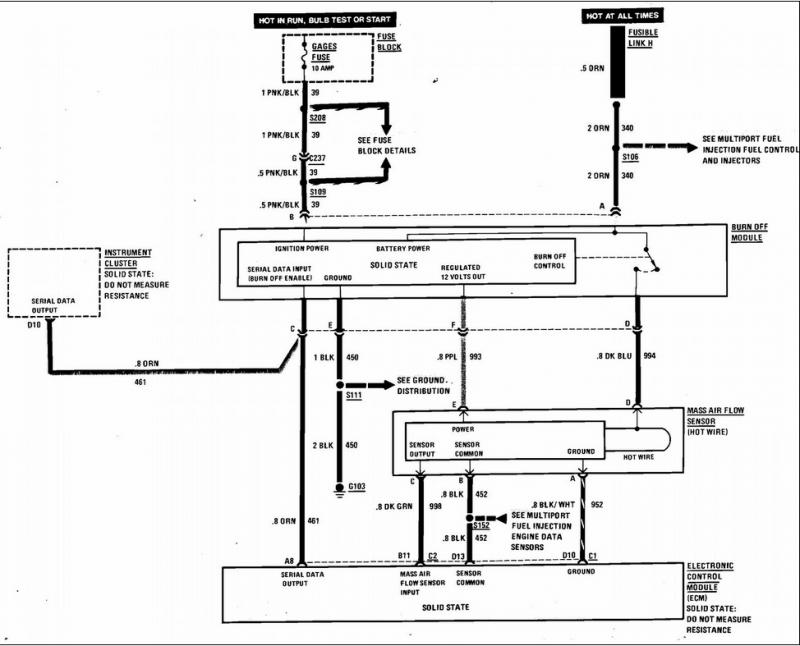
Note that the MAF burnoff circuit connects 12 volts directly to the MAF sensor wire (MAF pin D).
That's ECM pin B12 in 1986 through 1989.
Last edited by Cliff Harris; Jan 20, 2015 at 02:32 AM.
Racer
Joined: Apr 2011
Posts: 367
Likes: 7
From: Congupna Victoria
Thanks Cliff, so the ECM gets the burn off voltages from the same line as the signal from the MAF.
This makes sense and was what I kinda thought.
Checked the resistance of the Burn Off relay (when closed) last night - the manual says it needs to be less than 1 ohm, which it was (pretty much zero actually).
I think I need to check the resistance of the signal wire to the ECM from terminal C of the MAF.
The only other check is to ensure the burn off is getting the correct voltage.
The logic I'm using is this:
Without a "silly scope" I cant see what the input or output is, but I should be able to measure resistances for the two circuits to see if unusual resistance is altering the signals.
This makes sense and was what I kinda thought.
Checked the resistance of the Burn Off relay (when closed) last night - the manual says it needs to be less than 1 ohm, which it was (pretty much zero actually).
I think I need to check the resistance of the signal wire to the ECM from terminal C of the MAF.
The only other check is to ensure the burn off is getting the correct voltage.
The logic I'm using is this:
- The burn off occurs - check
- Error gets recorded = ECM sees either nothing or an "out of range" condition
- so input into MAF is out of spec causing output to be out of spec OR output from MAF is out of spec.
Without a "silly scope" I cant see what the input or output is, but I should be able to measure resistances for the two circuits to see if unusual resistance is altering the signals.
Race Director
Joined: Apr 2002
Posts: 10,036
Likes: 346
From: Anaheim CA
Sometimes just unplugging and replugging the connector can cause the interference fit between the pins to wipe off the corrosion and make a good metal-on-metal connection.
Racer


Joined: Nov 2008
Posts: 321
Likes: 2
From: Auburndale FL
I chased a code 36 for a while, and finally had it disappear after I cleaned all of the fusible link connections.
Mine were pretty corroded, but that seemed to have done it.
Or if that wasn't it, I bumped or moved a wire which fixed my issue.
I might have got lucky but I just offer it up as this seemed to have worked for me.
Best of luck....

Mine were pretty corroded, but that seemed to have done it.
Or if that wasn't it, I bumped or moved a wire which fixed my issue.
I might have got lucky but I just offer it up as this seemed to have worked for me.
Best of luck....