When you click on links to various merchants on this site and make a purchase, this can result in this site earning a commission. Affiliate programs and affiliations include, but are not limited to, the eBay Partner Network.
The trick here is to determine what voltage the ecm is seeing during the burnoff to better understand why it is failing.
I agree - if only I could find someone local who has and can run an oscilloscope correctly!
Originally Posted by tequilaboy
What we do know is that the MAF voltage is greater than 1.46 volts since the signal is being limited to 23 gm/sec by the max maf vs rpm table in the log data.
It does look that way, but is that what the ECM is seeing?
I'm not convinced - see first comment.
Originally Posted by tequilaboy
We also know that a voltage greater than 95 A/D counts will set the code 36 failure. Since 95 A/D counts is approx. 1.9 volts, we can safely assume that your MAF voltage during burnoff is exceeding 1.9 volts.
Not sure I agree here as the ECM doesn't tell you WHY it failed (i.e. high voltage, low voltage, didn't see the burn off event at all etc), it just says it failed.
My local guy and an "expert" claimed the ECM wasn't seeing the "end" of the burn off event - and claimed that may be why it was throwing the code..
Originally Posted by tequilaboy
Now if you would log the same event using TunerPro with an appropriate adx file and monitor the unlimited airflow signal during the burnoff and relate the value back to the appropriate MAF flow vs voltage table (likely the #2 MAF table), we could indirectly estimate the MAF voltage during burn off.
I agree. It's imperative that I know WHY it's failing.
I'll have another crack at getting Turnerpro working...
I really don't want to be lazy and just disable the reporting......but it's sooooo easy and tempting!!
If the voltage was failing on the low side during burnoff (< 20 A/D counts or approx. 0.40 volts), the MAF signal would reflect this and would be approx. 5 gm/sec.
Since we see 23 gm/sec, we know that the MAF signal is being limited to 23 gm/sec and that the voltage is greater than 1.46 volts.
If the voltage was failing on the low side during burnoff (< 20 A/D counts or approx. 0.40 volts), the MAF signal would reflect this and would be approx. 5 gm/sec.
Since we see 23 gm/sec, we know that the MAF signal is being limited to 23 gm/sec and that the voltage is greater than 1.46 volts.
Hopefully i can log it and see the burn off using your file (much appreciated) on tunerpro.
With Soooooo much assistance from Tequilaboy, finally got Tunerpro to work correctly, then I could actually log the burn-off taking place.
Cannot thank him enough
Both he and Cliff have been very helpful and patient..
Here is the screen shot of the logging
The burnoff level is 80 g/sec, which equates to approx 2.9V....above the 1.9V threshold.
The other MAF I had, showed a burnoff level of 79 g/sec - so pretty much the same.
As Tequilaboy said - trying another MAF is a "crap shoot"....so likely to either raise the burn off threshold to something like 3V or remove the reporting altogether....
I might just try one more MAF
Just to be sure.....
Be nice if I could find one in a car that isn't showing a code 36 error!
Your best bet might be to find a good used stock sensor instead of getting more of the rebuilt crap, at least then you would have a maf sensor that was within spec...WW
Your best bet might be to find a good used stock sensor instead of getting more of the rebuilt crap, at least then you would have a maf sensor that was within spec...WW
Some of the MAF Sensors being sold require a core to be returned. I just bought a MAF sensor as I was getting a Code 34 and the diagnostic chart in the FSM caused a Code 33 which indicated a bad MAF. There was a $40 core charge but I was able to bring in the old MAF so I didn't have to wait for a credit.
I did find brand new AC Delco MAF sensors (Amazon and RockAuto) but they were in the $900 price range, plus a core charge.
I would think that the only real way to find a good working MAF sensor would be from a parts car. And even then, you would have to test it to make sure it is OK.
If the op needs a broken sensor as a core I have one sitting on the shelf in the garage he can have free, just pay shipping.....I will never go back to the stock maf sensors now that I have one of the Blowerworks units.....My Blowerworks maf sensor only cost me around $350.00 to $400.00 including the new bin file, and a new Bosch unit is over $800.00....WW
All the places I looked listed the original Bosch sensor #101145 for the 86-87 Corvette, and the #101146 for the 88-89 Corvette.They may interchange but they are listed as different sensors....Some of the aftermarket sensors are listed for 86-89 Corvettes ,but it seems the 85 has a sensor specific to that year...I went to several sites and this information was consistant....WW
I know that there was a Delco MAF that put our a variable frequency vs. air flow. It was very inaccurate and didn't have much capacity, which is the reason to switch to the Bosch MAF.
For the record, my original '86 MAF has these markings on the bottom:
I like the "Durchfluss"...
I have wanted to take apart a MAF for a long time but I don't want to destroy the working spare that I have.
.
.
Last edited by Cliff Harris; Nov 11, 2015 at 12:38 AM.
I know that there was a Delco MAF that put our a variable frequency vs. air flow. It was very inaccurate and didn't have much capacity, which is the reason to switch to the Bosch MAF.
For the record, my original '86 MAF has these markings on the bottom:
.
.
mine has the following numbers:
0 280 213 002
14 081 243
Wonder what they actually mean?
Seems as though there is some disagreement if a maf is good for 1986-1989 or if there is a different version for 1986/87 and 1988/89...
so it seems my "original" MAF is actually from a 1985 and Cliff, yours is from a 1988-89.
Still haven't found the Bosch part# for the 1986-87 MAF yet.
But it seems that Tomco and several other suppliers seem to think there's enough of a difference to have 3 separate part#'s for 1985-1989.
So I'd be wary of any MAF claiming to be be suitable for 1985-89 or even 1986-89
After trying two different ECM's, 4 different MAF's, 4 different relays, learning how to access the ECM using two different software packages, MOATES hardware, I know WHY I'm getting the Code 36, but no way to remedy the problem....
All the data, no matter the combination, shows that the burn-off voltages are always above the threshold to pass the test. Thus the Code 36 gets set.
I found a local (here in Australia), who could access the chip and turn off the reporting of the code and thus no SES light due to Code 36.
Good thing about this is that any other code will light up the SES light, that previously may have been hidden by the SES being caused by the Code 36.
I thought about expanding the test parameters for the MAF burn off test, but the local guy wasn't too confident in doing so, so took the simple way out!
As of today, been driving it around town, getting out, turning it off, back on again numerous times.......NO SES light and no Code 36!!!!!!
I would replace the longest possible length of wire and the connector. Your wire could be broke inside the cover and you will never know.
I would first clean the connector (not with a wire brush unless battery is disconnected!) super good to maf. I think they sell maff connectors. I used to have every code and solved a lot by cleaning connectors and replacing some wires. Also as the plastic coating shrinks the wires will touch so I use a pencil once in a while to keep em separated. Good Luck







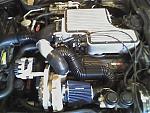





 ..I will never go back to the stock maf sensors now that I have one of the Blowerworks units..
 ...My Blowerworks maf sensor only cost me around $350.00 to $400.00 including the new bin file, and a new Bosch unit is over $800.00..
 ..WW
..WW