When you click on links to various merchants on this site and make a purchase, this can result in this site earning a commission. Affiliate programs and affiliations include, but are not limited to, the eBay Partner Network.
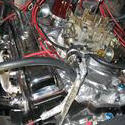
Yep that is exactly what it is a blueprint 383 stroker. I have my AFR 195 heads that I had milled to 58cc. I have a FAST stand alone engine management system on the car so tuning should not be an issue. Thanks for the reply yall.
I am looking into FAST system for my stand alone set up maybe on a 383 build, but Comp Cams tech couldn't tell me if there was anything else I needed or if it would plug into my HEI distributor to control 700R4 transmission as well as timing.c Did you know the answers to these questions and have you already put in the FAST unit previously with any advise??? Thanks.
A few years back I had built a
.030 over 350 ( 355)Sbc 1988 factory roller block
Dart 180 Iron Eagles Heads mild porting 72cc
Piston Speedpro .100 dome (70 LT1 piston) approx. 10:1 w/ head
Cams comp 282, GM HOT CAM and GM 847
intakes TPI, LT1 Conversion S/R and Dart Cool Can intake w/worked 750 carb
The engine was built for a S-10 to bracket race. I wanted to drive it to the track. Comp 282 and carb 12.2s on this setup
I went to Etown and seen they had a Corvette Challenge, and that's when the black hole began. Brought a 86 vette and stuck the sbc in, and change the cam to the Hot Cam with the TPI. The car 60ft 1.60s but only ran 13.6s. I change the intake to the LT1 conversion intake, the car pickup .5 and 5 mph.
I played with the different combos. I had the Hot Cam and the S/R with 3'' exhaust, 3.70 gears 3200 stall car ran 12.1s @ 112 mph. I took it to a dyno, it dyno 320 rwhp. That was about the same hp that it dyno when I had the engine in my S-10.
Two weeks later I put the Gm 847 cam and Lt1 intake on it and ran 11.6s @ 116 mph but I hated driving the car around. It was fun to drive.
That's when the LS came. I put a lot of money and time in my C4 that I could had purchased a C6, be I enjoy driving and working on my C4
Randy
I appreciate your posting with real components for the builds involved and wanted to know what you did for computer management. I am planning my 1990 c4 build as 383 or 406 based on what I can buy to use that is available but need the ecu part figured out since no one in Ohio does custom tune for my car. Jet performance says they make chips for $500 but I could spend $1000 for FAST system too for future builds. ****or I may do carb setup to save thousands of dollars since I have all parts already and you stated your carb'ed S10 did the LT1 style RWHP output the same***
Well thanks for the link on your build. I was expecting a wide or wider power band using the 219 duration cam you have while it looks like it shifted the curves to higher RPM - over the stock 350/cam. Well wider than cams with more duration than the LE cam. It's hard to tell what the stock cam might be doing below 3500 RPM for comparison but it was working with less c.i..
My understanding is the shorter duration cams have a greater usable RPM range/power band - meaning the cam starts the car rolling at lower RPM and makes power over a wider range even though it drops off sooner/lower max RPM. This is what I was looking for in your car using the A4 (really only 3 gears are used for racing).
Interesting because your car is faster than I expected for that LE cam. Maybe the added c.i. make that new cam proportionally or relatively smaller than it would be in a 350" motor.
I appreciate your posting with real components for the builds involved and wanted to know what you did for computer management. I am planning my 1990 c4 build as 383 or 406 based on what I can buy to use that is available but need the ecu part figured out since no one in Ohio does custom tune for my car. Jet performance says they make chips for $500 but I could spend $1000 for FAST system too for future builds. ****or I may do carb setup to save thousands of dollars since I have all parts already and you stated your carb'ed S10 did the LT1 style RWHP output the same***
I had a complete Accel DFI ECM with the S/R and I had a Chip burnt by PCMforless for the stock ECM which I still have laying around some were. That is one of the main reason I went to the LS setup the ECM and the better engine design.
I would try a Mega-squirt or a ECM and harness from a 96 vette and change the opti to distributor then you can reprogram it. But a Fast is probly easier to wire up.
I've had an LT4 also. For 95% of the autox's I ever ran; my High Flow TPI was a better choice and would out perform it.
In Street (formerly Stock) class, that may in fact be true. In another thread yesterday I suggested that for B Street an early Z51 would probably be the better choice over any LT car (at least with a ZF6), partly for that reason (also several other reasons). For every other class, if you aren't using the top half of your powerband, you simply need to change rear axle ratios. It is that simple, and you can do it in every other class. As I said before, you can certainly choose any ratio you want in any class where a stroker motor is legal. And this thread is focused on building a 383 for a C4.
If you impose artificial limits on a build (like "I don't want to swap gears" or "I don't need more power than X" or "ZOMG the police!"), then yeah you can construe a TPI to be the best choice. But if the OP is going through the trouble and expense of building a 383, then I am going to go ahead and assume he wants a lot of power and wants to go fast in some venue or another. His budget may preclude it - that's a perfectly valid reason to not buy another intake - but a short-runner intake is by far the better manifold for his build in terms of power, flexibility, and overall drivability. He's asking for the facts about the two types of intakes, and those are the facts.
Originally Posted by GREGGPENN
I think I'm also asking if a self-ported intake could be the culprit? Just as much as I might be concerned about putting an HSR on it -- due to vibration, I also have to be honest and say I'm curious if the HSR will CURE the mild vibration I perceive. I am certain the ports are even and symmetrical in the HSR. I am also certain my hand porting isn't CNC perfect. Plus, the SLP does have it's limitation in the end port tubes (mounting bosses create a pinch)...Logically, I have some inclination to wonder about my [inherently] imprecise hand-porting...and it effects on engine smoothness.
Gregg, I am no engine builder but I don't think the intake is the cause of your vibration. A vibration would have to be caused by a misfire - a cylinder not firing at all - rather than one just not being as efficient as another. It certainly is possible that it would cause one cylinder to be rich or lean, but I can't imagine a port job so f'd up that it kept one cylinder from firing at all - and especially only at low rpms. It would be easy to diagnose: put an IR thermometer on each primary exhaust tube and make sure they are all at a reasonable temp. I think you have something else going on structurally or in terms of balance. Is your clutch/flywheel or flexplate/TC balanced? Is that balancer on the front actually in good condition?
Again, I'm not an expert but I think I understand what Matlik is talking about. In order for those radial imbalances to show themselves, the crank has to actually flex (which is where the bearing wear he mentioned comes into play). Intuitively, it seems to me that if that were your problem, you would feel it most at a much higher range than 1600-2200. Or you would feel there and also at 3200-4400rpm (the next harmonic), only worse. I am skeptical that a cast crank would be so flimsy that a smallish imbalance would make it flex at such low rpms.
Originally Posted by cardo0
I was expecting a wide or wider power band using the 219 duration cam you have while it looks like it shifted the curves to higher RPM - over the stock 350/cam. Well wider than cams with more duration than the LE cam. It's hard to tell what the stock cam might be doing below 3500 RPM for comparison but it was working with less c.i..
My understanding is the shorter duration cams have a greater usable RPM range/power band...
The width of the power band has more to do with the LCA and the flow characteristics of the heads/intake/exhaust than the duration of the lobe profile. The duration will heavily influence how high or low the power band is, but not so much how wide it is. That cam appears to be a 112 LCA, which is fairly wide and should spread the power band compared to a narrower angle with more overlap. And if you look at the falling torque curve, it didn't drop off a cliff - it's a gradual and linear drop. Some of that is slight exaggeration from the torque converter (it makes the torque look higher than it really is at low rpms), assuming that chart from a chassis dyno. But the fact is that what you are seeing is the TPI limiting the higher end of this cam's power band. I don't know enough about the heads to comment, but they may be another limiting factor.
Again I'm no expert, but that's a pretty nice looking dyno chart for that build IMO. And he's obviously making it work at the track.
Originally Posted by rlane5
I would try a Mega-squirt or a ECM and harness from a 96 vette and change the opti to distributor then you can reprogram it.
I would suggest a 94/95 PCM rather than one from a 96, only because you have to spend real money to get software that will work with the 96. HP Tuners and other current popular software won't work. You have to use Carputing or Jet DST and the ECM-Pro logger, which are expensive and lack the knowledge base of more popular software. OTOH, the 94/95 can be scanned and logged by freeware and programmed using Tunercat, which is only about $70. I think those last-year OBD1 units have all the tuning parameters of the 96 OBD2 unit, and mainly lack some of the diagnostic tests. I can tell you my 96 runs great on a 94/95 PCM, fwiw.
From: Las Vegas - Just stop perpetuating myths please.
Originally Posted by MatthewMiller
The width of the power band has more to do with the LCA and the flow characteristics of the heads/intake/exhaust than the duration of the lobe profile. The duration will heavily influence how high or low the power band is, but not so much how wide it is. That cam appears to be a 112 LCA, which is fairly wide and should spread the power band compared to a narrower angle with more overlap. And if you look at the falling torque curve, it didn't drop off a cliff - it's a gradual and linear drop. Some of that is slight exaggeration from the torque converter (it makes the torque look higher than it really is at low rpms), assuming that chart from a chassis dyno. But the fact is that what you are seeing is the TPI limiting the higher end of this cam's power band. I don't know enough about the heads to comment, but they may be another limiting factor.
Again I'm no expert, but that's a pretty nice looking dyno chart for that build IMO. And he's obviously making it work at the track.
I'm not asking your opinion at all Matthew. I already mentioned there are more variables that affect the power band in my post #53. You continue to look at results while changing more than one variable and that makes them undefinable. I'm looking at a shorter cam that is shorter in duration only - no changes in LSA or lift or installed centerline. And I'm not going into the science here either as this is an intake thread not a cam thread. If you can't live with shorter cams producing a wider usable power band that is your own problem not mine take it or leave it. I just take the word of those professionals that have proved this with empirical testing/data. I'm in no way in their class of engine building.
What I was saying is I expected higher torque at lower RPM with TA's original but we will never really know as it wasn't on the graph. But I was surprised with how wide it was (pwr band) with his latest setup and looks to work with the A4 for the better. I was expecting the new larger cam to make a considerable peak near 4000RPM due to the TPI intake but it remained fairly flat.
I'm not asking your opinion at all Matthew. I already mentioned there are more variables that affect the power band in my post #53. You continue to look at results while changing more than one variable and that makes them undefinable. I'm looking at a shorter cam that is shorter in duration only - no changes in LSA or lift or installed centerline. And I'm not going into the science here either as this is an intake thread not a cam thread. If you can't live with shorter cams producing a wider usable power band that is your own problem not mine take it or leave it.
Wow, okay. Way to not understand what I wrote, I guess! I specifically stated that a change to duration only will generally not produce a wider power band, but will just move the torque peak higher in the rpm range (which increases power). That's one single variable I'm talking about. Then I said that, in general and all else being equal, LCA will determine how wide the power band is. Again, that's a single variable I am talking about.
Assuming the compression ratio remains constant, longer duration just moves the torque curve up the rpm range. Peak torque itself usually only increases a minor amount. The additional hp comes from the fact that the torque delivered happens at a higher rpm and power is directly proportional to torque times rpm.
So Vizard "can't live with shorter cams producing a wider usable power band" either.
From: Las Vegas - Just stop perpetuating myths please.
Originally Posted by Tom400CFI
That IS science...isn't it?
Well yes but I'm not going to try and explain it in detail. To easy make mistakes regurgitating someone else's work/information. Really just want to share my line of thinking - not defend it in detail.
From: Las Vegas - Just stop perpetuating myths please.
OK Matthew I found what the Vizard says 'bout extending intake and exhaust duration in his Camshafts and Valvetrains how to book. Page 44 and you can read all you want. But to try and summarize it he basically adds 30 degrees of timing on a sbc cam and the usable power band is reduced by 750 RPM. It moved from a 1500-4500rpm band up to 3250-5500rpm band with an increase of 32hp (gross or other I really don't know). Usable power was chosen as when the motor was at 90% of peak power.
I really didn't want to go here are there are endless details and exceptions. So if you don't buy it I really don't care anymore and you have to get his book and read up for yourself.
Good night folks.
Last edited by cardo0; Dec 31, 2016 at 10:33 PM.
Reason: Stupid autocorrect!
Haha, yes he's talking about why a cam would not be the proper choice for an engine with certain heads, displacement, etc. Go ahead and show me the example where an engine has a well-selected cam, and then going to a shorter duration increased the width of the power band.
2020 Corvette of the Year Finalist (appearance mods)
C4 of Year Winner (appearance mods) 2019
Originally Posted by MatthewMiller
Gregg, I am no engine builder but I don't think the intake is the cause of your vibration. A vibration would have to be caused by a misfire - a cylinder not firing at all - rather than one just not being as efficient as another. It certainly is possible that it would cause one cylinder to be rich or lean, but I can't imagine a port job so f'd up that it kept one cylinder from firing at all - and especially only at low rpms. It would be easy to diagnose: put an IR thermometer on each primary exhaust tube and make sure they are all at a reasonable temp. I think you have something else going on structurally or in terms of balance. Is your clutch/flywheel or flexplate/TC balanced? Is that balancer on the front actually in good condition?
Again, I'm not an expert but I think I understand what Matlik is talking about. In order for those radial imbalances to show themselves, the crank has to actually flex (which is where the bearing wear he mentioned comes into play). Intuitively, it seems to me that if that were your problem, you would feel it most at a much higher range than 1600-2200. Or you would feel there and also at 3200-4400rpm (the next harmonic), only worse. I am skeptical that a cast crank would be so flimsy that a smallish imbalance would make it flex at such low rpms.
I would say there's a second order harmonic but not exactly where you'd expect. It's about 500 rpms higher (3700-4400ish). Where the lower order feels more like the mildest misfire, the upper harmonic feels more like a lawn mower vibration. That said, the mere presence of a 2nd order harmonic is what sent me down this tangent (of possible balance issue).
When driving, the lower order vibration feels non-existent except in 6th under load. I've considered it to be the engine, wheel balance issue, u-joint, etc... Occasionally, I feel enough shake that I have to figure it out. The reason I'm back on the engine is due to my observations revving the motor while sitting still.
I don't discount the possibility I have combining sources of vibration...like a failing u-joint, motor mount, tire(s), and/or even a mild engine imbalance. Maybe my driveshaft is 180-deg out? For the first time, I felt a definite body shake when accelerating at a lower speed recently. It was in 4th or 5th gear IIRC.
If I continue to consider engine imbalance, a recent link I posted stated that pistons/rods/cranks experience more than 1100 ft/lbls of torque even at 1500 rpms. Because of losses, significantly less make it to the rear wheels. Are you SURE that's not enough to flex a crank?!?
I'm also thinking that less timing reduces the vibration(s). In doing so, explosions are transferred more radially around the crank. Maybe that lowers stress/flex slightly? Or...maybe it's my imagination.
Your idea about an IR thermometer isn't bad. Neither is a compression test, checking valve lash, checking springs, and several other things I can think of. I'm thinking of finally taking it to a local shop or two to see what they think. I know one independent that's been in the biz for 30 years and has worked on EVERYTHING. And, he owns a C3. I've also considered trying to find a local speedshop/racer that's got a lot of build experience OUTSIDE the guy who put mine together. In either case, leveraging that kind of experience may bring me an answer faster.
In searching for causes of vibration, I found at least one thread where it was solved by tying the headers together. To me, this is a variation on what factory builds have even leveraged in the past. By adding mass to the exhaust pipes, the harmonics of vibration are changed. Tying headers together (at the collector) -- if done well -- would simulate a LOT of mass. I'm trying to think of an easy way to do that....Maybe a short HEAVY rubber strap linking some perforated metal strap wrapped around the collectors?
There weren't any perimeter, balancing dowels in my original FW. When I bought a new one in 2010, I checked that. Yes, I know some late L98s and early LTx cars used perimeter dowels to "hone" the balance. And, that their location should be duplicated with replacement. Again, mine didn't have any...as it was before the factory balance "issue". The FW I bought was one of the last made. I can post pics if anyone is so familiar with them that they might disagree with what I've posted.
As far as mounting, I remember putting a temporary pin in the "offset" hole to make sure the FW was mounted/oriented correctly. The builder had the entire RA during balancing. Beyond what's stated, no other balancing was checked/performed. Also, I used a new Valeo clutch set.
I'd like to figure it out myself but I feel kind of "shotgunning" on this one.
Last edited by GREGGPENN; Jan 1, 2017 at 01:29 AM.
From: Las Vegas - Just stop perpetuating myths please.
Originally Posted by MatthewMiller
Haha, yes he's talking about why a cam would not be the proper choice for an engine with certain heads, displacement, etc. Go ahead and show me the example where an engine has a well-selected cam, and then going to a shorter duration increased the width of the power band.
No, I'm not going to continuously defend every detail as you can make assumptions and baseless judgements faster than I can reveal your bogus statements. BTW Vizard in no way mentioned what you claim he stated he's was trying to do/prove. But that's up to you and you can run your mouth as fast as you want - it's already a wasted effort to provide the truth. Believe what you want but don't expect me to even respond. I don't care how much experience you have if you continue to distort the truth to support false claims I won't work with you.
On a final note since you have absolutely nothing in your profile i have to wonder if you're another petty vendor maliguring here looking to make a few bucks while degrading or at least trying to degrade anyone else that could possibly make you look bad for business. I've seen it to many times before.
Now I've said to much but feel it's important other's here are aware of what they are dealing with.
If I continue to consider engine imbalance, a recent link I posted stated that pistons/rods/cranks experience more than 1100 ft/lbls of torque even at 1500 rpms. Because of losses, significantly less make it to the rear wheels. Are you SURE that's not enough to flex a crank?!?
No, I'm definitely not that sure of any of this. I'm just thinking that if it's a 2nd-order radial imbalance causing flex of the crank (and noting that without the flexure there will be no vibration of the type he described), then its magnitude should be dependent on rotational velocity. And in fact, it should be function of the square of the velocity, meaning that twice the rpm results in four times the force and flex. Based on that, I would expect the vibration to be much worse at the next higher harmonic. But this is all just hypothesis on my part.
Those typical forces on a crank that you cite from that link (the 1100lb/ft) should not include these secondary imbalance forces we're kicking around. But yes, a crank is subjected to lots of serious forces. Obviously there are the forces of cylinder pressure, but there are also serious impulse forces such as when one pops the clutch. All of which points back to my thinking that the crank is designed to withstand all this, and therefore is really stiff. It's also well supported in flex by the five main bearings. So I keep coming back to the idea that it would take a really horrendous imbalance to make it actually flex at 1600rpm, and that bad an imbalance would then become catastrophic at 3500rpm.
Here's how I'd approach this diagnostically. I think the first thing you must do is confirm that all eight are firing consistently. That will eliminate one possibility right away. Then eliminate the driveline by verifying that the problem exists at the rpm ranges you mention with the clutch disengaged. This keeps the pressure plate and input shaft out of the equation, as well as the rest of the trans and driveline. If you can replicate the vibration, then make sure all your drive belt accessories are working well and their brackets are snug, and verify the condition of your balancer. If you can verify that those things are not the cause, then you have to move to the clutch, and then the actual rotating mass itself.
I remain skeptical that its your engine assembly. When you said your builder had the whole rotating assembly, did he also balance your FW and clutch set? Or did anyone at a later date balance the FW and clutch set together? If not, then I'd suspect that even though these pieces are supposed to be zero-balanced as you bought them, they may be imperfect enough to cause a detectable vibration. These and other forums are full of warning to not trust the manufacturers' balancing, and to take the whole combo to a local shop and get them balanced. But if you did have them balanced at some stage along the way, then I'd take long hard look at the harmonic balancer up front. Check for runout, deteriorated rubber (I'm just assuming it's stock), etc.
These are just the thoughts of an armchair engine builder. Hopefully others will keep chiming in!
Originally Posted by cardo0
On a final note since you have absolutely nothing in your profile i have to wonder if you're another petty vendor maliguring here looking to make a few bucks while degrading or at least trying to degrade anyone else that could possibly make you look bad for business. I've seen it to many times before.
Now I've said to much but feel it's important other's here are aware of what they are dealing with.
That's a first for me, being a suspected "closet vendor." Yeah, uuuhhhhmmm, no. I'm a behavioral health clinician who has also been a life-long "car guy." I enjoy learning about cars, driving and competing in them, and (sometimes) working on them. I joined this forum when I bought my 1996 C4 from a good friend, MSR (he's been on this forum for years), about 16 months ago. I don't sell or produce anything at all, and certainly not related to cars. Take the tinfoil off your head, dude.
In Street (formerly Stock) class, that may in fact be true. In another thread yesterday I suggested that for B Street an early Z51 would probably be the better choice over any LT car (at least with a ZF6), partly for that reason (also several other reasons). For every other class, if you aren't using the top half of your powerband, you simply need to change rear axle ratios. It is that simple, and you can do it in every other class. As I said before, you can certainly choose any ratio you want in any class where a stroker motor is legal. And this thread is focused on building a 383 for a C4.
If you impose artificial limits on a build (like "I don't want to swap gears" or "I don't need more power than X" or "ZOMG the police!"), then yeah you can construe a TPI to be the best choice. But if the OP is going through the trouble and expense of building a 383, then I am going to go ahead and assume he wants a lot of power and wants to go fast in some venue or another. His budget may preclude it - that's a perfectly valid reason to not buy another intake - but a short-runner intake is by far the better manifold for his build in terms of power, flexibility, and overall drivability. He's asking for the facts about the two types of intakes, and those are the facts.
I haven't ran a stock class since 2006. I've been running a 406 since the season start of 2014. Gearing; I've had 3.07, 3.75, and 3.55. I've done substantial testing with different configs trying to find the best.
If the high flow TPI was not competetive I would have ditched it a long time ago. Like I said earlier, for most autox and multiple corner tracks the Low and mid range torque of the High Flow TPI is advantageous.
And when choosing an intake it is best to consider the application and what rpm range the engine will be in the majority of the time.
That's what gears and gearing is for (covered earlier in this thread). Honda S2000's (ALL Honda's, actually) were evidence of that, in Auto-x.
Exactly. Again, it is torque at the wheels that accelerates a car, not torque at the crankshaft. Example:
Car A has a TPI intake and 3.45 gears and it is fastest to shift it at 5000rpm.
Car B has a Mini Ram and 4.11 and it is fastest to shift it at 6000rpm, and everything else on the car is identical to Car A.
Both cars cover the same vehicle speed range in each gear (the 4.11s are 19% shorter and the 6000rpm shift point is 20% higher). There is no rpm or vehicle at which Car B won't be at least as fast as Car A, and it will be a significantly faster at many speeds.
2020 Corvette of the Year Finalist (appearance mods)
C4 of Year Winner (appearance mods) 2019
Originally Posted by MatthewMiller
Exactly. Again, it is torque at the wheels that accelerates a car, not torque at the crankshaft. Example:
Car A has a TPI intake and 3.45 gears and it is fastest to shift it at 5000rpm.
Car B has a Mini Ram and 4.11 and it is fastest to shift it at 6000rpm, and everything else on the car is identical to Car A.
Both cars cover the same vehicle speed range in each gear (the 4.11s are 19% shorter and the 6000rpm shift point is 20% higher). There is no rpm or vehicle at which Car B won't be at least as fast as Car A, and it will be a significantly faster at many speeds.
You know...I bet to a lot of people, this doesn't explain it. Some people MIGHT think to themselves:
If you "shorten" gearing by the same amount you rev the engine higher, won't they cover the same distance?
Without thinking about it too much, I think that's probably true. Distance may be a constant. Time is what HP is "about" because it employs torque's relationship to RPMs. (And, 5252 is the constant that's determined by it's relationship to 1HP (33,000) and 1 ft/lb of torque AROUND the crankshaft. Mostly, just accept this).
Let's say my car A has 450rwtq at 3500 rpms and 350rwhp at 4800 rpms....and it has to be shifted at 5k rpms (as stated above). If a conversion to a MR raises rwhp to 400rwhp, lowers rwtq by 50ft/lbs and raises peak to 6000rpm.
Since rwtq is the multiplication factor of the engine * gear * diff ratio, your engine produces the most power in the lowest gear. (no surprise). Since you get to stay in that lower gear 1000rpms longer, you get to take advantage of higher rwtq for a longer period of time. This helps to equalize that the lower hp setup has less torque. Time helps.
I would also add that from 5000 to 6000rpms, your motor gets to APPLY that lower torque at a faster rate than the higher TORQUE car. At 5000rpms, the 450rwtq car only gets to "apply" what torque remains (probably near 350rwhp) for 80 times per second. (That's 5000rpms/60 seconds...to get revolutions per second.)
The lower hp car is still gaining HP and is probably around 350rwhp at 5252rpms. And...it gets to "apply" it's torque from 80 times per second up to 100 times per second -- as it transverses the 5k-6k rpm interval.
So, that 5k-6k rpm interval makes a lot of difference by applying more power more "frequently" to the drivetrain.
Maybe my thinking is wrong on this...but that's how I've absorbed it.







 c Did you know the answers to these questions and have you already put in the FAST unit previously with any advise??? Thanks.



















 Yeah, uuuhhhhmmm, no. I'm a behavioral health clinician who has also been a life-long "car guy." I enjoy learning about cars, driving and competing in them, and (sometimes) working on them. I joined this forum when I bought my 1996 C4 from a good friend, MSR (he's been on this forum for years), about 16 months ago. I don't sell or produce anything at all, and certainly not related to cars. Take the tinfoil off your head, dude.