When you click on links to various merchants on this site and make a purchase, this can result in this site earning a commission. Affiliate programs and affiliations include, but are not limited to, the eBay Partner Network.
I have a 1996 LT1 with 85k miles. I purchased the car May 2019 and have only driven it about 1000 miles. Recently I was told by my mechanic that the head gasket has cracked and replacement would cost about $2000. I am concerned since I’ve already put about $2000 into the car since I purchased it. I’m also worried that this particular type of repair may cause other issues. Just not sure if it’s worth it. I love the car but only have limited amount of money to spend. I was just curious to know about any opinions you guys may have. Also Is this type of repair common with these cars? In addition is the cost for a head gasket about 2k or more?
I wouldn't say its common, not everyone will blow one, but if you own one long enough and drive it enough and if at some point it wasn't taken good care of, eventually it can happen. Common enough in the long run maybe. Yes you should go ahead and do the replacement, if the replacement is done right and he knows how to hook all the hoses back up correctly it shouldn't cause any other issues later. I would investigate possible causes, such as overheating, that might have led to it.
Is it blowing a lot of white smoke out the exhaust?
That would be a great project to tackle over the winter. Are you able to remove them yourself with the right tools? I have pulled the head off a small block and had it back together over a weekend. I have also replaced a piston that broke and cleaned up the bore before reassembling it.
If you have the Factory Service Manual as well as the tools it would be a great way to save some money. Most of the time when one side blows the head gasket then they replace both sides at the same time. If you could find the right thickness head gasket you might be able to get away with just the one side. (If this is not a Good Idea I am sure others will tell me so). I replaced the piston after I lost compression in the particular cylinder (#6) (on an old) LT1 engine. I was able to replace the piston with an exact match after a 90 minute ride. I pulled the whole top of the motor down and did the piston replacement without disturbing the other bearings on the crankshaft. It was fairly easy to do on the older LT1 engines like any small block Chevy.
I had a head gasket failure (in a Buick...) and they re-surfaced the heads which forced me to do both sides to keep the compression even. That was not an easy engine to fix mounted sideways in a Terraza. I paid a mechanic to do it for me as I don't have a lift or a good back anymore.
Check your radiator cap to be sure it is not over-pressurizing the cooling system... I am no expert on the modern LT1 engines but we see head gaskets fail on the older C4's with the L98 engines. Frequently it has to do with someone overheating their engine but they are known to just randomly choose when to fail. If you replace them INSIST on the best quality you can get, this is not something most people like doing twice. The price your mechanic is quoting sounds a bit high, I paid less than $1600 for both heads to be removed and machined/shaved and the re-installed on a 3.5 liter V6. I would be sure that is for doing the whole job of both heads and not just fixing one of them.
I used 100 Octane low lead aviation fuel in a High Compression C3 and got "big" lead deposits on the valves and their stems. Removing a Big Block Cast iron cylinder head by yourself is a "challenge", those bad boys weigh a ton (it seems). I did both over a weekend and had the car on the road on Monday. I do not like BB Cast Iron Cylinder heads.... Even the Aluminum BB heads are heavy.
So Look at the bright side if you have a warm garage it would be a "Fun" project and you can lift those aluminum small block heads out easily.
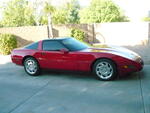
By the way, That Corvette of your is truly beautiful! That is a magnificent Convertible!
Actually doing it myself sounds like a great idea. However do I need any kind of a lift to access? I am not a mechanic but I am pretty handy.I’m assuming this is not that difficult a project in regard to the technical aspects.
Where is the antifreeze leaking from? If it's a puddle on the garage floor, you probably need a new mechanic.
Funny you should say that Because before I went ahead and did anything I wanted to confirm with another mechanic that that is the issue. Basically I saw it puddling underneath the front right side of engine compartment. Again, unfortunately I am not a mechanic.
Not to difficult, no lift required. What is required is a Factory Service Manual (FSM). Get a good set of head gaskets felpro has the kit, take lots of photos and label everything. Take your time. Do both sides, why do a half assed job as someone else mentioned. Ask questions here if you run into problems or just need some great advice. Do it yourself and save $1500 bucks.
But first confirm it's the head gasket and not something else! If you have a puddle under the car you should be able to see a leak when the engine is warm...
Good luck with your project!
Spend some time and look carefully. I have a 1991. I'm not sure how similar my 91 is to your 96 in that area but the right front is where the drain for the radiator is located on my 91 and there is also one of the main radiator hoses connected in that area. The water pump is probably up front there also. My car blew the head gasket a few years ago #7 on the left rear of the engine and what happened was that it blew coolant into the overflow reservoir and overflowed it you need to check that as well if like mine it is located on the right front in front of the wheel. Is it running over? If that is happening you probably need head gasket but you may get lucky with one of those other items. If the head gasket is blown it opens a lot of possibilities I started taking mine apart to fix it but after looking around a bit and seeing 300 HP V6's I yanked the whole thing and installed a new power plant I built myself. But it all depends on how you're set for funds.Replacing the head gasket isn't a super difficult project, probably a lot easier than a TPI, and if you want to be a 'vette owner learning to do some of this stuff will serve you well. You might poke around here on the forum, you might find someone in your local area who would be willing to guide you through the project. Good luck.
Last edited by wsherrard; Nov 20, 2019 at 10:33 PM.
Yes I am curious about something. I dont see any type of overflow near the engine itself but am seeing signs near the expansion tank and below. Expansion tank at right front of compartment. Could it be just the expansion tank?
I have attached some photos of what I saw around the expansion tank. Sorry gents I actually am pretty handy with construction, but limited experience with engines. I would love to repair but am concerned I may get in over my head. If I could find a step by step guide I would do it in a second. Whatever help you guys can provide I would greatly appreciate.
Expansion tank edge has fluid on it Expansion tank Fluid on frame below expansion tank Drip marks in front and below expansion tank
From: Las Vegas - Just stop perpetuating myths please.
$2000 sounds kinda high for a head gasket replace - unless they recondition the heads too. When I pulled my LT1 from my camaro I found a buildup of sealer on the driver's head in the front. Big pile of green goo. So I've read the aluminum head LT1s commonly had blown head gaskets. And GM sold a sealer for this that goes into the coolant. May not fix all head gasket leaks but worth the try. Ask your chevy dealer for a coolant sealer.
In fact I recall now the block had so much sealer the block drain plug was blocked and I had chisel through it. Someone told me that was a stock additive from the factory back then. I don't really know but unless I really wanted to take the heads off I would try that first.
I would look carefully and try to identify the location of where it is leaking. I would not trust that mechanics opinion after seeing your photos. Even if you clean the engine and then watch it you might learn the exact location of the leak. Cardboard on the floor is a good way to start. The leakage around the reservoir looks like someone spilled the coolant.
LT1 Buffs, why is there oil trying to escape out of the oil fill? I don't like the way it appears that the filler is pushing oil mist out. It could have been spilled on the valve cover when adding oil I suppose. Or is the engine pressurizing itself when running?
If you pressurized the cooling system it might point out the leak in the cooling system. You can buy the tools to do this yourself if you choose to do so. Eastwood would be a good start for the specific tools unless you prefer Harbor Freight tools as they are a bit less expensive than other sources.
The process of removing the heads and replacing them is well covered in the FSM so you will need a set for your particular year Corvette. They are available in print or dvd. The hard copies are about $85 and the DVD is about $20 last time I looked.
R&Ring the cylinder heads is probably within your abilities with the FSM at your side. Their are a few tools you might end to acquire but that all depends on your shop. It would be the best way to really "Know" the condition of your engine personally.
I don't know if you are familiar with a "Leak Down" test, it is where you pressurize the cylinder by pushing air in the spark plug hole while at TDC and seeing how much remains. On my old Cessna 172 they would tell me that my cylinders were 100/85 or 100/92 and that means they put 100 psi into the cylinder and 85 psi remains showing you that the health of the cylinder. So the higher the second number means that there is little wear on that cylinder, the lower the worse the health of that cylinder. If you had a 100/60 it was time to start thinking about rebuild. The best part is you can listen where the air is going. If you hear air coming from the oil fill hole then you know it is blow by around the rings, if you heard air coming out of the intake your intake valve is leaking, out of the exhaust again points to the valve, this time the exhaust valve. If you hear air coming out of the radiator or cooling system that will show your blown head gasket. The test is used on piston powered aircraft engines every day around the world. It is a very useful but a bit more than most novices could undertake. I learned from my Aircraft mechanic how to use the Leak Down equipment. They sell the leak down testers at HF or Eastwood as well, they do need a good source of air pressure to be able to supply 100 psi into the system. The hard part is getting the piston at Top Dead Center and holding it stationary while you are forcing 100 psi in at TDC. The engine will want to rotate as soon as you start to put pressure in, on my airplane one of us would hold the propeller while testing. On my Corvettes I put a 1/2 " breaker bar with a socket on the nut located on the crankshaft snout. Just be very careful and have someone help you if you try the Leak Down test.
Being up North I would imagine you will have plenty of time to work on the Corvette before the snow stops. I really enjoyed living in Manlius for that year, it was an eye-opening experience for sure. I went from there to a school in Northern Virginia that was just then de-segregating. I would return to upstate NY in a heartbeat if it wasn't so expensive to live in NY state. Having a summer house on one of the finger lakes would be just perfect for me. We stayed on lake Otisco for a month waiting for the house we were moving into to be ready. Rough life...
If you have any more questions we are here waiting to help you out!
Spend the 30 minutes with a coolant pressure tool and verify where your leaks are coming from. Yes it is possible that you have a blown head gasket, and it as pressurized the expansion tank into leaking. But definitely get the right tools and check to make sure. You can also get some strips at the parts store to see if you have combustion gasses in the coolant as well.
Wow can’t say enough about you guys. I really appreciate you guys taking the time to give me the information and your opinions. I’ll keep you updated.
either way get a FSM, not the ones on ebay that are $100+, I got a mint set for $60 shipped on facebook marketplace, so I think $50 - $80 is a good range. You will really like it, very detailed and will give you confidence if you take on the project
I agree with doing a coolant system pressure test. You "probably" don't have to buy one if your local chain parts stores rent tools ( actually some of them loan them for free, you just use a credit card to cover the cost of the tool if you don't return it.) and spend the time pressurizing the system and then looking for leaks. You may want to get some UV dye for the cooling system as well in case it's in a hard spot to locate. Run the car to operating temperature and wait for the fan to kick on. Then shut off and start hunting with a black light/uv light. It'll stand out for sure! Used this method more than a few times myself on other cars.








 Head gasket