When you click on links to various merchants on this site and make a purchase, this can result in this site earning a commission. Affiliate programs and affiliations include, but are not limited to, the eBay Partner Network.
Hey folks,
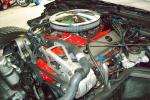
I aquired an L83 crossfire engine/transmission for cheap recently to use as a mock up block for making transmission shifter brackets and wiring in the engine bay while the original engine is getting rebuilt. I've no need to actually run this engine, but though it might be fun to tinker with it and see if it can actually run again. It was out of a wrecked car and sat for a good number of years before I picked it up. With fresh oil and filter I can get 45 PSI oil pressure using a drill primer, and compression is 130-140 across all cylinders so it can't be in terrible shape. Cylinder #2 is where the issue is, I'm guessing that one stopped with one of the valves open last it ran and some water got into the cylinder. It's got dark oxidation on the walls and a series of small pits on the bottom of the cylinder. I've no need to make this run, but I'm curious if this damage is fatal, or if this engine could actually run for a while I'm this condition. I don't want to put any serious money into it, but wondering if it's worth putting new head gaskets on and putting it back together to see if it will run again.
Agree, should be fun learning experience. Do you have something to put it in? I'd expect it to go 30i-40K miles with no major issues other than some oil consumption. Oil will get trapped in the pits and burned off on the power stroke. Could be the pits will fill somewhat with burned oil/carbon and oil consumption will go down. Perfect project for a run stand a buddy and I made from junk parts.
Agree, should be fun learning experience. Do you have something to put it in?
The current plan is to put it in my 84 which is waiting for a 383 to be built with other parts I already have. My idea was to use this one to get the transmission, wiring for Holley EFI, fuel lines, exhaust, and intake sorted out so that when the 383 is done, it's just a drop in and everything is in the right place. If it runs for a few months next spring before the new engine is finished, all the better, I just want to make sure it's worth the effort cleaning and putting new gaskets on and not something that will likely go boom I'm 5 minutes of running.
I wouldn't mind making a test stand, but I'm already short garage space as it is!
Put the piston at the bottom, use grease around the edge between the piston and wall to keep crap out. Run the hone about 3/4 of the way down a few (about a dozen) times. Wipe off the grease, then wipe down and lube the wall with oil. Definitely shade tree, but better then nothing.
I think you should go for it. Sounds like a good plan to me. Expect you'll be surprised at how well it does for you.
with this. I've got engines running that were way, WAY worse, and they ran pretty good. You already have 130 pounds of cranking compression...which is more than enough to run pretty good.
Story time: A kid brought me a jet boat and a junkyard sourced AMC 401 V8 to put together into a running/working boat for him. The 401 engine was seized from rusted bores. I looked in the cylinders w/a bore-scope and the cylinders were completely covered in rust. Not thin/discolored metal, rust.....RUST. I had little hope for that bone-yard AMC, but filled the cylinders w/oil and began trying to work the crank w/a wrench. At first, nothing, but soon got movement. I worked the crank back and forth over and over, gaining ground over time. The rings were doing all the work of scraping the rust off the bores...ugh! Not good (feeling), but I was gaining ground so I kept after it until I could make a full rotation of the crank. Flipped it over, drained they cylinders and filled w/fresh oil, spun it over some more, until it would not only make a complete revolution, but do so, smoothly, w/no catches or hang-ups.
Eventually, I "felt" good enough to move forward so I put the engine in the boat, hooked up the essentials and ran a compression test; 50-90 lbs. Ugh...that ain't good! I put plugs in, primed carb and tried to start it....it fired and ran...fair. I ran it for about 5 minutes, then killed it and drained the engine oil, refillled, fired it up again. It fired quicker/better and ran better too; smoother idle, revved better, etc. I ran it for about 10 minutes, shut it down, pulled plugs and did another compression test; ~130's-150's. WOW. This was looking promising. I ran it for about another 45 minutes, changing the oil every 10 minutes or so...then finished up the install, rigging etc, and gave the boat back to the kid. He ran it several times gave me feedback that it ran good .....and then he sank the boat.
SO....you situation is way, WAY more encouraging. I think that thing will run, and run O.K.
You have it pretty much disassembled. Pull the pistons and hone it. Then install new rings. Run an emery cloth on the rod journals. Install a new oil pump and off you go. That should be less than or right around $100. Plus you get to build the engine more and that's always a plus! I mean who doesn't want to build an engine?
My take from Tom is DON’T DO IT!!!! your car will sink.
I’d probably run it as is…if you want to be nice to it and maybe sell it afterwards as a proven/running engine then go through the extra effort..could help offset some of your costs.
Good compression, good oil control, good hydrocarbons, and the cylinder works fine.
If you do anything, best advice in my opinion is completely disassemble, clean and inspect the block and crank, new pistons at 30 over, bore with torque plates and honing to proper size for the pistons, inspect everything, new bearings, timing chain, seals, and also any parts not good replaced. It's a few $K's at most, . Short of that, keep it running.
If you do anything, best advice in my opinion is completely disassemble, clean and inspect the block and crank, new pistons at 30 over, bore with torque plates and honing to proper size for the pistons, inspect everything, new bearings, timing chain, seals, and also any parts not good replaced. It's a few $K's at most, . Short of that, keep it running.
Well, I've already got that planned for the engine that was originally in my car. Roller block, and I've got 30 over pistons, rods, and a crankshaft to make a 383. So for a full rebuild, I'm just planning to finish that whenever the budget will allow, I just don't have the $3-$4k to finish it properly at the moment.
For this one, I was more curious if it was worth the few hundred in gaskets and fluids to see if it would run for a few months vs having it sieze up within a few minutes. Sounds like theres a good chance it will! Not expecting miracles, but it would be nice to actually drive the car a bit next summer.
Will a vortec long block drop directly in an 89 with all the front accessories ? factory TPI, etc..
You would have to get a base that matches the vortec intake pattern but otherwise yes... just swap the front drive parts from an 89 onto the vortec I'd say.
Will a vortec long block drop directly in an 89 with all the front accessories ? factory TPI, etc..
Everything but the accessory drive and the intake as 84 4+3 mentioned should work. For the TPI, you'd need a vortec pattern TPI base which do exist. SDPC sells one, and I think there was one for sale here on the forum recently.
Designer Imagines A Corvette That Looks More Like a Corvette Than the Corvette
Slideshow: A Jaguar designer's personal project imagines what a modern front-engined Corvette might look like if Chevrolet revisited the golden age of the Stingray.









 Cylinder Bore rust, how bad is this?













 with this. I've got engines running that were way, WAY worse, and they ran pretty good. You already have 130 pounds of cranking compression...which is more than enough to run pretty good.