


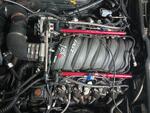





396 vs 427....

Thread Starter
Le Mans Master


Joined: Mar 2001
Posts: 9,740
Likes: 0
From: A Pretty Part of MO
 396 vs 427....
Ok, so both of these displacements can be made with a small block, using a different crank and a bore job. Cost wise, is the 427 significantly more expensive to build? Both engines would require a whole new rotating assembly, new cam, new heads, better intake and all. Are the extra 31 inches worth the extra $? The main difference that I can think of is having to find a good 400 block for the 427, while the 396 can come from the 350 style block. Thoughts?

Drifting


Joined: Dec 2002
Posts: 1,861
Likes: 4
From: Houston TX
Re: 396 vs 427.... (90qzrblu)
Quite honestly, if you're going to spend the money to build a stroker motor, I would personally choose the one that has the bigger bore as well. You will need better heads and a bigger cam for the 427 than you will for the 396, but I would go 427.
As far as the block goes, if you're going to build a stout 427 (or even a hard running 396) I would get a new block from GM, preferrably a Rocket Block. I know it's not necessary from the strict standpoint of fitting the assembly in the motor and that you need special parts for these blocks, but here are some things to consider....
1) The rocket blocks are designed with spread oil pan rails meaning that the rotating assembly will fit with less "massaging" of the block which will result in a stronger block.
2) The rocket blocks have a raised cam location which requires a specific timing chain assembly, BUT, you don't have to run a small base-circle cam to fit everything nicely. Now, I will qualify this by saying that I honestly have not actually measured the clearance between the rotating assembly and the cam on a 396 or 427 to see if a small base-circle cam is otherwise necessary, but I wouldn't be surprised. A small base-circle cam will not only be weaker, but you will have all kinds of problems with spark-scatter in your ignition timing. Now, this may not be a big deal to many people, but you can't truly optimize the engine with a lot of spark scatter.
In short, I would personally go the route of a 427 with a GM Rocket Block (which is something I may end up doing if the SB2 thing doesn't pan out, but right now it looks like it will :D ) over the 396 because if you're going big, you might as well go big with bore as well as stroke. Either way, though, I would recommend a stout block, not a factory high production casting.
As far as the block goes, if you're going to build a stout 427 (or even a hard running 396) I would get a new block from GM, preferrably a Rocket Block. I know it's not necessary from the strict standpoint of fitting the assembly in the motor and that you need special parts for these blocks, but here are some things to consider....
1) The rocket blocks are designed with spread oil pan rails meaning that the rotating assembly will fit with less "massaging" of the block which will result in a stronger block.
2) The rocket blocks have a raised cam location which requires a specific timing chain assembly, BUT, you don't have to run a small base-circle cam to fit everything nicely. Now, I will qualify this by saying that I honestly have not actually measured the clearance between the rotating assembly and the cam on a 396 or 427 to see if a small base-circle cam is otherwise necessary, but I wouldn't be surprised. A small base-circle cam will not only be weaker, but you will have all kinds of problems with spark-scatter in your ignition timing. Now, this may not be a big deal to many people, but you can't truly optimize the engine with a lot of spark scatter.
In short, I would personally go the route of a 427 with a GM Rocket Block (which is something I may end up doing if the SB2 thing doesn't pan out, but right now it looks like it will :D ) over the 396 because if you're going big, you might as well go big with bore as well as stroke. Either way, though, I would recommend a stout block, not a factory high production casting.

Le Mans Master

Joined: Oct 1999
Posts: 9,713
Likes: 3
From: Sachse Texas
Cruise-In I Veteran
Cruise-In II Veteran
Re: 396 vs 427.... (90qzrblu)
Depends what your after with the car.
My own rule of thumb, every cube will equate to ~1 extra horsepower/torque potential.
My own rule of thumb, every cube will equate to ~1 extra horsepower/torque potential.

Le Mans Master


Joined: Jul 2001
Posts: 8,183
Likes: 3
From: Santa Maria, CA
Re: 396 vs 427.... (90qzrblu)
hmmm...I was under the impression anything but a little M or Motown block couldn't have that much material bored out. But they are $1,800.00 un finished so I think that would be the biggest difference. Everything else like you mention is pretty much priced in the same ballpark. Forged instead of cast recip assembly would add another what....$1,000?
:confused:
I wonder what would be a good intake for a 427 tho......a miniram and a 58mm TB?
AFR 220's race ported w/ L98 plug angle another $2,000?
that would be a dream set up tho. I really hope you can do it and show us the results! I would love to see what a monster like that can do.
:cheers:
:confused:
I wonder what would be a good intake for a 427 tho......a miniram and a 58mm TB?
AFR 220's race ported w/ L98 plug angle another $2,000?
that would be a dream set up tho. I really hope you can do it and show us the results! I would love to see what a monster like that can do.
:cheers:
Drifting
Joined: Dec 2002
Posts: 1,861
Likes: 4
From: Houston TX
Re: 396 vs 427.... (ld85)
There is plenty of room in even a stock 400 Chevy block to build a 427 SBC (at least in terms of bore....the clearancing for the crank is a little more than I personally would be comfortable with on a stock block for strength purposes)
A 427 SBC is a 4.125" bore (stock Chevy 400 bore) and a 4.000" stroke. A 434 is 427 SBC with a 4.155" bore (0.030" overbore) instead of the stock 4.125" bore.
A 427 SBC is a 4.125" bore (stock Chevy 400 bore) and a 4.000" stroke. A 434 is 427 SBC with a 4.155" bore (0.030" overbore) instead of the stock 4.125" bore.

Melting Slicks


Joined: Sep 2000
Posts: 3,099
Likes: 0
From: PITTSBURGH PA
Cruise-In IV Veteran
Cruise-In V Veteran
Re: 396 vs 427.... (CorvetteZ51Racer)
go with a 434 and use either motown block or 400 bowtie both of these engines will take the stroke with out the need for special chains and pans the only way i would personally use the rocket block if you were going to go bigger yet like a 454-460 small block then it would be a benefeit :cheers:
Corvette Stories
The Best of Corvette for Corvette Enthusiasts

Top 10 Most Expensive Corvettes Ever Sold on Bring A Trailer
Brett Foote
10 Things Every Corvette Owner Needs (2026 Edition)
Michael S. Palmer
8 Most "Only Corvette Owners Understand" Quirks and Problems
Pouria Savadkouei
10 Reasons the C6 Z06 is Still A Performance Benchmark After 20 Years
Joe Kucinski
How Much Horsepower Every Corvette Engine "LOST" in 1972
Joe Kucinski
Top 10 DOs and DON'Ts for Protecting Your Convertible Top!
Michael S. Palmer
Top 10 Most Explosive Corvettes Ever Made: Power-to-Weight Ratio Ranked!
Joe Kucinski
150 hp to 1,250 hp: Every Corvette Generation Compared by the Specs That Matter
Joe Kucinski
8 Coolest Corvette Pace Cars (and Replicas) of All Time
Verdad Gallardo

Melting Slicks
Joined: Mar 2002
Posts: 3,195
Likes: 0
From: Lake George NY
Cruise-In IV Veteran
Re: 396 vs 427.... (90qzrblu)
just as an example... I had a 72 Chevelle with a 400sb and would beat the 396bb engines all the time... not sure if the extra weight had anything to do with it for the bb engine? Im no mechanic by any means, but the 400 was fast as heck, low end and top end.
