When you click on links to various merchants on this site and make a purchase, this can result in this site earning a commission. Affiliate programs and affiliations include, but are not limited to, the eBay Partner Network.
I just randomly came across it.
I have a engine that uses oil due to low tension rings. I use breather only. Apparently that doesnt help a bit on the LT1. I need to let my PCV and coalescing oil filter separate the oil.
But this valve system intrigues me. Looks snazzy
It is, but if it actually does what it says, it could be worth it on a modified engine.
Thing I am not liking is, it takes all that crap swirling around in the crankcase and puts it back into the cylinder, theoretically, to be reburned.
I would think that would affect the air fuel quality.
If a single PCV valve does not offer enough flow rate you can add a second, third, fourth, etc... in parallel to increase the flow rate through the crankcase thereby cleaning oil and improving engine longevity and oil quality.
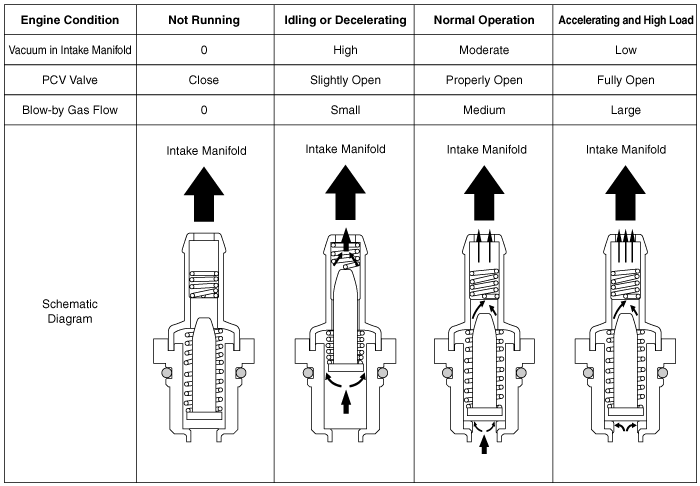
PCV valves vary flow based on pressure differential, more vacuum applied = less flow
PCV Valves are not equal. Some leak. Some flow more than others. Some aftermarket are different than original.
These differences matter. Engines are also different. Wear creates additional blow-by. Piston temperature, rodxstroke ratio, intake vacuum signal, ring design, oil conformity, etc... many variables influence the PCV requirements of an engine as they change over time and conditioning.
Therefore no matter what type of engine you have and what type of PCV system you intent to use, the one thing that must always be done just like with tire pressure, boost pressure, fuel pressure, coolant pressure, transmission pressure, oil pressure, etc... is you must measure the crankcase pressure and set the crankcase pressure properly. Imagine if you did not set the fuel or tire pressure properly. There are consequences to ignoring these pressure settings. In the PCV system the crankcase pressure controls blow-by rate, oil leaking, oil droplet radius, oil droplet density, oil wicking and return oil to the pan, piston ring behavior. The crankcase pressure setting is fundamental to the operation and reliability of any engine.
Im so glad you asked. It is just like measuring tire pressure, boost pressure, fuel pressure, coolant pressure, etc... Use a pressure gauge with the correct resolution.
I'll show data and measurement techniques , how people use it, and a video at the end how I do it using cost effective rapid method (no expensive equipment)
This is an example of electric vacuum pumping crankcase scavenging withCrankcase Measurement
The next thing I did today was to relocate the vacuum source for my PCV setup from the PCV can to the front valve cover. I wanted to see if the vacuum was the same between the two references. Essentially, I don't see a noticeable difference whether I read the vacuum from the can or from the front valve cover. While I was doing this I decided the short the Hobbs switch to check out the vacuum with the air pump turned on. To my surprise it wasn't turning on. Upon inspecting the 15amp fuse it had blown so it was not working when under boost. This might explain why I had oil pushing past the rear main seal. I swapped in a 20amp fuse and it works like it should and pulls ~5" at idle. Because I monitor the pressure with my AeroForce Gauge it allows me to set a warning light. I now have the warning light come on anytime the PCV presssure exceeds 0psi.
Notice:
- He measures the crankcase pressure and has a gauge with a warning set for positive crankcase pressure
- He noticed the crankcase pressure was forcing oil out of the engine seals and corrected it with a vacuum signal before it got worse
The correct pressure range is 1.0"Hg to 3"Hg of Crankcase pressure at wide open throttle for wet sump. There are high resolution vacuum gauges specifically made for this purpose of measurement of that range.
Here is a digital example
Crankcase pressure measurement and setting is to be done for all engines , any engine wet or dry sump they all have a target pressure range for idle/cruise/WOT. You must set it by measuring yourself, just like fuel pressure, tire pressure, coolant pressure, transmission pressure, boost pressure, etc... all the pressures of the vehicle need to be monitored and controlled more often as performance is increasing. https://www.corvetteforum.com/forums...post1607797430
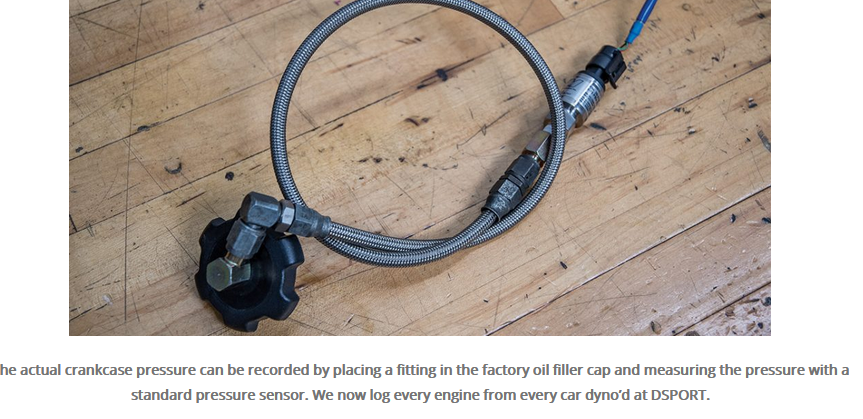
For monitoring real-time in vehicle I find like this to be ideal pressure sensor design
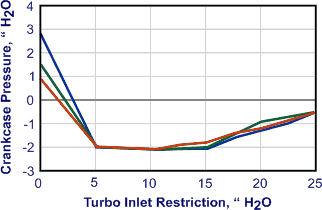
On the order of inches of water in measurement for wet sump engines, perhaps 60"H2O Is a decent target. i.e. a couple negative PSI is really good.
The cheapest way I found to one-off measurement (as opposed to real-time constant from in the vehicle like a gauge) is using a map sensor. I made a video how to diy using a cheap map sensor.
A map sensor is NOT ideal. But will work FINE and serve its purpose if used correctly. It is the cheapest easiest fastest way to take measurements using multi-meter.
If using a microcontroller deivce such as arduino or hptuners or ECU logging etc... there is some concern with the analog offset of such measurements thus a CONTROL sensor would be required or some calibration effort. Otherwise you should never trust data collected by a microcontroller on its face value. The multi-meter method eliminates analog offset if done properly which is why it is preferred method for starting out. If you later add a gauge or controller you could compare with the multi-meter measurement technique for accuracy/validation.
Please any questions I have many diagrams and data to share to answer all questions on this subject
Old thread, I know. However I've run one of these on a non Corvette application (Model A street rod, 331 SBF w/ 282 HR). To answer "what did it do for me?" It always had a stain around the valve cover gaskets, and the breathers and grommets. After I installed and adjusted it per instructions all those damp spots dried up.
I adjusted one for another gent, he had a 427 in a Chevelle with an even hotter cam (less than 3" vacuum at idle, hot, I've got almost 11"). He had a similar problem that also went away.
The inside of the engine seems to be cleaner than with a regular PCV valve.
However, with all that extra flow, I found you have to improve the baffling from wherever you're drawing from or it will siphon copious amounts of oil.






 Wagner PCV valve?