





300mph C5???

Race Director


Joined: Jan 2003
Posts: 14,285
Likes: 0
From: Houston, Tx Got traction?
CI 5-6-7-8-9-10 Veteran
St. Jude Donor '07-'08

Everybody points out the Bugatti, and the butt loads of power the bi-twin turbo set up has. However nobody's mentioned the technology in that car to make it accomplish 250mph. The aerodynamics change on the car, as do a few other things. When the Bugatti is in top speed mode, it is not safe to drive in traffic, and the first time you touch the brakes it goes back to sport mode. The only time you can get into top speed mode is at a stop with the engine running.
I read a very interesting article on the car it's amazing the technology involved in going 250mph safely. I don't foresee a corvette with only basic steering rack set up, basic non-adjustable suspension, safely approaching anywhere near 300mph, let alone never catching up to the bugati's 250mph.

Chris
I read a very interesting article on the car it's amazing the technology involved in going 250mph safely. I don't foresee a corvette with only basic steering rack set up, basic non-adjustable suspension, safely approaching anywhere near 300mph, let alone never catching up to the bugati's 250mph.
Chris

Melting Slicks

Joined: Aug 2003
Posts: 3,306
Likes: 5
I don't care how much horsepower it has, it will not do 300mph. Some of you guys sound crazy actually thinking its possible. Have any of you ever been to 200mph? Do you actually think it'll just cruise right up to 300mph without any serious issues?

Race Director

Joined: Nov 2001
Posts: 11,530
Likes: 0
From: New Bloomfield Pa
Cruise-In VI Veteran
St. Jude Donor '03-'04-'05-'06-'07-'10
...cant see it.
A Top Fueler makes around 6500 Hp and it weighs in at slightly over 2100. It took until 1996 to reach 300. Now I understand that this is only in 1/4 mile but look at some of the cars on the dry lakes with the same HP and weight....they reach about 230
A Top Fueler makes around 6500 Hp and it weighs in at slightly over 2100. It took until 1996 to reach 300. Now I understand that this is only in 1/4 mile but look at some of the cars on the dry lakes with the same HP and weight....they reach about 230

Supporting Tuner
Joined: Sep 2004
Posts: 51,896
Likes: 39
From: ================== Houston, Texas www.englandgreen.com ================== Necessary Evil™ __________
CI 6-7-8-9-10 Veteran
St. Jude Donor '05-'06-'07-'08-'09-'10-'11-'12-'13-'14
Originally Posted by stsears1
What about with an ironing board bolted to the back???? Hahahaha..........
 Ironing board is only good to 192mph. You have to go to the park bench model to break 200mph....
Last edited by EG@EnglandGreen; Dec 6, 2005 at 03:23 PM.

Pro

Joined: Nov 2005
Posts: 655
Likes: 0
From: Virginia
Rember the bugatti veyron weighs around 4000 pounds and the vette only ways about 3100 pounds. Plus I am sure that LPE shaves off a lot of weight when building a monster like this. I think its possible....call me crazy........ 

Racer

Joined: Apr 2005
Posts: 466
Likes: 0
From: Greenville NC
Weight has no bearing on top speed "what so ever". Top speed is simply a function of power vs. aerodynamic drag. Aerodynamic drag does not increase linearly, this is why you see a 1000+hp car hitting "only" 250mph. It's very unlikely that a modified "production car" will hit 300mph anytime soon, unless your definition of "modified" is radical enough to include a completely redesigned suspension, chasis, body panels and engine.
Ahmet
Ahmet
Corvette Stories
The Best of Corvette for Corvette Enthusiasts

Top 10 Most Explosive Corvettes Ever Made: Power-to-Weight Ratio Ranked!
Joe Kucinski
150 hp to 1,250 hp: Every Corvette Generation Compared by the Specs That Matter
Joe Kucinski
8 Coolest Corvette Pace Cars (and Replicas) of All Time
Verdad Gallardo
Top 10 Corvette Engines RANKED by Peak Torque (70+ Years of Muscle!)
Joe Kucinski
Corvette ZR1X Will Be Pacing the Indy 500, And Could Probably Race, Too!
Verdad Gallardo
Top 10 Corvettes Coming to Mecum Indy 2026!
Brett Foote
Top 10 C9 Corvette MUST-HAVES to Fix These C8 Generation Flaws!
Michael S. Palmer
10 Revolutionary 'Corvette Firsts' Most People Don't Know
Joe Kucinski
5 Reasons to Upgrade to an LS6-Powered Corvette; 5 Reasons to Stay LT2
Michael S. Palmer
Navigator
Joined: Apr 2005
Posts: 9
Likes: 0
From: Cary NC
Weight has no bearing on top speed "what so ever". Top speed is simply a function of power vs. aerodynamic drag. Aerodynamic drag does not increase linearly, this is why you see a 1000+hp car hitting "only" 250mph. It's very unlikely that a modified "production car" will hit 300mph anytime soon, unless your definition of "modified" is radical enough to include a completely redesigned suspension, chasis, body panels and engine.
Ahmet
Ahmet
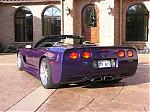
Thread Starter
Drifting

Joined: Apr 2005
Posts: 1,509
Likes: 1
From: Lafayette CA
Originally Posted by sage666
Probably meant 300 KPH, not MPH...

Thread Starter
Drifting
Joined: Apr 2005
Posts: 1,509
Likes: 1
From: Lafayette CA
Originally Posted by C6this
Rember the bugatti veyron weighs around 4000 pounds and the vette only ways about 3100 pounds. Plus I am sure that LPE shaves off a lot of weight when building a monster like this. I think its possible....call me crazy........






 Euro dash gauges....
Melting Slicks


Joined: Jun 2004
Posts: 3,439
Likes: 6
From: Newark, DE
St. Jude Donor '06
300mph? Maybe on a dyno!
Here's an interesting calculator which addresses this topic:
http://www.rbracing-rsr.com/aerohpcalc.html
It is intended for bikes, but seems to scale to 4 wheeled vehicles if the proper variables are plugged in. Here are the figures for a C5 coupe, which has the best chance of succeeding (right ), since it has better aerodynamics than the Z06:
After adding in my weight, it would take over 1217rwhp to propel me to 300mph (assuming the Z-rated tires don't explode or the car become airborne first).
http://www.rbracing-rsr.com/aerohpcalc.html
It is intended for bikes, but seems to scale to 4 wheeled vehicles if the proper variables are plugged in. Here are the figures for a C5 coupe, which has the best chance of succeeding (right
), since it has better aerodynamics than the Z06:Cd = .29
Frontal area = 21.3
Weight = 3210 + your weight *
Speed = 300
* Add weight if you have the typical s/s catback; subtract weight if you have the Z06 Ti.Frontal area = 21.3
Weight = 3210 + your weight *
Speed = 300
After adding in my weight, it would take over 1217rwhp to propel me to 300mph (assuming the Z-rated tires don't explode or the car become airborne first).


Parrothead


Joined: May 2002
Posts: 48,231
Likes: 289
From: Margaritaville Embassy
St. Jude Donor '08-'09,'13, '14
Look at it this way.. a NASCAR puts out sonmething like 800 HP and Bill Elliott set the speed record of 212 at Talladega.. no way is a 900 HP car reaching 300 MPH.
Slap a JATO pack on ith THEN you might have something
Slap a JATO pack on ith THEN you might have something


Racer

Joined: Oct 2004
Posts: 326
Likes: 1
From: Cologne (Köln) Germany
Here's the math:
The power P needed to reach a speed v in a car is approximately proportional to the cube of the latter,
P ~ v^3......................(1)
With
P' ~ v'^3.....................(2)
and dividing Eq. (1) by Eq. (2) and multiplying both sides by P', we get a formula to estimate the power P needed to achieve a speed v when the car reaches a speed v' with a power P'
P = P' (v/v')^3..............(3)
Thus, with P'=350 hp, v'=175 mph, and v=300 mph, we get P=1763 hp. Moreover, we may solve Eq. (3) for v, to obtain the top speed at a given power P,
v = cube root(P/P') v'.....(4)
With P=992 hp, P'=350 hp, and v=175 mph, we get v=248 mph. Remark: I used engine powers instead of rear wheel powers. However, assuming that the losses in the drive train are proportional to the engine power, the above calculation is unchanged if we insert rear wheel powers for P and P'.
Its great to be a theoretical physicist
The power P needed to reach a speed v in a car is approximately proportional to the cube of the latter,
P ~ v^3......................(1)
With
P' ~ v'^3.....................(2)
and dividing Eq. (1) by Eq. (2) and multiplying both sides by P', we get a formula to estimate the power P needed to achieve a speed v when the car reaches a speed v' with a power P'
P = P' (v/v')^3..............(3)
Thus, with P'=350 hp, v'=175 mph, and v=300 mph, we get P=1763 hp. Moreover, we may solve Eq. (3) for v, to obtain the top speed at a given power P,
v = cube root(P/P') v'.....(4)
With P=992 hp, P'=350 hp, and v=175 mph, we get v=248 mph. Remark: I used engine powers instead of rear wheel powers. However, assuming that the losses in the drive train are proportional to the engine power, the above calculation is unchanged if we insert rear wheel powers for P and P'.
Its great to be a theoretical physicist

Race Director

Joined: Aug 2002
Posts: 10,232
Likes: 96
From: not far enough from Chicago
Originally Posted by bobdt173
To do 300mph the car would have to have some major body mods to hold it to the ground. I think the stock body is only rated to 200mph. This is only an opinion take it for what its worth.
Bob
Bob