





Batteries Question Advice?

Le Mans Master


Joined: Dec 2001
Posts: 7,788
Likes: 6
From: Winchester TN
Cruise-In III Veteran
Cruise-In IV Veteran
Cruise-In V Veteran
St. Jude Donor '03-'04-'05-'06-'07-'11

Originally Posted by MrLeadFoot
Not to hijack this thread, or anything, but a friend of mine just asked me if he needs to get some kind of mounting adapter for his C5, because he wants to install an Optima Redtop 75/25 (75/35), which he says is the correct model to install. I looked at the Optima web site, and it does indeed mention several different kinds of adapters, which supposedly MAY come with the battery. From the pics on the site, I am assuming he may need the "puck" so that his stock mounting clamp will work.
My friend was at Costco when he called and said he doesn't see an adapter. Do any of you who've installed this battery know what my friend is talking about?
Thanks.
My friend was at Costco when he called and said he doesn't see an adapter. Do any of you who've installed this battery know what my friend is talking about?
Thanks.
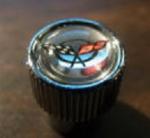
I put this battery -
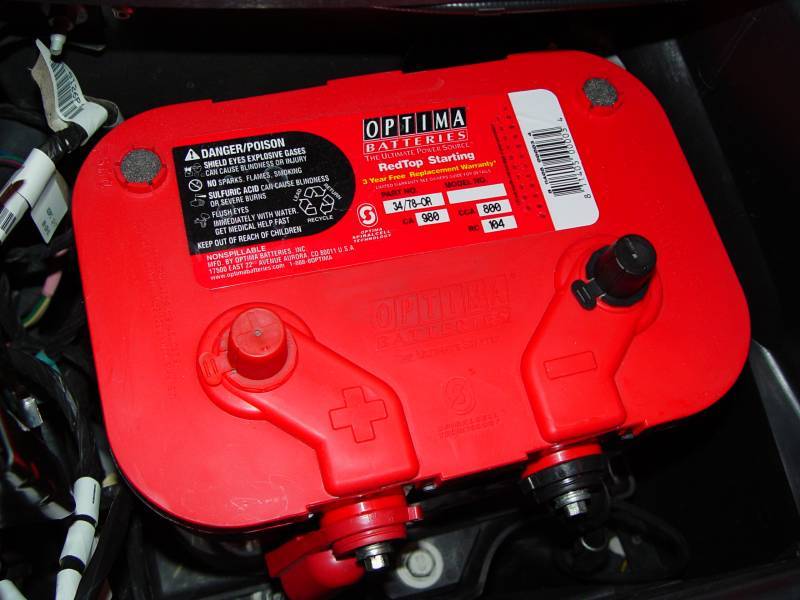
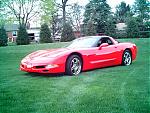
in this car
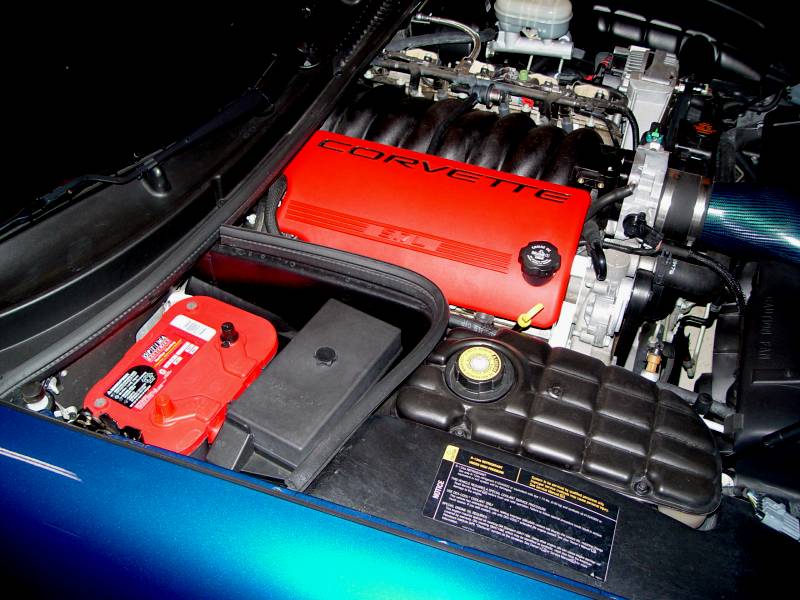
with no adapter or additional parts necessary. the battery bolted right in.
best regards -
mqqn
Instructor


Joined: Jul 2005
Posts: 118
Likes: 0
From: Knoxville TN
Cruise-In VI Veteran
Cruise-In VII Veteran
I just noticed my lights dim and brighten during deceleration and acceleration on my 02 coupe.
The battery is the original one put in the car Mar, 2002, almost 4 years ago. It is reading 12.4 volts.
What do you think? Is it battery time or do I have an alternator acting up?
I just don't want to get stranded by a dead car one of these days.
Thanks,
Scott
The battery is the original one put in the car Mar, 2002, almost 4 years ago. It is reading 12.4 volts.
What do you think? Is it battery time or do I have an alternator acting up?
I just don't want to get stranded by a dead car one of these days.
Thanks,
Scott

Melting Slicks

Joined: Jul 2004
Posts: 2,340
Likes: 35
From: Folsom Lake CA
Originally Posted by ScottSuff
I just noticed my lights dim and brighten during deceleration and acceleration on my 02 coupe.
The battery is the original one put in the car Mar, 2002, almost 4 years ago. It is reading 12.4 volts.
What do you think? Is it battery time or do I have an alternator acting up?
I just don't want to get stranded by a dead car one of these days.
Thanks,
Scott
The battery is the original one put in the car Mar, 2002, almost 4 years ago. It is reading 12.4 volts.
What do you think? Is it battery time or do I have an alternator acting up?
I just don't want to get stranded by a dead car one of these days.
Thanks,
Scott

Drifting

Joined: Sep 2003
Posts: 1,363
Likes: 7
From: 1994 LT1 Coupe 6-speed with FX3 & 2000 LS1 Vert 6-Speed with F45 Hunterdon County, NJ
to Yechi7
Yechi7,
good questions, I'll try and answer each in order, after this first statement:
No battery is absolutely 'leak-proof'. Whether it is a pure liquid acid (as in normal 'wet cell' ACDelco batteries) or GEL'd acid between flat (AGM) or round (Orbital) plates, it can still leak if the case is compromised (either by cracks or failure of sealant around the posts).
1. the ACDelco AGM (Absorbed Glass Mat) composition was desireable based on its 'reduced' chance of leakage and its increased cycle life (number of discharge/recharge cycles, even if deeply discharged).
However, as with everything there are compromises, and the negatives of the ACDelco AGM's were low CCA's (Cold Cranking Amps) and reported complete failures with no warning (possibly due to vibration not typical of other AGM applications, i.e. planes/boats).
My reason for not choosing the Optima and Exide orbital was taken from my boating electrical knowledge. I could not confirm they were true AGM's, but maybe just GEL's in a round format. True AGM's have a charging curve that closely matches that of typical 'wet cells', whereas GEL's require a slightly different charging curve, inclusive of being more sensitive to overcharging. So if they were GEL's, then they would not match the alternator/regulator charging curve. further the Optima had many reports of failures and case cracking.
So, it narrowed the field back to a normal wet-cells.
And a visit to Auto-Zone and BJ's proved their battery options did not include 'maintenance free' chemistry.
Therefore, the ACDelco batteries were the logical conclusion (since Sears was too far away -- possibly made by the same company that makes Optima).
2. 'Maintenance free' is a chemistry specific to 'wet cells', and doesn't apply to AGM or GEL type batteries. 'Maintenance Free' batteries use calcium in their chemistry (instead of antimony?) which reduces gassing and their rate of self-discharge, and therefore less corrosion in/around the battery/terminals. Further, 'maintenance free' means the caps are sealed and there is minimal venting of battery gasses and thereby possible normal leakage terminal corrosion.
Sears' Gold are 'maintenance free', but are still 'wet cells'.
Exide Orbital's attractiveness may be due to its NOT being a 'wet cell' (for those concerned about leakage) and the case seems beefier than the Optima. It may be a good choice, but since Optima's were failing, I was not convinced that the Exide Orbital's would not fail also.
As to which is more important, I would suggest something you didn't mention.
Reliability - The battery needs to be able start the car after you drive it somewhere.
Whereas 'wet cell' batteries are 'older' technology, they typically give hints before they fail and can recover a few times before complete failure (e.g. we had about a 1.5 year warning on our TransAm's).
Corvettes are often 'garage queens', so keeping an eye open for leakage in the garage is relatively easy, as is keeping a charger/battery tender on the battery to keep a 'wet cell' healthier. However, having a AGM/GEL/Orbital battery just fail in the mall parking lot is not easy nor fun and potentially more costly.
Also, acid absorbing mats can be placed under the front half of the battery, further reducing leakage concerns.
So, assuming the choice is 'wet cell', then 'maintenance free' is the next level of importance to get the best possible 'wet cell' option and to possibly match the charging curve of our alternator/regulator.
Last in my priority list would be AGM (if available anymore) or AGM/GEL 'spiral-wound' technology batteries.
In summary,
my reason for recommending ACDelco 75/78 - 6/7yr is GM puts them in C5's ---and---
After all, it is JUST a $100 +/- battery, and if concerned/needed, it could be replaced every year for 'free' just by eating at Burger King instead of Friday's twice per year.
I hope I was able to answer all your questions...
good questions, I'll try and answer each in order, after this first statement:
No battery is absolutely 'leak-proof'. Whether it is a pure liquid acid (as in normal 'wet cell' ACDelco batteries) or GEL'd acid between flat (AGM) or round (Orbital) plates, it can still leak if the case is compromised (either by cracks or failure of sealant around the posts).
1. the ACDelco AGM (Absorbed Glass Mat) composition was desireable based on its 'reduced' chance of leakage and its increased cycle life (number of discharge/recharge cycles, even if deeply discharged).
However, as with everything there are compromises, and the negatives of the ACDelco AGM's were low CCA's (Cold Cranking Amps) and reported complete failures with no warning (possibly due to vibration not typical of other AGM applications, i.e. planes/boats).
My reason for not choosing the Optima and Exide orbital was taken from my boating electrical knowledge. I could not confirm they were true AGM's, but maybe just GEL's in a round format. True AGM's have a charging curve that closely matches that of typical 'wet cells', whereas GEL's require a slightly different charging curve, inclusive of being more sensitive to overcharging. So if they were GEL's, then they would not match the alternator/regulator charging curve. further the Optima had many reports of failures and case cracking.
So, it narrowed the field back to a normal wet-cells.
And a visit to Auto-Zone and BJ's proved their battery options did not include 'maintenance free' chemistry.
Therefore, the ACDelco batteries were the logical conclusion (since Sears was too far away -- possibly made by the same company that makes Optima).
2. 'Maintenance free' is a chemistry specific to 'wet cells', and doesn't apply to AGM or GEL type batteries. 'Maintenance Free' batteries use calcium in their chemistry (instead of antimony?) which reduces gassing and their rate of self-discharge, and therefore less corrosion in/around the battery/terminals. Further, 'maintenance free' means the caps are sealed and there is minimal venting of battery gasses and thereby possible normal leakage terminal corrosion.
Sears' Gold are 'maintenance free', but are still 'wet cells'.
Exide Orbital's attractiveness may be due to its NOT being a 'wet cell' (for those concerned about leakage) and the case seems beefier than the Optima. It may be a good choice, but since Optima's were failing, I was not convinced that the Exide Orbital's would not fail also.
As to which is more important, I would suggest something you didn't mention.
Reliability - The battery needs to be able start the car after you drive it somewhere.
Whereas 'wet cell' batteries are 'older' technology, they typically give hints before they fail and can recover a few times before complete failure (e.g. we had about a 1.5 year warning on our TransAm's).
Corvettes are often 'garage queens', so keeping an eye open for leakage in the garage is relatively easy, as is keeping a charger/battery tender on the battery to keep a 'wet cell' healthier. However, having a AGM/GEL/Orbital battery just fail in the mall parking lot is not easy nor fun and potentially more costly.
Also, acid absorbing mats can be placed under the front half of the battery, further reducing leakage concerns.
So, assuming the choice is 'wet cell', then 'maintenance free' is the next level of importance to get the best possible 'wet cell' option and to possibly match the charging curve of our alternator/regulator.
Last in my priority list would be AGM (if available anymore) or AGM/GEL 'spiral-wound' technology batteries.
In summary,
my reason for recommending ACDelco 75/78 - 6/7yr is GM puts them in C5's ---and---
After all, it is JUST a $100 +/- battery, and if concerned/needed, it could be replaced every year for 'free' just by eating at Burger King instead of Friday's twice per year.
I hope I was able to answer all your questions...
Last edited by theadmiral94; Jan 26, 2006 at 12:50 AM.
Melting Slicks
Joined: Jul 2004
Posts: 2,340
Likes: 35
From: Folsom Lake CA
Originally Posted by mqqn
hi Mr. Leadfoot -
I put this battery -
in this car
with no adapter or additional parts necessary. the battery bolted right in.
best regards -
mqqn
I put this battery -
in this car
with no adapter or additional parts necessary. the battery bolted right in.
best regards -
mqqn
Melting Slicks
Joined: Jul 2004
Posts: 2,340
Likes: 35
From: Folsom Lake CA
Originally Posted by Vettman 1
Costco has the Red-Top 
Racer
Joined: May 2000
Posts: 415
Likes: 0
From: Fairfax, VA 22032
Originally Posted by FrankTank
I have seen all the Hype on the Redtop/Yellow Top and many claimed they are the Cat's azz of batteries, but then you'll find just as many that say if you leave your car sit for a few weeks the Redtops give out 
good luck with your selection
good luck with your selection

Corvette Stories
The Best of Corvette for Corvette Enthusiasts

Every 2027 Corvette Engine Explained
Joe Kucinski
Designer Imagines A Corvette That Looks More Like a Corvette Than the Corvette
Verdad Gallardo
10 Ugly Corvettes That We Still Kinda Love
Joe Kucinski
Top 10 Most Expensive Corvettes Ever Sold on Bring A Trailer
Brett Foote
10 Things Every Corvette Owner Needs (2026 Edition)
Michael S. Palmer
8 Most "Only Corvette Owners Understand" Quirks and Problems
Pouria Savadkouei
10 Reasons the C6 Z06 is Still A Performance Benchmark After 20 Years
Joe Kucinski
How Much Horsepower Every Corvette Engine "LOST" in 1972
Joe Kucinski
Top 10 DOs and DON'Ts for Protecting Your Convertible Top!
Michael S. Palmer
Thread Starter
Instructor
Joined: Dec 2005
Posts: 187
Likes: 0
From: North Miami Beach FL
Originally Posted by theadmiral94
Yechi7,
good questions, I'll try and answer each in order, after this first statement:
No battery is absolutely 'leak-proof'. Whether it is a pure liquid acid (as in normal 'wet cell' ACDelco batteries) or GEL'd acid between flat (AGM) or round (Orbital) plates, it can still leak if the case is compromised (either by cracks or failure of sealant around the posts).
1. the ACDelco AGM (Absorbed Glass Mat) composition was desireable based on its 'reduced' chance of leakage and its increased cycle life (number of discharge/recharge cycles, even if deeply discharged).
However, as with everything there are compromises, and the negatives of the ACDelco AGM's were low CCA's (Cold Cranking Amps) and reported complete failures with no warning (possibly due to vibration not typical of other AGM applications, i.e. planes/boats).
My reason for not choosing the Optima and Exide orbital was taken from my boating electrical knowledge. I could not confirm they were true AGM's, but maybe just GEL's in a round format. True AGM's have a charging curve that closely matches that of typical 'wet cells', whereas GEL's require a slightly different charging curve, inclusive of being more sensitive to overcharging. So if they were GEL's, then they would not match the alternator/regulator charging curve. further the Optima had many reports of failures and case cracking.
So, it narrowed the field back to a normal wet-cells.
And a visit to Auto-Zone and BJ's proved their battery options did not include 'maintenance free' chemistry.
Therefore, the ACDelco batteries were the logical conclusion (since Sears was too far away -- possibly made by the same company that makes Optima).
2. 'Maintenance free' is a chemistry specific to 'wet cells', and doesn't apply to AGM or GEL type batteries. 'Maintenance Free' batteries use calcium in their chemistry (instead of antimony?) which reduces gassing and their rate of self-discharge, and therefore less corrosion in/around the battery/terminals. Further, 'maintenance free' means the caps are sealed and there is minimal venting of battery gasses and thereby possible normal leakage terminal corrosion.
Sears' Gold are 'maintenance free', but are still 'wet cells'.
Exide Orbital's attractiveness may be due to its NOT being a 'wet cell' (for those concerned about leakage) and the case seems beefier than the Optima. It may be a good choice, but since Optima's were failing, I was not convinced that the Exide Orbital's would not fail also.
As to which is more important, I would suggest something you didn't mention.
Reliability - The battery needs to be able start the car after you drive it somewhere.
Whereas 'wet cell' batteries are 'older' technology, they typically give hints before they fail and can recover a few times before complete failure (e.g. we had about a 1.5 year warning on our TransAm's).
Corvettes are often 'garage queens', so keeping an eye open for leakage in the garage is relatively easy, as is keeping a charger/battery tender on the battery to keep a 'wet cell' healthier. However, having a AGM/GEL/Orbital battery just fail in the mall parking lot is not easy nor fun and potentially more costly.
Also, acid absorbing mats can be placed under the front half of the battery, further reducing leakage concerns.
So, assuming the choice is 'wet cell', then 'maintenance free' is the next level of importance to get the best possible 'wet cell' option and to possibly match the charging curve of our alternator/regulator.
Last in my priority list would be AGM (if available anymore) or AGM/GEL 'spiral-wound' technology batteries.
In summary,
my reason for recommending ACDelco 75/78 - 6/7yr is GM puts them in C5's ---and---
After all, it is JUST a $100 +/- battery, and if concerned/needed, it could be replaced every year for 'free' just by eating at Burger King instead of Friday's twice per year.
I hope I was able to answer all your questions...
good questions, I'll try and answer each in order, after this first statement:
No battery is absolutely 'leak-proof'. Whether it is a pure liquid acid (as in normal 'wet cell' ACDelco batteries) or GEL'd acid between flat (AGM) or round (Orbital) plates, it can still leak if the case is compromised (either by cracks or failure of sealant around the posts).
1. the ACDelco AGM (Absorbed Glass Mat) composition was desireable based on its 'reduced' chance of leakage and its increased cycle life (number of discharge/recharge cycles, even if deeply discharged).
However, as with everything there are compromises, and the negatives of the ACDelco AGM's were low CCA's (Cold Cranking Amps) and reported complete failures with no warning (possibly due to vibration not typical of other AGM applications, i.e. planes/boats).
My reason for not choosing the Optima and Exide orbital was taken from my boating electrical knowledge. I could not confirm they were true AGM's, but maybe just GEL's in a round format. True AGM's have a charging curve that closely matches that of typical 'wet cells', whereas GEL's require a slightly different charging curve, inclusive of being more sensitive to overcharging. So if they were GEL's, then they would not match the alternator/regulator charging curve. further the Optima had many reports of failures and case cracking.
So, it narrowed the field back to a normal wet-cells.
And a visit to Auto-Zone and BJ's proved their battery options did not include 'maintenance free' chemistry.
Therefore, the ACDelco batteries were the logical conclusion (since Sears was too far away -- possibly made by the same company that makes Optima).
2. 'Maintenance free' is a chemistry specific to 'wet cells', and doesn't apply to AGM or GEL type batteries. 'Maintenance Free' batteries use calcium in their chemistry (instead of antimony?) which reduces gassing and their rate of self-discharge, and therefore less corrosion in/around the battery/terminals. Further, 'maintenance free' means the caps are sealed and there is minimal venting of battery gasses and thereby possible normal leakage terminal corrosion.
Sears' Gold are 'maintenance free', but are still 'wet cells'.
Exide Orbital's attractiveness may be due to its NOT being a 'wet cell' (for those concerned about leakage) and the case seems beefier than the Optima. It may be a good choice, but since Optima's were failing, I was not convinced that the Exide Orbital's would not fail also.
As to which is more important, I would suggest something you didn't mention.
Reliability - The battery needs to be able start the car after you drive it somewhere.
Whereas 'wet cell' batteries are 'older' technology, they typically give hints before they fail and can recover a few times before complete failure (e.g. we had about a 1.5 year warning on our TransAm's).
Corvettes are often 'garage queens', so keeping an eye open for leakage in the garage is relatively easy, as is keeping a charger/battery tender on the battery to keep a 'wet cell' healthier. However, having a AGM/GEL/Orbital battery just fail in the mall parking lot is not easy nor fun and potentially more costly.
Also, acid absorbing mats can be placed under the front half of the battery, further reducing leakage concerns.
So, assuming the choice is 'wet cell', then 'maintenance free' is the next level of importance to get the best possible 'wet cell' option and to possibly match the charging curve of our alternator/regulator.
Last in my priority list would be AGM (if available anymore) or AGM/GEL 'spiral-wound' technology batteries.
In summary,
my reason for recommending ACDelco 75/78 - 6/7yr is GM puts them in C5's ---and---
After all, it is JUST a $100 +/- battery, and if concerned/needed, it could be replaced every year for 'free' just by eating at Burger King instead of Friday's twice per year.
I hope I was able to answer all your questions...
Man, you are one smart guy! I think you were my chemistry professor in high school.
 I might have to change my hat size after digesting your post.
  I feel my brain getting bigger, as we speak.
Not to give you a hard time, but 2 points:
1) You said, "my reason for recommending ACDelco 75/78 - 6/7yr is GM puts them in C5's". But GM also was responsible for all the screw-ups posted in the Sticky: "Weights, measurements, etc.", including the original ACDelco leaky batteries, the poor placement of the battery over the PCM & electronics, the infamous steering wheel lock, etc.
2) And one question you didn't answer: Why are so many people running after the Exide Orbital?
David
Le Mans Master
Joined: Dec 2001
Posts: 7,788
Likes: 6
From: Winchester TN
Cruise-In III Veteran
Cruise-In IV Veteran
Cruise-In V Veteran
St. Jude Donor '03-'04-'05-'06-'07-'11
Originally Posted by MrLeadFoot
According to the Optima site, that's not the recommended battery. Obviously it's working for you, though. Any reason you went with this particular battery?
I went with the higher CA/CCA battery - the car does not REQUIRE the higher rating.
The one I went with bolted right in, and has 980 CA compared to 910, and it was not much more $.
My decision was just my choice, not based on facts or data - it was me chossing "bigger is better" (amperage wise...).
best regards -
mqqn
Drifting
Joined: Sep 2003
Posts: 1,363
Likes: 7
From: 1994 LT1 Coupe 6-speed with FX3 & 2000 LS1 Vert 6-Speed with F45 Hunterdon County, NJ
thanks for the compliments
Hi Yechi7,
thanks and no problem, can you tell I like this stuff... plus having a sailboat means having to know alot about batteries...
In answer to your additional questions:
1. True GM did make those mistakes, as does other manufacturers make ones too. Could they do it better? Probably, but then there's always costs and trade-offs and the all-mighty 'stock market' concerns that seem to drive some American companies in non-consumer-focused directions.
That said, the improvement in quality within the Corvette line, year to year and model to model is noticable, but as always with advanced technology comes risks and with every design, there are compromises (e.g. provide a passenger side air-bag and a glove box by putting the computers outside under the battery).
The Cheverlot Corvette is the performance pioneering group in GM. I liken it to the computer field. Being on the 'bleeding edge', means having top-end performance (latest and greatest cpu/memory/drives/etc) with risks -- e.g. it might not run some game or an older version of MS Word, nor boot-up cleanly all the time, but we just accept that as the cost of being on the 'bleeding edge', why not some of GM's errors too.
Ok, now I'll get off my soap-box and answer your question:
because I believe that most folks try to do good, ditto with the GM person(s) who decided to use ACDelco 'maintenance free' batteries, perhaps because Leakages were not anticipated or did not happen before (remember side-post batteries are relatively new compared to good old top-post batteries). Case in point, 2004's returned to a top-post connection.
2. Actually I did, but it was buried in all the other information, but here it is again nonetheless:
Exide Orbital's attractiveness may be due to its NOT being a 'wet cell' (for those concerned about leakage) and the case seems beefier than the Optima. It may be a good choice, but since Optima's were failing, I was not convinced that the Exide Orbital's would not fail also.
Now onto some additional thoughts.
Batteries are consumables (just like tires and brakes), and nothing more than a small chemical reactor which has a finite quantity of activators with a finite life.
And they are a relative inexpensive and easy item to replace, and can and should be done as often as someone feels is needed.
Many folks (like me too until I pause to think) expect too much from a battery.
after all, there was a time when cars did not outlast their batteries as years ago it was surprising to have a battery last longer than 4 years.
Further, the car and its battery is designed to be driven frequently.
However, many of us (me included) make them into 'garage queens' (because we can afford to do so), which puts a strain on the design of the battery.
If by contrast the car is driven frequently, one should only place importance on reported complaints driven the same way (i.e. my favorite phrase "everything in life is relative").
I often wonder if GM would have liked to (except for legal advice to the contrary) have recommend replacing the battery every 2-3 years if not driven regularly.
thanks and no problem, can you tell I like this stuff... plus having a sailboat means having to know alot about batteries...
In answer to your additional questions:
1. True GM did make those mistakes, as does other manufacturers make ones too. Could they do it better? Probably, but then there's always costs and trade-offs and the all-mighty 'stock market' concerns that seem to drive some American companies in non-consumer-focused directions.
That said, the improvement in quality within the Corvette line, year to year and model to model is noticable, but as always with advanced technology comes risks and with every design, there are compromises (e.g. provide a passenger side air-bag and a glove box by putting the computers outside under the battery).
The Cheverlot Corvette is the performance pioneering group in GM. I liken it to the computer field. Being on the 'bleeding edge', means having top-end performance (latest and greatest cpu/memory/drives/etc) with risks -- e.g. it might not run some game or an older version of MS Word, nor boot-up cleanly all the time, but we just accept that as the cost of being on the 'bleeding edge', why not some of GM's errors too.
Ok, now I'll get off my soap-box and answer your question:
because I believe that most folks try to do good, ditto with the GM person(s) who decided to use ACDelco 'maintenance free' batteries, perhaps because Leakages were not anticipated or did not happen before (remember side-post batteries are relatively new compared to good old top-post batteries). Case in point, 2004's returned to a top-post connection.
2. Actually I did, but it was buried in all the other information, but here it is again nonetheless:
Exide Orbital's attractiveness may be due to its NOT being a 'wet cell' (for those concerned about leakage) and the case seems beefier than the Optima. It may be a good choice, but since Optima's were failing, I was not convinced that the Exide Orbital's would not fail also.
Now onto some additional thoughts.
Batteries are consumables (just like tires and brakes), and nothing more than a small chemical reactor which has a finite quantity of activators with a finite life.
And they are a relative inexpensive and easy item to replace, and can and should be done as often as someone feels is needed.
Many folks (like me too until I pause to think) expect too much from a battery.
after all, there was a time when cars did not outlast their batteries as years ago it was surprising to have a battery last longer than 4 years.
Further, the car and its battery is designed to be driven frequently.
However, many of us (me included) make them into 'garage queens' (because we can afford to do so), which puts a strain on the design of the battery.
If by contrast the car is driven frequently, one should only place importance on reported complaints driven the same way (i.e. my favorite phrase "everything in life is relative").
I often wonder if GM would have liked to (except for legal advice to the contrary) have recommend replacing the battery every 2-3 years if not driven regularly.
Last edited by theadmiral94; Jan 26, 2006 at 01:32 PM. Reason: additional thoughts
Thread Starter
Instructor
Joined: Dec 2005
Posts: 187
Likes: 0
From: North Miami Beach FL
Originally Posted by theadmiral94
Hi Yechi7,
thanks and no problem, can you tell I like this stuff... plus having a sailboat means having to know alot about batteries...
thanks and no problem, can you tell I like this stuff... plus having a sailboat means having to know alot about batteries...
Thanks for all the clarification.Now, I've got to decide between the ACDelco you bought, the Sears Diehard (Sears is close to where I live), & the Exide Orbital, (which is getting all these good reviews).
Thanks again.
David
Last edited by yechi7; Jan 26, 2006 at 08:15 PM.

Team Owner

Joined: Jan 2006
Posts: 58,551
Likes: 95
From: The warm part of Anger Island
St. Jude Donor '09
Ask any good parts salesman/saleswoman that knows the difference between a spark plug hole and a hole in the ground who makes most of the batteries available. You will find the 90% of the batteries you can buy are made by exide. The only difference between the different models is the sticker on the side and their warranty policies.
I like the Red Top Orbital because the EXIDE rep did some great demonstrations. He dropped this on the ground from shoulder height with no damage or leaks. then, this true, he drilled a hole through one of the cylinders. Still no leaks. The battery tested good after all this abuse. Now that we know it is sealed really well, battery exhaust fumes, if present, are not even noticible. I've been using them in my Trans am since the Orbitals came out and put one in my C5 the day the original battery died.
John
I like the Red Top Orbital because the EXIDE rep did some great demonstrations. He dropped this on the ground from shoulder height with no damage or leaks. then, this true, he drilled a hole through one of the cylinders. Still no leaks. The battery tested good after all this abuse. Now that we know it is sealed really well, battery exhaust fumes, if present, are not even noticible. I've been using them in my Trans am since the Orbitals came out and put one in my C5 the day the original battery died.
John
Race Director

Joined: Dec 2000
Posts: 19,304
Likes: 85
From: San Diego CA
Originally Posted by DJ_Critterus
I like the Red Top Orbital because the EXIDE rep did some great demonstrations. He dropped this on the ground from shoulder height with no damage or leaks. then, this true, he drilled a hole through one of the cylinders. Still no leaks. The battery tested good after all this abuse. Now that we know it is sealed really well, battery exhaust fumes, if present, are not even noticible. I've been using them in my Trans am since the Orbitals came out and put one in my C5 the day the original battery died.
John
John
As far as beefy and therefore, least-likely to leak, the Exide Orbital seems to be # 1.
Melting Slicks
Joined: Jul 2004
Posts: 2,340
Likes: 35
From: Folsom Lake CA
Originally Posted by DJ_Critterus
I like the Red Top Orbital because the EXIDE rep did some great demonstrations. He dropped this on the ground from shoulder height with no damage or leaks. then, this true, he drilled a hole through one of the cylinders. Still no leaks. The battery tested good after all this abuse. Now that we know it is sealed really well, battery exhaust fumes, if present, are not even noticible. I've been using them in my Trans am since the Orbitals came out and put one in my C5 the day the original battery died.
John
John

Team Owner

Joined: May 2001
Posts: 36,836
Likes: 244
From: Dear Karma, I have a list of people you missed.
St. Jude Donor '08-'09-'10-'11-'12-'13-'14-'15-'16
Originally Posted by MrLeadFoot
According to the Optima site, that's not the recommended battery. Obviously it's working for you, though. Any reason you went with this particular battery?
Tell your friend to get the 34/78 like you see in the picture. It's only a few dollars more.
Safety Car


Joined: Jul 2004
Posts: 4,806
Likes: 70
From: Rochester MN
I was just at Sams Club today and they carry both the Exide Orbital; as well as the Exide Nascar regular side terminal battery for under $50. Both have a full replacement 3 - year warranty. If you do not overtighten the cables, I see either as a good choice.
Thread Starter
Instructor
Joined: Dec 2005
Posts: 187
Likes: 0
From: North Miami Beach FL
Originally Posted by DJ_Critterus
I like the Red Top Orbital because the EXIDE rep did some great demonstrations. He dropped this on the ground from shoulder height with no damage or leaks. then, this true, he drilled a hole through one of the cylinders. Still no leaks. The battery tested good after all this abuse. Now that we know it is sealed really well, battery exhaust fumes, if present, are not even noticible.
John
John

David
Team Owner
Joined: Jan 2006
Posts: 58,551
Likes: 95
From: The warm part of Anger Island
St. Jude Donor '09
Originally Posted by MrLeadFoot
Hey, John, you wrote Red Top Orbital. Did you mean Optima Red Top or Exide Orbital?
There are so many arguments for and against this type of battery... honestly, after reading all the threads, find something that works and stay with it. As for me, I haven't had any trouble with either type of orbital so, when the ones that I have in my cars go out, I'll buy whichever orbital is cheaper and has the best warranty (Optima or Exide).
Drifting
Joined: Sep 2003
Posts: 1,363
Likes: 7
From: 1994 LT1 Coupe 6-speed with FX3 & 2000 LS1 Vert 6-Speed with F45 Hunterdon County, NJ
Optima made by Johnson Controls
Originally Posted by DJ_Critterus
Ask any good parts salesman/saleswoman that knows the difference between a spark plug hole and a hole in the ground who makes most of the batteries available. You will find the 90% of the batteries you can buy are made by exide. The only difference between the different models is the sticker on the side and their warranty policies.
... Partial Quote ....
John
... Partial Quote ....
John
Originally Posted by DJ_Critterus
It really doesn't make a difference. The case for the exide orbital is a little beefer as stated in a post earlier in the thread by someone else... but none the less... they are both made by Exide.
Even if they happen to be made at the same manufacturing facility, that does not mean they are the same (i.e. I could change a car's oil with either Mobil-1 or Walmart brand oil, but that doesn't make it the same, just because I did it or did them both in my garage).
However, I fully agree with your other statement:
Originally Posted by DJ_Critterus
There are so many arguments for and against this type of battery... honestly, after reading all the threads, find something that works and stay with it.
Info from Johnson Control's website link above:
OPTIMA® Batteries, is a Colorado based company that is proud to be manufacturing a revolutionary product that is rapidly becoming the world wide standard for electrochemical power sources.
The OPTIMA battery was first developed by engineers at Denver's Gates Rubber Company in the early 1970's. Research and development continued during the 70's and 80's. In 1992, the OPTIMA research and manufacturing operation was acquired by the Gylling Group of Scandinavia. The Gylling Group built a new manufacturing plant and corporate headquarters near Denver International Airport.
On November 1, 2000, Johnson Controls, Inc. purchased OPTIMA Batteries, Inc. from the Gylling Group of Scandinavia.
Today, Colorado-made OPTIMA batteries are sold and shipped from Denver to dealers and distributors in 60 countries throughout the world, including Africa, Asia, Europe, Middle East and South America.
OPTIMA® BATTERIES AND OPTIMA SPIRALCELL® TECHNOLOGY are registered trademarks owned by Johnson Controls, Inc.