








Ac 101

Tech Contributor


Joined: Dec 1999
Posts: 32,910
Likes: 2,402
From: Anthony TX
CI 6,7,8,9,11 Vet
St. Jude Donor '08

Heres another good AC post that might help:
Rocco’s post http://forums.corvetteforum.com/c5-t...post1571637102
Rocco’s post http://forums.corvetteforum.com/c5-t...post1571637102

5th Gear

Joined: Aug 2010
Posts: 5
Likes: 0
From: CT
I'm fairly new here and new to Corvette ownership. Your post here and several of BillCurlee's have made owning a vette so much easier and affordable. When in my teens and first married, I turned wrenches out of neccessity to keep the cars running. Though the vette is not my only means of transport, if I had to pay some one to fix every little thing that goes south on the vette or my Harleys, I would not be able to afford them. Over the years I have aquired most all the tools and what I don't have I buy. This post was outstanding! Its funny how people behind the parts counter are so quick to dazzle you with the knowledge they DON'T HAVE. I have the manifold gauge set and was told, "you don't need those any more......you don't need to know what the pressure is on the high side, just screw this can on to the low side and fill it until it reads 35lbs and your done, AC will be working fine." Ah......but I knew better then that!
Thanks again for a great post.
Life is hard.........but harder if your stupid!
Thanks again for a great post.
Life is hard.........but harder if your stupid!

Burning Brakes

Joined: Feb 2007
Posts: 1,211
Likes: 4
From: Vancouver B.C.
Thanks for all the effort to make this understandable. There is a problem with the Harbor Freight link, it leads to a drip irrigation kit:
http://www.harborfreight.com/cpi/cta...emnumber=92649
Just realized this is an ancient thread recently resurrected. This forum is beginning to turn into THE NIGHT OF THE LIVING THREAD
http://www.harborfreight.com/cpi/cta...emnumber=92649
Just realized this is an ancient thread recently resurrected. This forum is beginning to turn into THE NIGHT OF THE LIVING THREAD
Last edited by jornahow; Aug 12, 2012 at 03:22 PM.
Corvette Stories
The Best of Corvette for Corvette Enthusiasts

5 Best & 5 Worst Corvette Daily Drivers
Joe Kucinski
The Headlights of Every Corvette Generation Explained
Joe Kucinski
5 Best & 5 Most Overrated Corvette Track Packages of All Time!
Joe Kucinski
Every 2027 Corvette Engine Explained
Joe Kucinski
Designer Imagines A Corvette That Looks More Like a Corvette Than the Corvette
Verdad Gallardo
10 Ugly Corvettes That We Still Kinda Love
Joe Kucinski
Top 10 Most Expensive Corvettes Ever Sold on Bring A Trailer
Brett Foote
10 Things Every Corvette Owner Needs (2026 Edition)
Michael S. Palmer
8 Most "Only Corvette Owners Understand" Quirks and Problems
Pouria Savadkouei

Le Mans Master


Joined: Sep 2003
Posts: 8,847
Likes: 795
From: Longview Texas
How do tell if my AC is short on refrigerant? This question keeps coming back so I thought I would offer up my way of checking and correcting AC charge problems. First we need to determine what the correct charge looks like because the pressures vary a great deal depending on engine speed, humidity, ambient temp and some other things. Shown below is a chart I’ve used for years with some success.
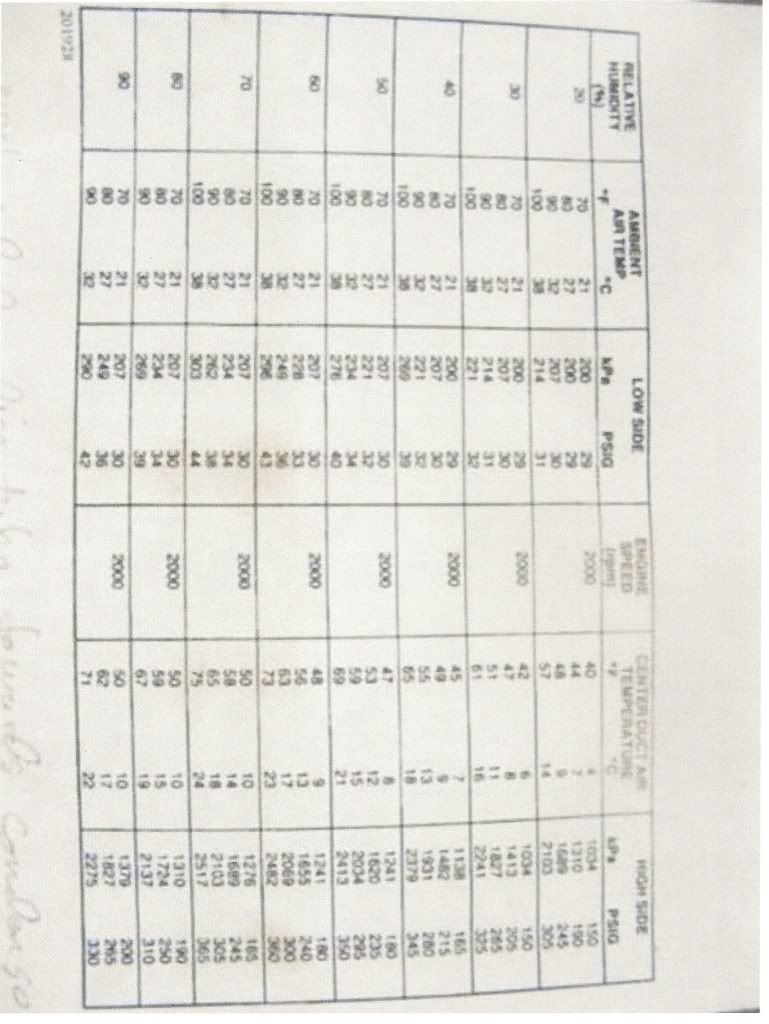
Notice that humidity has a strong effect and that all readings are taken at 2000 rpm.
Notice that humidity has a strong effect and that all readings are taken at 2000 rpm.

Melting Slicks

Joined: Jul 2006
Posts: 2,332
Likes: 31
From: Silver Spring MD
Never saw a CLAMP to puncture the side of the can - mine screws onto the top
My can tapper just screws onto the top of a R134a can not puncturing it from the side. Would think that is safer then possibly getting an explosion from poor mating surface in the side. My tapper has a wing nut piercer that punctures the metal after first screwing it onto the top of the can. Where in the world did you get that one?

Le Mans Master
Joined: Sep 2003
Posts: 8,847
Likes: 795
From: Longview Texas
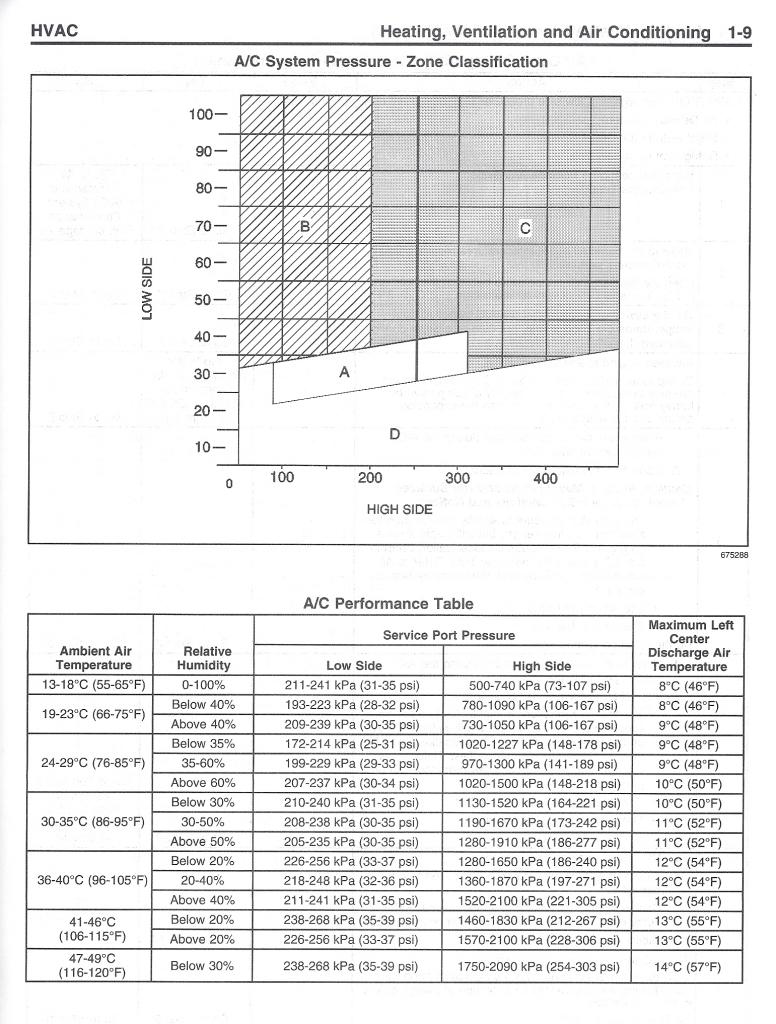
The top chart just tells you which troubleshooting procedure to use to repair a system, depending on which "zone" the high and low side pressures fall...
By the way, the outlet temperatures are with the blower on high, temp. at lowest setting, and inlet air on recirculate. I did not see that mentioned above.
Last edited by TEXHAWK0; Jul 21, 2013 at 12:38 PM.


Melting Slicks

Joined: Jan 2009
Posts: 3,275
Likes: 739
From: Miami FL
I mainly posted the temperature and pressure chart at the bottom for comparison to the general chart at the beginning of this thread.
The top chart just tells you which troubleshooting procedure to use to repair a system, depending on which "zone" the high and low side pressures fall...
By the way, the outlet temperatures are with the blower on high, temp. at lowest setting, and inlet air on recirculate. I did not see that mentioned above.
The top chart just tells you which troubleshooting procedure to use to repair a system, depending on which "zone" the high and low side pressures fall...
By the way, the outlet temperatures are with the blower on high, temp. at lowest setting, and inlet air on recirculate. I did not see that mentioned above.

Melting Slicks
Joined: Jan 2009
Posts: 3,275
Likes: 739
From: Miami FL

Do you have any recommendation?

8th Gear
Joined: Aug 2013
Posts: 8
Likes: 0
another a/c question... probably again. Lost power to A/C, radio, cigarette lighter. No fuses blown in console panel (passengers door) Heard under hood fuses/relays were near battery but can't find anything. Help please.

Burning Brakes


Joined: Jul 2013
Posts: 1,008
Likes: 57
From: Kensington MD
Resurrecting this thread again: if you hook up the manifold and get zero pressure on the gauges and no compressor activity--engine off or running--is it a fair assumption that the system is devoid of refrigerant?
Tech Contributor
Joined: Dec 1999
Posts: 32,910
Likes: 2,402
From: Anthony TX
CI 6,7,8,9,11 Vet
St. Jude Donor '08
If your Schrader fitting PINTAL valve is actually being depressed by the manifold hose connector, then the answer would be YES.
Just take a nail and quickly depress the pintal valve and see if there is pressure in the system.
Wear safety glasses and only let a very small amount out to test for pressure.
Normally if the gage says ZERO,, its ZERO..
Just take a nail and quickly depress the pintal valve and see if there is pressure in the system.
Wear safety glasses and only let a very small amount out to test for pressure.
Normally if the gage says ZERO,, its ZERO..