











Ac 101

Thread Starter
Pro


Joined: Jun 2007
Posts: 631
Likes: 3
From: Joppa AL
 Ac 101
How do tell if my AC is short on refrigerant? This question keeps coming back so I thought I would offer up my way of checking and correcting AC charge problems. First we need to determine what the correct charge looks like because the pressures vary a great deal depending on engine speed, humidity, ambient temp and some other things. Shown below is a chart I’ve used for years with some success.
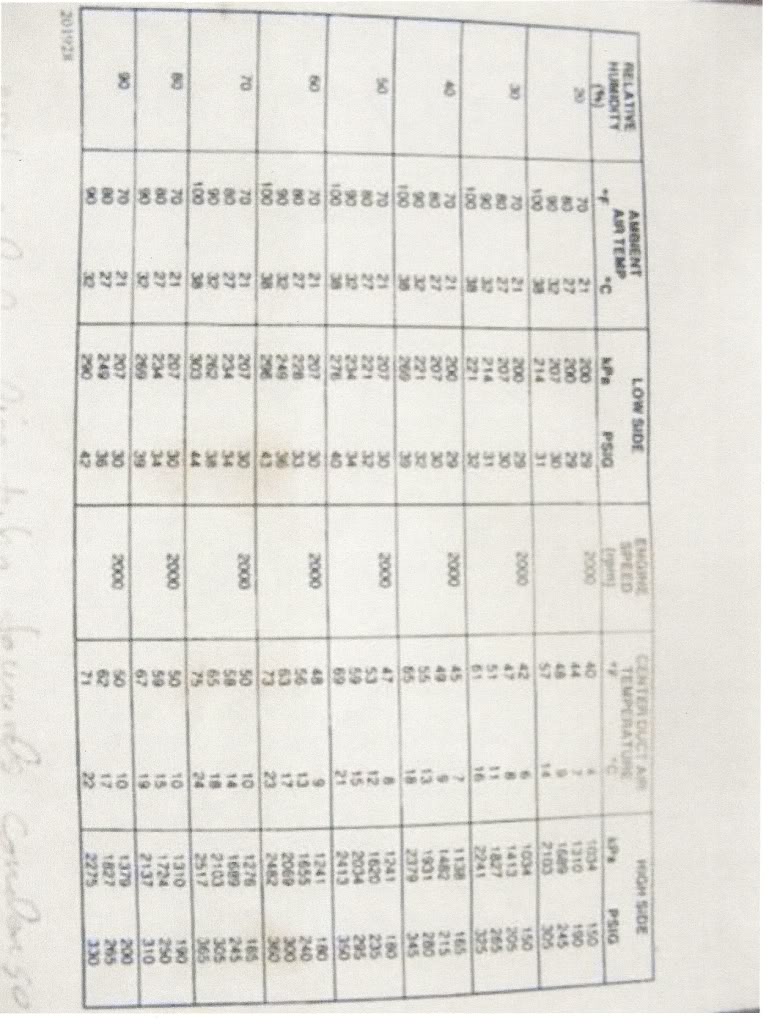
Notice that humidity has a strong effect and that all readings are taken at 2000 rpm.
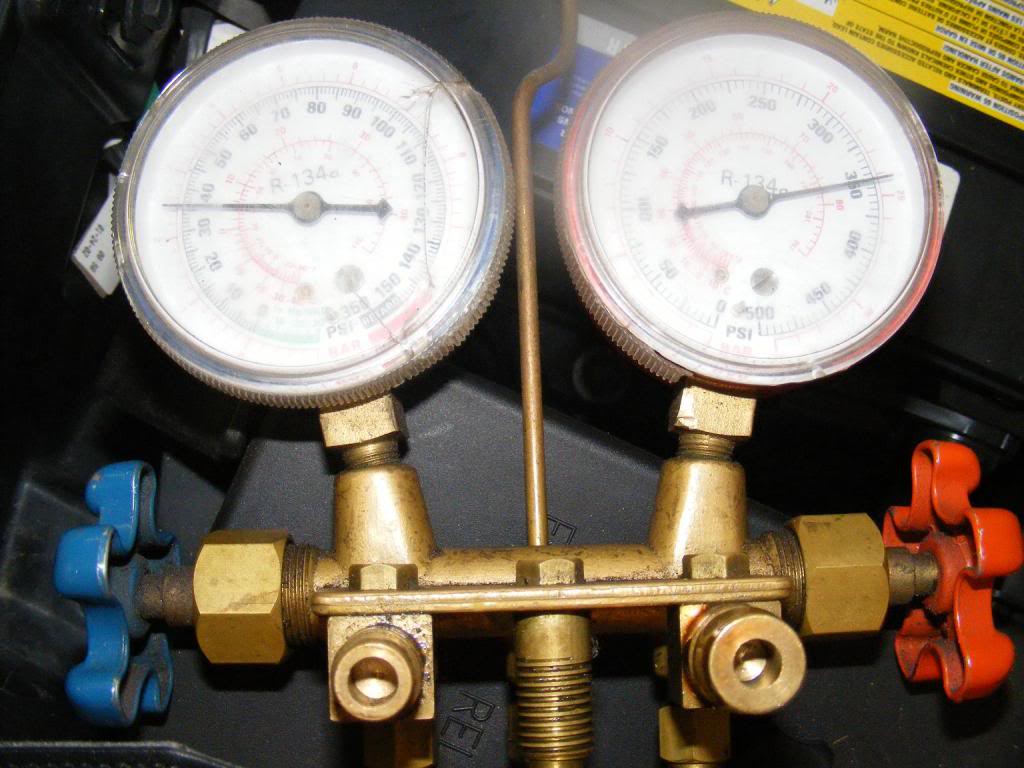
OK, how do we measure these pressures. The pic below shows the equipment needed. Yeah, I know a lot of people just use the Walmart can that reads the low side only and do fine. I just like doing it this way and the whole setup can be bought for less than $60; not big bucks for a tool nut. You don’t need one off the Snap On truck for our purposes. Look here:
http://www.harborfreight.com/cpi/cta...emnumber=92649
Don’t forget the clamp that goes around the can of R134 and punctures the side of it.
Look here: http://www.ctd4ac.com/actools6.asp
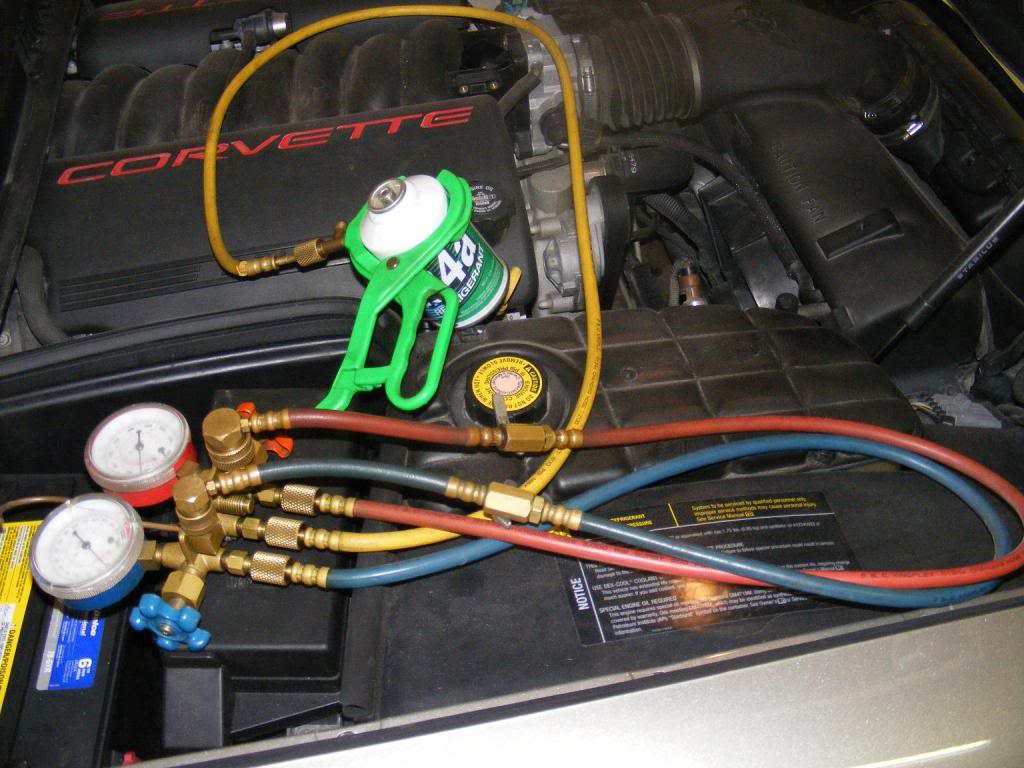
Now that we have our new toy, how do we use it? Make sure both hand wheels on the gage set are closed. Turn them clockwise until they seat. Look under the hood of your C5 on the pass side and you will see the test ports covered with a black plastic cap. Unscrew the caps and snap the gage hose connectors onto the test ports with the engine off. You cannot hook them up wrong because the low and high side test ports are different.
LOW SIDE-rear of eng compartment
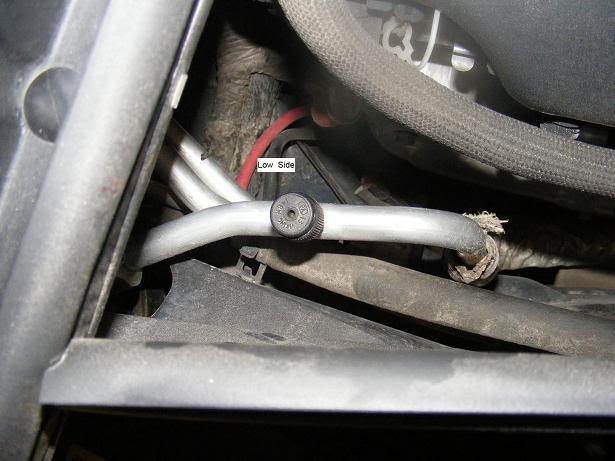
HIGH SIDE-front of eng compartment


Here the hoses are connected

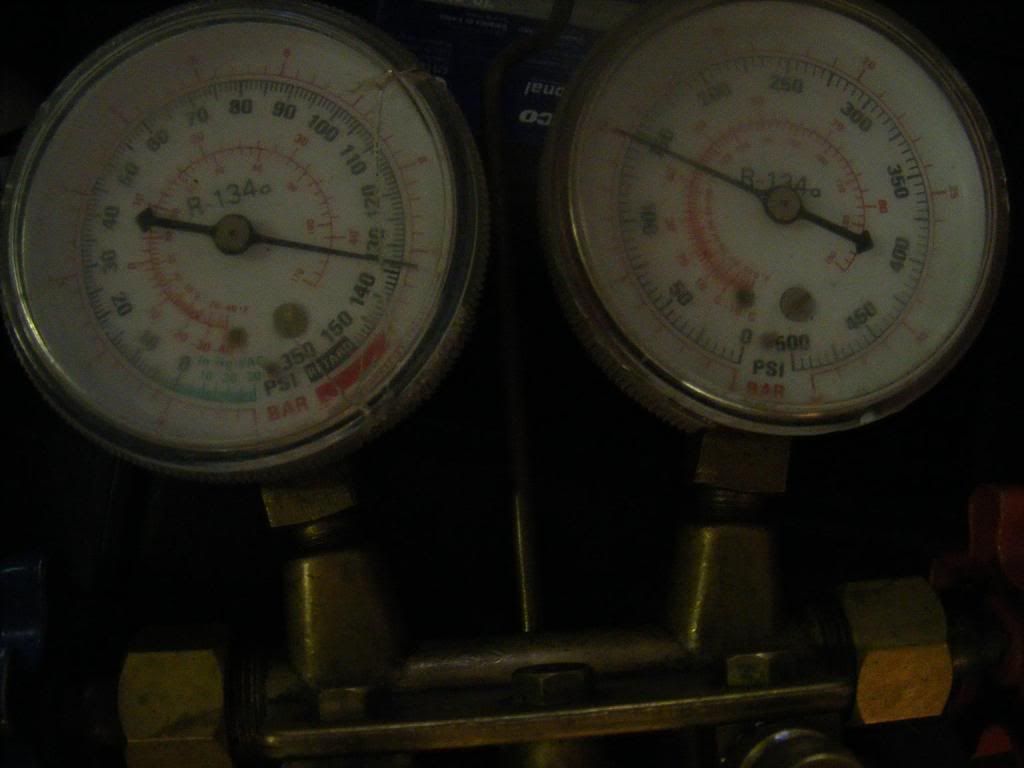
Once you’re hooked up with the eng off you are reading static pressure. It will be over 100 on both gages on a hot day. Both gages should be about the same, if not, you have other problems. The left gage is low side and the right is high side. See the pic below showing static pressure on my C5.
Now we need to start the eng, turn AC to it’s coldest setting, fastest fan speed, lower both windows and place a thermometer in the center air vent. When you start the eng the low side will start to drop and the high side will go up. If this doesn’t happen, your compressor is not working. Look at the front of the compressor to see if the clutch is turning with the rest of the pulleys. If it isn’t, and your static pressures are close to zero, the computer may have shut down the compressor to avoid damage. Disconnecting the batt cable for a few minutes will usually fix this. If that doesn’t work, your problem is beyond the scope of this post.
Below is a pic showing correct pressure, both low and high, for a 60% humidity, 100 degree day and an eng speed of 2000 rpm. You younger guys can probably find a Hooters girl to press on the gas pedal, the rest of us use a wife or grandkid. My center duct temp was 50 degrees at this point. Look at the chart above and you will see we’re OK. Actually the duct temp is much better than the chart. Score one for GM engineering (wonder if the same guys did the column lock). If this is what you see your AC is working well and you are wasting your time reading this post.
If your readings are a bit low on both gages and duct temp is too high your car is probably undercharged. Now connect your can clamp to the center hose(yellow) and clamp it around your can of R134. Then gently loosen the yellow hose connector where it attaches to the gages. When a clear or white mist comes out you have purged that line of the air in it and it is full of refrigerant. If you skip this step the air in the hose will be added to your system.
To add 134 you simply open the left hand wheel gently. Do not touch the right hand wheel. Keep the high side closed. You should now see the low side pressure increase because we have connected the can to the system and it will typically have up to 90 psi on a warm day. Make sure you keep the can sitting on its base to keep from pumping liquid into the system. The compressor cannot deal with liquid very well. Allow the 134 time to enter the system while you periodically close the left hand valve to get an accurate reading of the low side pressure without the pressure of the can being involved. While you’re doing this keep an eye on the high side gage (RH) and do not allow it to exceed the chart pressure. There are few things in life more exciting than blowing an AC hose with your head under the hood. Don’t ask me how I know this.
When both low and high side readings approximate the chart your center duct temp should match or be lower than the chart . Close the left hand valve, shut down the engine, remove your gages and replace the caps on the test ports. You are now a highly skilled AC technician and may want to open your own business.
A NOTE ABOUT LEAKS. If you used half a can(6 oz) you have replaced 20% of the total system charge. If that amount leaked out over a period of 5 years don’t waste your time trying to find the leak. Just plan on recharging in another 5 years. If, on the other hand, you just added refrigerant a month ago you need to find and fix the leak or adding refrig will be a monthly service.
This isn’t a Bible. There are different ways to go about this. It’s just the way I do it and it’s always worked well for me. Some people are intimidated by AC repair. It’s a whole lot simpler than some of the stuff I read on this forum. Heck, we’ve got guys here who could repair their PCM with bubble gum and baling wire alongside the road at night! Give this a try, you might like it!
Notice that humidity has a strong effect and that all readings are taken at 2000 rpm.
OK, how do we measure these pressures. The pic below shows the equipment needed. Yeah, I know a lot of people just use the Walmart can that reads the low side only and do fine. I just like doing it this way and the whole setup can be bought for less than $60; not big bucks for a tool nut. You don’t need one off the Snap On truck for our purposes. Look here:
http://www.harborfreight.com/cpi/cta...emnumber=92649
Don’t forget the clamp that goes around the can of R134 and punctures the side of it.
Look here: http://www.ctd4ac.com/actools6.asp
Now that we have our new toy, how do we use it? Make sure both hand wheels on the gage set are closed. Turn them clockwise until they seat. Look under the hood of your C5 on the pass side and you will see the test ports covered with a black plastic cap. Unscrew the caps and snap the gage hose connectors onto the test ports with the engine off. You cannot hook them up wrong because the low and high side test ports are different.
LOW SIDE-rear of eng compartment
HIGH SIDE-front of eng compartment
Here the hoses are connected
Once you’re hooked up with the eng off you are reading static pressure. It will be over 100 on both gages on a hot day. Both gages should be about the same, if not, you have other problems. The left gage is low side and the right is high side. See the pic below showing static pressure on my C5.
Now we need to start the eng, turn AC to it’s coldest setting, fastest fan speed, lower both windows and place a thermometer in the center air vent. When you start the eng the low side will start to drop and the high side will go up. If this doesn’t happen, your compressor is not working. Look at the front of the compressor to see if the clutch is turning with the rest of the pulleys. If it isn’t, and your static pressures are close to zero, the computer may have shut down the compressor to avoid damage. Disconnecting the batt cable for a few minutes will usually fix this. If that doesn’t work, your problem is beyond the scope of this post.
Below is a pic showing correct pressure, both low and high, for a 60% humidity, 100 degree day and an eng speed of 2000 rpm. You younger guys can probably find a Hooters girl to press on the gas pedal, the rest of us use a wife or grandkid. My center duct temp was 50 degrees at this point. Look at the chart above and you will see we’re OK. Actually the duct temp is much better than the chart. Score one for GM engineering (wonder if the same guys did the column lock). If this is what you see your AC is working well and you are wasting your time reading this post.
If your readings are a bit low on both gages and duct temp is too high your car is probably undercharged. Now connect your can clamp to the center hose(yellow) and clamp it around your can of R134. Then gently loosen the yellow hose connector where it attaches to the gages. When a clear or white mist comes out you have purged that line of the air in it and it is full of refrigerant. If you skip this step the air in the hose will be added to your system.
To add 134 you simply open the left hand wheel gently. Do not touch the right hand wheel. Keep the high side closed. You should now see the low side pressure increase because we have connected the can to the system and it will typically have up to 90 psi on a warm day. Make sure you keep the can sitting on its base to keep from pumping liquid into the system. The compressor cannot deal with liquid very well. Allow the 134 time to enter the system while you periodically close the left hand valve to get an accurate reading of the low side pressure without the pressure of the can being involved. While you’re doing this keep an eye on the high side gage (RH) and do not allow it to exceed the chart pressure. There are few things in life more exciting than blowing an AC hose with your head under the hood. Don’t ask me how I know this.
When both low and high side readings approximate the chart your center duct temp should match or be lower than the chart . Close the left hand valve, shut down the engine, remove your gages and replace the caps on the test ports. You are now a highly skilled AC technician and may want to open your own business.
A NOTE ABOUT LEAKS. If you used half a can(6 oz) you have replaced 20% of the total system charge. If that amount leaked out over a period of 5 years don’t waste your time trying to find the leak. Just plan on recharging in another 5 years. If, on the other hand, you just added refrigerant a month ago you need to find and fix the leak or adding refrig will be a monthly service.
This isn’t a Bible. There are different ways to go about this. It’s just the way I do it and it’s always worked well for me. Some people are intimidated by AC repair. It’s a whole lot simpler than some of the stuff I read on this forum. Heck, we’ve got guys here who could repair their PCM with bubble gum and baling wire alongside the road at night! Give this a try, you might like it!
Last edited by Plasticfan; Jun 13, 2012 at 05:10 PM. Reason: restore pics

Team Owner

Joined: May 2001
Posts: 36,836
Likes: 244
From: Dear Karma, I have a list of people you missed.
St. Jude Donor '08-'09-'10-'11-'12-'13-'14-'15-'16
Nice post Don. Straight and to the point. 
I agree with you that gauges can be had relatively inexpensively and I got a set at auto-zone for something in the $30-$40 range IIRC.
With a few basic items, a few minutes of reading and then applying common sense, I think many can do this quite easily. Personally, I generally stay away from places like Harbor Freight since so much of what they sell is junk, not to mention the whole return by mail factor if dissatisfied, etc.
Although I do prefer the Hooter's girl method of throttle control, I have found that if you're by yourself, you can also place the gauges (depending on the length of the hoses) in a much closer proximity to the windshield so you can see them while sitting behind the wheel.

Robert
I agree with you that gauges can be had relatively inexpensively and I got a set at auto-zone for something in the $30-$40 range IIRC.
With a few basic items, a few minutes of reading and then applying common sense, I think many can do this quite easily. Personally, I generally stay away from places like Harbor Freight since so much of what they sell is junk, not to mention the whole return by mail factor if dissatisfied, etc.
Although I do prefer the Hooter's girl method of throttle control, I have found that if you're by yourself, you can also place the gauges (depending on the length of the hoses) in a much closer proximity to the windshield so you can see them while sitting behind the wheel.
Robert

Melting Slicks


Joined: Sep 2004
Posts: 3,024
Likes: 18
From: DFW Texas
Great Post - luv it when someone documents a good DIY guide on how to do things with confidence.
Question though...
Got a car that blows out hot air only. The A/C compressor kicks on for about 1 second, then kicks off. Stays off for a minute or so, then same thing...kicks in, then immediately off again.
The low pressure side (on one of those charge hoses - not full gage set) shows it very high in the red. Over the course of about a half hour, I was able to get it to finally suck in most of the can of refrigerant. Now pressure is even HIGHER in the red, but does come down a little for that breif moment the compressor kicks in.
So, what to do? Hot air still blowing out of vents and compressor still only kicks in breifly then off again.
Ideas?
Question though...
Got a car that blows out hot air only. The A/C compressor kicks on for about 1 second, then kicks off. Stays off for a minute or so, then same thing...kicks in, then immediately off again.
The low pressure side (on one of those charge hoses - not full gage set) shows it very high in the red. Over the course of about a half hour, I was able to get it to finally suck in most of the can of refrigerant. Now pressure is even HIGHER in the red, but does come down a little for that breif moment the compressor kicks in.
So, what to do? Hot air still blowing out of vents and compressor still only kicks in breifly then off again.
Ideas?
Corvette Stories
The Best of Corvette for Corvette Enthusiasts

Every 2027 Corvette Engine Explained
Joe Kucinski
Designer Imagines A Corvette That Looks More Like a Corvette Than the Corvette
Verdad Gallardo
10 Ugly Corvettes That We Still Kinda Love
Joe Kucinski
Top 10 Most Expensive Corvettes Ever Sold on Bring A Trailer
Brett Foote
10 Things Every Corvette Owner Needs (2026 Edition)
Michael S. Palmer
8 Most "Only Corvette Owners Understand" Quirks and Problems
Pouria Savadkouei
10 Reasons the C6 Z06 is Still A Performance Benchmark After 20 Years
Joe Kucinski
How Much Horsepower Every Corvette Engine "LOST" in 1972
Joe Kucinski
Top 10 DOs and DON'Ts for Protecting Your Convertible Top!
Michael S. Palmer
Race Director


Joined: Jun 2005
Posts: 17,640
Likes: 1
From: Lenoir City TN
St. Jude Donor '08-'09-'10-'11
Great Post - luv it when someone documents a good DIY guide on how to do things with confidence.
Question though...
Got a car that blows out hot air only. The A/C compressor kicks on for about 1 second, then kicks off. Stays off for a minute or so, then same thing...kicks in, then immediately off again.
The low pressure side (on one of those charge hoses - not full gage set) shows it very high in the red. Over the course of about a half hour, I was able to get it to finally suck in most of the can of refrigerant. Now pressure is even HIGHER in the red, but does come down a little for that breif moment the compressor kicks in.
So, what to do? Hot air still blowing out of vents and compressor still only kicks in breifly then off again.
Ideas?
Question though...
Got a car that blows out hot air only. The A/C compressor kicks on for about 1 second, then kicks off. Stays off for a minute or so, then same thing...kicks in, then immediately off again.
The low pressure side (on one of those charge hoses - not full gage set) shows it very high in the red. Over the course of about a half hour, I was able to get it to finally suck in most of the can of refrigerant. Now pressure is even HIGHER in the red, but does come down a little for that breif moment the compressor kicks in.
So, what to do? Hot air still blowing out of vents and compressor still only kicks in breifly then off again.
Ideas?
Well w/o seeing the the pressures the system is either overcharged or undercharged. These scenarios are classic with clutch sort cycling. With you saying the pressure is in the red I would say overcharged.
Thread Starter
Pro
Joined: Jun 2007
Posts: 631
Likes: 3
From: Joppa AL
 We need to know the high side pressure on this one. It certainly sounds overcharged.


Race Director
Joined: Jun 2005
Posts: 17,640
Likes: 1
From: Lenoir City TN
St. Jude Donor '08-'09-'10-'11
Temp Chart
or easier
easier chart
Last edited by Bob CTS; Aug 31, 2007 at 10:33 PM. Reason: easier chart

Thread Starter
Pro
Joined: Jun 2007
Posts: 631
Likes: 3
From: Joppa AL
 Since C5's don't use Muncies I did the AC.

Tech Contributor


Joined: Dec 1999
Posts: 32,910
Likes: 2,402
From: Anthony TX
CI 6,7,8,9,11 Vet
St. Jude Donor '08
Don
I'm a self taught mechanic. I am very good at applying theory to practice and had to learn AC theory and AC System repair out of necessity many years ago. Being in the Navy and being exposed to submarine issues, C5 issues seem minor compared to the BIG units.
Your post was very informative and makes it easy for others to understand. Wish I would had something like that the very first time I cracked an AC system open!
I have never been to any mechanical repair or automotive repair schools. I have been to electronics schools in high school and in the Navy. Again electronics theory to practice comes easy for me! It's my cross word puzzle.
Again, SUPERB Post!
Bill C
BC
I'm a self taught mechanic. I am very good at applying theory to practice and had to learn AC theory and AC System repair out of necessity many years ago. Being in the Navy and being exposed to submarine issues, C5 issues seem minor compared to the BIG units.
Your post was very informative and makes it easy for others to understand. Wish I would had something like that the very first time I cracked an AC system open!
I have never been to any mechanical repair or automotive repair schools. I have been to electronics schools in high school and in the Navy.
Again electronics theory to practice comes easy for me! It's my cross word puzzle.Again, SUPERB Post!
Bill C
BC

Melting Slicks
Joined: Feb 2006
Posts: 3,400
Likes: 3
From: Sarasota Florida
Don
I'm a self taught mechanic. I am very good at applying theory to practice and had to learn AC theory and AC System repair out of necessity many years ago. Being in the Navy and being exposed to submarine issues, C5 issues seem minor compared to the BIG units.
Your post was very informative and makes it easy for others to understand. Wish I would had something like that the very first time I cracked an AC system open!
I have never been to any mechanical repair or automotive repair schools. I have been to electronics schools in high school and in the Navy. Again electronics theory to practice comes easy for me! It's my cross word puzzle.
Again, SUPERB Post!
Bill C
BC
I'm a self taught mechanic. I am very good at applying theory to practice and had to learn AC theory and AC System repair out of necessity many years ago. Being in the Navy and being exposed to submarine issues, C5 issues seem minor compared to the BIG units.
Your post was very informative and makes it easy for others to understand. Wish I would had something like that the very first time I cracked an AC system open!
I have never been to any mechanical repair or automotive repair schools. I have been to electronics schools in high school and in the Navy.
Again electronics theory to practice comes easy for me! It's my cross word puzzle.Again, SUPERB Post!
Bill C
BC
if Bill says it is a keeper then it is going into my "favorites" for the day I need it......thanks