

4 post help

Thread Starter
Racer

Joined: Mar 2005
Posts: 314
Likes: 0
From: Mile Hi Colorado
 4 post help
Looking at getting a new 4-post lift. Anyone know the minium, or "workable" ceiling height of the garage. Any recomandations. Mine is 9`6" to the ceiling. Will this give me space for my CTS below? Thanks.

Melting Slicks


Joined: Aug 2007
Posts: 2,123
Likes: 2
From: Humble TX
St. Jude Donor '09-'10-'11-'12
Sounds like there are plenty of lifts that will clear that height, the question is how high you'll be able to lift your car. Check the overall height of car, pretty easy to figure out how high you'll be able to lift it and what it'll leave to slide around underneath on a stool on wheels maybe.

Racer

Joined: Dec 2005
Posts: 474
Likes: 3
From: Chandler Arizona
That will be tight but it might work. My ceiling is the same height and I am able to stack 2 corvettes with extra room. The rule of thumb is the height of the 2 vehicles plus the height of your runways (usually about 4 inches) plus another 2-4 inches to raise the lift to get it off the locks.
You will probably need to get the garage door raised to hug the ceiling. This is what I had to do as well.
You will probably need to get the garage door raised to hug the ceiling. This is what I had to do as well.

Race Director

Joined: Jan 2006
Posts: 10,554
Likes: 33
From: Not on either liberal coast.
Depending on your depth of garage/shop, you may have to close your garage/shop bay door to allow for maximum height with a vehicle on the lift. I've been there, done that. It was poor planning on my part. In my new garage/shop, I planned better with 33 ft depth x 55 ft width. 

Burning Brakes

Joined: Nov 2006
Posts: 810
Likes: 0
From: Coulmbia New Jersey

I have a ceiling of 10'6" and a Back Yard Buddy
It's going to be very close. Is there a way you can pocket the ceiling over the car?
Remember you need to raise the car up to the lock point of the lift then lower it back down a couple of inches.
Dave
Last edited by CTSV OWNER; Nov 21, 2007 at 07:49 PM.

Team Owner


Joined: Sep 2001
Posts: 23,283
Likes: 906
From: Lake Elsinore, CA
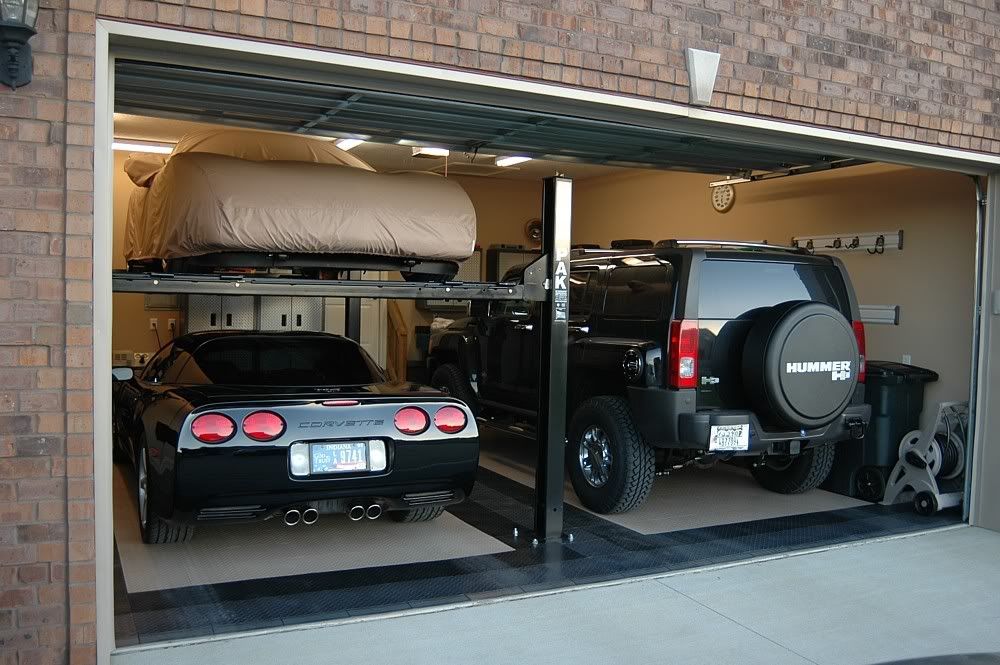
My ceiling is 10 feet high and I park one C5 under and one C5 on the lift.


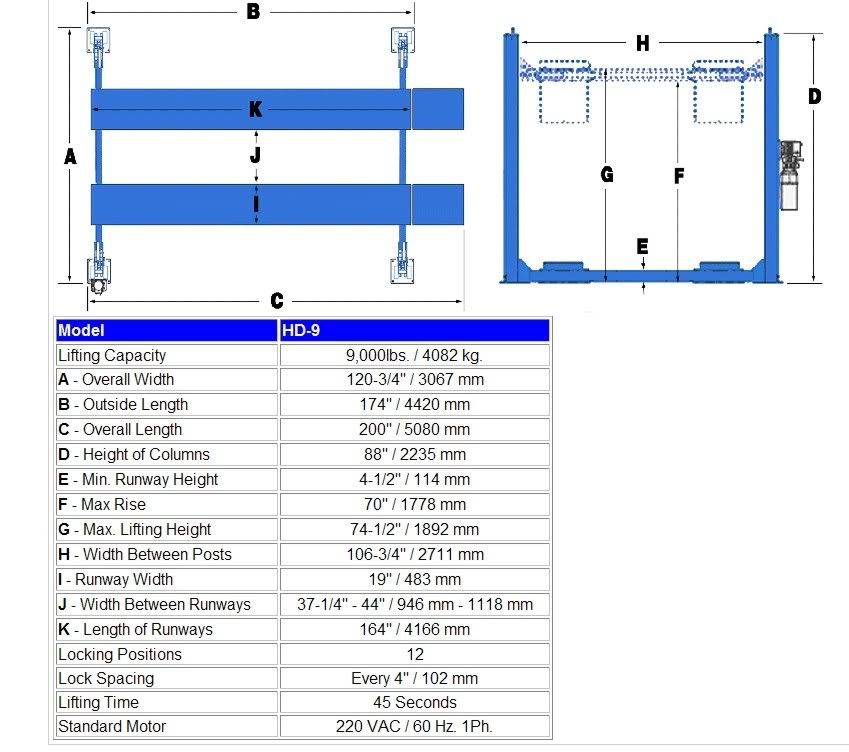
Here are my lift's dimensions.
Here are a couple of threads I posted on my Bend Pak HD-9 installation.
http://forums.corvetteforum.com/show....php?t=1468748
http://forums.corvetteforum.com/show....php?t=1470876
I will only speak to the two types / brands of 4-post lift I am most familiar with - the AutoLifters which a friend of mine owned (AL now out of business but being produced by former AL employees - same design as the BYB) and the Bend Pak HD-9 I currently own. I spent many a weekend under the AutoLifters (7K lb. cap.) over a few years and have owned my HD-9 (9K lb. cap.) for less than a year.
The AL uses the fully boxed post section with collar-style crossbeam ends while the BP has a C-channel post design with internal runners that slide on ladder locks suspended from the top caps.
There seems to be a perception that the C-channels can spread under load, but that's not how these lifts work. There is virtually no side load on the posts and certainly nothing to splay the channels apart during raising or lowering. Basically, they are cable and pulley systems with crossbeam and column supports to manage the transmitted loads. What's important is that the members remain stationary (rigid) and no one corner binds - or lets loose - during the lifting or lowering process, destabilizing the equilibrium enough to allow one of the posts to tip too far.
The posts can actually tilt in/out a certain amount without destabilizing the lift and toppling it. I've seen this happen twice in person - once on the AL lift when one of the manual lever-actuated locks didn't engage while lowering and the other the first time I actuated my BP and one of the cables was still too loose. Both times, the tilt in the post was completely recoverable because the lift was not allowed to travel beyond one lock level. Remember that the entire mechanism is tied together with a tensioned cable system and tends to want to stay tied together rather than spread out.
I have noticed that neither design has more tendency for the corner attachments to decouple from the post or allow post tilt. Both designs are quite secure. What I have noted are the differences in lock designs which is the reason I went with my BP. The BP has a double lock system - the first is a pneumatically-actuated, "normally-closed" set of ladder locks. These are the primaries and the only way for these to allow the lift to lower is to keep one's hand on the release button and hydraulic release continuously and simultaneously until the lowest lock is passed.
The secondary, "slack-cable" set of locks are purely for safety. Should a cable break or go slack for any reason, that corner lock will release and automatically lock into the next detent, not allowing that corner to drop uncontrolled. This was the failure suffered recently by an AL lift with pictures posted here.
http://forums.corvetteforum.com/show...ht=autolifters
I'll qualify that link by saying that could have been prevented with proper maintenance and replacement of a faulty pulley setup that the manufacturer warned of. But it does illustrate that, ultimately, it's up to the owner/operator to safely install, maintain and operate his lift.
Also, high quality components and construction are vital when weighing the issues of cost and safety. My Bend Pak is made in America with solid engineering backed by decades of commercial lift design and construction, high-strength, high-quality components and great workmanship, including beautiful welds. The cost was comparable to it's competitors too.
I spent a lot of time researching lifts before ordering mine and I still believe I'd make the same choice today that I did when I chose the BP. Others have their own thoughts and opinions - and requirements. My decision was between the All American, the Revolution (Rotary), the Backyard Buddy and Bend Pak. Cost was not the primary factor, safety was. Check all the certification and testing that a manufacturer does on it's lifts - that alone is a very educational process.
Whatever your choice is, have a healthy respect for the potentially dangerous piece of heavy equipment that a lift is. Safety should be foremost on your mind always when working around a lift. That behavior alone should keep it a safe and fun piece of equipment to own.
As always, this is JMHO.
My buddy's AutoLifters. Note the collar-style beam ends.

The channel and ladder setup on my HD-9. You can see the air-cylinder-enabled main lock and the spring/lever pulley secondary safety.

I recently lubed and retensioned the cables during maintenance. It's important to frequently inspect all the lifts components and assess their condition.
Here are my lift's dimensions.
Here are a couple of threads I posted on my Bend Pak HD-9 installation.
http://forums.corvetteforum.com/show....php?t=1468748
http://forums.corvetteforum.com/show....php?t=1470876
I will only speak to the two types / brands of 4-post lift I am most familiar with - the AutoLifters which a friend of mine owned (AL now out of business but being produced by former AL employees - same design as the BYB) and the Bend Pak HD-9 I currently own. I spent many a weekend under the AutoLifters (7K lb. cap.) over a few years and have owned my HD-9 (9K lb. cap.) for less than a year.
The AL uses the fully boxed post section with collar-style crossbeam ends while the BP has a C-channel post design with internal runners that slide on ladder locks suspended from the top caps.
There seems to be a perception that the C-channels can spread under load, but that's not how these lifts work. There is virtually no side load on the posts and certainly nothing to splay the channels apart during raising or lowering. Basically, they are cable and pulley systems with crossbeam and column supports to manage the transmitted loads. What's important is that the members remain stationary (rigid) and no one corner binds - or lets loose - during the lifting or lowering process, destabilizing the equilibrium enough to allow one of the posts to tip too far.
The posts can actually tilt in/out a certain amount without destabilizing the lift and toppling it. I've seen this happen twice in person - once on the AL lift when one of the manual lever-actuated locks didn't engage while lowering and the other the first time I actuated my BP and one of the cables was still too loose. Both times, the tilt in the post was completely recoverable because the lift was not allowed to travel beyond one lock level. Remember that the entire mechanism is tied together with a tensioned cable system and tends to want to stay tied together rather than spread out.
I have noticed that neither design has more tendency for the corner attachments to decouple from the post or allow post tilt. Both designs are quite secure. What I have noted are the differences in lock designs which is the reason I went with my BP. The BP has a double lock system - the first is a pneumatically-actuated, "normally-closed" set of ladder locks. These are the primaries and the only way for these to allow the lift to lower is to keep one's hand on the release button and hydraulic release continuously and simultaneously until the lowest lock is passed.
The secondary, "slack-cable" set of locks are purely for safety. Should a cable break or go slack for any reason, that corner lock will release and automatically lock into the next detent, not allowing that corner to drop uncontrolled. This was the failure suffered recently by an AL lift with pictures posted here.
http://forums.corvetteforum.com/show...ht=autolifters
I'll qualify that link by saying that could have been prevented with proper maintenance and replacement of a faulty pulley setup that the manufacturer warned of. But it does illustrate that, ultimately, it's up to the owner/operator to safely install, maintain and operate his lift.
Also, high quality components and construction are vital when weighing the issues of cost and safety. My Bend Pak is made in America with solid engineering backed by decades of commercial lift design and construction, high-strength, high-quality components and great workmanship, including beautiful welds. The cost was comparable to it's competitors too.
I spent a lot of time researching lifts before ordering mine and I still believe I'd make the same choice today that I did when I chose the BP. Others have their own thoughts and opinions - and requirements. My decision was between the All American, the Revolution (Rotary), the Backyard Buddy and Bend Pak. Cost was not the primary factor, safety was. Check all the certification and testing that a manufacturer does on it's lifts - that alone is a very educational process.
Whatever your choice is, have a healthy respect for the potentially dangerous piece of heavy equipment that a lift is. Safety should be foremost on your mind always when working around a lift. That behavior alone should keep it a safe and fun piece of equipment to own.
As always, this is JMHO.
My buddy's AutoLifters. Note the collar-style beam ends.
The channel and ladder setup on my HD-9. You can see the air-cylinder-enabled main lock and the spring/lever pulley secondary safety.
I recently lubed and retensioned the cables during maintenance. It's important to frequently inspect all the lifts components and assess their condition.
Last edited by Patches; Nov 22, 2007 at 09:06 AM.

Le Mans Master


Joined: Feb 2003
Posts: 6,369
Likes: 73
From: The line waiting to see Santa Claus stretched all the way back to Terre Haute, and I was at the end, Indiana
St. Jude Donor '08-'09-'10-'11-'12-'13-'14-'15-'16-'17-'18
My ceilings are 11.5'. Relocating the garage door tracks gave me 10'4" of useable height. I have about 5.5' clearance under the deck with a Corvette on it. The rule of thumb is height of each car + 4" (ramp ht) + 6" (lock/travel).
My wife's CTS is approximately 60" tall, my C5 is 48", my 64 is 55" (top up, 53" top down).
Garage door/tracks relocated

Plenty of clearance for 2 Vettes

My wife's CTS is approximately 60" tall, my C5 is 48", my 64 is 55" (top up, 53" top down).
Garage door/tracks relocated
Plenty of clearance for 2 Vettes
Corvette Stories
The Best of Corvette for Corvette Enthusiasts

Top 10 Most Expensive Corvettes Ever Sold on Bring A Trailer
Brett Foote
10 Things Every Corvette Owner Needs (2026 Edition)
Michael S. Palmer
8 Most "Only Corvette Owners Understand" Quirks and Problems
Pouria Savadkouei
10 Reasons the C6 Z06 is Still A Performance Benchmark After 20 Years
Joe Kucinski
How Much Horsepower Every Corvette Engine "LOST" in 1972
Joe Kucinski
Top 10 DOs and DON'Ts for Protecting Your Convertible Top!
Michael S. Palmer
Top 10 Most Explosive Corvettes Ever Made: Power-to-Weight Ratio Ranked!
Joe Kucinski
150 hp to 1,250 hp: Every Corvette Generation Compared by the Specs That Matter
Joe Kucinski