When you click on links to various merchants on this site and make a purchase, this can result in this site earning a commission. Affiliate programs and affiliations include, but are not limited to, the eBay Partner Network.
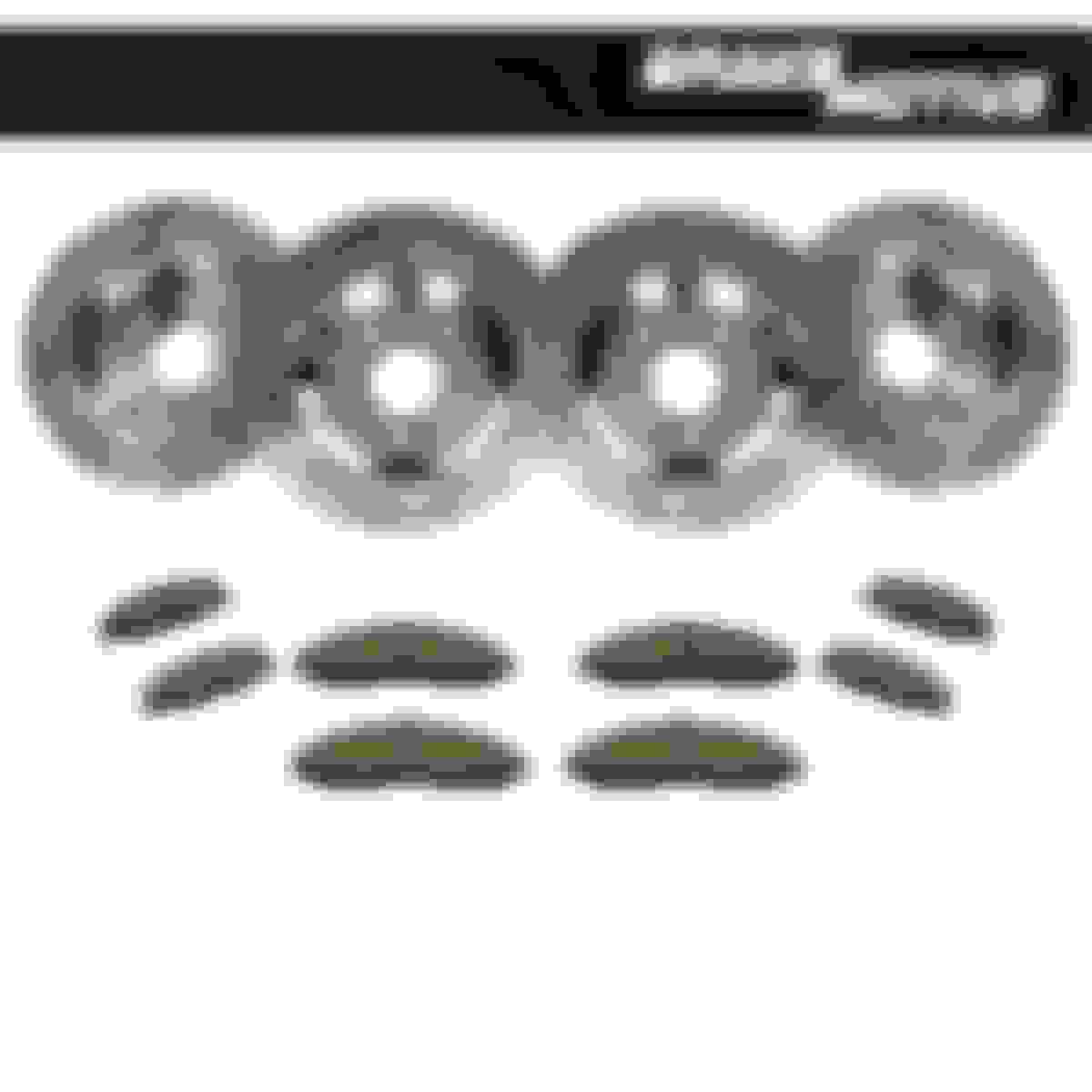
Anyone use these brakes & rotors? If so, what are your thoughts? Not going to be used for track purposes, but looking for an improvement over my stock brakes for some spirited driving in the hills as well as being quiet, predictable with low to no dust on my wheels.
I have no experience with the ones you posted but for exactly half the price you can get Brake Motive's set. Nothing but good reviews on the forum if you do a forum search.
I personally would never pay money for drilled rotors - they look nice, but they offer no advantage and only disadvantage (they love to crack when driven hard.) Much less of an issue off-track than on-track, but still.
Regardless, if what you are looking for is no track time and only spirited drives, my experience is that you can easily get away with the cheapest setup that is considered reputable by folk (forum folk, your favorite trusted mechanic, etc.) You're simply not going to cook a stock or stock-like setup on the street without really, really driving like an insane person.
In virtually all street-driven cases, the tire is what allows you to brake harder or accelerate harder. Your stock brake system will, unless completely worn, allow you to lock up your wheels (or rather, activate ABS). That means that the limit isn't in the brakes, it's in the tires and your driving.
With that said, for brake pads, you have three main characteristics: stopping performance over a temperature range (cold, warm, hot - and how hot is hot?), dust, and noise. You also have a characteristic of how nicely the pads play with the iron rotor (read: how fast they grind through it.)
Noise has two components: the screech of the brake pad material against the rotor, and the vibration of the rotor against the caliper piston. The latter is solved with brake-quiet on the backing pad, done. (Plus make sure to use brake grease to lube not just the slide pins, but also the rails on which the brake pad moves back and forth.) Virtually no street pads will screech against the rotor, they only start doing so when you go to a street-track-style or a track-style pad (or when a street pad gets really hot.) So you just get any ol' pad and be happy.
Brake dust is, well, brake dust. Your basic pad usually won't dust as much. The OEM stuff, the brake-motive stuff, the power-stop stuff, they all dust to some degree, but not too much in comparison to more aggressive pads.
Similarly, street pads will almost always play real nice with your rotors.
The only thing left is hot performance. A basic street pad works great cold, warm, and kinda hot, but between the standard DOT3 fluid and a street pad, it won't work when properly hot. The good news is that, again, unless you drive like a real a-hole, you won't ever get your brakes that hot on the street. You can street-drive a 500whp C5 on stock brakes with no issue.
So when you say your goals are to have a brake kit that lets you drive in a more spirited fashion, I'm gonna say, keep it simple: save some money and just get tires that can handle your needs. Your stock brakes will work fine, as will inexpensive stock-ish setups, both like what you found and what has already been recommended.
Looking for an upgrade? Use a DOT4+ fluid (Motul 5.1 is affordable and easy to find), and go for a more aggressive street setup (eg, Hawk HPS 5.0), and wash your wheels regularly, because pretty much all upgrades to pads over stock performance will dust. Anything beyond just more aggressive but street-oriented pads-and-fluid is overkill for the street.
I personally would never pay money for drilled rotors - they look nice, but they offer no advantage and only disadvantage (they love to crack when driven hard.) Much less of an issue off-track than on-track, but still.
Regardless, if what you are looking for is no track time and only spirited drives, my experience is that you can easily get away with the cheapest setup that is considered reputable by folk (forum folk, your favorite trusted mechanic, etc.) You're simply not going to cook a stock or stock-like setup on the street without really, really driving like an insane person.
In virtually all street-driven cases, the tire is what allows you to brake harder or accelerate harder. Your stock brake system will, unless completely worn, allow you to lock up your wheels (or rather, activate ABS). That means that the limit isn't in the brakes, it's in the tires and your driving.
With that said, for brake pads, you have three main characteristics: stopping performance over a temperature range (cold, warm, hot - and how hot is hot?), dust, and noise. You also have a characteristic of how nicely the pads play with the iron rotor (read: how fast they grind through it.)
Noise has two components: the screech of the brake pad material against the rotor, and the vibration of the rotor against the caliper piston. The latter is solved with brake-quiet on the backing pad, done. (Plus make sure to use brake grease to lube not just the slide pins, but also the rails on which the brake pad moves back and forth.) Virtually no street pads will screech against the rotor, they only start doing so when you go to a street-track-style or a track-style pad (or when a street pad gets really hot.) So you just get any ol' pad and be happy.
Brake dust is, well, brake dust. Your basic pad usually won't dust as much. The OEM stuff, the brake-motive stuff, the power-stop stuff, they all dust to some degree, but not too much in comparison to more aggressive pads.
Similarly, street pads will almost always play real nice with your rotors.
The only thing left is hot performance. A basic street pad works great cold, warm, and kinda hot, but between the standard DOT3 fluid and a street pad, it won't work when properly hot. The good news is that, again, unless you drive like a real a-hole, you won't ever get your brakes that hot on the street. You can street-drive a 500whp C5 on stock brakes with no issue.
So when you say your goals are to have a brake kit that lets you drive in a more spirited fashion, I'm gonna say, keep it simple: save some money and just get tires that can handle your needs. Your stock brakes will work fine, as will inexpensive stock-ish setups, both like what you found and what has already been recommended.
Looking for an upgrade? Use a DOT4+ fluid (Motul 5.1 is affordable and easy to find), and go for a more aggressive street setup (eg, Hawk HPS 5.0), and wash your wheels regularly, because pretty much all upgrades to pads over stock performance will dust. Anything beyond just more aggressive but street-oriented pads-and-fluid is overkill for the street.
Mostly agreed here but I'm not so sure the stock brakes would lock up the wheels at higher speeds? I imagine this is where the larger brake kits would offer an advantage on the street as well as track. Thoughts?
I have no experience with the ones you posted but for exactly half the price you can get Brake Motive's set. Nothing but good reviews on the forum if you do a forum search.
Mostly agreed here but I'm not so sure the stock brakes would lock up the wheels at higher speeds? I imagine this is where the larger brake kits would offer an advantage on the street as well as track. Thoughts?
Absolutely, stock brakes will let you activate ABS with a proper stab of the brake pedal. In all cars, stock brakes should be able to overpower both the tires during driving, and the engine in a runaway-engine situation, if fully applied.
I upgraded from a stock brake setup, to a stock-size brake setup (DBA blanks) with Hawk HPS 5.0 pads, to a big brake kit (Wilwood Aero6/Aero4 calipers with 14.25"/14.00" two-piece rotors, retaining parking brake) and between those three, there were zero differences on the street. I am not a good enough driver to have felt any handling differences - the big brakes are heavier, the forged aluminum calipers are lighter, I suspect a better driver may have been able to tell that it handles slightly worse due to the higher unsprung rotating mass - but as far as braking goes, they all felt completely stock at street speeds.
Also, completely stock feeling at autocross-braking speeds.
The real difference is that during my track day, I could repeatedly haul the car down from 110 to 50mph twice per lap, and 125 down to 70mph once per lap, over and over and over again with zero brake fade and without cooking the fluid (I use RBF600 for now.) There is no way you could do that with a stock brake kit and stock fluid, of course.
I do like the Hawk pads for their street manners. Hell, I got 'em on my buick. I don't actually feel any difference in brake feel from them, nor brake performance - I spend the money as a form of insurance, just in case I accidentally run the car hard enough for it to make a difference. In practical terms, I don't do things like slam on the gas and then slam on the brakes a dozen times in three miles, so it's not really needed, it just feels nice.
Absolutely, stock brakes will let you activate ABS with a proper stab of the brake pedal. In all cars, stock brakes should be able to overpower both the tires during driving, and the engine in a runaway-engine situation, if fully applied.
I upgraded from a stock brake setup, to a stock-size brake setup (DBA blanks) with Hawk HPS 5.0 pads, to a big brake kit (Wilwood Aero6/Aero4 calipers with 14.25"/14.00" two-piece rotors, retaining parking brake) and between those three, there were zero differences on the street. I am not a good enough driver to have felt any handling differences - the big brakes are heavier, the forged aluminum calipers are lighter, I suspect a better driver may have been able to tell that it handles slightly worse due to the higher unsprung rotating mass - but as far as braking goes, they all felt completely stock at street speeds.
Also, completely stock feeling at autocross-braking speeds.
The real difference is that during my track day, I could repeatedly haul the car down from 110 to 50mph twice per lap, and 125 down to 70mph once per lap, over and over and over again with zero brake fade and without cooking the fluid (I use RBF600 for now.) There is no way you could do that with a stock brake kit and stock fluid, of course.
I do like the Hawk pads for their street manners. Hell, I got 'em on my buick. I don't actually feel any difference in brake feel from them, nor brake performance - I spend the money as a form of insurance, just in case I accidentally run the car hard enough for it to make a difference. In practical terms, I don't do things like slam on the gas and then slam on the brakes a dozen times in three miles, so it's not really needed, it just feels nice.
You don't think you'd notice an increase in braking power hauling the car down in an emergency from 100+ mph? I'm thinking the big brakes would prove beneficial in that situation. It's been a long time since I've done that so maybe I'm totally off my rocker. For some reason I think the stock brakes would not be able to lock at that speed. Wrong?
Next question would be tires. Say you're running something bigger and much stickier than stock on the street (most of us do, right?) At which point will the stock brakes be out matched by the tire grip?
My car weighs about 3500 pounds with me in it and fully wet. This is ~1590 kilograms. (Plenty of aftermarket crap attached, about 150 pounds over stock.)
50mph =~ 22m/s (m/s is around half of mph, very convenient)
70mph =~ 31m/s
110mph =~ 49m/s
125mph =~ 56m/s
So if (eg) you slow down from 125mph to 70mph, that's 56m/s to 31m/s.
Now, kinetic energy = 1/2 m v^2.
So, kinetic energy at:
50mph -> 1/2 * 1590 * 500 =~ 397 kJ
70mph -> 778.5 kJ
110mph -> 1,922.5 kJ
125mph -> 2,482.5 kJ
Okay, so if we slow down from 125mph to 70mph using only our brakes, we need to turn (2482.5 - 778.5 =) 1,704 kJ (1.7 megajoules) of energy from kinetic energy into heat.
The usual cast iron rotor will have a specific heat of around 490 J per kilogram.
We're gonna have to get a little hand-wavy, because a two-piece rotor big brake kit will have around twice the swept area (and around twice the weight) of the stock rotor surface up front, and in my case probably closer to 3x in the rear, but the question of thermal conductivity and how that heat travels into an aluminum or iron hat versus the one-piece cast rotor's hat will be a bit different ...
Anyways, my rotor rings are around 18.7 pounds and 14.7 pounds (front and rear), which is 8.5 and 6.7 kg respectively.
If I dumped all 1.7 megajoules of energy into the four rings simultaneously (30.4 kg), which require 30.4 * 490 = 14,986 J per degree centigrade, that'd increase their temperatures by ~113.7 degrees centigrade (204.66 degrees F). Add that on top of ambient temps for total temperature.
How quickly can that be dissipated? That depends on the airflow and rotor/caliper geometries. Of course it also depends on how well that temperature conducts into the rotor hat, the hub, the wheel, the pads, the caliper, the fluid, etc.
But let's take that as a grain of salt. If I have ~2.5x more swept area and weight, I get ~2.5x less heat increase, _and_ due to the bigger surface are and rotor vane area, I get faster heat dissipation. Which is good, because that's one hard brake zone out of several on a three mile course.
---
However, let's compare this to a much more normal situation, let's say you're street driving kinda hard, maybe in a mountainy area, and you're hitting 70mph in the straights and diving down to 25mph to make a turn. Most people would consider this very aggressive for street driving, right? If you're not sure, ask your girlfriend how she'd feel about passengering while you slam brakes from 70mph to 25mph and immediately pull a hard turn.
So we already know 70mph is 778.5 kJ, and 25mph is 11.2 m/s => ~99.3 kJ. So that really hard street brake is about 680kJ.
With my brakes that'd be somewhere around 45 degrees C of temperature increase, with a stock brake kit that might be more like ~113.3 degrees C (if my estimate of ~2.5x less heat generated due to a ~2.5x larger thermal mass is accurate.)
Hey, that's a really convenient number, that I promise I didn't try hard to end up with. What does it mean? It means that if my estimates are reasonably accurate, my big brake kit lets me brake from 125mph to 70mph as easily as a stock brake kit will do 70mph to 25mph, but then mine will dissipate the heat much faster, meaning I can brake that hard much more often.
And that makes sense as a use case, because on the track you need to shed that much heat every 40 seconds or so, whereas on the street if you're diving from 70mph to 25mph more often than once every several minutes you're doing something really whack!
It also explains why there's no issue doing this at autox, you're going to dive from 70mph to 25mph probably just once per course, most hard brakes are gonna be more like 60->30, then you're gonna let the car cool down for ten minutes. No problemo.
---
But do remember that at the end of the day, the only thing separating your car from road is your tires, and it is their traction upon which you rely in order to stop the car. Bigger brakes won't help you stop one time. Better pads won't help you stop one time. Better fluid won't help you stop one time. All that stuff is there to do is to soak up heat, soak up punishment, and keep working over and over. A stock-style setup is adequate in most cases.
You don't think you'd notice an increase in braking power hauling the car down in an emergency from 100+ mph? I'm thinking the big brakes would prove beneficial in that situation. It's been a long time since I've done that so maybe I'm totally off my rocker. For some reason I think the stock brakes would not be able to lock at that speed. Wrong?
Next question would be tires. Say you're running something bigger and much stickier than stock on the street (most of us do, right?) At which point will the stock brakes be out matched by the tire grip?
Hauling the car down once? There won't be any brake fade, not even on the cheapest (adequately safe) hardware. I mean, that's almost a tautology, because hardware can't be adequately safe unless it hauls you down safely once.
I can absolutely engage ABS at very high speeds (with the previous brake setup), but I would never purposefully engage ABS going 100mph unless I was on a very large skidpad. The car will tend to shudder and jerk to a side when you do that. I can however promise you that, specifically on very large skidpads, I was easily (and accidentally) able to engage ABS at high speeds with my stock-style brakes.
Realistically, most of us run a reasonably sticky street tire, ie, a high performance summer tire. Stock brakes will handle that no problem.
If however you are running compounds that are intended to get you to and from the track, and then race on the track - or compounds that aren't even intended to get you to and from, only racing - then it is entirely possible that you may fail to lock up the brakes / trip the ABS at high speeds.
Of course, if you're running cup tires, or RS4s or RE71Rs or, hell, Hoosiers, and you don't have a proper pad and high temp fluid in there, then you're crazy-pants. Certainly anyone running a very sticky tire should be running a good, and significantly more expensive, pad at the minimum. I have not seen anyone put on a set of $1500 (incl. shipping, mount, balance, tax) track-oriented tires and stock pads. Rotors, sure, rotors all day long, in fact I suspect that at tighter autox tracks you're best served running stock size rotors, but certainly people will do pads and fluid.
However, most corvette owners (average age of 55 for the C5?) run either run-flats, or an entry level high performance summer tire, all of which will be fine with an entry level brake setup on the street.
In my personal experience, I have had zero issue using stock brakes slowing down rapidly from 120-130 on nice deserted highways with excellent visibility, down to normal speeds. The main difference being that I'd only ever need to do so once in a blue moon, as opposed to repeatedly. I've never faded them on the street, not in any scenario, not pad fade nor boiled fluid.
At 140 dollars shipped for the Brakemotive kit that performs extremely well for a stock setup I can't complain. And as far as not buying drilled rotors well that's a debate that will live on forever. 140 bucks for 4 rotors and pads? I don't give a crap if they crack lol. They likely wont anytime soon. Besides, I don't think the mass produced rotors are drilled anyways. They're cast.
I'll probably never buy another Powerstop product again.
At $140 shipped, buy two sets, then if one cracks you can replace it. You get to have your pretty hole-y rotors and you get peace of mind. Problem solved!
Hauling the car down once? There won't be any brake fade, not even on the cheapest (adequately safe) hardware. I mean, that's almost a tautology, because hardware can't be adequately safe unless it hauls you down safely once.
I can absolutely engage ABS at very high speeds (with the previous brake setup), but I would never purposefully engage ABS going 100mph unless I was on a very large skidpad. The car will tend to shudder and jerk to a side when you do that. I can however promise you that, specifically on very large skidpads, I was easily (and accidentally) able to engage ABS at high speeds with my stock-style brakes.
Realistically, most of us run a reasonably sticky street tire, ie, a high performance summer tire. Stock brakes will handle that no problem.
If however you are running compounds that are intended to get you to and from the track, and then race on the track - or compounds that aren't even intended to get you to and from, only racing - then it is entirely possible that you may fail to lock up the brakes / trip the ABS at high speeds.
Of course, if you're running cup tires, or RS4s or RE71Rs or, hell, Hoosiers, and you don't have a proper pad and high temp fluid in there, then you're crazy-pants. Certainly anyone running a very sticky tire should be running a good, and significantly more expensive, pad at the minimum. I have not seen anyone put on a set of $1500 (incl. shipping, mount, balance, tax) track-oriented tires and stock pads. Rotors, sure, rotors all day long, in fact I suspect that at tighter autox tracks you're best served running stock size rotors, but certainly people will do pads and fluid.
However, most corvette owners (average age of 55 for the C5?) run either run-flats, or an entry level high performance summer tire, all of which will be fine with an entry level brake setup on the street.
In my personal experience, I have had zero issue using stock brakes slowing down rapidly from 120-130 on nice deserted highways with excellent visibility, down to normal speeds. The main difference being that I'd only ever need to do so once in a blue moon, as opposed to repeatedly. I've never faded them on the street, not in any scenario, not pad fade nor boiled fluid.
This jives with everything I've read about high performance brakes and something I love to point out when people talk brake upgrade. If you can get ABS engagement and aren't on a track situation where fade will be an issue, tires are your weak point. My understanding (and correct me if I'm wrong) different pad compounds / stainless lines / etc can improve brake "feel" but from a strictly facts and figures approach won't touch brake performance numbers, correct?
I personally would never pay money for drilled rotors - they look nice, but they offer no advantage and only disadvantage (they love to crack when driven hard.) Much less of an issue off-track than on-track, but still.
Regardless, if what you are looking for is no track time and only spirited drives, my experience is that you can easily get away with the cheapest setup that is considered reputable by folk (forum folk, your favorite trusted mechanic, etc.) You're simply not going to cook a stock or stock-like setup on the street without really, really driving like an insane person.
In virtually all street-driven cases, the tire is what allows you to brake harder or accelerate harder. Your stock brake system will, unless completely worn, allow you to lock up your wheels (or rather, activate ABS). That means that the limit isn't in the brakes, it's in the tires and your driving.
With that said, for brake pads, you have three main characteristics: stopping performance over a temperature range (cold, warm, hot - and how hot is hot?), dust, and noise. You also have a characteristic of how nicely the pads play with the iron rotor (read: how fast they grind through it.)
Noise has two components: the screech of the brake pad material against the rotor, and the vibration of the rotor against the caliper piston. The latter is solved with brake-quiet on the backing pad, done. (Plus make sure to use brake grease to lube not just the slide pins, but also the rails on which the brake pad moves back and forth.) Virtually no street pads will screech against the rotor, they only start doing so when you go to a street-track-style or a track-style pad (or when a street pad gets really hot.) So you just get any ol' pad and be happy.
Brake dust is, well, brake dust. Your basic pad usually won't dust as much. The OEM stuff, the brake-motive stuff, the power-stop stuff, they all dust to some degree, but not too much in comparison to more aggressive pads.
Similarly, street pads will almost always play real nice with your rotors.
The only thing left is hot performance. A basic street pad works great cold, warm, and kinda hot, but between the standard DOT3 fluid and a street pad, it won't work when properly hot. The good news is that, again, unless you drive like a real a-hole, you won't ever get your brakes that hot on the street. You can street-drive a 500whp C5 on stock brakes with no issue.
So when you say your goals are to have a brake kit that lets you drive in a more spirited fashion, I'm gonna say, keep it simple: save some money and just get tires that can handle your needs. Your stock brakes will work fine, as will inexpensive stock-ish setups, both like what you found and what has already been recommended.
Looking for an upgrade? Use a DOT4+ fluid (Motul 5.1 is affordable and easy to find), and go for a more aggressive street setup (eg, Hawk HPS 5.0), and wash your wheels regularly, because pretty much all upgrades to pads over stock performance will dust. Anything beyond just more aggressive but street-oriented pads-and-fluid is overkill for the street.
Thanks, this is great info. My stock setup does work immensely for my driving needs.Thanks for the feedback!
I struggle to consider it a 'brake kit' other than it's one stop shopping. You'd think they'd at least include ss braided hoses- that alone might justify the word "kit". Then you'd have what I call a "brake enhancement package" ie. the best you're going to get for the stock brakes.
Unless the rotor is larger they won't stop any better. The Coefficient of friction is dictated by the pad of choice- the amount of leverage is the same on a 13" rotor (ex) regardless of the finish- slots, holes, both, dimples, etc. (and no...there are no iron rotors with holes cast in them, think cnc drill work) Pick a rotor you like the look of. If that's the one go with it. Unless you track it a lot they'll hold up for quite a while. When they do crack (and they will) like someone said; buy another set. *Any surface treatment will lead to faster pad wear also so balance the dust in your equation
Pick pads you can live with. Want more brake "power" then expect more wear and dust. It's a byproduct of friction. There's no free lunch.
Put some ss hoses on it and you'll like the improved response and feel. And you'll probably say its stops faster. (not really it just feels firmer under your foot, which is quite nice)
Last edited by Todd TCE; Dec 14, 2018 at 09:03 AM.
Anyone use these brakes & rotors? If so, what are your thoughts? Not going to be used for track purposes, but looking for an improvement over my stock brakes for some spirited driving in the hills as well as being quiet, predictable with low to no dust on my wheels.
At $140 shipped, buy two sets, then if one cracks you can replace it. You get to have your pretty hole-y rotors and you get peace of mind. Problem solved!
Funny thing is if you do a search outside of this site for brakemotive and cracked rotors you will find little to nothing. It's very rare. and yes they're cheap. There are more vibrating plain rotors out there than there are cracked cast rotors from probably any brand IMO.
All that other stuff you mentioned is fine, but we're talking about stock sized brakes here. I just like the OP will likely never need any kind of a real upgrade like the two vendors are talking about above.
My 2 cents: Powerstop? I have a Powerstop kit (rotors, pads calipers) on my F-150 for past 2 years and best brakes I ever had and I tow stuff. With this personal experience, I bought Powerstop kit (rotors and pads) for my C5 Z06 - worst vibration ever on test drive, both off and on the brakes. Got out my dial indicator, 3 of the rotors exceeded maximum runout, a couple of them by large amount. I previously wrote about this experience in detail on CF. Boxed it all up and sent it back, tied up my money for several weeks till I got refund, bought a set of EBCs that I'm currently happy with. Probably could have been as happy with OEM, but....... Whatever you buy, confirm return/refund policies prior to purchase.











 Power Stop Evolution Barke Kit