



Best Rotors
NCM, WSCC & SCC Member


Joined: Oct 2002
Posts: 2,900
Likes: 1

Originally Posted by Aquaman
Thanks for the IM it was very enlightning. I would see about getting that info straight that I sent you. I would be very concerned if I were you.  All that money to run an team and not one single ounce of credit. Not to mention the League didn't even know your "driver" was racing the year you "owned" the team he was on.
The rotors above were CAST with the holes, and guess what they still crack. and they crack bad. Makes little difference.
Again thanks for the education. But Like I said I'll keep racing on solid rotors that stop me shorter (because of added material) and don't break (Because of structural weakness from missing material). I guess I'm just old fashioned
All that money to run an team and not one single ounce of credit. Not to mention the League didn't even know your "driver" was racing the year you "owned" the team he was on.The rotors above were CAST with the holes, and guess what they still crack. and they crack bad. Makes little difference.
Again thanks for the education. But Like I said I'll keep racing on solid rotors that stop me shorter (because of added material) and don't break (Because of structural weakness from missing material). I guess I'm just old fashioned
In any case, disclosing PM information on the forum is a violation of forum rules and a moderator should take close look at this.
Last edited by #001 2001 Z06; Apr 27, 2005 at 01:44 PM.

Safety Car

Joined: Jul 2001
Posts: 3,667
Likes: 0
From: TurtleCreek Twp Ohio
Cruise-In III Veteran
Originally Posted by #001 2001 Z06
The one person that should be concerned is you, with the above statement. It is incorrect. I would request that you redact it to avoid issues, sir. Again, I said, I would more than happy send you an email with our label on the car. Actually, scratch that, I will just send the e-mail information to, "Kevin(ShinobiZ)." I am done with this. At this point, I am not giving you any of my private information or anyone elses that is associated with us.
In any case, disclosing PM information on the forum is a violation of forum rules and a moderator should take close look at this.
In any case, disclosing PM information on the forum is a violation of forum rules and a moderator should take close look at this.
Get over yourself

NCM, WSCC & SCC Member
Joined: Oct 2002
Posts: 2,900
Likes: 1
You are responsible for your own actions and negative derogatory comments. My only purpose here, is to enjoy the forum, share my actual experiences and look at others actual experiences. I went out my way to reply to you repeatedly, in spite of your commentary. I have zero duty to you, to do so, besides treating others with mutual respect, which I have attempted to do.
I wish you well in life.
Alcon Slotted.
http://www.alcon.co.uk/frameset.asp
Stoptech Slotted. They have ones with Holes as well.
http://www.davidfarmerracing.com/vettstuff.html
LG uses these as well on their World Chanlenge Car as well.
http://www.brembo.com/ENG/Cars/Bremb...MMaranello.htm
Hmm. Ceramic's with holes. Plain/Slotted/Holes. By the way, same ones on the Enzo & MC12.
I wish you well in life.
Alcon Slotted.
http://www.alcon.co.uk/frameset.asp
Stoptech Slotted. They have ones with Holes as well.
http://www.davidfarmerracing.com/vettstuff.html
LG uses these as well on their World Chanlenge Car as well.
http://www.brembo.com/ENG/Cars/Bremb...MMaranello.htm
Hmm. Ceramic's with holes. Plain/Slotted/Holes. By the way, same ones on the Enzo & MC12.
Last edited by #001 2001 Z06; Apr 27, 2005 at 03:37 PM.

Drifting

Joined: Oct 2003
Posts: 1,884
Likes: 2
From: Walnut CA
Originally Posted by byte_me
If you are not into looks (slotted\Cross Drilled etc...) I bought a complete set of Rotors from NAPA Auto Parts for abut $100 BRAND NEW. Have them on my 97 with PFC Z rated pads from Autozone...work great for me...I know of others that use them and then toss them when they wear out...for that price...can't be beat!
Cheers
Cheers
I just put the PFC Z rated pads on my car... do they take a couple of stops to start working right? They didn't seem to grip as well when I did my 8 minute commute to the train station this morning...
NCM, WSCC & SCC Member
Joined: Oct 2002
Posts: 2,900
Likes: 1
Melting Slicks


Joined: Jul 2003
Posts: 3,427
Likes: 2
From: Fountain Inn, South Carolina
Did you break them in by doing progressively harder and harder braking from 70 - 10 mph ?? Do this about 6 times... doing harder braking each time. Allow several miles of driving between each braking... as to let them cool down abit.
Don't come to a complete stop.
The last time should be all out, anti locks brakes on the edge of engaging... but not.
Don't come to a complete stop.
The last time should be all out, anti locks brakes on the edge of engaging... but not.
Drifting
Joined: Oct 2003
Posts: 1,884
Likes: 2
From: Walnut CA
Originally Posted by George8211
Did you break them in by doing progressively harder and harder braking from 70 - 10 mph ?? Do this about 6 times... doing harder braking each time. Allow several miles of driving between each braking... as to let them cool down abit.
Don't come to a complete stop.
The last time should be all out, anti locks brakes on the edge of engaging... but not.
Don't come to a complete stop.
The last time should be all out, anti locks brakes on the edge of engaging... but not.
Corvette Stories
The Best of Corvette for Corvette Enthusiasts

Corvette ZR1X Will Be Pacing the Indy 500, And Could Probably Race, Too!
Verdad Gallardo
Top 10 Corvettes Coming to Mecum Indy 2026!
Brett Foote
Top 10 C9 Corvette MUST-HAVES to Fix These C8 Generation Flaws!
Michael S. Palmer
10 Revolutionary 'Corvette Firsts' Most People Don't Know
Joe Kucinski
5 Reasons to Upgrade to an LS6-Powered Corvette; 5 Reasons to Stay LT2
Michael S. Palmer
2027 Corvette vs The World: Every C8 vs Its Closest Competitor
Joe Kucinski
10 Most Common Corvette Problems of the Last 20 Years!
Joe Kucinski
5 MOST and 5 LEAST Popular Corvette Model Years in History!
Joe Kucinski
2027 Corvette Buyer's Guide: Everything You Need to Know!
Joe Kucinski
NCM, WSCC & SCC Member
Joined: Oct 2002
Posts: 2,900
Likes: 1
Aquaman, where did you go?
Aquaman,
What's this?
C6Z06 Alcon's with holes
http://vorlon.case.edu/~aap8/gallery...Corvette_Mag_9
And this?
C5R Ceramic Alcon's with holes
http://www.z06-corvette.com/super/corvette-c5r-05.jpg
I think, I will rely on GM Racing and other race professionals to build my C6R, like I did my C5 Z06.

P.S. Paras,
you're welcome. Also, put about 350+ gentle miles on the PFC's before you get into them and they will completely bed properly and last a very long time.
What's this?
C6Z06 Alcon's with holes
http://vorlon.case.edu/~aap8/gallery...Corvette_Mag_9
And this?
C5R Ceramic Alcon's with holes
http://www.z06-corvette.com/super/corvette-c5r-05.jpg
I think, I will rely on GM Racing and other race professionals to build my C6R, like I did my C5 Z06.
P.S. Paras,
you're welcome. Also, put about 350+ gentle miles on the PFC's before you get into them and they will completely bed properly and last a very long time.
Drifting
Joined: Oct 2003
Posts: 1,884
Likes: 2
From: Walnut CA
Originally Posted by #001 2001 Z06
P.S. Paras,
you're welcome. Also, put about 350+ gentle miles on the PFC's before you get into them and they will completely bed properly and last a very long time.
you're welcome. Also, put about 350+ gentle miles on the PFC's before you get into them and they will completely bed properly and last a very long time.
NCM, WSCC & SCC Member
Joined: Oct 2002
Posts: 2,900
Likes: 1
Originally Posted by Paras
Hey thanks--do you do the bedding before or after the 350 gentle miles?

Le Mans Master


Joined: Aug 2002
Posts: 8,222
Likes: 0
From: Norfolk VA
Originally Posted by Maniac
The sportbrakes rotors ( slotted only ), at least on my LT4, provided a vast improvement in braking power over the stock rotors. I replaced them because I was tired of " rusty rotor " syndrome and I was amazed at the difference in performance. Also, since I had replaced pads only 1200 miles before, I did not replace them. Not trying to disprove anything, just relating my own experience.
as others have said, Drilled/slotted is bling, bling only and doesn't hold up to real abuse. Look at the T1, Speed WC GT/TC, ALMS, F1, NASCAR, CART, IRL, Trans Am, or any other race car you can think of and you won't find drilled rotors.
NCM, WSCC & SCC Member
Joined: Oct 2002
Posts: 2,900
Likes: 1
Originally Posted by Lancer033
I'm willing to be that when you had your rotors replaced, they also bleed your brakes. Fresh fluid will do a lot to improbe your brakes.
as others have said, Drilled/slotted is bling, bling only and doesn't hold up to real abuse. Look at the T1, Speed WC GT/TC, ALMS, F1, NASCAR, CART, IRL, Trans Am, or any other race car you can think of and you won't find drilled rotors.
as others have said, Drilled/slotted is bling, bling only and doesn't hold up to real abuse. Look at the T1, Speed WC GT/TC, ALMS, F1, NASCAR, CART, IRL, Trans Am, or any other race car you can think of and you won't find drilled rotors.

Safety Car
Joined: Sep 2001
Posts: 4,411
Likes: 1
From: Wilmington NC
Originally Posted by #001 2001 Z06
Actually, you find a lot of slotted, some plain and some with holes in those series. Not that I put enough examples above to prove it.
As long as you are still posting on this thread, I'd like to ask, again, what is it that you feel makes the NAPA/Raybestos rotors "cheap". Unless you mean "cheap" as in price, I'd like to hear where they are short in quality.
Le Mans Master
Joined: Aug 2002
Posts: 8,222
Likes: 0
From: Norfolk VA
Originally Posted by #001 2001 Z06
Actually, you find a lot of slotted, some plain and some with holes in those series. Not that I put enough examples above to prove it.

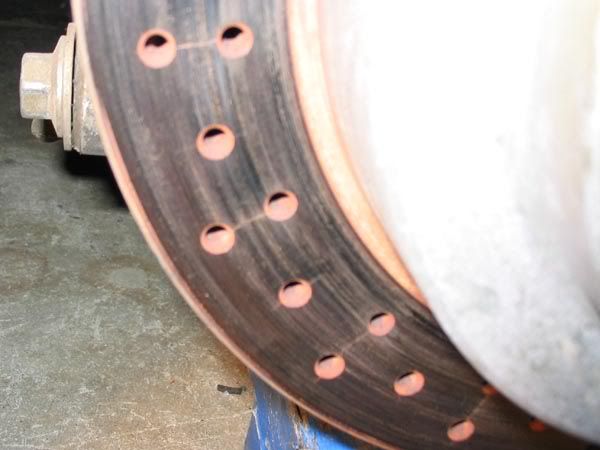
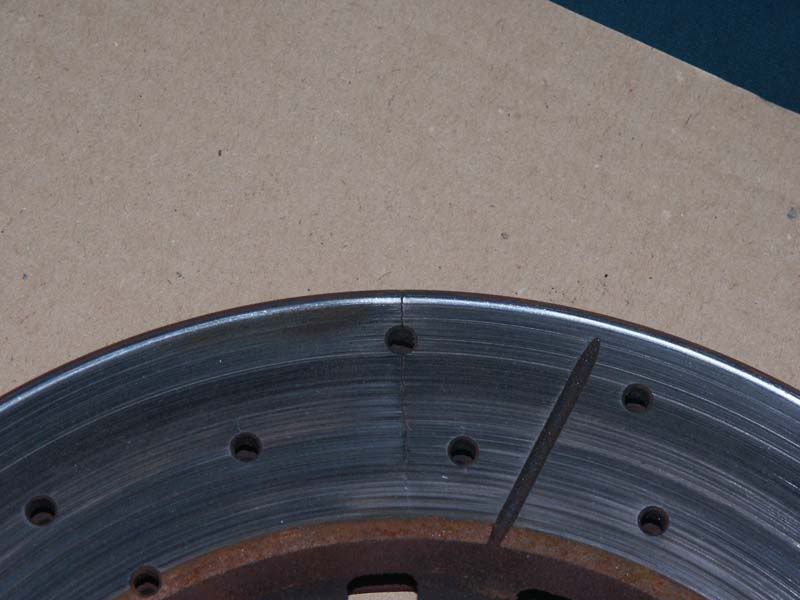
now let's compair
Drilled rotors

Solid Rotors

and if you don't like it from me, listen to an engineer that designs brake systems
This was written by forum member Mighty-Mouse
3.5 years with Foundation (first engineering job) - Rotors, Calipers, basically the stuff inside the wheel
~4 years with Actuation - Vacuum boosters, Active boosters, Master Cylinders (mostly for ESP) and adjustable pedal assemblies
A bit under 2 years with Electronic Driver's Aid Development - ABS/TC/ESP(AH in Vette speak)
just over 1 year as a Brake System Engineer (less engineering and more project management),
http://forums.corvetteforum.com/show....php?t=1024509
"Cross-drilling:
They where created to allow gas from the pads, out-gassing, to escape so it does not create a barrier.
They where never meant to be used for long, one race and in the garbage.
No modern pad out-gasses anymore until the temperature gets so high that the brake fluid stops being fluid and goes into a gaseous state.
Now the "hype" is that they improve cooling. And on a brake dyno test stand or in simulations they do somewhat. The theory being that air is drawn through the holes and out the vents.
In the real world, they don't because the air flow is way too turbulent. You turn the wheel, the car moves up and down, sideways, etc., etc.
It's old technology for an old problem.
Slotted:
Where also created for out-gassing, actually slotted rotors where invented because drilled rotors cracked so badly and so often.
Slotted rotors do have a slight benefit in the real world of "pad cleaning" which is basically scraping a very thin film off the pad. It actually does happen, but it probably has no effect on braking distances. And not worth any extra cost. For an out and out race car it's probably worth it because they can use every little 1/1000 of a second.
Slotted rotors will increase pad wear noticeably."
-------------------------
"Real world experience, well thought out reasoning and engineering know-how is no match for Madison Avenue
Point in case, one of my fellow club members (BMW CCA) when I lived in Michigan also insisted that drilled rotors where much better.
After showing him data that showed the exact opposite he responded by saying, "Well the engineers at Porsche and Ferrari use them and they're a lot smarter than anyone at your company."
The company was Continental-Teves (aka ITT-Teves, aka Ate Brakes).
It was almost as if I had questioned his religious faith.
Here's the crust of most research done on perforated rotors:
------------------------------------------------------------------------------------------------------------------------------------------
The drilled rotor was actually cooler, but not because it dissipated heat better. But because it could not retain heat as well as a solid rotor.
The pads, brake fluid, caliper housing and wheel bearings all showed a marked INCREASE in temperature with perforated rotors.
The perforated rotor is the equivalent of mounting a smaller rotor with the increased possibility of cracking.
In the system, and that's what matters, the temperatures are HIGHER with perforated rotors as compared to a solid rotor.
That means early on set of brake torque loss (fade), lower friction levels over the temperature range, more frequent brake fluid bleeds and increased wear.
So, when some people say, "Drilled rotors are cooler." It's like saying that a V8 with 2 cylinders down runs....technically it's not a lie..but it really is mis-leading.
A good rotor absorbs heat, holds it until the air pump that is the vented rotor can dissipate that heat away from the vital areas radially outward.
When you remove mass from a rotor you effectively decrease the ability to absorb and hold heat and the heat radiates out in all directions, just like an old fashion radiator in a house, directly effecting nearby components.
This is why you rarely if ever see a non-vented rotor on the front of a car. The car would reach terminal fade in no time without some big, heavy disk.
This is also why cooling ducts are so effective, if they are placed correctly.
------------------------------------------------------------------------------------------------------------------------------------------
The perforated rotor also shows obvious signs of uneven surface wear and pad compound laying due the different rates of heating and cooling over the surface of the rotor.
------------------------------------------------------------------------------------------------------------------------------------------
Pad wear life was reduced by at least 5%.
------------------------------------------------------------------------------------------------------------------------------------------
Even the most mundane brake pad will not gas until very high temps today. And some pads will not gas at all, they'll go "slippery" (less than 0.15mu coefficient of friction) and there's nothing any rotor can do to help that.
You'll more likely lose brake pressure due to boiling fluid long before that.
FYI - The steel backing plate will give you 0.20-0.25mu
-------------------------------------------------------------------------------------------------------------------------------------------
If your pads out-gas bad enough to effect braking, then you need to stop being so cheap and spend a few extra bucks on the good stuff or at least the mediocre stuff.
------------------------------------------------------------------------------------------------------------------------------------------
If you think about what has been posted in this thread from most of the posters, you'll realize that it's actually basic common sense.
Believe people that have real world experience and technical training with no stake or believe the hype."
and here are some pictures from that post
CTS-V

AP racing on the SunTrust car
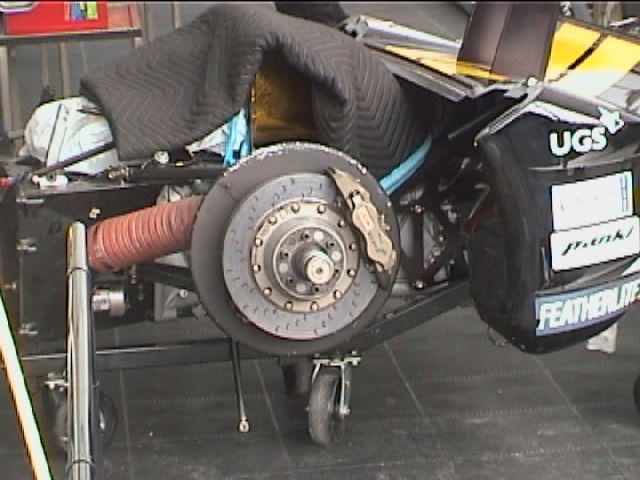
Performance Friction Brakes

Hardbar's race car

or you can go to Wilwood's site and find this under their FAQ
"Q: Why are some rotors drilled or slotted?
A: Rotors are drilled to reduce rotating weight, an issue near and dear to racers searching for ways to minimize unsprung weight. Drilling diminishes a rotor's durability and cooling capacity.
Slots or grooves in rotor faces are partly a carryover from the days of asbestos pads. Asbestos and other organic pads were prone to "glazing" and the slots tended to help "scrape or de-glaze" them. Drilling and slotting rotors has become popular in street applications for their pure aesthetic value. Wilwood has a large selection of drilled and slotted rotors for a wide range of applications."
On top of that, Porsche specifically warns customers to keep an eye out for cracks if they track their cars. I can verify that because I used to have a set of porsche rotors on my car and get less than 500 track miles out of them with Hawk HPS pad before they cracked. Most people can get 500 track miles out of a set of Raybestos rotors using full track pads that are much harsher than HPS pads. So you tell me what is a better rotor, $600 for rotors that crack after 500 miles with street pads, or $100 rotors that crack after 500 miles with race pads.
now that all of that is on there, I think this has got to be close to the record for longest post

Last edited by Lancer033; Apr 30, 2005 at 07:14 AM.
NCM, WSCC &amp;amp; SCC Member
Joined: Oct 2002
Posts: 2,900
Likes: 1
Good post Lancer.
Lancer, I will make sure I read it several times and give you the consideration you deserve for your effort.
I have seen three structural engineering/physist/dymanic Ph'd's argue back and forth on this subject. The only conclusion I have drawn is that there is more than one way to skin a cat.
My arguement is/was is that there are a variety of brakes rotors on the track. Always will be. I think we will been seeing some water cooled brakes(Alcon), wafer thin titaninium rotors(ZMI), double rotors(GM), in the near future. I am sure that those will be even more controversial.
I have own several Ferrari's and Porsche's. I have never had any problems with the brakes or the rotors on the track.
I have seen three structural engineering/physist/dymanic Ph'd's argue back and forth on this subject. The only conclusion I have drawn is that there is more than one way to skin a cat.
My arguement is/was is that there are a variety of brakes rotors on the track. Always will be. I think we will been seeing some water cooled brakes(Alcon), wafer thin titaninium rotors(ZMI), double rotors(GM), in the near future. I am sure that those will be even more controversial.
I have own several Ferrari's and Porsche's. I have never had any problems with the brakes or the rotors on the track.
Last edited by #001 2001 Z06; Apr 30, 2005 at 03:05 PM.