




battery drain possibly?

Thread Starter
Pro


Joined: Jun 2005
Posts: 631
Likes: 7
From: Nashville TN
 battery drain possibly?
ok, first off I had the column lock recall done (the latest one, never had the first one) and I kept getting the pull key, wait 10 seconds every once in a while. It also would stall after starting rolling as if the first recall was done, I know it never was though. I have been really puzzled by this, tried different keys, it had a new battery last fall. Well I tried to start it today and the battery is drained. So I think I have a drain on the battery when it is not on. How do I find where the drain is coming from? If any of you have experienced this where is the likely place to start looking?
Thanks for the help.

Thanks for the help.
Race Director


Joined: Dec 2000
Posts: 19,304
Likes: 85
From: San Diego CA
The traditional way to check for drains was to connect a test light between the battery positive cable connector and the positive terminal. An energized light would indicate a drain on the battery. You would then systematically pull fuses until the light went out. A better method today involves using a high-amperage multimeter in the same place. See
http://autorepair.about.com/library/faqs/bl470f.htm
for a brief explaination and diagram. Since there will always be minor drains, you'd be looking for something significant enough to drain the battery quickly.
BTW, if the dealership did not actually remove your column lock and/or install a block-off plate, you may still have a working column lock. If you hear "Bzzzzt" every time you go to start your car or after you turn it off, you have a working column lock. In that case, get the bypass - pronto!
http://autorepair.about.com/library/faqs/bl470f.htm
for a brief explaination and diagram. Since there will always be minor drains, you'd be looking for something significant enough to drain the battery quickly.
BTW, if the dealership did not actually remove your column lock and/or install a block-off plate, you may still have a working column lock. If you hear "Bzzzzt" every time you go to start your car or after you turn it off, you have a working column lock. In that case, get the bypass - pronto!

Melting Slicks


Joined: Feb 2002
Posts: 2,148
Likes: 1
From: GA
I am having this same issue as we speak on my 2004 Z06 w 9800 mi..
New Optima Battery will run down after about three days with car parked. Problem started a couple of weeks ago when I went to drive car after about a week of sitting and 2nd Delco (1st replaced two months after I bought the car ~2 yrs. ago) was dead. Up to that point nothing had changed with the car in months as far as something that could cause this condition. I have eliminated the following as causing this slow drain
* headlight relays (aftermarket)
* foglight relays (aftermarket)
* underhood light
* vanity lights
* mirror lights
* door lights
* seat motor
No evidence exists that I have got something not turning off. No lights, relay clicking, nothing. When I run a meter from positive terminal to battery post I get no evidence of current draw (meter reads 0-0.1 mA).
On battery measurement:
5/10/06 pm - 12.2V
5/11/06 am -11.8v
5/12/06 am - 11.6v
There is definitely something drawing this down. I think I will buy a battery tender this weekend and will probably take it to the shop for diagnostics as I am stumped after two weeks of trying to figure out what I've got. It seems this problem is more common than I realized...
New Optima Battery will run down after about three days with car parked. Problem started a couple of weeks ago when I went to drive car after about a week of sitting and 2nd Delco (1st replaced two months after I bought the car ~2 yrs. ago) was dead. Up to that point nothing had changed with the car in months as far as something that could cause this condition. I have eliminated the following as causing this slow drain
* headlight relays (aftermarket)
* foglight relays (aftermarket)
* underhood light
* vanity lights
* mirror lights
* door lights
* seat motor
No evidence exists that I have got something not turning off. No lights, relay clicking, nothing. When I run a meter from positive terminal to battery post I get no evidence of current draw (meter reads 0-0.1 mA).
On battery measurement:
5/10/06 pm - 12.2V
5/11/06 am -11.8v
5/12/06 am - 11.6v
There is definitely something drawing this down. I think I will buy a battery tender this weekend and will probably take it to the shop for diagnostics as I am stumped after two weeks of trying to figure out what I've got. It seems this problem is more common than I realized...

Racer

Joined: Apr 2005
Posts: 348
Likes: 2
From: Miami Fl
i got a draw myself but i haven't had a chance to diagnose,it'll kill the battery in like 15 hours and also they did the column lock recall on my m6 and i still hear the buzzing sound from the actuator but the steering wheel no longer locks at all.

Tech Contributor


Joined: Dec 1999
Posts: 32,910
Likes: 2,402
From: Anthony TX
CI 6,7,8,9,11 Vet
St. Jude Donor '08
Ok!!! The newer cars with security systems, memory and automatic fob functions always have a certain ammount of current draw. Checking it with a test light just wont work.
I helped someone in the past with a problem like this and it turned out to be a bad battery.
Anyway,, here is how to see if you have an excessive current draw:
First thing that you need is a meter able to read at least 10 amps of current. Make sure that you have EVERYTHING that can draw current off, shut or removed. Stuff like, shut the trunk, shut both doors, remove the bulb or disconnect the hood light disconnect you radar detector ect.... Make sure that the meter is set up to read CURRENT and you put the leads in SERIES with the battery Then you will disconnect the negative battery cable.
Connect the meter between the battery terminal and the cable (series circuit) as shown:
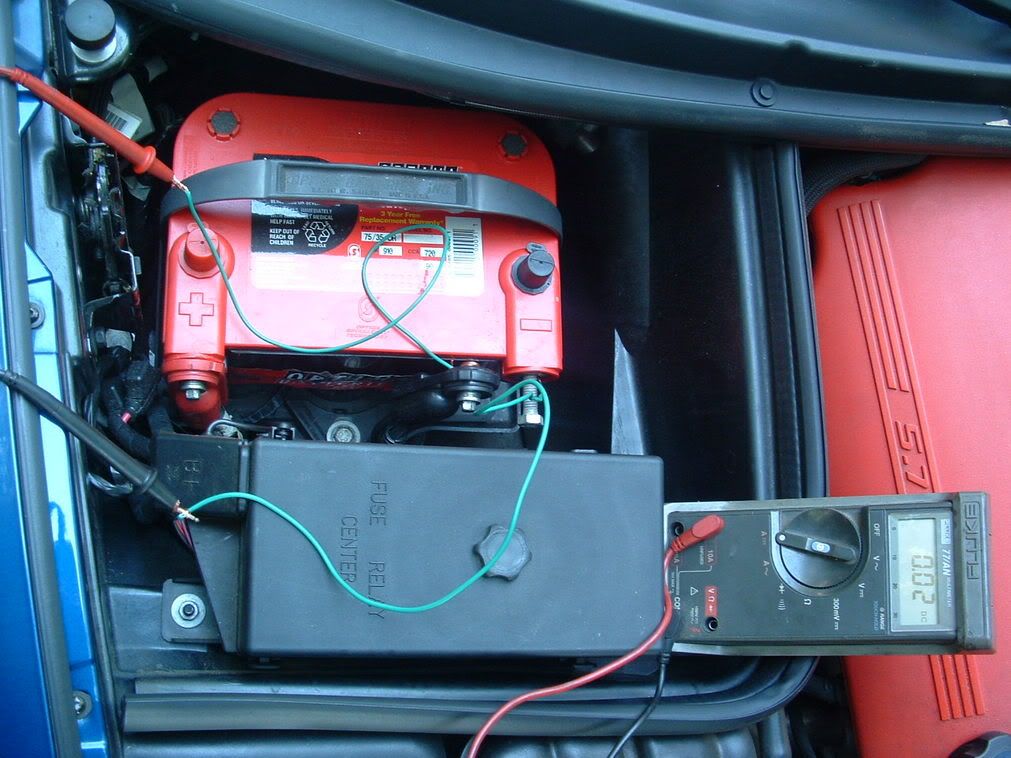
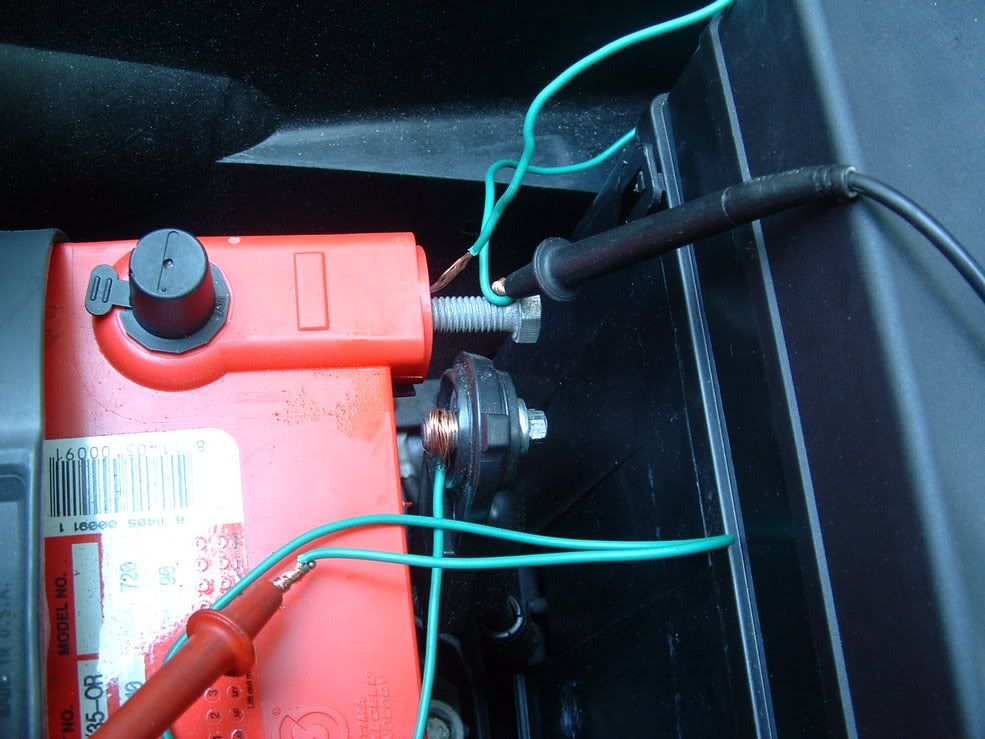
When you connect the meter, you will see it go right to approx 8 amps!
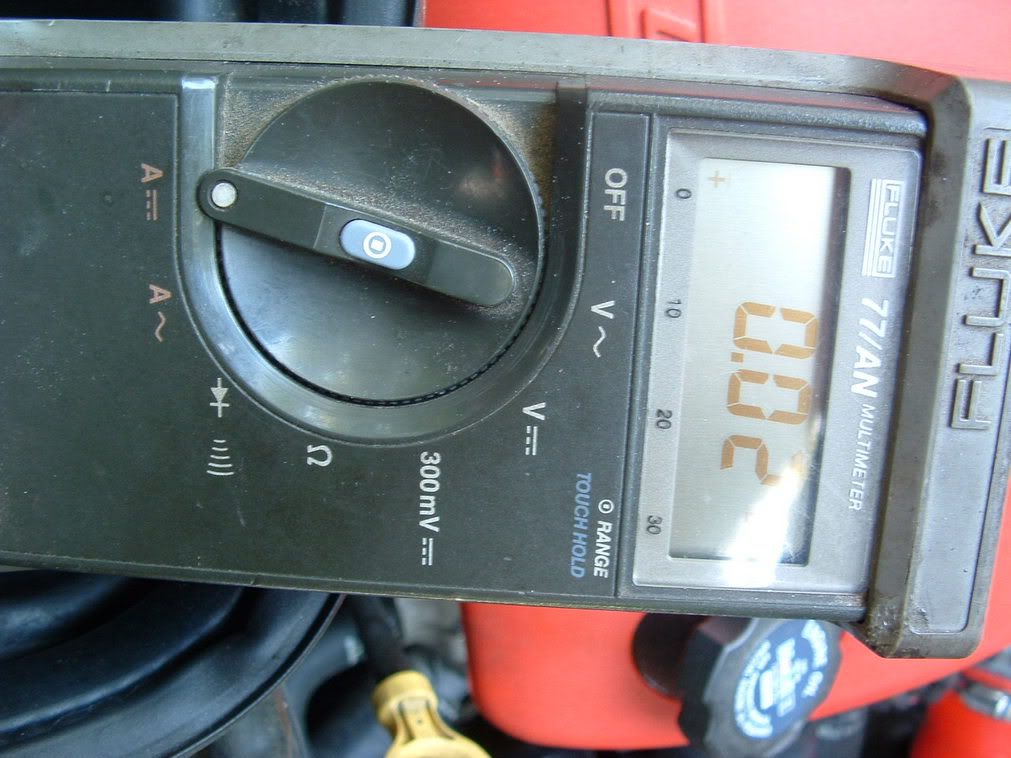
This current draw is all of the modules and circuits waking up and turning on. As the BCM monitors the car and doesnt see any need to maintain the currently active circuits, it will go into SLEEP MODE and only supply power to stuff like the BCM, RFA, security circuits ect. When the car goes into in sleep mode, you will see the current drop down in steps 8, 4, 2.5. .002 and it should end up drawing right around 20 milliamps.
If you have any questions, please let me know.
Bill C
I helped someone in the past with a problem like this and it turned out to be a bad battery.
Anyway,, here is how to see if you have an excessive current draw:
First thing that you need is a meter able to read at least 10 amps of current. Make sure that you have EVERYTHING that can draw current off, shut or removed. Stuff like, shut the trunk, shut both doors, remove the bulb or disconnect the hood light disconnect you radar detector ect.... Make sure that the meter is set up to read CURRENT and you put the leads in SERIES with the battery Then you will disconnect the negative battery cable.
Connect the meter between the battery terminal and the cable (series circuit) as shown:
When you connect the meter, you will see it go right to approx 8 amps!
This current draw is all of the modules and circuits waking up and turning on. As the BCM monitors the car and doesnt see any need to maintain the currently active circuits, it will go into SLEEP MODE and only supply power to stuff like the BCM, RFA, security circuits ect. When the car goes into in sleep mode, you will see the current drop down in steps 8, 4, 2.5. .002 and it should end up drawing right around 20 milliamps.
If you have any questions, please let me know.
Bill C

Team Owner


Joined: May 2001
Posts: 36,836
Likes: 244
From: Dear Karma, I have a list of people you missed.
St. Jude Donor '08-'09-'10-'11-'12-'13-'14-'15-'16
Originally Posted by Bill Curlee
Ok!!! The newer cars with security systems, memory and automatic fob functions always have a certain ammount of current draw. Checking it with a test light just wont work.
I helped someone in the past with a problem like this and it turned out to be a bad battery.
Anyway,, here is how to see if you have an excessive current draw:
First thing that you need is a meter able to read at least 10 amps of current. Make sure that you have EVERYTHING that can draw current off, shut or removed. Stuff like, shut the trunk, shut both doors, remove the bulb or disconnect the hood light disconnect you radar detector ect.... Make sure that the meter is set up to read CURRENT and you put the leads in SERIES with the battery Then you will disconnect the negative battery cable.
Connect the meter between the battery terminal and the cable (series circuit) as shown:
When you connect the meter, you will see it go right to approx 8 amps!
This current draw is all of the modules and circuits waking up and turning on. As the BCM monitors the car and doesnt see any need to maintain the currently active circuits, it will go into SLEEP MODE and only supply power to stuff like the BCM, RFA, security circuits ect. When the car goes into in sleep mode, you will see the current drop down in steps 8, 4, 2.5. .002 and it should end up drawing right around 20 milliamps.
If you have any questions, please let me know.
Bill C
I helped someone in the past with a problem like this and it turned out to be a bad battery.
Anyway,, here is how to see if you have an excessive current draw:
First thing that you need is a meter able to read at least 10 amps of current. Make sure that you have EVERYTHING that can draw current off, shut or removed. Stuff like, shut the trunk, shut both doors, remove the bulb or disconnect the hood light disconnect you radar detector ect.... Make sure that the meter is set up to read CURRENT and you put the leads in SERIES with the battery Then you will disconnect the negative battery cable.
Connect the meter between the battery terminal and the cable (series circuit) as shown:
When you connect the meter, you will see it go right to approx 8 amps!
This current draw is all of the modules and circuits waking up and turning on. As the BCM monitors the car and doesnt see any need to maintain the currently active circuits, it will go into SLEEP MODE and only supply power to stuff like the BCM, RFA, security circuits ect. When the car goes into in sleep mode, you will see the current drop down in steps 8, 4, 2.5. .002 and it should end up drawing right around 20 milliamps.
If you have any questions, please let me know.
Bill C
 Excellent tip Bill, as usual. Especially the part about making absolutely sure the meter has the ability to read 10 amps DC at a minimum. Mucho importante!
Just curious, over what period of time did you find the current reduction taking place after the key was turned off?
Robert
Corvette Stories
The Best of Corvette for Corvette Enthusiasts

8 Coolest Corvette Pace Cars (and Replicas) of All Time
Verdad Gallardo
Top 10 Corvette Engines RANKED by Peak Torque (70+ Years of Muscle!)
Joe Kucinski
Corvette ZR1X Will Be Pacing the Indy 500, And Could Probably Race, Too!
Verdad Gallardo
Top 10 Corvettes Coming to Mecum Indy 2026!
Brett Foote
Top 10 C9 Corvette MUST-HAVES to Fix These C8 Generation Flaws!
Michael S. Palmer
10 Revolutionary 'Corvette Firsts' Most People Don't Know
Joe Kucinski
5 Reasons to Upgrade to an LS6-Powered Corvette; 5 Reasons to Stay LT2
Michael S. Palmer
2027 Corvette vs The World: Every C8 vs Its Closest Competitor
Joe Kucinski
10 Most Common Corvette Problems of the Last 20 Years!
Joe Kucinski
Tech Contributor
Joined: Dec 1999
Posts: 32,910
Likes: 2,402
From: Anthony TX
CI 6,7,8,9,11 Vet
St. Jude Donor '08
If I remember correctly, it was around 45 sec to a bit over 60 sec. Didnt take long at all. If yiou leave the hood light on it will take a LONG time as the BCM will have to wait for the monitored circuit timer to shut the hood light off!
Team Owner
Joined: May 2001
Posts: 36,836
Likes: 244
From: Dear Karma, I have a list of people you missed.
St. Jude Donor '08-'09-'10-'11-'12-'13-'14-'15-'16
Originally Posted by Bill Curlee
If I remember correctly, it was around 45 sec to a bit over 60 sec. Didnt take long at all. If yiou leave the hood light on it will take a LONG time as the BCM will have to wait for the monitored circuit timer to shut the hood light off!
Tech Contributor
Joined: Dec 1999
Posts: 32,910
Likes: 2,402
From: Anthony TX
CI 6,7,8,9,11 Vet
St. Jude Donor '08
Thats correct!! If you set up the car so that nothing that uses RAP (Retained Ascessory Power) is on, it will not come into play (i.e. the hood light, open door, open trunk ect. With in approx 2 min, you should be down to minimum amps, .002