








Update for oil sensor relocate

Thread Starter
Burning Brakes


Joined: Aug 2005
Posts: 845
Likes: 0
From: Mesa Arizona
 Update for oil sensor relocate
Hope I'm not stepping on any toe's posting this. But it clears up couple of questions for this sticky
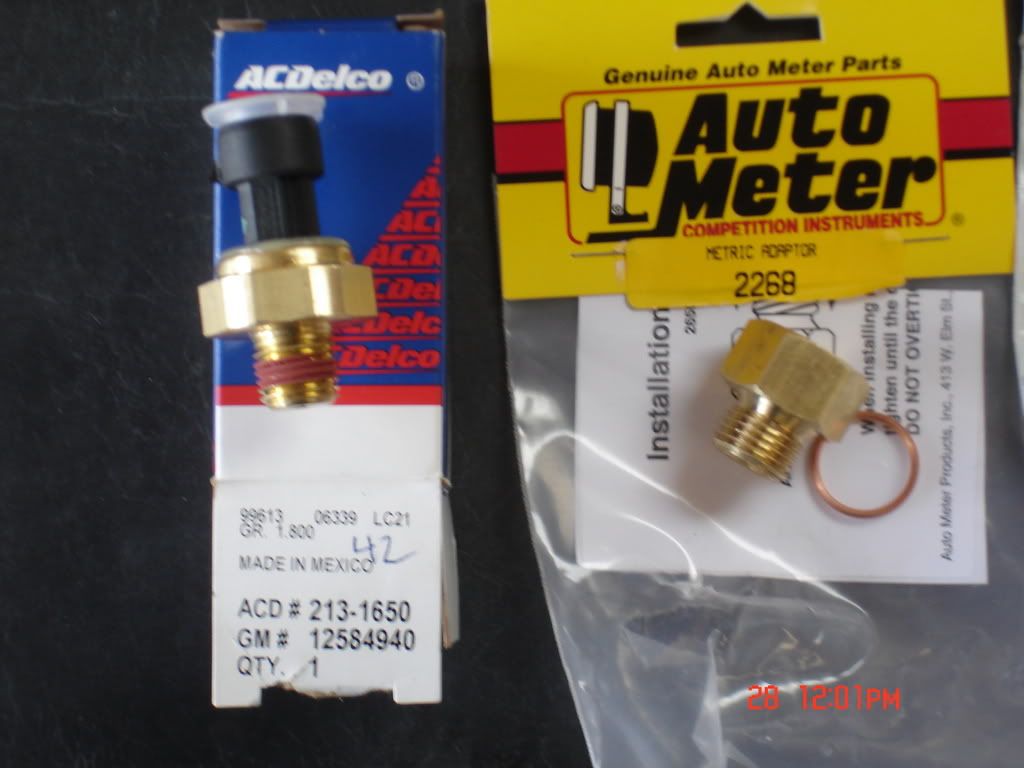
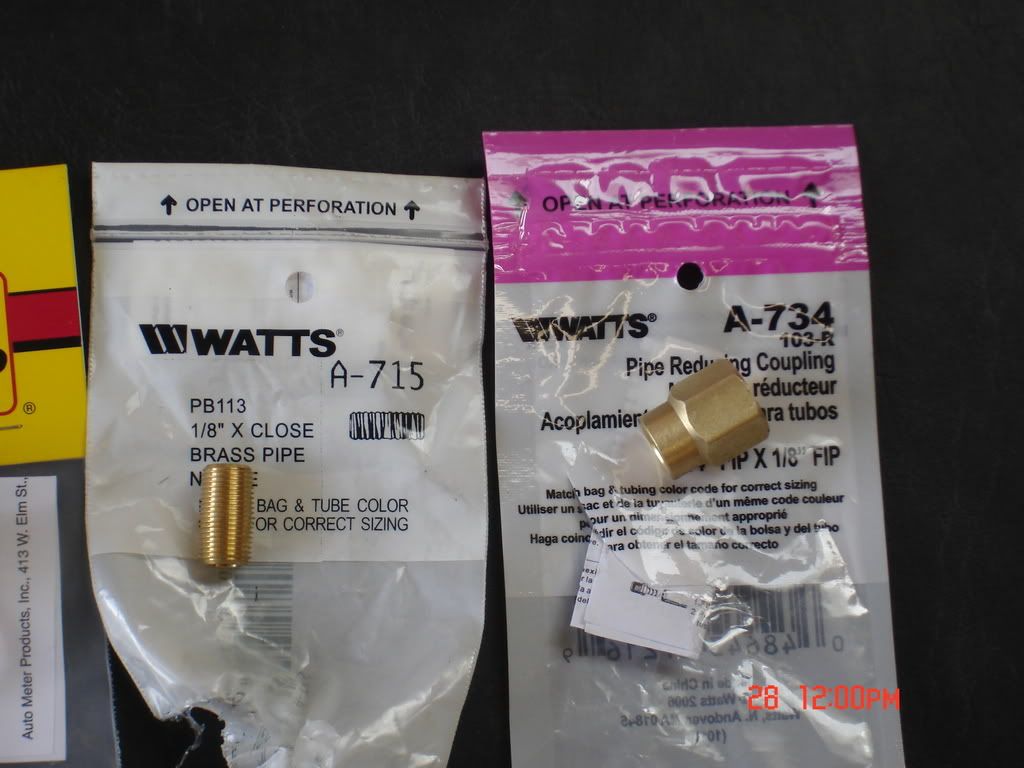
The fitting for the block that Hemi426 handmade, a M16X1.5 X 1/8" can be purchased at ur local speed shop for $8. It's an AutoMeter part no. 2268, metric adaptor & has the crush washer included, the part for the Buick sensor can be found at Home Depot, it's a Watts
#A734, a double female, 1/4" X 1/8", about $2.75, which when using the oil line kit makes it easy to hook everything up together. Couple pics attached


Again, I was just trying to help w/info for those doing the relocate like me.
The fitting for the block that Hemi426 handmade, a M16X1.5 X 1/8" can be purchased at ur local speed shop for $8. It's an AutoMeter part no. 2268, metric adaptor & has the crush washer included, the part for the Buick sensor can be found at Home Depot, it's a Watts
#A734, a double female, 1/4" X 1/8", about $2.75, which when using the oil line kit makes it easy to hook everything up together. Couple pics attached
Again, I was just trying to help w/info for those doing the relocate like me.
Last edited by jaxvet; Sep 28, 2007 at 06:19 AM.

Tech Contributor

Joined: Dec 2006
Posts: 10,962
Likes: 29
From: Van Buren Arkansas
Wounded Warrior Escort '11
Just a quick thought... I did the relocation too, but used copper tubing. I am an Engineer and was looking at most of the available plastic tubing due to the fact its obviously easy to route as needed. Most of what I saw had fairly low maximum temperature capabilities then comparing those numbers to the highest possible oil temps for our cars...I didn't like what I saw. I decided that I didn't need that line melting on me driving down the freeway, so I went with copper and I've had no problems.

Melting Slicks

Joined: Jan 2005
Posts: 2,409
Likes: 34
From: St. Louis Missouri
Just a quick thought... I did the relocation too, but used copper tubing. I am an Engineer and was looking at most of the available plastic tubing due to the fact its obviously easy to route as needed. Most of what I saw had fairly low maximum temperature capabilities then comparing those numbers to the highest possible oil temps for our cars...I didn't like what I saw. I decided that I didn't need that line melting on me driving down the freeway, so I went with copper and I've had no problems.
 I have had a plastic line melt and once it starts leaking it is a big safety issue, oil everywhere and a big fire hazard. Be safe and use the copper line from the start.
Tech Contributor
Joined: Dec 2006
Posts: 10,962
Likes: 29
From: Van Buren Arkansas
Wounded Warrior Escort '11
Yep. Our cars can hit upwards of 300 Deg F if driven hard and even in normal traffic that I see out here in S. Calif. I see 217 Deg F all the time. The plastic lines can vary in temperature ratings from 100-180Deg F. I wouldn't want oil spraying all over either.
Melting Slicks


Joined: May 2000
Posts: 2,498
Likes: 4
From: Brentwood TN

Charlie

Instructor

Joined: Jul 2007
Posts: 197
Likes: 0
From: West Jordan Utah
I just used the Auto Meter along with the watts part & a 1/8 in close MM as I did not want the hose up top of the motor. I watched my last one fail on Thursday I had just changed my oil and cold start up my pressure reached 50 lbs then the gauge went crazy. I think the the heat expands the aluminum and ruins the seal. My wife has a 05 Bonneville and the oil pressure is always 50 - 60 lbs. So I hope this trick lasts.

Last edited by Richard Nogen; Sep 29, 2007 at 11:13 AM. Reason: change pics
Corvette Stories
The Best of Corvette for Corvette Enthusiasts

How Much Horsepower Every Corvette Engine "LOST" in 1972
Joe Kucinski
Top 10 DOs and DON'Ts for Protecting Your Convertible Top!
Michael S. Palmer
Top 10 Most Explosive Corvettes Ever Made: Power-to-Weight Ratio Ranked!
Joe Kucinski
150 hp to 1,250 hp: Every Corvette Generation Compared by the Specs That Matter
Joe Kucinski
8 Coolest Corvette Pace Cars (and Replicas) of All Time
Verdad Gallardo
Top 10 Corvette Engines RANKED by Peak Torque (70+ Years of Muscle!)
Joe Kucinski
Corvette ZR1X Will Be Pacing the Indy 500, And Could Probably Race, Too!
Verdad Gallardo
Top 10 Corvettes Coming to Mecum Indy 2026!
Brett Foote
Top 10 C9 Corvette MUST-HAVES to Fix These C8 Generation Flaws!
Michael S. Palmer
Burning Brakes


Joined: Nov 2002
Posts: 807
Likes: 21
From: Los Altos CA
Just a quick thought... I did the relocation too, but used copper tubing. I am an Engineer and was looking at most of the available plastic tubing due to the fact its obviously easy to route as needed. Most of what I saw had fairly low maximum temperature capabilities then comparing those numbers to the highest possible oil temps for our cars...I didn't like what I saw. I decided that I didn't need that line melting on me driving down the freeway, so I went with copper and I've had no problems.
Tech Contributor
Joined: Dec 2006
Posts: 10,962
Likes: 29
From: Van Buren Arkansas
Wounded Warrior Escort '11
Yes, you can do that but many forum members were reporting fumes getting into the ventilation system afterwards. I tend to suspect as well that having a hole there where it wasn't meant to be isn't such a great idea with rain water pouring on top of things that wasn't meant for it either...GM designers wouldn't have put that plastic tray there for no reason, it has a specific purpose.
Burning Brakes
Joined: Nov 2002
Posts: 807
Likes: 21
From: Los Altos CA
Yes, you can do that but many forum members were reporting fumes getting into the ventilation system afterwards. I tend to suspect as well that having a hole there where it wasn't meant to be isn't such a great idea with rain water pouring on top of things that wasn't meant for it either...GM designers wouldn't have put that plastic tray there for no reason, it has a specific purpose.

Race Director

Joined: Aug 2000
Posts: 12,975
Likes: 22
The other thread is incredibly long and for good reason. It seems everyone is doing the Buick sensor mod. I want to use the Airtex unit for the Vette and mount it remotely. Can I just get the correct fittings for it, plus the oil line and use the Vette sending unit?

Drifting

Joined: Apr 2001
Posts: 1,744
Likes: 72
From: Cincinnati OH
I just used the Auto Meter along with the watts part & a 1/8 in close MM as I did not want the hose up top of the motor. I watched my last one fail on Thursday I had just changed my oil and cold start up my pressure reached 50 lbs then the gauge went crazy. I think the the heat expands the aluminum and ruins the seal. My wife has a 05 Bonneville and the oil pressure is always 50 - 60 lbs. So I hope this trick lasts.
also, does it just screw in where the old sensor was?
thanks
Last edited by beefcake; Feb 19, 2008 at 03:24 PM.


Racer
Joined: Feb 2007
Posts: 251
Likes: 0
From: Springdale AR
Dang I'm learning something new about these cars all the time. I'd read long ago about this oil pressure unit relocation, but gave it no thought because my pressure gauge worked fine. Lately I've noticed that my gauge hovers around 40 psi at idle, but climbs to 70 or a bit more under acceleration or revving. Both the needle gauge and DIC read 0 psi when the engine is stopped. I've never noticed my gauge doing this until lately. I recently changed plugs and wires, but that should have nothing to do with oil pressure readings (especially since the sending unit is under the intake manifold). Is this erratic gauge a sign that it's failing? If so, when I take the car in for a few other fixes next week, I'll have them look at this too. Thanks!


Drifting
Joined: Apr 2001
Posts: 1,744
Likes: 72
From: Cincinnati OH

Burning Brakes
Joined: Jul 2006
Posts: 968
Likes: 12
From: Regina Sask
Russ Kemp
Racer
Joined: Feb 2007
Posts: 251
Likes: 0
From: Springdale AR
I've read on this forum that when the sending unit fails, there will be an oil pressure reading even with the engine turned off (ignition at RUN, but without the engine running). I'm not to that point yet, but I'm curious if my erratic readings points to a failing sending unit.
Last edited by tvlance; Feb 20, 2008 at 07:19 PM. Reason: added more info

Race Director

Joined: May 2005
Posts: 15,960
Likes: 21
From: West Norriton PA
St. Jude Donor '08
I've read on this forum that when the sending unit fails, there will be an oil pressure reading even with the engine turned off (ignition at RUN, but without the engine running). I'm not to that point yet, but I'm curious if my erratic readings points to a failing sending unit.