

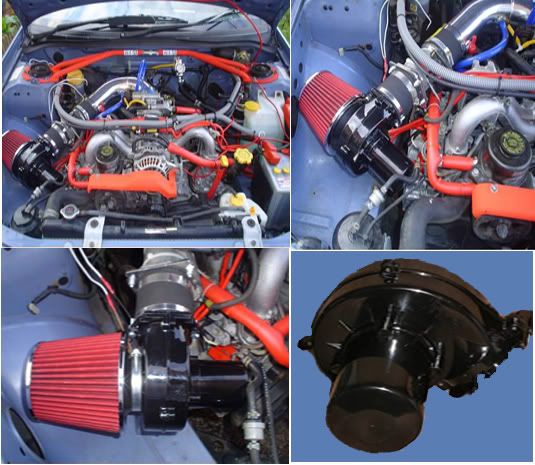





Do Electric Superchargers Work?

Racer

Joined: Jul 2007
Posts: 261
Likes: 0
From: Lehighton PA

Old school, fear of technoloy, whatever is a  smokescreen. Here's the reality - unless you've found a way to change the laws of physics, a certain amount of power is needed to move a given volume of air at a specified rate. The air doesn't know where that power comes from and the physics doesn't care. If it takes 40 hp to belt drive a blower to mover enough air to provide 7 psi boost to a 5.7 L engine, it will take a closely simiar amount of electrical power to do it as well. Forty horsepower is about 30 KW or 30,000 watts. A typical automobile puts out about 14 volts, but for simplicity, let's say it puts out 15vdc. That means we need on 2,000 amps from our alternator to power our electric blower. I've never seen one, but let's suppose there is a 200 amp alternator available. We'll only need TEN of them to drive our electric supercharger, plus the standard alternator to drive the other accessories. The alternator is not 100% efficient so it will take more than the equivalent of 40 hp to drive the alternators.
Cliff Notes - Buy some of those "R" decals for your car. The horsepower gain is about the same as the "electric supercharger" and costs less. If you still want to spend some money, buy one of the "modules" for $22 that tricks the IAT into thinking it's still seeing cold air. You'll go faster because you wallet is lighter.
Need more? Buy TWO of the gas line magnets, a couple of the "water vapor injectors" that suck PCV bleed air through a jug of water to "humidify that power robbing bone dry air". It reduces spark knock, improves economy, increases power, reduces emissioins, stops global warming and assures peace and prosperity for all mankind.
Charlie
smokescreen. Here's the reality - unless you've found a way to change the laws of physics, a certain amount of power is needed to move a given volume of air at a specified rate. The air doesn't know where that power comes from and the physics doesn't care. If it takes 40 hp to belt drive a blower to mover enough air to provide 7 psi boost to a 5.7 L engine, it will take a closely simiar amount of electrical power to do it as well. Forty horsepower is about 30 KW or 30,000 watts. A typical automobile puts out about 14 volts, but for simplicity, let's say it puts out 15vdc. That means we need on 2,000 amps from our alternator to power our electric blower. I've never seen one, but let's suppose there is a 200 amp alternator available. We'll only need TEN of them to drive our electric supercharger, plus the standard alternator to drive the other accessories. The alternator is not 100% efficient so it will take more than the equivalent of 40 hp to drive the alternators.Cliff Notes - Buy some of those "R" decals for your car. The horsepower gain is about the same as the "electric supercharger" and costs less. If you still want to spend some money, buy one of the "modules" for $22 that tricks the IAT into thinking it's still seeing cold air. You'll go faster because you wallet is lighter.
Need more? Buy TWO of the gas line magnets, a couple of the "water vapor injectors" that suck PCV bleed air through a jug of water to "humidify that power robbing bone dry air". It reduces spark knock, improves economy, increases power, reduces emissioins, stops global warming and assures peace and prosperity for all mankind.
Charlie
This man is correct.
Safety Car


Joined: Apr 2004
Posts: 3,932
Likes: 8
From: Hayward California
Uhhhhh .... with the stock electrical system ... of course there is a parasitic loss. Where do you think the electricity comes from in a car??? The battery is a storage device, the device that MAKES the electricity is the alternator (generator on much older cars).
If you attach a device to the car that needs X amount of amps to drive it, the alternator IMMEDIATELY increases its load on the engine to generate that X amperage. And that load is a parasitic loss, it takes HP to make the electricity.
Maybe if you added a whole bunch of batteries to the car that only powered this "turbo" and re-charged them only by, say, plugging them into a charger when you get home ..... then you might argue that there is no loss .... though I would argue the added weight of the batteries, this "turbo" unit, etc, undoubtably would waste more power than one of these POS units could generate in its makers wildest wet dreams.

If you attach a device to the car that needs X amount of amps to drive it, the alternator IMMEDIATELY increases its load on the engine to generate that X amperage. And that load is a parasitic loss, it takes HP to make the electricity.
Maybe if you added a whole bunch of batteries to the car that only powered this "turbo" and re-charged them only by, say, plugging them into a charger when you get home ..... then you might argue that there is no loss .... though I would argue the added weight of the batteries, this "turbo" unit, etc, undoubtably would waste more power than one of these POS units could generate in its makers wildest wet dreams.
I stand corrected... at the point of getting that much power from batteries it may as well tie in to the flywheel and be called a hybrid


Le Mans Master


Joined: Jun 2004
Posts: 6,269
Likes: 50
From: Dallas Texas
St. Jude Donor '06-'07-'09-'10
Lets face it the only free supercharging is the exhaust driven turbocharger that utilizes the energy from expanding hot gases to spin the turbine wheel. The alternative would be to power a compressor when needed with a small engine like a two stroke Rotax.
The unit in the above pix looks like a HVAC fan and motor that would probably be a restriction at WOT.
The unit in the above pix looks like a HVAC fan and motor that would probably be a restriction at WOT.
Race Director


Joined: Apr 2007
Posts: 11,152
Likes: 890
From: South Western Ontario
 and if you figure out that 30hp will require at least 1600A @ 14VDC that makes getting the necessary power impossible.
So, any claims as to the operation of these things is complete
Peter
Corvette Stories
The Best of Corvette for Corvette Enthusiasts

5 Best & 5 Worst Corvette Daily Drivers
Joe Kucinski
The Headlights of Every Corvette Generation Explained
Joe Kucinski
5 Best & 5 Most Overrated Corvette Track Packages of All Time!
Joe Kucinski
Every 2027 Corvette Engine Explained
Joe Kucinski
Designer Imagines A Corvette That Looks More Like a Corvette Than the Corvette
Verdad Gallardo
10 Ugly Corvettes That We Still Kinda Love
Joe Kucinski
Top 10 Most Expensive Corvettes Ever Sold on Bring A Trailer
Brett Foote
10 Things Every Corvette Owner Needs (2026 Edition)
Michael S. Palmer
8 Most "Only Corvette Owners Understand" Quirks and Problems
Pouria Savadkouei
Race Director


Joined: Mar 2007
Posts: 18,308
Likes: 21
From: Marlton. Increasing performance one speeding ticket at a time! NJ
Old school, fear of technoloy, whatever is a smokescreen. Here's the reality - unless you've found a way to change the laws of physics, a certain amount of power is needed to move a given volume of air at a specified rate. The air doesn't know where that power comes from and the physics doesn't care. If it takes 40 hp to belt drive a blower to mover enough air to provide 7 psi boost to a 5.7 L engine, it will take a closely simiar amount of electrical power to do it as well. Forty horsepower is about 30 KW or 30,000 watts. A typical automobile puts out about 14 volts, but for simplicity, let's say it puts out 15vdc. That means we need on 2,000 amps from our alternator to power our electric blower. I've never seen one, but let's suppose there is a 200 amp alternator available. We'll only need TEN of them to drive our electric supercharger, plus the standard alternator to drive the other accessories. The alternator is not 100% efficient so it will take more than the equivalent of 40 hp to drive the alternators.
Cliff Notes - Buy some of those "R" decals for your car. The horsepower gain is about the same as the "electric supercharger" and costs less. If you still want to spend some money, buy one of the "modules" for $22 that tricks the IAT into thinking it's still seeing cold air. You'll go faster because you wallet is lighter.
Need more? Buy TWO of the gas line magnets, a couple of the "water vapor injectors" that suck PCV bleed air through a jug of water to "humidify that power robbing bone dry air". It reduces spark knock, improves economy, increases power, reduces emissioins, stops global warming and assures peace and prosperity for all mankind.
Charlie
smokescreen. Here's the reality - unless you've found a way to change the laws of physics, a certain amount of power is needed to move a given volume of air at a specified rate. The air doesn't know where that power comes from and the physics doesn't care. If it takes 40 hp to belt drive a blower to mover enough air to provide 7 psi boost to a 5.7 L engine, it will take a closely simiar amount of electrical power to do it as well. Forty horsepower is about 30 KW or 30,000 watts. A typical automobile puts out about 14 volts, but for simplicity, let's say it puts out 15vdc. That means we need on 2,000 amps from our alternator to power our electric blower. I've never seen one, but let's suppose there is a 200 amp alternator available. We'll only need TEN of them to drive our electric supercharger, plus the standard alternator to drive the other accessories. The alternator is not 100% efficient so it will take more than the equivalent of 40 hp to drive the alternators.Cliff Notes - Buy some of those "R" decals for your car. The horsepower gain is about the same as the "electric supercharger" and costs less. If you still want to spend some money, buy one of the "modules" for $22 that tricks the IAT into thinking it's still seeing cold air. You'll go faster because you wallet is lighter.
Need more? Buy TWO of the gas line magnets, a couple of the "water vapor injectors" that suck PCV bleed air through a jug of water to "humidify that power robbing bone dry air". It reduces spark knock, improves economy, increases power, reduces emissioins, stops global warming and assures peace and prosperity for all mankind.
Charlie
You just can't get enough power, plain and simple.
Now, I've worked with blowers that put out 1200-1500CFM and use maybe 50Watts. That's more than our engines need at full throttle 6500 RPM (for a stock 346 that's a max of 650CFM). So on the first glance, looks like those blowers flow more than we need. Problem is pressure. To get something that can handle the amount of backpressure necessary requires something that is much more powerful.
From a technological perspective, it can't work.
From a common sense perspective, something so great yet no one uses it, is just a scam.
But I would still like to buy one. I'll ask them to send me some to Nigeria. In return, they can keep the excess money from that money order. Nothing as satisfactory as scamming a scammer.

Melting Slicks


Joined: Aug 2003
Posts: 2,786
Likes: 7
From: Iowa
I was going to post just the same. fact of the matter is: 30 hp = 22,370.9961 watts; 40 hp = 29,827.9949 watts. either way, just no way to generate that kind of power in a car.
even if you could, a 30-40hp motor would be the size of your LS1, that would require quite a hood modification. the inrush current on such a motor would difficult to deal with also. you would have to use a variable frequency drive to control the motor and allow it to change speeds with engine rpm. yet another very expensive piece of equipment.
no matter which direction you attempt to approach this method of supercharging...it just won't work.
Racer
Joined: Apr 2007
Posts: 311
Likes: 0
From: Dallas TX
Worms
Buddy I think you opened up a can of worms! I am sure you regret asking about this right about now-but someone was going to do it eventually. I personally think that if you are looking for more performance get it done right the first time. Also take note that if this item fell apart it would destroy your beautiful machine. Now everyone wants to get faster cheaper, but there are some things that just don't make 1 lick of sense!!


Instructor
Joined: Jul 2006
Posts: 210
Likes: 2
From: Elkins Park PA
The GA Projects site posted above by sugarwolf seems to be a fairly truthful & authoritative source.... http://www.gaprojects.com/electricsuper/
They confirm that 13-20hp is a typical mechanical supercharger requirement, and admit that their electric supercharger project kit comes nowhere close to that nor is it intended to compete with a traditional supercharger. Their system apparently runs at 36 volts, they use 3 batteries in series to run and then rewire in parallel to recharge, which reduces the current requirements (and alternator demand). Their system is only intended for use in short bursts, not continuous (which will further reduce alternator demand). Their system is intended to provide boost at low engine speeds, but will apparently present a restriction at high engine speeds -- the intended purpose is to improve torque & response at low engine speeds, so this makes sense in that light.
They also refer to a Thomas Knight electric supercharger which apparently will go head-to-head against a mechanical supercharger. Presumably it costs more than $100.
They confirm that 13-20hp is a typical mechanical supercharger requirement, and admit that their electric supercharger project kit comes nowhere close to that nor is it intended to compete with a traditional supercharger. Their system apparently runs at 36 volts, they use 3 batteries in series to run and then rewire in parallel to recharge, which reduces the current requirements (and alternator demand). Their system is only intended for use in short bursts, not continuous (which will further reduce alternator demand). Their system is intended to provide boost at low engine speeds, but will apparently present a restriction at high engine speeds -- the intended purpose is to improve torque & response at low engine speeds, so this makes sense in that light.
They also refer to a Thomas Knight electric supercharger which apparently will go head-to-head against a mechanical supercharger. Presumably it costs more than $100.

Team Owner


Joined: Apr 2001
Posts: 54,204
Likes: 180
From: S.W. Ohio. . . . . . NRA Life Member



Instructor
Joined: Oct 2007
Posts: 208
Likes: 1
From: Houston TX
http://www.walmart.com/catalog/produ...uct_id=7850222
Walmart sells a bunch of electric superchargers. This one is even anodized Red!!
Their prices ranges are 9.94 to 44.86 and HP gains of 50-60000 HP!!!
Walmart sells a bunch of electric superchargers. This one is even anodized Red!!
Their prices ranges are 9.94 to 44.86 and HP gains of 50-60000 HP!!!