



 Guess it's time to do a clean on the TAC plug and replace the throttle position sensor.

P2101 Hc

Thread Starter
Racer

Joined: Mar 2008
Posts: 328
Likes: 1
From: Houston TX
St. Jude Donor '08
 P2101 Hc
Is this a "Throttle position sensor" code? I don't have service manual. I've ordered a set, but not here yet. I did a tune up (replaced plugs and wires) and washed down the engine, and then the problem occured. So I'll try wd40 on the connectors first before replacing. But I'd like to know what the code is so I have the right area to look at.
Thanks for your help
Thanks for your help

Tech Contributor


Joined: Apr 2007
Posts: 10,924
Likes: 78
From: Forney Texas
Is this a "Throttle position sensor" code? I don't have service manual. I've ordered a set, but not here yet. I did a tune up (replaced plugs and wires) and washed down the engine, and then the problem occured. So I'll try wd40 on the connectors first before replacing. But I'd like to know what the code is so I have the right area to look at.
Thanks for your help
Thanks for your help
The code should be: Control Module Throttle Actuator Position Performance
I would un-plug the throttle body harness and the TPS harness off the throttle body, spray it with electronic cleaner and blow it dry. Plug back in. Turn on key, reset codes and see if it comes back.
Thread Starter
Racer
Joined: Mar 2008
Posts: 328
Likes: 1
From: Houston TX
St. Jude Donor '08
Control Module Throttle Actuator Position
I found this site.
http://www.digitalcorvettes.com/foru...ad.php?t=56027
P2101
Control Module Throttle Actuator Position Performance
ECM
does anyone have a picture of it. I think I know where it is, but would appreciate any info.
http://www.digitalcorvettes.com/foru...ad.php?t=56027
P2101
Control Module Throttle Actuator Position Performance
ECM
does anyone have a picture of it. I think I know where it is, but would appreciate any info.

Safety Car


Joined: Jan 2001
Posts: 4,387
Likes: 691
From: Boise ID
I didn't see it in the 2000 manual but it does have it in the 2004 manual.
DTC P2101
Circuit Description
The commanded throttle position, based on accelerator pedal position and possibly on other limiting factors, is compared to the actual throttle position. The 2 values should be within a calibrated range of each other. Both the powertrain control module (PCM) and the throttle actuator control (TAC) module redundantly monitor the commanded and actual throttle position. If the PCM detects an out-of-range condition between the commanded and the actual pedal position, DTC P2101 sets.
Conditions for Running the DTC
• DTCs P0601, P0602, P0604, P0606, P1516, P2108, U0107 are not set.
• DTCs P0120, P0220 and P2135 are not set at the same time, or DTCs P0120 and P0220 are not set at the same time.
• The ignition switch is in the crank or the run position.
• The ignition voltage is greater than 8.5 volts.
• The TAC system is not in the battery saver mode.
Conditions for Setting the DTC
• The PCM detects that the commanded and the actual throttle positions are not within a calibrated range of each other.
• The above condition is met for less than 1 second.
Action Taken When the DTC Sets
• The control module illuminates the malfunction indicator lamp (MIL) when the diagnostic runs and fails.
• The control module records the operating conditions at the time the diagnostic fails. The control module stores this information in the Freeze Frame and/or the Failure Records.
• The control module commands the TAC system to operate in the Reduced Engine Power mode.
• A message center or an indicator displays Reduced Engine Power.
• Under certain conditions the control module commands the engine OFF.
Conditions for Clearing the MIL/DTC
• The control module turns OFF the malfunction indicator lamp (MIL) after 3 consecutive ignition cycles that the diagnostic runs and does not fail.
• A current DTC, Last Test Failed, clears when the diagnostic runs and passes.
• A history DTC clears after 40 consecutive warm-up cycles, if no failures are reported by this or any other emission related diagnostic.
• Clear the MIL and the DTC with a scan tool.
Diagnostic Aids
• If you do not find any trouble, inspect for mechanical problems or for binding that may be temperature related. Components may not move freely in extreme heat or cold due to the presence of contaminants or due to ice formation.
• Inspect the TAC module connectors for signs of water intrusion. When water intrusion occurs, multiple DTCs could be set with no circuit or component conditions found during diagnostic testing. • When the TAC module detects a condition within the TAC system, more than 1 TAC system related DTC may set. This is due to the many redundant tests that run continuously on this system. Locating and repairing 1 individual condition may correct more than 1 DTC. Disconnecting components during testing may set additional DTCs. Keep this in mind when reviewing the stored information, Capture info.
Throttle Actuator Control (TAC) System Description
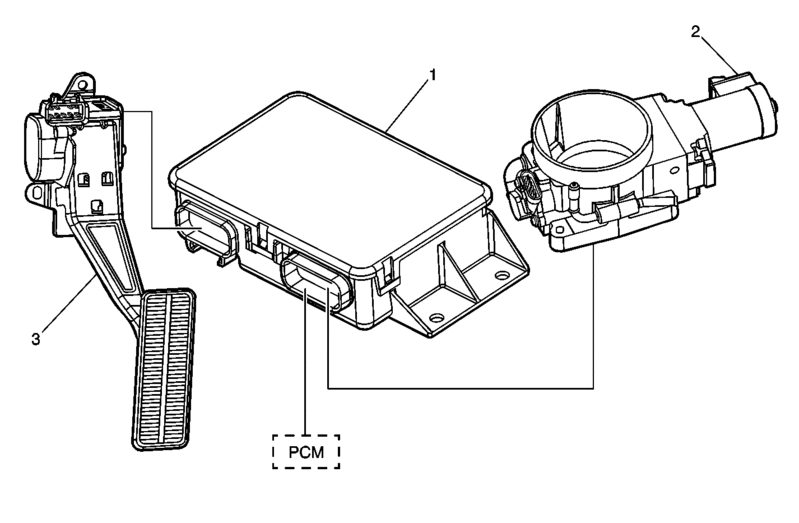
(1) Throttle Actuator Control (TAC) Module
(2) Throttle Body Assembly
(3) Accelerator Pedal Position (APP) Sensor
The throttle actuator control (TAC) system uses the vehicle electronics and components in order to calculate and control the position of the throttle blade. This system eliminates the need for a mechanical cable attachment from the accelerator pedal to the throttle body. This system also performs the cruise control functions.
The TAC system components include but is not limited to the following:
• The accelerator pedal position (APP) sensor
• The throttle body
• The throttle actuator control (TAC) module
• The powertrain control module (PCM)
Each of these components interface together in order to ensure accurate calculations, and in order to control the throttle position.
Accelerator Pedal Position (APP) Sensor
The accelerator pedal position (APP) sensor is mounted on the accelerator pedal assembly. The APP is actually 3 individual accelerator pedal position sensors within 1 housing. Three separate signal, low reference, and 5-volt reference circuits are used in order to connect the APP and the TAC module. The APP sensor 1 voltage should increase at the same time that the accelerator pedal is depressed, from below 1 volt at 0 percent pedal travel to above 2 volts at 100 percent pedal travel. APP sensor 2 voltage should decrease from above 4 volts at 0 pedal travel to below 2.9 volts at 100 percent pedal travel. APP sensor 3 voltage should decrease from above 3.8 volts at 0 pedal travel to below 3.1 volts at 100 percent pedal travel.
Throttle Body Assembly
The throttle body for the TAC system is similar to a conventional throttle body with some exceptions. One exception is the use of a motor to control the throttle position (TP) instead of a mechanical cable. The other exception is the new design TP sensor. The TP sensor mounts on the side of the throttle body opposite the throttle actuator motor. The TP sensor is actually 2 individual TP sensors within 1 housing. Separate low reference and 5-volt reference circuits are used in order to connect the TP sensors and the TAC module. The TP sensor 1 signal voltage increases at the same time that the throttle opens. The voltage increases, from approximately 1 volt at 0 throttle to above 3.5 volts at 100 percent throttle. TP sensor 2 signal voltage decreases at the same time that the throttle is opened. The voltage increases from approximately 3.8 volts at 0 throttle to below 1 volt at 100 percent throttle.
Throttle Actuator Control (TAC) Module Replacement
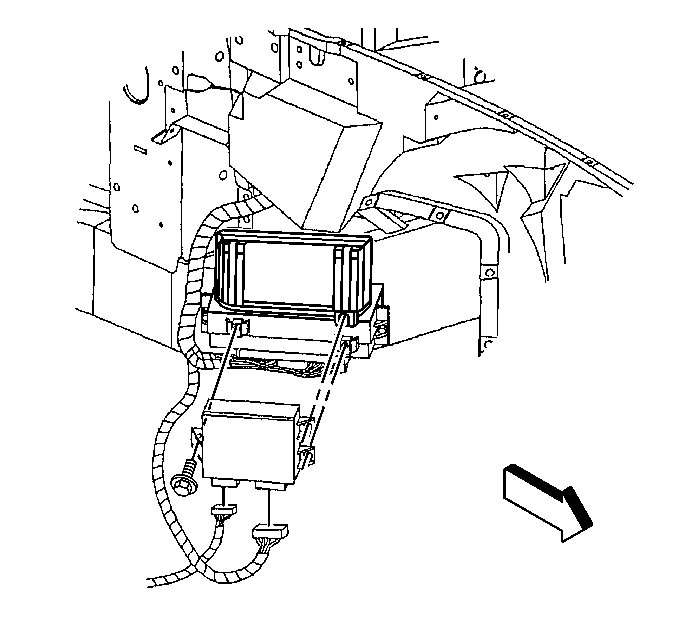
Removal Procedure
1. Remove the wheelhouse filler panel. Refer to Wheelhouse Filler Replacement in Body Front End.
2. Remove the fasteners retaining the throttle actuator control (TAC) module to the powertrain control module (PCM) mounting bracket.
Important
o Remove any debris from the TAC module connector surfaces before servicing the TAC module. Inspect the TAC module connector gaskets if you diagnose or replace the TAC module. Verify that the gaskets are installed correctly. The gaskets prevent contaminate intrusion into the TAC module.
o Do not touch the connector pins in order to prevent possible electrostatic discharge (ESD) damage to the TAC module.
o The ignition should always be OFF if you install or remove the TAC module connectors.
3. Remove the electrical connectors from the TAC module.
4. Remove the TAC module from the vehicle.
Installation Procedure
1. Connect the electrical connectors to the TAC module.
2. Align the hole in the rear mounting tab of the TAC module to the corresponding hole in the PCM mounting bracket. Position the TAC module below the rear mounting tab for greater clearance in order to install the rear retaining fastener.
3. Install the TAC module rear retaining fastener.
4. Align the front mounting holes of the TAC module.
Notice
Refer to Fastener Notice in Cautions and Notices.
5. Install the TAC module front retaining fasteners. Tighten
Tighten the TAC module retaining fasteners to 2.0 N•m (17 lb in).
6. Install the wheelhouse filler panel. Refer to Wheelhouse Filler Replacement in Body Front End.
DTC P2101
Circuit Description
The commanded throttle position, based on accelerator pedal position and possibly on other limiting factors, is compared to the actual throttle position. The 2 values should be within a calibrated range of each other. Both the powertrain control module (PCM) and the throttle actuator control (TAC) module redundantly monitor the commanded and actual throttle position. If the PCM detects an out-of-range condition between the commanded and the actual pedal position, DTC P2101 sets.
Conditions for Running the DTC
• DTCs P0601, P0602, P0604, P0606, P1516, P2108, U0107 are not set.
• DTCs P0120, P0220 and P2135 are not set at the same time, or DTCs P0120 and P0220 are not set at the same time.
• The ignition switch is in the crank or the run position.
• The ignition voltage is greater than 8.5 volts.
• The TAC system is not in the battery saver mode.
Conditions for Setting the DTC
• The PCM detects that the commanded and the actual throttle positions are not within a calibrated range of each other.
• The above condition is met for less than 1 second.
Action Taken When the DTC Sets
• The control module illuminates the malfunction indicator lamp (MIL) when the diagnostic runs and fails.
• The control module records the operating conditions at the time the diagnostic fails. The control module stores this information in the Freeze Frame and/or the Failure Records.
• The control module commands the TAC system to operate in the Reduced Engine Power mode.
• A message center or an indicator displays Reduced Engine Power.
• Under certain conditions the control module commands the engine OFF.
Conditions for Clearing the MIL/DTC
• The control module turns OFF the malfunction indicator lamp (MIL) after 3 consecutive ignition cycles that the diagnostic runs and does not fail.
• A current DTC, Last Test Failed, clears when the diagnostic runs and passes.
• A history DTC clears after 40 consecutive warm-up cycles, if no failures are reported by this or any other emission related diagnostic.
• Clear the MIL and the DTC with a scan tool.
Diagnostic Aids
• If you do not find any trouble, inspect for mechanical problems or for binding that may be temperature related. Components may not move freely in extreme heat or cold due to the presence of contaminants or due to ice formation.
• Inspect the TAC module connectors for signs of water intrusion. When water intrusion occurs, multiple DTCs could be set with no circuit or component conditions found during diagnostic testing. • When the TAC module detects a condition within the TAC system, more than 1 TAC system related DTC may set. This is due to the many redundant tests that run continuously on this system. Locating and repairing 1 individual condition may correct more than 1 DTC. Disconnecting components during testing may set additional DTCs. Keep this in mind when reviewing the stored information, Capture info.
Throttle Actuator Control (TAC) System Description
(1) Throttle Actuator Control (TAC) Module
(2) Throttle Body Assembly
(3) Accelerator Pedal Position (APP) Sensor
The throttle actuator control (TAC) system uses the vehicle electronics and components in order to calculate and control the position of the throttle blade. This system eliminates the need for a mechanical cable attachment from the accelerator pedal to the throttle body. This system also performs the cruise control functions.
The TAC system components include but is not limited to the following:
• The accelerator pedal position (APP) sensor
• The throttle body
• The throttle actuator control (TAC) module
• The powertrain control module (PCM)
Each of these components interface together in order to ensure accurate calculations, and in order to control the throttle position.
Accelerator Pedal Position (APP) Sensor
The accelerator pedal position (APP) sensor is mounted on the accelerator pedal assembly. The APP is actually 3 individual accelerator pedal position sensors within 1 housing. Three separate signal, low reference, and 5-volt reference circuits are used in order to connect the APP and the TAC module. The APP sensor 1 voltage should increase at the same time that the accelerator pedal is depressed, from below 1 volt at 0 percent pedal travel to above 2 volts at 100 percent pedal travel. APP sensor 2 voltage should decrease from above 4 volts at 0 pedal travel to below 2.9 volts at 100 percent pedal travel. APP sensor 3 voltage should decrease from above 3.8 volts at 0 pedal travel to below 3.1 volts at 100 percent pedal travel.
Throttle Body Assembly
The throttle body for the TAC system is similar to a conventional throttle body with some exceptions. One exception is the use of a motor to control the throttle position (TP) instead of a mechanical cable. The other exception is the new design TP sensor. The TP sensor mounts on the side of the throttle body opposite the throttle actuator motor. The TP sensor is actually 2 individual TP sensors within 1 housing. Separate low reference and 5-volt reference circuits are used in order to connect the TP sensors and the TAC module. The TP sensor 1 signal voltage increases at the same time that the throttle opens. The voltage increases, from approximately 1 volt at 0 throttle to above 3.5 volts at 100 percent throttle. TP sensor 2 signal voltage decreases at the same time that the throttle is opened. The voltage increases from approximately 3.8 volts at 0 throttle to below 1 volt at 100 percent throttle.
Throttle Actuator Control (TAC) Module Replacement
Removal Procedure
1. Remove the wheelhouse filler panel. Refer to Wheelhouse Filler Replacement in Body Front End.
2. Remove the fasteners retaining the throttle actuator control (TAC) module to the powertrain control module (PCM) mounting bracket.
Important
o Remove any debris from the TAC module connector surfaces before servicing the TAC module. Inspect the TAC module connector gaskets if you diagnose or replace the TAC module. Verify that the gaskets are installed correctly. The gaskets prevent contaminate intrusion into the TAC module.
o Do not touch the connector pins in order to prevent possible electrostatic discharge (ESD) damage to the TAC module.
o The ignition should always be OFF if you install or remove the TAC module connectors.
3. Remove the electrical connectors from the TAC module.
4. Remove the TAC module from the vehicle.
Installation Procedure
1. Connect the electrical connectors to the TAC module.
2. Align the hole in the rear mounting tab of the TAC module to the corresponding hole in the PCM mounting bracket. Position the TAC module below the rear mounting tab for greater clearance in order to install the rear retaining fastener.
3. Install the TAC module rear retaining fastener.
4. Align the front mounting holes of the TAC module.
Notice
Refer to Fastener Notice in Cautions and Notices.
5. Install the TAC module front retaining fasteners. Tighten
Tighten the TAC module retaining fasteners to 2.0 N•m (17 lb in).
6. Install the wheelhouse filler panel. Refer to Wheelhouse Filler Replacement in Body Front End.

Safety Car

Joined: Aug 2000
Posts: 4,933
Likes: 30
From: San Rafael CA
You say you "washed down the engine" ..... 
NEVER .... EVER ..... do that ....
The Corvette engine compartment is not designed to have a hose taken to it ..... there is way too much electronics in there for this to be a good idea.
An example .... if you take a hose to the engine, water will pool under the intake manifold, and will damage/destroy your knock sensors .....
Like the Mythbuster's say .... don't try this at home .... EVER .....
NEVER .... EVER ..... do that ....
The Corvette engine compartment is not designed to have a hose taken to it ..... there is way too much electronics in there for this to be a good idea.
An example .... if you take a hose to the engine, water will pool under the intake manifold, and will damage/destroy your knock sensors .....
Like the Mythbuster's say .... don't try this at home .... EVER .....
Thread Starter
Racer
Joined: Mar 2008
Posts: 328
Likes: 1
From: Houston TX
St. Jude Donor '08
Replacing Throttle Position Sensor.
Problem continues. I've ordered a new throttle position sensor from GMPARTSDIRECT. Have not heard back from them yet. Hopefully this will be $85 well spent. 
Corvette Stories
The Best of Corvette for Corvette Enthusiasts

Top 10 Most Expensive Corvettes Ever Sold on Bring A Trailer
Brett Foote
10 Things Every Corvette Owner Needs (2026 Edition)
Michael S. Palmer
8 Most "Only Corvette Owners Understand" Quirks and Problems
Pouria Savadkouei
10 Reasons the C6 Z06 is Still A Performance Benchmark After 20 Years
Joe Kucinski
How Much Horsepower Every Corvette Engine "LOST" in 1972
Joe Kucinski
Top 10 DOs and DON'Ts for Protecting Your Convertible Top!
Michael S. Palmer
Top 10 Most Explosive Corvettes Ever Made: Power-to-Weight Ratio Ranked!
Joe Kucinski
150 hp to 1,250 hp: Every Corvette Generation Compared by the Specs That Matter
Joe Kucinski
8 Coolest Corvette Pace Cars (and Replicas) of All Time
Verdad Gallardo
Thread Starter
Racer
Joined: Mar 2008
Posts: 328
Likes: 1
From: Houston TX
St. Jude Donor '08
Fixed!
Replaced the throttle position sensor and cleaned the throttle body. It had some carbon build up. How does that happen? I mean, it's just air going through there. At any rate, car runs like a Bat out of #**!.
