




Cold Air Induction Question

Thread Starter
1st Gear

Joined: Jan 2009
Posts: 1
Likes: 0
 Cold Air Induction Question
I have a 1999 C5 and I am considering installing a cold air induction kit from Mid-America.
#628-196 Ram Air Intake System with our High Flow Mass Air Flow Sensor and a Smooth Flow Air Coupler. Sale price $399.00
http://www.mamotorworks.com/corvette-2-135-7248.html
How much horsepower will it add for REAL?
Do you have any recommendations?
#628-196 Ram Air Intake System with our High Flow Mass Air Flow Sensor and a Smooth Flow Air Coupler. Sale price $399.00
http://www.mamotorworks.com/corvette-2-135-7248.html
How much horsepower will it add for REAL?
Do you have any recommendations?
Race Director


Joined: Dec 2000
Posts: 19,304
Likes: 85
From: San Diego CA
This is not a cold air induction kit and any gains you get will be lost once the engine bay heat-soaks from slow moving and stop & go driving. If you do buy something like this, make sure you open up your fog light covers by coring holes in them or installing a predrilled set. For the ultimate in preformance AND quality right out of the box, the Callaway Honker is top-tier but fairly expensive. For a brief description of other options, see below:
My costs may be a bit off, but most of what is stated here is based upon my experience with aftermarket intake systems for the C5....
If you live in California, think twice about the Vararam, as it can be a royal pain to install/uninstall/reinstall for smog tests. If you live in a state that doesn't have visual inspections, then also take a look at the following (grouped by cold air and non-cold air, but in no particular order) and my comments, if any:
Vararam: Brings cold air in through the fog light panel area to a panel-type filter. Owners have had good luck with system on the dragstrip, but plan on spending hours to install and a bit more to get everything lined up well. Downside: Eliminates engine bay-cooling air that would've come in from the fog light panels (Z06 or coupe/vert with opened-up panels), so the engine bay may end up being toastier, especially if you add headers later. $300-$400 (NOT smog legal in CA)
Vortech Rammer: Brings cold air up from in front of the radiator and into an enclosed box. Its filter is quite a bit smaller than the Halltech Warhead or Blackwing unit. $250 (NOT smog legal in CA)
Callaway Honker intake system: This one relocates the MAF so that it is just in front of the throttlebody. It directs cold air from underneath and costs about $500. I believe this unit is 50 states legal (smogwise) for non=Z06 C5s. Excellent design and quality. If cost is no object, this bad boy should be at the top of your list.
K&N FIPK: This is more of a semi-cold air system, as the cold air intake opening is more of a slit. Its filter endcaps are carbon fiber. However, it is configured similarly to the Halltech Stinger-R and is 50-states legal. $350
Reverse Zip-tie: Allows cold air to be drawn in from underneath, but the bare filter is exposed to potential damage from larger objects. The advantage here is that you may pass smog if the tech doesn't know "which way is up".
Warm air systems: (Easy installation)
Halltech Stinger-R: Not only contains the massive Warhead filter, but also includes a larger-than-stock airbridge and smooth throttlebody coupler. For $350.00 or less, this system represents one of the best bangs for the buck. Fortunately, if you don't like Z06 screens in front of cored-out fog light panels, (for about $40) you can add cold air induction. See my procedure at http://www.conceptualpolymer.com/corvette_c5_corner.htm
This is what I did and a swap to smog-legal status is very easy to do, as I have kept my Z06 intake box.
Halltech Stinger SSM: This intake system features an even larger filter than that of the Stinger-R, TRAP, and Blackwing. < $400
Blackwing: Includes just a large filter, but an excellent one at that. Its cost is close to that of the Stinger. Like the Stinger, it is not smog-legal in CA, but can easily be swapped.
Volant Twin Cone: This system gives you more open filter surface area than any stock box does and is well suited to an engine bay that gets cold air in from the fog light panels, as the filters are more or less in the air flow path. $265
2002+ Z06 airbox cover: A larger opening allows more air to be drawn in through the filter. Expect up to a 5 RWHP gain from this simple swap. $50
Zip-tie: An easy and inexpensive mod (eliminates the OEM box’s upper lid), but its sealing ability is questionable at best.
According to Jim Hall of Halltech, at 95-degrees IAT, the Blackwing (and other non-CAI intakes) will lose 1 degree of timing. At 135-degrees a full 12 degrees is pulled on the LS1 which equals 10 RWHP.
I measured before and after air intake temperature data with a stock Halltech Stinger and then with the same intake but with my CAI mod. The difference was staggering:
After sitting in traffic/slow-moving for 10 minutes or so, my stock Halltech setup was pulling in air that reached 145+ degreesF. Even after driving at highway speeds for 15 minutes, the intake temps never fell below 110F or so.
After installing my CAI mod, sitting in traffic/slow-moving for 10 minutes or more never produced more than 110 degrees F intake temps. After driving on the highway for less than a few minutes, the intake temps went all the way down to ambient temperatures (about 80 degrees F).
As far as horsepower gains, most aftermarket intakes will produce about the same horsepower gains if the intake air is kept relatively cool. During the many dyno runs I have seen, each car had its hood open and a large fan blowing air on the radiator. Vararam-equipped C5s produced the same gains as the Halltech and Blackwing-equipped C5s.
As was mentioned, the gains are only achieved permanently if the intake air is kept below a certain level. If not, much, if not all of your gains will be "dialed back" by the ECU.
Ebay specials: Most intake system air "runners" are made of plastic, not because it is the cheapest (it often isn't) material, but because the last thing most people want is the engine bay heat being transferred to the intake air via a metal runner. Many of the inexpensive Ebay intakes I've seen have metal runners - not good, IMO. Also, the filter is the most critical part of the intake system - why buy an unknown brand of filter for such a critical application? Please, don't cheap-out on an intake system. Stick with brands that have a long history of making quality products.
How good are these systems? My experience has shown that most will bump up RWHP by at least 10. The advantage of having cold air is that power will not be "dialed down" under slow moving/stop&go conditions.
You could easily lose 10 HP with a warm air system after engine bay temps rise during slow-moving conditions. Cold air prevents this from happening.
My costs may be a bit off, but most of what is stated here is based upon my experience with aftermarket intake systems for the C5....
If you live in California, think twice about the Vararam, as it can be a royal pain to install/uninstall/reinstall for smog tests. If you live in a state that doesn't have visual inspections, then also take a look at the following (grouped by cold air and non-cold air, but in no particular order) and my comments, if any:
Vararam: Brings cold air in through the fog light panel area to a panel-type filter. Owners have had good luck with system on the dragstrip, but plan on spending hours to install and a bit more to get everything lined up well. Downside: Eliminates engine bay-cooling air that would've come in from the fog light panels (Z06 or coupe/vert with opened-up panels), so the engine bay may end up being toastier, especially if you add headers later. $300-$400 (NOT smog legal in CA)
Vortech Rammer: Brings cold air up from in front of the radiator and into an enclosed box. Its filter is quite a bit smaller than the Halltech Warhead or Blackwing unit. $250 (NOT smog legal in CA)
Callaway Honker intake system: This one relocates the MAF so that it is just in front of the throttlebody. It directs cold air from underneath and costs about $500. I believe this unit is 50 states legal (smogwise) for non=Z06 C5s. Excellent design and quality. If cost is no object, this bad boy should be at the top of your list.
K&N FIPK: This is more of a semi-cold air system, as the cold air intake opening is more of a slit. Its filter endcaps are carbon fiber. However, it is configured similarly to the Halltech Stinger-R and is 50-states legal. $350
Reverse Zip-tie: Allows cold air to be drawn in from underneath, but the bare filter is exposed to potential damage from larger objects. The advantage here is that you may pass smog if the tech doesn't know "which way is up".
Warm air systems: (Easy installation)
Halltech Stinger-R: Not only contains the massive Warhead filter, but also includes a larger-than-stock airbridge and smooth throttlebody coupler. For $350.00 or less, this system represents one of the best bangs for the buck. Fortunately, if you don't like Z06 screens in front of cored-out fog light panels, (for about $40) you can add cold air induction. See my procedure at http://www.conceptualpolymer.com/corvette_c5_corner.htm
This is what I did and a swap to smog-legal status is very easy to do, as I have kept my Z06 intake box.
Halltech Stinger SSM: This intake system features an even larger filter than that of the Stinger-R, TRAP, and Blackwing. < $400
Blackwing: Includes just a large filter, but an excellent one at that. Its cost is close to that of the Stinger. Like the Stinger, it is not smog-legal in CA, but can easily be swapped.
Volant Twin Cone: This system gives you more open filter surface area than any stock box does and is well suited to an engine bay that gets cold air in from the fog light panels, as the filters are more or less in the air flow path. $265
2002+ Z06 airbox cover: A larger opening allows more air to be drawn in through the filter. Expect up to a 5 RWHP gain from this simple swap. $50
Zip-tie: An easy and inexpensive mod (eliminates the OEM box’s upper lid), but its sealing ability is questionable at best.
According to Jim Hall of Halltech, at 95-degrees IAT, the Blackwing (and other non-CAI intakes) will lose 1 degree of timing. At 135-degrees a full 12 degrees is pulled on the LS1 which equals 10 RWHP.
I measured before and after air intake temperature data with a stock Halltech Stinger and then with the same intake but with my CAI mod. The difference was staggering:
After sitting in traffic/slow-moving for 10 minutes or so, my stock Halltech setup was pulling in air that reached 145+ degreesF. Even after driving at highway speeds for 15 minutes, the intake temps never fell below 110F or so.
After installing my CAI mod, sitting in traffic/slow-moving for 10 minutes or more never produced more than 110 degrees F intake temps. After driving on the highway for less than a few minutes, the intake temps went all the way down to ambient temperatures (about 80 degrees F).
As far as horsepower gains, most aftermarket intakes will produce about the same horsepower gains if the intake air is kept relatively cool. During the many dyno runs I have seen, each car had its hood open and a large fan blowing air on the radiator. Vararam-equipped C5s produced the same gains as the Halltech and Blackwing-equipped C5s.
As was mentioned, the gains are only achieved permanently if the intake air is kept below a certain level. If not, much, if not all of your gains will be "dialed back" by the ECU.
Ebay specials: Most intake system air "runners" are made of plastic, not because it is the cheapest (it often isn't) material, but because the last thing most people want is the engine bay heat being transferred to the intake air via a metal runner. Many of the inexpensive Ebay intakes I've seen have metal runners - not good, IMO. Also, the filter is the most critical part of the intake system - why buy an unknown brand of filter for such a critical application? Please, don't cheap-out on an intake system. Stick with brands that have a long history of making quality products.
How good are these systems? My experience has shown that most will bump up RWHP by at least 10. The advantage of having cold air is that power will not be "dialed down" under slow moving/stop&go conditions.
You could easily lose 10 HP with a warm air system after engine bay temps rise during slow-moving conditions. Cold air prevents this from happening.

Team Owner


Joined: Mar 1999
Posts: 22,025
Likes: 192
From: At the beach in little Rhody
I have a 1999 C5 and I am considering installing a cold air induction kit from Mid-America.
#628-196 Ram Air Intake System with our High Flow Mass Air Flow Sensor and a Smooth Flow Air Coupler. Sale price $399.00
http://www.mamotorworks.com/corvette-2-135-7248.html
How much horsepower will it add for REAL?
Do you have any recommendations?
#628-196 Ram Air Intake System with our High Flow Mass Air Flow Sensor and a Smooth Flow Air Coupler. Sale price $399.00
http://www.mamotorworks.com/corvette-2-135-7248.html
How much horsepower will it add for REAL?
Do you have any recommendations?
Drifting


Joined: Nov 2007
Posts: 1,616
Likes: 11
From: Newport, RI
People seem to rave about the Callaway Honker, but how is the Honker any different from the inexpensive Reverse Zip-tie???? Seems like the easiest and cheapest method is the Reverse Zip-tie....................
-
-

Melting Slicks

Joined: Dec 2003
Posts: 2,334
Likes: 11
From: las vegas nv.
Cheap mod--cut your air box from the original opening across to the metal clamps--than cut all the way down-the opening will be about 9 3/4 in across by 4 1/2 in down --put closed cell foam on the sides of the air box--wont let any hot engine heat in00all you will have is outside air from the z06 front screens getting into the filter--works great-
Melting Slicks

Joined: Jun 2004
Posts: 2,453
Likes: 81
From: Fishin' Pole FL

Le Mans Master

Joined: Feb 2003
Posts: 6,683
Likes: 144
From: Memphis Tennessee
I chose the chrome twin filter type, and did so for looks alone.
As mentioned, there is really little SOTP improvement with any of the systems. I suggest you do your research and then choose one that you like the look of.
JMHO
As mentioned, there is really little SOTP improvement with any of the systems. I suggest you do your research and then choose one that you like the look of.
JMHO
Corvette Stories
The Best of Corvette for Corvette Enthusiasts

Top 10 Most Expensive Corvettes Ever Sold on Bring A Trailer
Brett Foote
10 Things Every Corvette Owner Needs (2026 Edition)
Michael S. Palmer
8 Most "Only Corvette Owners Understand" Quirks and Problems
Pouria Savadkouei
10 Reasons the C6 Z06 is Still A Performance Benchmark After 20 Years
Joe Kucinski
How Much Horsepower Every Corvette Engine "LOST" in 1972
Joe Kucinski
Top 10 DOs and DON'Ts for Protecting Your Convertible Top!
Michael S. Palmer
Top 10 Most Explosive Corvettes Ever Made: Power-to-Weight Ratio Ranked!
Joe Kucinski
150 hp to 1,250 hp: Every Corvette Generation Compared by the Specs That Matter
Joe Kucinski
8 Coolest Corvette Pace Cars (and Replicas) of All Time
Verdad Gallardo
Race Director
Joined: Dec 2000
Posts: 19,304
Likes: 85
From: San Diego CA
The Callaway Honker relocates the MAF - a major advantage when you don't want excessive oil from an aftermarket filter getting on the MAF wires. C6s have their MAF in the same location - right in front of the TB.

Safety Car


Joined: Oct 2000
Posts: 4,949
Likes: 10
From: Monticello MN
I know the Callaway gets great reviews and I don't doubt it performs very well. Perhaps I don't understand the design, but, it appears to me to be just a fancier version of the Vortex, except for the relocation of the MAF. Now, the Vortex had a greater propensity for water injestion, than many, due to getting fed from the air dam which acts as a scoop when driving through deeper puddles. Also, when stopped, or moving very slowly, it appears to me that the air flowing next to a hot radiator will pick up a pretty fair amount of heat. How is the Callaway different in these respects from the Vortex? Can someone please enlighten me? Thanks!
Ed
Ed
Race Director
Joined: Dec 2000
Posts: 19,304
Likes: 85
From: San Diego CA
The height of the scoop is very nearly the same as the front fascia where your foglights (or open screens) are, so you'd have to traverse a very deep stream to ingest enough water to hydrolock the engine. I've driven through torrential downpours after installing my home-made CAI scoop and the worst that happened was the filter became damp.
But you are correct in that the Callaway pulls cold air in from the same general area as the Vortex. Both are true cold air systems. However, I like the idea that my version also blasts cold air into the engine bay to cool off my catch can, drive belt, hoses, and electronic components. Heat accelerates the death of eleastomers and hard plastics.
But you are correct in that the Callaway pulls cold air in from the same general area as the Vortex. Both are true cold air systems. However, I like the idea that my version also blasts cold air into the engine bay to cool off my catch can, drive belt, hoses, and electronic components. Heat accelerates the death of eleastomers and hard plastics.
Safety Car
Joined: Oct 2000
Posts: 4,949
Likes: 10
From: Monticello MN
The height of the scoop is very nearly the same as the front fascia where your foglights (or open screens) are, so you'd have to traverse a very deep stream to ingest enough water to hydrolock the engine. I've driven through torrential downpours after installing my home-made CAI scoop and the worst that happened was the filter became damp.
But you are correct in that the Callaway pulls cold air in from the same general area as the Vortex. Both are true cold air systems. However, I like the idea that my version also blasts cold air into the engine bay to cool off my catch can, drive belt, hoses, and electronic components. Heat accelerates the death of eleastomers and hard plastics.
But you are correct in that the Callaway pulls cold air in from the same general area as the Vortex. Both are true cold air systems. However, I like the idea that my version also blasts cold air into the engine bay to cool off my catch can, drive belt, hoses, and electronic components. Heat accelerates the death of eleastomers and hard plastics.
My foglight shrouds are drilled. I suspect, then, I could have the best of both also with the Callaway. Is this true?
Ed

Tech Contributor


Joined: Jan 2007
Posts: 19,470
Likes: 1,171
From: Dyer, IN


Le Mans Master


Joined: Mar 2002
Posts: 8,466
Likes: 51
St. Jude Donor '17
DId you ever look at the calloway site? you get a different MAF and it is relocated.
Le Mans Master
Joined: Mar 2002
Posts: 8,466
Likes: 51
St. Jude Donor '17
GUess you picked the wrong system.. Sorry
Drifting
Joined: Nov 2007
Posts: 1,616
Likes: 11
From: Newport, RI
I went with Vararam. A buddy of mine did Vararam a while back and his 0-60 time went from 5.0 to 4.5 seconds (stock '98 C5 vert). We did a number of tests (to confirm) using G-Tech accelerometer and we always tested on the same stretch of road. That's an incredible improvement in 0-60 times. Shows what a difference it can make to get cold air into the engine.
-

Administrator


Joined: Jun 2007
Posts: 66,409
Likes: 2,061
From: Bel Air (by way of Fort Worth, TX) Maryland
St. Jude Donor '12 thru '21
Fact is, on an otherwise stock motor, an intake will not gain you much HP wise. 7-15 HP depending on the intake selected.
That increase is at the top of the RPM range. If you race your Vette, then swapping out the intake for a Callaway or a VaraRam is a helpful modification in shaving that 1/4 mile time.
Swapping an intake along with an exhaust modification is a logical first step to power mods that will require the increased air.


Burning Brakes

Joined: Feb 2005
Posts: 1,099
Likes: 1
From: Branford Connecticut
I know the Callaway gets great reviews and I don't doubt it performs very well. Perhaps I don't understand the design, but, it appears to me to be just a fancier version of the Vortex, except for the relocation of the MAF. Now, the Vortex had a greater propensity for water injestion, than many, due to getting fed from the air dam which acts as a scoop when driving through deeper puddles. Also, when stopped, or moving very slowly, it appears to me that the air flowing next to a hot radiator will pick up a pretty fair amount of heat. How is the Callaway different in these respects from the Vortex? Can someone please enlighten me? Thanks!
Ed
Ed
2. When stopped, if the engine is up to temperature and the fans are on, cooler ambient air is being pulled into the area in front of and through the radiator. The inlet air going into the filter element doesn't get a chance to absorb radiator heat. As soon as the car begins to move, Chevrolet designed the body such that air can flow into this area freely. The inlet air temperature sensor constantly provides updated temperature values to the PCM and the injector pulse width and spark timing are adjusted. If the engine isn't up to temperature yet, you should avoid WOT acceleration.
3. Given the thousands of Honkers sold, Callaway has never received a verified report of water ingestion. There have been some reports in the Forum, but I've reached out to get details and haven't been able to get confirmation. If standing water is deep enough to get ingested into the Honker, it would most likely have the same effect with a stock air cleaner system. Callaway engineers tested extensively before C5 Honker introduction in 2003, including testing for water ingestion.
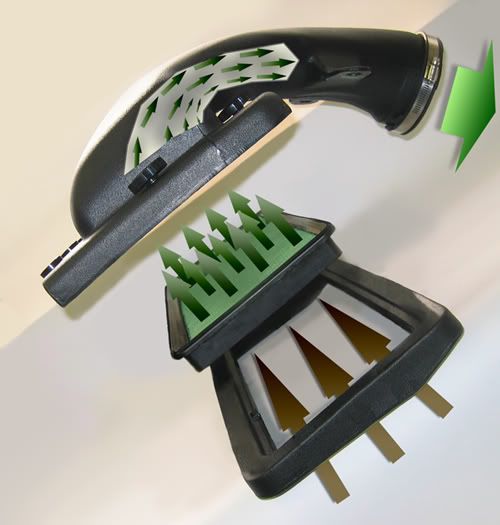
4. Another significant difference is relocatiion of the MAF sensor toward the throttle body, eliminating the air bridge and the turbulence that the complex duct shape produces. "High flow" air bridges have tried to reduce turbulence and increase power. Callaway engineers determined how to orient everything for maximum airflow while avoiding DTC's. A side benefit is the expense of the high flow air bridge is eliminated as well. The stock C6 air filter system locates the MAF sensor this way.
Here's an illustration of the C6 Honker (from when we used the Green Filter) that shows the unrestricted, straight air path. It's very similar to the C5 system. Just the shape of the top of the C5 duct is oval instead of round as shown in the C6 here:
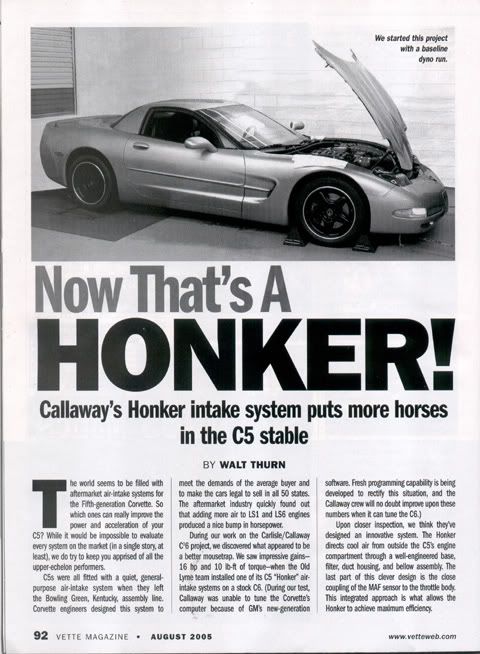
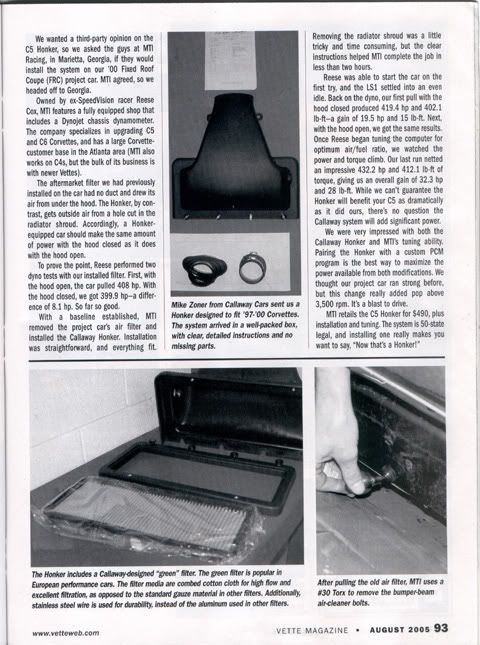
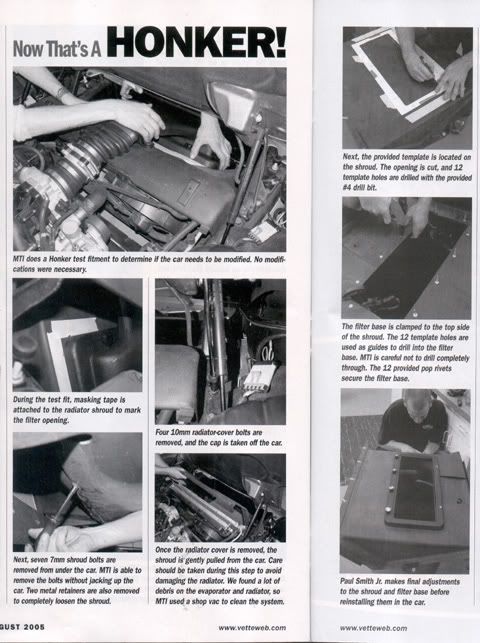
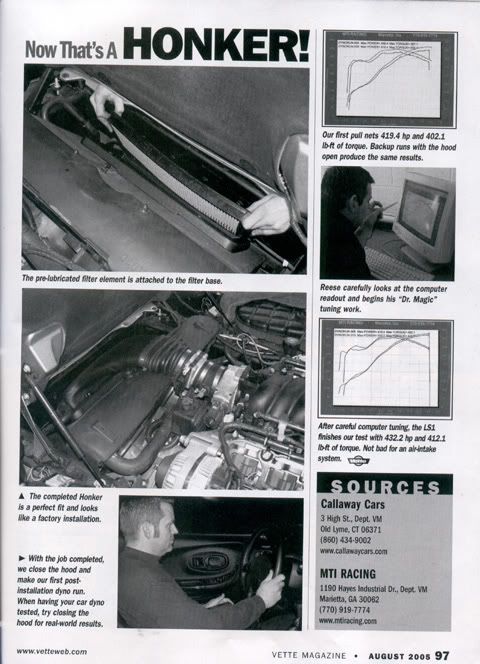
Here's an article from Vette Magazine that described the results they saw in an independent test:
Last edited by mcv; Jan 10, 2009 at 11:50 AM.