








whats a catch can for?

Race Director


Joined: Jan 2006
Posts: 10,554
Likes: 33
From: Not on either liberal coast.

There's lots of past debates, some very heated, about the pros/cons of the catch can use on an LSx motor.
Some say you don't need it or GM would have put them there. Some say you don't need any oil in your intake. That latter was my justification to install one. I check it every oil change and find a small amount trapped in the can.
Use "catch can" in C5 Tech as the keywords. You can use search or search this forum in the red banner...
Some say you don't need it or GM would have put them there. Some say you don't need any oil in your intake. That latter was my justification to install one. I check it every oil change and find a small amount trapped in the can.
Use "catch can" in C5 Tech as the keywords. You can use search or search this forum in the red banner...
Last edited by hotwheels57; Feb 8, 2009 at 11:41 AM.

Burning Brakes

Joined: Aug 2006
Posts: 1,217
Likes: 5
From: Stark County Ohio
Usually means catching stuff in a can. 
I crack myself up.
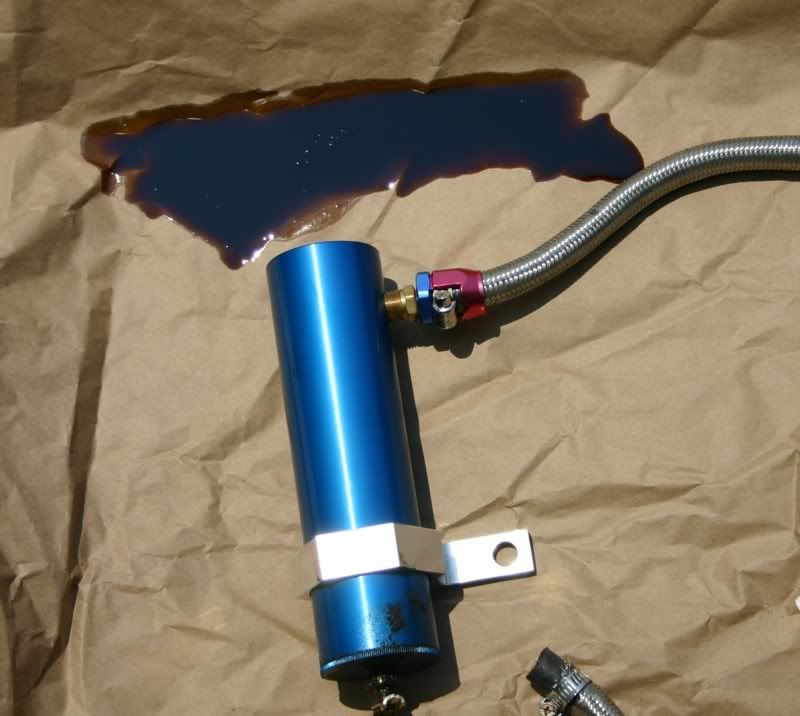
LSx engines benefit from placing a catch can in the PCV system to remove oil (and depositing it in said can) from the PCV air stream before it enters the intake manifold.
I crack myself up.
LSx engines benefit from placing a catch can in the PCV system to remove oil (and depositing it in said can) from the PCV air stream before it enters the intake manifold.

Tech Contributor


Joined: Jan 2007
Posts: 19,422
Likes: 1,146
From: Dyer, IN

Le Mans Master


Joined: Jun 2002
Posts: 8,352
Likes: 103
From: In the pit, trying to love someone.
Corvette Stories
The Best of Corvette for Corvette Enthusiasts

10 Reasons the C6 Z06 is Still A Performance Benchmark After 20 Years
Joe Kucinski
How Much Horsepower Every Corvette Engine "LOST" in 1972
Joe Kucinski
Top 10 DOs and DON'Ts for Protecting Your Convertible Top!
Michael S. Palmer
Top 10 Most Explosive Corvettes Ever Made: Power-to-Weight Ratio Ranked!
Joe Kucinski
150 hp to 1,250 hp: Every Corvette Generation Compared by the Specs That Matter
Joe Kucinski
8 Coolest Corvette Pace Cars (and Replicas) of All Time
Verdad Gallardo
Top 10 Corvette Engines RANKED by Peak Torque (70+ Years of Muscle!)
Joe Kucinski
Corvette ZR1X Will Be Pacing the Indy 500, And Could Probably Race, Too!
Verdad Gallardo
Top 10 Corvettes Coming to Mecum Indy 2026!
Brett Foote
Race Director
Joined: Dec 2000
Posts: 19,304
Likes: 85
From: San Diego CA

Tech Contributor
Joined: Jan 2004
Posts: 20,030
Likes: 289
From: Wylie TX --> Less is More, except under the hood !
A few weeks ago, I cleaned my air filter (Vararam) and pulled my throttle body off to clean it also. I looked inside the black intake manifold and found a small puddle of oil (silver dollar sized) right after the intake opening. Is that what the catch can is supposed to get rid of ?
Toque
Toque
Tech Contributor
Joined: Jan 2004
Posts: 20,030
Likes: 289
From: Wylie TX --> Less is More, except under the hood !
A few weeks ago, I cleaned my air filter (Vararam) and pulled my throttle body off to clean it also. I looked inside the black intake manifold and found a small puddle of oil (silver dollar sized) right after the intake opening. Is that what the catch can is supposed to get rid of ?
Toque
Toque
Answered my own question with some searches on here. Looks like I'm adding a catch can. Maybe a Father's day present from my wife/son...

I was wondering what that oil was doing in my intake...
 .
. Toque

Former Vendor
Joined: May 2005
Posts: 3,749
Likes: 4
From: Valencia Ca
Think more in terms of "oil separator" and you'll be on the right track. Check LPE's website -they have one of the finest, most cost effective solutions going.

Premium Supporting Vendor
Joined: Oct 2004
Posts: 36,838
Likes: 438
From: Manassas Park VA
St. Jude Donor '07-'08,-'13-'14, '16-'17





Drifting

Joined: Feb 2007
Posts: 1,993
Likes: 7
From: LaPine Oregon
cause and effect................
First off if you have a LSx engine you need a oil catch can/ tank i.e. oil seperator for the oil vapor that is emitted from your PVC / crankcase.
The PVC system is closed so that this nasty, oily , water moisture vapor is routed back into the combustion chamber . That's where the fun begins.
This contaminated air fouls the throttle body and MAF sensor causing malfunction or failure.
It will mess up the air /fuel mixture ratio which will cause detenation,then the EMC to retard the timing and reduce power.
Excessive carbon build-up or better think of charcoal bricketts on valves , pistons , ring lands, combustion chambers and spark plugs.
Also this contaminated oil will foul and plug up the CATs and O2 sensors which will increase emissions .
All the above will also eliminate the need for you to carry a wallet, cause you won't have any money left after the repairs.
http://forums.corvetteforum.com/newr...1&p=1568895720
http://www.customcorvetteaccessories...lcatchcan.html
The PVC system is closed so that this nasty, oily , water moisture vapor is routed back into the combustion chamber . That's where the fun begins.
This contaminated air fouls the throttle body and MAF sensor causing malfunction or failure.
It will mess up the air /fuel mixture ratio which will cause detenation,then the EMC to retard the timing and reduce power.
Excessive carbon build-up or better think of charcoal bricketts on valves , pistons , ring lands, combustion chambers and spark plugs.
Also this contaminated oil will foul and plug up the CATs and O2 sensors which will increase emissions .
All the above will also eliminate the need for you to carry a wallet, cause you won't have any money left after the repairs.
http://forums.corvetteforum.com/newr...1&p=1568895720
http://www.customcorvetteaccessories...lcatchcan.html

Race Director


Joined: Feb 1999
Posts: 19,659
Likes: 34
From: Lenoir City Tennessee
Ci 6, 8 & 10 Veteran
St. Jude Donor '05-'06-'07-'08-'09-'10-'11-'12-'13-'14-'15
I have seen several different versions of the catch can installed. It does intrigue me what the difference is in them. I have seen an moisture separator installed and working as a catch can. This seems to be a very cost effective solution to the problem. A couple of weeks ago I installed new water pump seals on my Z and noticed the oil in my intake. I knew when I saw this I needed to pursue the catch can installation.
Racer


Joined: Nov 2006
Posts: 491
Likes: 5
From: Tampa Bay Area, U.S.A. (Zombie Nation)
It may be difficult to quantify but how much worse is this oil-in-intake problem in a racing environment compared to street? Let's say on a scale of 1 to 10. Does it get noticeably worse as an engine wears and blowby increases?
Drifting
Joined: Feb 2007
Posts: 1,993
Likes: 7
From: LaPine Oregon
oil consumption for the LSx
Understand the cause of this blow-by as explained by GM i.e.http://www.rjsmith.com/gm-894549.html
This issue was explained by Dave Hill , Chief Corvette Engineer and John Juriga, Asst Chief Engineer of the Gen 3 engines back in 2002. Driving style, aggressive driving style where high engine speed along with low or no engine load caused piston ring flutter that allowed crankcase oil blow-by.
Well, that's true to a point. It goes deeper. Starting with the 1997 LS1 and then the LS6 Gen 3 (5300) aluminum block has issues with the siamesed cylinder bores ( except the last 20mm) and the limited coolant passages between them. This limited cooling area causes hot spots in the upper areas of the bore that causes distortion both in diameter and bore taper. Gm's machining tolerances for the cylinder bores were also not as tight as it now appears they should have been.
Take that scenerio then add the very thin (at 1.5mm ) flat face piston racing rings with nine (9) pounds of tension ( low tension for less friction). With the condition of the cylinder bores , the rings were taxed to control blow by, particularly when the driving style , as described by Dave Hill came into play.
GM engineers could not determine the acutal problem till the LS6 hit production with its high rpm operating range. The problem became more pronounced. So Bulletin #894549 came to be. The fix was to replace the top piston ring in owners cars that met the criteria with a higher (13 pound ) tension ring with a Napier scaper face. That appeased some of the owners. * Note a new larger diameter piston with a new anti friction polymer was introduced to the 2001 M/Y production line in mid April 2001. This was to address complaints about the 'cold start slap' . This new piston decreased the piston to wall dimension and may have helped the OEM piston rings as well.
With the introduction of the LS6, the PVC oil baffle /oil seperator was placed under the new intake manifold for less exposure to oil vapor.
A new piston ring pack , with the same criteria was introduced to the 2002 M/Y production line, along with the new cold start piston. Oil issues still remain. Engine reliability has never been an issue.
The oil consumption varies widely from car to car and owner to owner. I have three C5s, two (2) 2000 FRC and the 2001 Z06 and all use about the same oil, half quart between 3000 mile oil changes. Note * all the cars have 25,000 or less miles and are not DD. Also all have the LS6 PVC system.
As to will the oil consumption increase with miles , I have not read anyone that complained of that. But reality is that wear will cause increased blow-by but at an accelerated rate, which is what I believe you were refering to.
The LS2 has a new Gen 4 block that addressed the issues of cylinder bore tolerances and cooling. The LS2 uses piston rings still use the Napier face but are thinner (1.2mm) and has less over all tension than the 2001 LS6 does ( so much for those that faulted the piston ring tension alone). Plus the LS2 has PVC oil baffles or seperators at both fresh air inlet and fouled air outlet. Go to the C6 topic area and you will find that they also have oil issues and discuss the installation of oil catch cans or air/oil and condensation seperators.
Many auto manufactures have OEM catch cans, particularly turbo or supercharged cars. Hope this helps . DD
Last edited by dieseldave56; Feb 12, 2009 at 05:59 AM.

