



Degree my Cam?
Melting Slicks


Joined: Dec 2005
Posts: 2,291
Likes: 0
From: sterling ct

in all the pics people have posted, never have i seen a degree wheel in any of them when they show a cam being intalled...they post dozens of pics..one would think a pic of the wheel would be in one...also if the heads are not removed....no way you can degree that cam....
Melting Slicks


Joined: Oct 2007
Posts: 2,464
Likes: 2
From: Cedarburg, WI
in all the pics people have posted, never have i seen a degree wheel in any of them when they show a cam being intalled...they post dozens of pics..one would think a pic of the wheel would be in one...also if the heads are not removed....no way you can degree that cam....
And.....see this thread - I believe you will see a degree wheel more than once starting at post #52!
http://forums.corvetteforum.com/c5-t...of-pics-3.html

Last edited by vsocks1; May 2, 2009 at 09:22 AM.
Melting Slicks
Joined: Dec 2005
Posts: 2,291
Likes: 0
From: sterling ct
funny you should say that...you see i have always known that one can degree a cam with the heads off, but not heads on...when i put out a post last year with respect to what shops degree a cam....a very well known shop on this board and ls1 said "you can not degree a cam with the heads on" so you see....i never said i was an expert...yet a major sponser on this and ls1 who are the "experts" are incorrect.

Le Mans Master


Joined: Sep 2003
Posts: 6,276
Likes: 227
From: Farmington CT
Cruise-In VII Veteran
funny you should say that...you see i have always known that one can degree a cam with the heads off, but not heads on...when i put out a post last year with respect to what shops degree a cam....a very well known shop on this board and ls1 said "you can not degree a cam with the heads on" so you see....i never said i was an expert...yet a major sponser on this and ls1 who are the "experts" are incorrect.


Thread Starter
Burning Brakes

Joined: Jul 2004
Posts: 781
Likes: 1
From: Buffalo Grove IL
Thanks to everyone. I have all the tools necessary except the degree wheel. I have one on order from NAPA (about $50) After spending near $1000 for the parts to do this, and investing all the time, $50 is a minor cost to do it right.
Steve
Steve

Race Director

Joined: Oct 2002
Posts: 16,477
Likes: 26
From: Gone
CI 6-7-8-9-10 Veteran
St. Jude Donor '03
You can degree a cam with the heads on.
Pretty sure Kurtomac just did his this way not long ago.
Spark plug piston stop for locating TDC.
The tough part would be finding a suitable long extension rod for the indicator to reach down to the lifter cup. (...kinda gives me a neat idea for modifying some old stock pushrods to use for this purpose).
And once it is set up, some downward pressure would need to be kept on the indicator rod, or the lifter will likely stick in the tray at peak lift, and it needs to keep following the lobe down.
Pretty sure Kurtomac just did his this way not long ago.
Spark plug piston stop for locating TDC.
The tough part would be finding a suitable long extension rod for the indicator to reach down to the lifter cup. (...kinda gives me a neat idea for modifying some old stock pushrods to use for this purpose).
And once it is set up, some downward pressure would need to be kept on the indicator rod, or the lifter will likely stick in the tray at peak lift, and it needs to keep following the lobe down.

Pro

Joined: Sep 2006
Posts: 731
Likes: 9
From: Ivins, Utah
I love this thread
We used to degree our cams with the heads on all the time.
Like Comp Cams says :
We also recommend positioning the dial indicator on the
#1 intake retainer (this is the valve spring retainer) because lift measurements will include any deflection that may occur in the pushrod and rocker arm. This makes the degreeing process as accurate as possible in relation to what actually
goes on inside the engine.
Step 1: The camshaft and timing set have been installed. Make sure that the timing marks on both the
cam gear and crank gear are aligned properly per the cam installation instructions. Use chalk or
similar marker to better define the marks.
Step 2: For example, we have our cam card and it suggests we install the cam on 106 degree intake
centerline.
Install all the rocker arms and pushrods in the engine as normal.
On #1 intake lobe, install the solid lifter in place of a hydraulic lifter. If a solid lifter or roller cam is being checked, use that respective lifter. Adjust the #1 intake lash to exactly zero. Do not pre-load the lifter. Next, adjust the
#1 exhaust lash to zero. You should be able to turn both pushrods with your fingers easily.
Step 3: Attach the pointer to the block. Many people will make a pointer out of some sort of rigid, yet
manageable wire. A stiff coat hanger wire works well.
Step 4: Attach the degree wheel to the balancer and install the assembly on the crankshaft. There are
several ways to attach the degree wheel to the crankshaft. The crank may be rotated from either the
front or from the flywheel end. Obviously, if the engine is in the car, you must rotate from
We used to degree our cams with the heads on all the time.
Like Comp Cams says :
We also recommend positioning the dial indicator on the
#1 intake retainer (this is the valve spring retainer) because lift measurements will include any deflection that may occur in the pushrod and rocker arm. This makes the degreeing process as accurate as possible in relation to what actually
goes on inside the engine.
Step 1: The camshaft and timing set have been installed. Make sure that the timing marks on both the
cam gear and crank gear are aligned properly per the cam installation instructions. Use chalk or
similar marker to better define the marks.
Step 2: For example, we have our cam card and it suggests we install the cam on 106 degree intake
centerline.
Install all the rocker arms and pushrods in the engine as normal.
On #1 intake lobe, install the solid lifter in place of a hydraulic lifter. If a solid lifter or roller cam is being checked, use that respective lifter. Adjust the #1 intake lash to exactly zero. Do not pre-load the lifter. Next, adjust the
#1 exhaust lash to zero. You should be able to turn both pushrods with your fingers easily.
Step 3: Attach the pointer to the block. Many people will make a pointer out of some sort of rigid, yet
manageable wire. A stiff coat hanger wire works well.
Step 4: Attach the degree wheel to the balancer and install the assembly on the crankshaft. There are
several ways to attach the degree wheel to the crankshaft. The crank may be rotated from either the
front or from the flywheel end. Obviously, if the engine is in the car, you must rotate from
Corvette Stories
The Best of Corvette for Corvette Enthusiasts

How Much Horsepower Every Corvette Engine "LOST" in 1972
Joe Kucinski
Top 10 DOs and DON'Ts for Protecting Your Convertible Top!
Michael S. Palmer
Top 10 Most Explosive Corvettes Ever Made: Power-to-Weight Ratio Ranked!
Joe Kucinski
150 hp to 1,250 hp: Every Corvette Generation Compared by the Specs That Matter
Joe Kucinski
8 Coolest Corvette Pace Cars (and Replicas) of All Time
Verdad Gallardo
Top 10 Corvette Engines RANKED by Peak Torque (70+ Years of Muscle!)
Joe Kucinski
Corvette ZR1X Will Be Pacing the Indy 500, And Could Probably Race, Too!
Verdad Gallardo
Top 10 Corvettes Coming to Mecum Indy 2026!
Brett Foote
Top 10 C9 Corvette MUST-HAVES to Fix These C8 Generation Flaws!
Michael S. Palmer
Instructor

Joined: Jan 2007
Posts: 247
Likes: 41
From: Blue Springs MO
I know part of what you are taking into account when you degree, is the sprockets/timing set, however I have heard some say it even less necessary to degree your cam if you order it from a place like TR, and have it doctored. I believe this is an extra $25 from them.
Thoughts?
Thoughts?
Race Director
Joined: Oct 2002
Posts: 16,477
Likes: 26
From: Gone
CI 6-7-8-9-10 Veteran
St. Jude Donor '03
We used to degree our cams with the heads on all the time.
Like Comp Cams says :
We also recommend positioning the dial indicator on the
#1 intake retainer (this is the valve spring retainer) because lift measurements will include any deflection that may occur in the pushrod and rocker arm. This makes the degreeing process as accurate as possible in relation to what actually
goes on inside the engine.....
On #1 intake lobe, install the solid lifter in place of a hydraulic lifter.
Like Comp Cams says :
We also recommend positioning the dial indicator on the
#1 intake retainer (this is the valve spring retainer) because lift measurements will include any deflection that may occur in the pushrod and rocker arm. This makes the degreeing process as accurate as possible in relation to what actually
goes on inside the engine.....
On #1 intake lobe, install the solid lifter in place of a hydraulic lifter.

You wouldn't be able to degree with an assembled valvetrain and measuring the valve movement with a hyd lifter.
You'd need to indicate the actual lifter movement, in such a manner that you don't compress it, but yet keeping just enough pressure on it to keep the lifter riding on the lobe.

Uneducated autodidact


Joined: Feb 2001
Posts: 5,413
Likes: 252
From: West of the Sabine, Texas

Pro
Joined: Sep 2006
Posts: 731
Likes: 9
From: Ivins, Utah
And how ya gonna do that without pulling the head?
You wouldn't be able to degree with an assembled valvetrain and measuring the valve movement with a hyd lifter.
You'd need to indicate the actual lifter movement, in such a manner that you don't compress it, but yet keeping just enough pressure on it to keep the lifter riding on the lobe.
You wouldn't be able to degree with an assembled valvetrain and measuring the valve movement with a hyd lifter.
You'd need to indicate the actual lifter movement, in such a manner that you don't compress it, but yet keeping just enough pressure on it to keep the lifter riding on the lobe.
You put dummy lifer in, a solid lifter (everyone has one or two of these don't they ??), maybe even a lighter valve spring, depending on if it's a flat tappet cam or not (flat tappet cams should use a light spring to keep the new cam from galling on the botton of the lifter)(good idea to use a lighter spring to "run" the cam in too)

Melting Slicks
Joined: Jul 2000
Posts: 2,541
Likes: 0
From: Chicago
Fact of the matter is anyone swapping a cam to a popular moderate lift/duration cam from a reputable vendor isn't going to gain anything from degreeing their cam other than piece of mind and an intimate understanding of just exactly how their engine works (both good things). For most people the added expense and time required to degree a cam just isn't justifiable. That said however, I would recommend degreeing your cam whenever possible. And definitely if you know that valvetrain clearance is going to be close.
If you buy the comp cam kit you'll need to make a custom mount for the dial indicator mount, purchase an adjustable pushrod length checker and you'll also need to make a solid lifter. You can either epoxy/weld or shim a stock lifter. While degreeing the cam you should also determine the appropriate pushrod length to account for the smaller base circle of the cam (again, for most common cam swaps the vendor can usually recommend an appropriate length push rod based on the heads/gasket/lifters you are using), as well as check the wipe pattern on the valve stem to ensure proper valve train geometry.
For anyone serious about degreeing their cam you should search gmhightech online for the how to write up. It seems like a daunting task at first, but anyone who has patience and an understanding of basic mathematics can properly degree a cam.
Melting Slicks
Joined: Jul 2000
Posts: 2,541
Likes: 0
From: Chicago

Melting Slicks
Joined: Jan 2008
Posts: 2,394
Likes: 0
From: Goldsboro NC
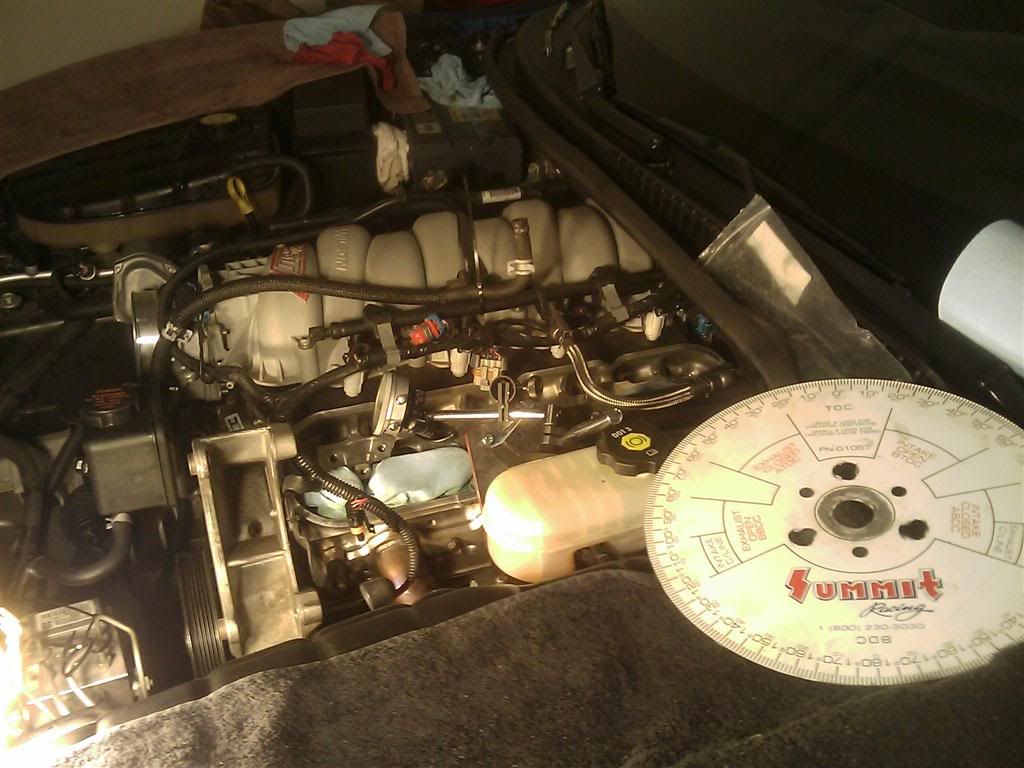
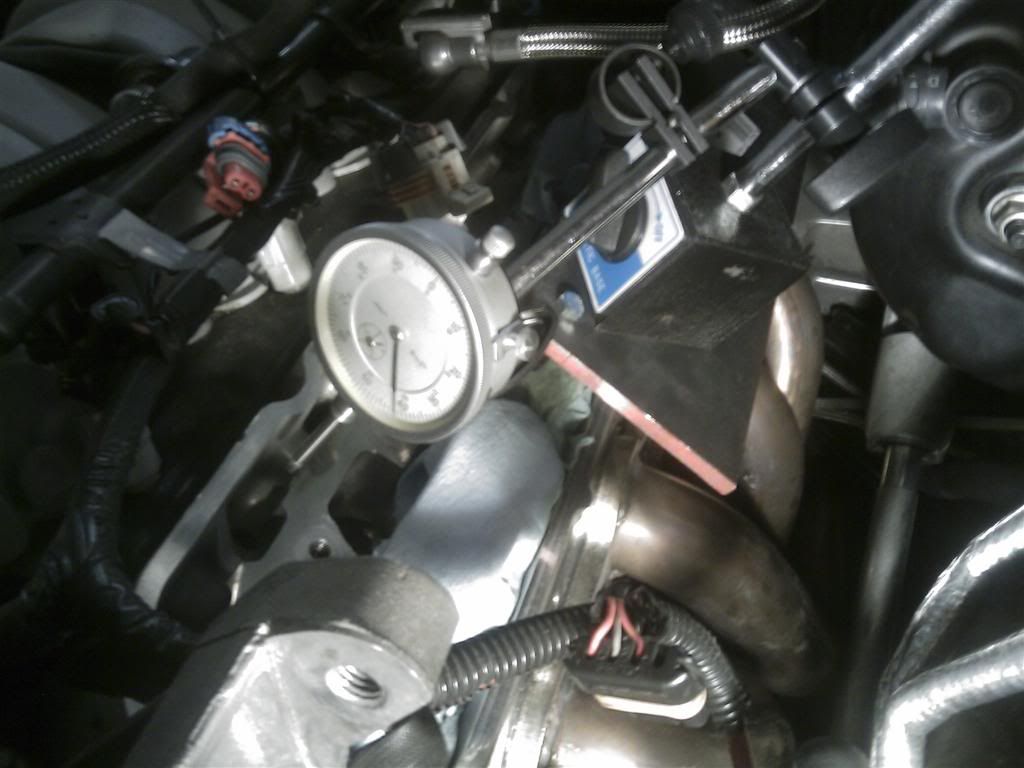
Y2K speaks the truth
You can degree a cam with the heads on.
Pretty sure Kurtomac just did his this way not long ago.
Spark plug piston stop for locating TDC.
The tough part would be finding a suitable long extension rod for the indicator to reach down to the lifter cup. (...kinda gives me a neat idea for modifying some old stock pushrods to use for this purpose).
And once it is set up, some downward pressure would need to be kept on the indicator rod, or the lifter will likely stick in the tray at peak lift, and it needs to keep following the lobe down.
Pretty sure Kurtomac just did his this way not long ago.
Spark plug piston stop for locating TDC.
The tough part would be finding a suitable long extension rod for the indicator to reach down to the lifter cup. (...kinda gives me a neat idea for modifying some old stock pushrods to use for this purpose).
And once it is set up, some downward pressure would need to be kept on the indicator rod, or the lifter will likely stick in the tray at peak lift, and it needs to keep following the lobe down.
