






Ask twice,purchase once.............
Thread Starter
Drifting


Joined: Apr 2005
Posts: 1,545
Likes: 3
From: CLIFTON PARK NY
 Ask twice,purchase once.............
Hey guys,will the relocation of the MAF mess up the readings or cause a check engine light to come on if the MAF is relocated from the air cleaner end of the air bridge to the other end where the throttle body is?Any info is appreciated,as id like to be certain it wont make a difference before i purchase a Vararam power duct which allows the relocation of the MAF,thanks
Burning Brakes


Joined: Sep 2007
Posts: 930
Likes: 3
From: Lawrenceville GA
I installed the Vararam Power duct on my '02 Z06 and it did throw
a code. Since the code said it was lean on one side, I decided to
take the Power duct off until I could get a dyno tune, which I did
about a month ago when I put long tube headers on.
I don't know if everyone has the same problem...
Oh, and I don't remember what code it was. Sorry.
a code. Since the code said it was lean on one side, I decided to
take the Power duct off until I could get a dyno tune, which I did
about a month ago when I put long tube headers on.
I don't know if everyone has the same problem...
Oh, and I don't remember what code it was. Sorry.

Race Director

Joined: Oct 2002
Posts: 16,477
Likes: 26
From: Gone
CI 6-7-8-9-10 Veteran
St. Jude Donor '03
More accurate is probably technically correct, but that doesn't always mean it's a good thing either.
The sensor itself (in theory) should read the airflow more accurately near the throttle body, as the air flow through it will be straighter (more laminar), and less turbulent as opposed to placed right by the airbox or filter.
But, consider the MAF calibration within the PCM tune, is a lookup table of static values. (x g/sec of airflow = x hz).
By making the MAF "more accurate", only means the actual airflow now corresponds to a different frequency (hz) that the MAF reports to the PCM.
If you do not re-plot the MAF calibration to reflect those changes, then the only thing you accomplished is made engine fueling more inaccurate, because now the PCM is now receiving incorrect airflow information, even though the sensor itself may be reading the airflow better.
And the MAF is a big player in how the PCM fuels the engine.
I'm sure the Vararam (and Callaway and Halltech) and any other system that was designed to relocate the MAF has been designed with this in mind, and are such that no tuning changes are "required"...but changing anything with the MAF, even screen removal, will alter the readings it reports to the PCM. Sometimes for the good, sometimes the other way....but never "more accurate" unless recalibration was also done.

The sensor itself (in theory) should read the airflow more accurately near the throttle body, as the air flow through it will be straighter (more laminar), and less turbulent as opposed to placed right by the airbox or filter.
But, consider the MAF calibration within the PCM tune, is a lookup table of static values. (x g/sec of airflow = x hz).
By making the MAF "more accurate", only means the actual airflow now corresponds to a different frequency (hz) that the MAF reports to the PCM.
If you do not re-plot the MAF calibration to reflect those changes, then the only thing you accomplished is made engine fueling more inaccurate, because now the PCM is now receiving incorrect airflow information, even though the sensor itself may be reading the airflow better.
And the MAF is a big player in how the PCM fuels the engine.
I'm sure the Vararam (and Callaway and Halltech) and any other system that was designed to relocate the MAF has been designed with this in mind, and are such that no tuning changes are "required"...but changing anything with the MAF, even screen removal, will alter the readings it reports to the PCM. Sometimes for the good, sometimes the other way....but never "more accurate" unless recalibration was also done.
Corvette Stories
The Best of Corvette for Corvette Enthusiasts

Top 10 Most Expensive Corvettes Ever Sold on Bring A Trailer
Brett Foote
10 Things Every Corvette Owner Needs (2026 Edition)
Michael S. Palmer
8 Most "Only Corvette Owners Understand" Quirks and Problems
Pouria Savadkouei
10 Reasons the C6 Z06 is Still A Performance Benchmark After 20 Years
Joe Kucinski
How Much Horsepower Every Corvette Engine "LOST" in 1972
Joe Kucinski
Top 10 DOs and DON'Ts for Protecting Your Convertible Top!
Michael S. Palmer
Top 10 Most Explosive Corvettes Ever Made: Power-to-Weight Ratio Ranked!
Joe Kucinski
150 hp to 1,250 hp: Every Corvette Generation Compared by the Specs That Matter
Joe Kucinski
8 Coolest Corvette Pace Cars (and Replicas) of All Time
Verdad Gallardo
Le Mans Master


Joined: Nov 2003
Posts: 8,004
Likes: 250
From: Tampa Fl
St. Jude Donor '12-'13-'14
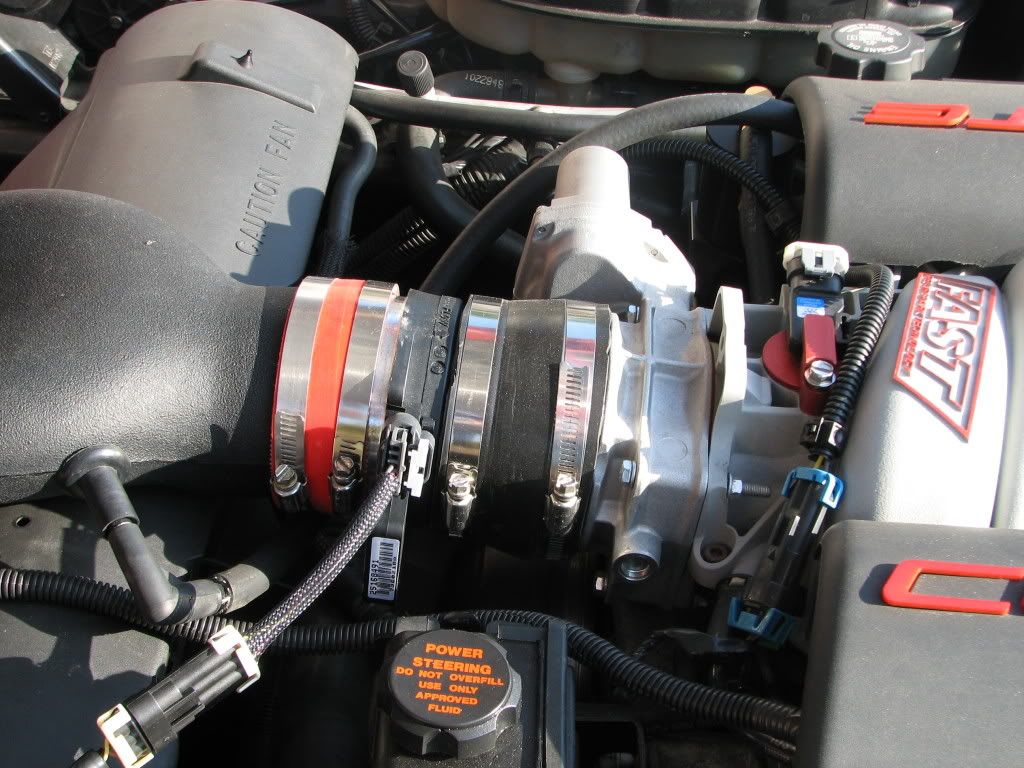
I had mine in the stock position and didnt think twice about it. I was tuning a car a couple months ago, and he had a vararam power duct which relocates the MAF in front of the throttle body.
I liked the idea so when I installed my 85mm MAF, I relocated mine in front of the throttle body. Im not sure if it helps, but I liked the theory behind it.
I have a picture of it floating around the forum somewhere
I liked the idea so when I installed my 85mm MAF, I relocated mine in front of the throttle body. Im not sure if it helps, but I liked the theory behind it.
I have a picture of it floating around the forum somewhere
Last edited by phils C5 vette; Aug 23, 2009 at 09:44 AM.
Tech Contributor


Joined: May 2008
Posts: 2,843
Likes: 16
From: Howell Michigan
St. Jude Donor '09-'10-'11
More accurate is probably technically correct, but that doesn't always mean it's a good thing either.
The sensor itself (in theory) should read the airflow more accurately near the throttle body, as the air flow through it will be straighter (more laminar), and less turbulent as opposed to placed right by the airbox or filter.
But, consider the MAF calibration within the PCM tune, is a lookup table of static values. (x g/sec of airflow = x hz).
By making the MAF "more accurate", only means the actual airflow now corresponds to a different frequency (hz) that the MAF reports to the PCM.
If you do not re-plot the MAF calibration to reflect those changes, then the only thing you accomplished is made engine fueling more inaccurate, because now the PCM is now receiving incorrect airflow information, even though the sensor itself may be reading the airflow better.
The sensor itself (in theory) should read the airflow more accurately near the throttle body, as the air flow through it will be straighter (more laminar), and less turbulent as opposed to placed right by the airbox or filter.
But, consider the MAF calibration within the PCM tune, is a lookup table of static values. (x g/sec of airflow = x hz).
By making the MAF "more accurate", only means the actual airflow now corresponds to a different frequency (hz) that the MAF reports to the PCM.
If you do not re-plot the MAF calibration to reflect those changes, then the only thing you accomplished is made engine fueling more inaccurate, because now the PCM is now receiving incorrect airflow information, even though the sensor itself may be reading the airflow better.
 Another factor to consider, the placement of the MAF sensor away from from the throttle body is to reduce the affects caused by pulsations that come out of the intake from influencing the MAF sensor readings. The pulsations can change the actual velocity of of the incoming air mucking up the reading. Placement of the MAF sensor more up stream allows for most of the pulses to be damped out and having less of an affect on the MAF readings.
Race Director
Joined: Mar 2008
Posts: 12,413
Likes: 502
From: Rio Rancho NM
I installed the Vararam Power duct on my '02 Z06 and it did throw
a code. Since the code said it was lean on one side, I decided to
take the Power duct off until I could get a dyno tune, which I did
about a month ago when I put long tube headers on.
I don't know if everyone has the same problem...
Oh, and I don't remember what code it was. Sorry.
a code. Since the code said it was lean on one side, I decided to
take the Power duct off until I could get a dyno tune, which I did
about a month ago when I put long tube headers on.
I don't know if everyone has the same problem...
Oh, and I don't remember what code it was. Sorry.



Safety Car

Joined: May 2008
Posts: 4,237
Likes: 11
From: Lacombe Louisiana
I disagree, the MAF is merely a sensor it doesnt care whether it is 3" or 18" from the TB,it only measures what is passing through it and the ECM takes that measurement and applys it. Being closer to the source may help in that the response time may be reduced by a very minute amount.
Tech Contributor
Joined: May 2008
Posts: 2,843
Likes: 16
From: Howell Michigan
St. Jude Donor '09-'10-'11
If it doesn't matter where the MAF is placed, why hasn't GM integrated it into the throttle body compared to having separate devices? Why are they always mounted to the body side of the inlet air system and not on the engine side?
Mount too close to the throttle body and the sensor will detect flow going in and coming out of the inlet. The problem is the MAF sensor is non-directional. So any out flowing pulses are treated as ingoing. Bottom line the sensor can send a signal showing more air into the engine then there really is.
Mount too close to the throttle body and the sensor will detect flow going in and coming out of the inlet. The problem is the MAF sensor is non-directional. So any out flowing pulses are treated as ingoing. Bottom line the sensor can send a signal showing more air into the engine then there really is.
Tech Contributor
Joined: May 2008
Posts: 2,843
Likes: 16
From: Howell Michigan
St. Jude Donor '09-'10-'11

Melting Slicks


Joined: Feb 2009
Posts: 2,857
Likes: 234
From: SW Nuh Hampsha
2018 C5 of Year Finalist
I had to do the Idle Relearn procedure after installing my Power Duct, once the VR-B2 was already in place. The car would idle, but not drive until I did the relearn. All is well now. 
Burning Brakes
Joined: Sep 2007
Posts: 930
Likes: 3
From: Lawrenceville GA
and the MAF sends an incorrect signal to the computer, which then injects the wrong amount of fuel (apparently not enough).
And that's just my opinion of what's going on....