




Spark Plug removal?

Thread Starter
Instructor

Joined: May 2009
Posts: 125
Likes: 0
 Spark Plug removal?
I was planning on changing the factory spark plugs on my 98 C5 with 55,000 miles. I have heard horror stories about the threads stripping in the cylinder heads.
Does anyone have any tips or insight BEFORE I attempt removing the plugs?
Thanks!!
Does anyone have any tips or insight BEFORE I attempt removing the plugs?
Thanks!!

Tech Contributor


Joined: Jan 2007
Posts: 19,465
Likes: 1,166
From: Dyer, IN

Relax, changing plugs on a C5 is no different than any other car made within the last 10 years. If you have the correct tools and experience, you will be fine.


Instructor
Joined: Sep 2009
Posts: 196
Likes: 3
I just did mine today no problem even the number 7 wasn't that hard short extension and just push back the silver tubing to get the ratchet on. On a few of the new plugs I put like 3' section of hose on the tip to help get the plug started on ones hard to reach. I also used a large long screwdriver pried on the metal ridge of the boot along with pulling the boot to get the old spark plug wire boots off without destroying them. Check all your old plug wire ends going to the coil make sure none are corroded.
Instructor
Joined: Sep 2009
Posts: 196
Likes: 3
Let me just clarify one thing on the number 7 I had to put the short extension with the spark plug socket on the plug FIRST. Then put the ratchet on the extension while pushing back the silver tubing that’s kind of blocking.

Racer
Joined: Sep 2006
Posts: 280
Likes: 0

Melting Slicks


Joined: Oct 2007
Posts: 2,798
Likes: 8
From: It's true money can't buy happiness, but it is more comfortable crying in a Corvette than on a bicyc
St. Jude Donor '13
I'd have a new set of wires standing by. And some never seize and dielectric silicone. Mine sure groaned and squeaked coming out but the was no horror.

Tech Contributor


Joined: Dec 1999
Posts: 32,910
Likes: 2,402
From: Anthony TX
CI 6,7,8,9,11 Vet
St. Jude Donor '08
I removed/reinstalled and or changed dozens of LS engine spark plugs and have never had an issue. Make sure that the engine is DEAD COLD before you start, check the new plugs over for defects and "CHECK" the gap before you install the plug.
Use a "SMALL" amount of anti seize on the threads of the new plug, and the new plug should easily start and thread in by hand. DO NOT glob it on the threads!
CROSS THREADING! That’s where the problems start. People cross thread the plug when they install it and the threads rip out when someone removes the plug. If you cant thread the plug in the head with your fingers, something is very wrong.
If you cant thread it in almost all the way to the seat by hand, remove the plug and start over. Do NOT use a ratchet to force the plug in! It should NEVER be that hard to screw in.
When you apply dielectric compound to the boots, make sure that you burp the trapped air out of the coil boot once it is installed on the coil tower. I’ve had trapped air pop the boot back off once the engine gets hot.
I slip the flat end of a small tie wrap into the coil boot and then install the boot on to the coil. One the wire SNAPS in place on the coil tower, lift up on the tie wrap and any trapped air will exit. Then just pull out the tie wrap. I have never had a pop off issue after doing that procedure.
Stock OEM plug wires are spiral wound wires and had a specific resistance value. Use an ohm meter and check the plug wire from end to end. the resistance of the wire should equal 250-750 ohms. Most of the wires that I have measured normally read 300-350 ohms. If you read out side the GM designed resistance, replace the wire.
If you have to replace the wires, the best quality wire for the buck is the GM RED Performance Wires. Gene has them for $60ish dollars.
Bill
Use a "SMALL" amount of anti seize on the threads of the new plug, and the new plug should easily start and thread in by hand. DO NOT glob it on the threads!
CROSS THREADING! That’s where the problems start. People cross thread the plug when they install it and the threads rip out when someone removes the plug.
If you cant thread the plug in the head with your fingers, something is very wrong.If you cant thread it in almost all the way to the seat by hand, remove the plug and start over.
Do NOT use a ratchet to force the plug in! It should NEVER be that hard to screw in.When you apply dielectric compound to the boots, make sure that you burp the trapped air out of the coil boot once it is installed on the coil tower. I’ve had trapped air pop the boot back off once the engine gets hot.
I slip the flat end of a small tie wrap into the coil boot and then install the boot on to the coil. One the wire SNAPS in place on the coil tower, lift up on the tie wrap and any trapped air will exit. Then just pull out the tie wrap. I have never had a pop off issue after doing that procedure.
Stock OEM plug wires are spiral wound wires and had a specific resistance value. Use an ohm meter and check the plug wire from end to end. the resistance of the wire should equal 250-750 ohms. Most of the wires that I have measured normally read 300-350 ohms. If you read out side the GM designed resistance, replace the wire.
If you have to replace the wires, the best quality wire for the buck is the GM RED Performance Wires. Gene has them for $60ish dollars.
Bill
Instructor
Joined: Sep 2009
Posts: 196
Likes: 3
Excellent posts and advice esp on the cross threading exactly how I did it thread as far as you can go by hand and if in doubt start over I agree . The tie wrap is a new for me never knew about that. One thing I'll mention came to mind the old plugs are gapped 60 the new plugs (41-110) come gapped at 40 leave them at 40 (don't gap to 60) but just check the gap like Bill mentioned. The red GM wires were nice quality and snapped on nice and tight
Last edited by TR97C5; Dec 3, 2009 at 10:15 AM.
Corvette Stories
The Best of Corvette for Corvette Enthusiasts

Top 10 Most Expensive Corvettes Ever Sold on Bring A Trailer
Brett Foote
10 Things Every Corvette Owner Needs (2026 Edition)
Michael S. Palmer
8 Most "Only Corvette Owners Understand" Quirks and Problems
Pouria Savadkouei
10 Reasons the C6 Z06 is Still A Performance Benchmark After 20 Years
Joe Kucinski
How Much Horsepower Every Corvette Engine "LOST" in 1972
Joe Kucinski
Top 10 DOs and DON'Ts for Protecting Your Convertible Top!
Michael S. Palmer
Top 10 Most Explosive Corvettes Ever Made: Power-to-Weight Ratio Ranked!
Joe Kucinski
150 hp to 1,250 hp: Every Corvette Generation Compared by the Specs That Matter
Joe Kucinski
8 Coolest Corvette Pace Cars (and Replicas) of All Time
Verdad Gallardo





Melting Slicks
Joined: Sep 2006
Posts: 2,041
Likes: 4
From: Rockford Illinois
I have heard of people removing plugs while the heads were still hot and the threads actually coming out of the head. It makes sence as the heads are aluminum and once they are hot the metal could be easily pulled out.

Burning Brakes

Joined: May 2008
Posts: 1,147
Likes: 1
From: Mohegan Lake New York

I removed/reinstalled and or changed dozens of LS engine spark plugs and have never had an issue. Make sure that the engine is DEAD COLD before you start, check the new plugs over for defects and "CHECK" the gap before you install the plug.
Use a "SMALL" amount of anti seize on the threads of the new plug, and the new plug should easily start and thread in by hand. DO NOT glob it on the threads!
CROSS THREADING! That’s where the problems start. People cross thread the plug when they install it and the threads rip out when someone removes the plug. If you cant thread the plug in the head with your fingers, something is very wrong.
If you cant thread it in almost all the way to the seat by hand, remove the plug and start over. Do NOT use a ratchet to force the plug in! It should NEVER be that hard to screw in.
When you apply dielectric compound to the boots, make sure that you burp the trapped air out of the coil boot once it is installed on the coil tower. I’ve had trapped air pop the boot back off once the engine gets hot.
I slip the flat end of a small tie wrap into the coil boot and then install the boot on to the coil. One the wire SNAPS in place on the coil tower, lift up on the tie wrap and any trapped air will exit. Then just pull out the tie wrap. I have never had a pop off issue after doing that procedure.
Stock OEM plug wires are spiral wound wires and had a specific resistance value. Use an ohm meter and check the plug wire from end to end. the resistance of the wire should equal 250-750 ohms. Most of the wires that I have measured normally read 300-350 ohms. If you read out side the GM designed resistance, replace the wire.
If you have to replace the wires, the best quality wire for the buck is the GM RED Performance Wires. Gene has them for $60ish dollars.
Bill
Use a "SMALL" amount of anti seize on the threads of the new plug, and the new plug should easily start and thread in by hand. DO NOT glob it on the threads!
CROSS THREADING! That’s where the problems start. People cross thread the plug when they install it and the threads rip out when someone removes the plug.
If you cant thread the plug in the head with your fingers, something is very wrong.If you cant thread it in almost all the way to the seat by hand, remove the plug and start over.
Do NOT use a ratchet to force the plug in! It should NEVER be that hard to screw in.When you apply dielectric compound to the boots, make sure that you burp the trapped air out of the coil boot once it is installed on the coil tower. I’ve had trapped air pop the boot back off once the engine gets hot.
I slip the flat end of a small tie wrap into the coil boot and then install the boot on to the coil. One the wire SNAPS in place on the coil tower, lift up on the tie wrap and any trapped air will exit. Then just pull out the tie wrap. I have never had a pop off issue after doing that procedure.
Stock OEM plug wires are spiral wound wires and had a specific resistance value. Use an ohm meter and check the plug wire from end to end. the resistance of the wire should equal 250-750 ohms. Most of the wires that I have measured normally read 300-350 ohms. If you read out side the GM designed resistance, replace the wire.
If you have to replace the wires, the best quality wire for the buck is the GM RED Performance Wires. Gene has them for $60ish dollars.
Bill
Last edited by K RIPPER; Dec 6, 2009 at 09:12 AM. Reason: spell
Tech Contributor
Joined: Dec 1999
Posts: 32,910
Likes: 2,402
From: Anthony TX
CI 6,7,8,9,11 Vet
St. Jude Donor '08
Great advice B.C. Like usual you are right on one thing I'de like to add if your spark plug socket is an old one or was passed on to you make sure it has the foam/rubber support inside the socket that supports the plug on the final tighten without it sometimes to socket ***** to one side and cracks the porceline on the plug the car then may or may not show a miss right away and may only miss when revvedand may not even be noticed except the car will be slower and sometimes its hard to diagnose as you assume plugs are good.plug changing a simple "most can do job" stays simpleif you are aware of what to do and watch out for.If you hear a little "snap" on final tighten AND ytou have to wiggle and work the socket to get it off the plug better to pull back out and check Yep,,,and the plug will look just like THIS!
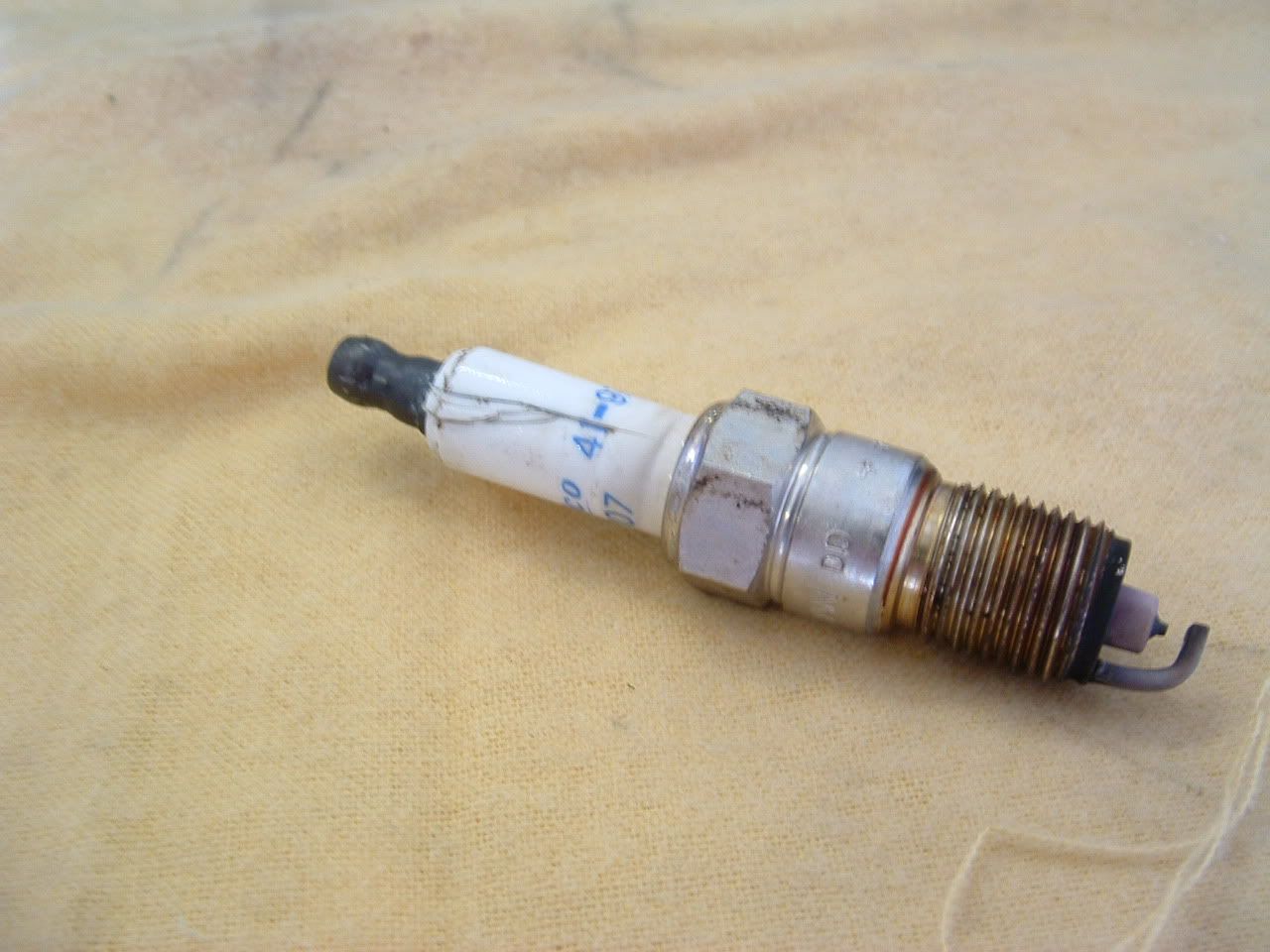
This one was damaged during a header install when the installer decided that the plugs didn't need to be removed.
Made a healthy miss under power.
BC


Le Mans Master


Joined: Nov 2003
Posts: 8,004
Likes: 250
From: Tampa Fl
St. Jude Donor '12-'13-'14
I think Ill be doing this over the weekend. Im not looking forward to the number 7.
With the headers it looks much easier, but im wondering if I should disconnect the EGR bracket
With the headers it looks much easier, but im wondering if I should disconnect the EGR bracket


Team Owner

Joined: May 2001
Posts: 36,836
Likes: 244
From: Dear Karma, I have a list of people you missed.
St. Jude Donor '08-'09-'10-'11-'12-'13-'14-'15-'16
HTH
Le Mans Master
Joined: Nov 2003
Posts: 8,004
Likes: 250
From: Tampa Fl
St. Jude Donor '12-'13-'14
sorry yes i meant the air connection. the hose off the brake boast is just a vacuum? ill take that off
I bought the XL work gloves yesterday and they are tight on me lol
I bought the XL work gloves yesterday and they are tight on me lol