



2002 z06 will not start!!please help

Thread Starter
Navigator

Joined: Feb 2011
Posts: 9
Likes: 0
 2002 z06 will not start!!please help
Hello guys, Im new here but not to the corvette world. I have already did a search and tried all options so now Im here for some help. I own a 2002 Z06 that is having, what I thought was an issue with the vats system. I order a complete bypass for it, which wires directly into the bcm, and the car still will not stay running. Also when I go to lock the car with the key pad the cars taillights, marker lights & interior lights flash on and off until I hit the unlike button which is telling me that the vats system is a problem. So the car has to be locked manually or in my case I have disconected the battery. Im so lost right now and fed up with this car. Please if anyone can help me I would truly appreciate it.

Tech Contributor


Joined: Jan 2007
Posts: 19,564
Likes: 1,207
From: Dyer, IN
Hello guys, Im new here but not to the corvette world. I have already did a search and tried all options so now Im here for some help. I own a 2002 Z06 that is having, what I thought was an issue with the vats system. I order a complete bypass for it, which wires directly into the bcm, and the car still will not stay running. Also when I go to lock the car with the key pad the cars taillights, marker lights & interior lights flash on and off until I hit the unlike button which is telling me that the vats system is a problem. So the car has to be locked manually or in my case I have disconected the battery. Im so lost right now and fed up with this car. Please if anyone can help me I would truly appreciate it.

Tech Contributor


Joined: Dec 1999
Posts: 32,910
Likes: 2,402
From: Anthony TX
CI 6,7,8,9,11 Vet
St. Jude Donor '08
I agree with Lucky. Please read and post all your DTCs.. If there are a LOT of history DTCs, CLEAR ALL OF THEM and see what DTCs come back once you expierence an issue.
Heres is a write up on how to read and clear your DTCs:
READING YOUR Engine Diagnostic Trouble Codes (DTC)
This procedure should be carried out any time you experience a problem with your C5. Most inexpensive store bought aftermarket code readers will ONLY read power train DTC’s. Reading the DTC’s with the C5 built in code reader will allow you to read ALL the modules in the vehicle.
The Diagnostic Display Mode is entered with the following procedure:
1) Turn on the ignition but don't start the engine.
2) Press the RESET button to turn off any warning messages. (i.e. door open, trunk open ect)
3) Press and hold the OPTIONS button
4) While holding OPTIONS, press FUEL button four times within a 10 -second period.
Initially, the on-board diagnostics go into an Automatic Mode which will cycle through each module and shows diagnostic codes in a pre-set sequence: PCM - TCS - RTD - BCM - IPC - RADIO - HVAC - LDCM - RDCM - SCM - RFA. All codes will be displayed for each module. ( i.e. PCM = 4 codes) If none are present in a given module, you will see No More Codes on the display.
There are two types of diagnostic codes, Current and History designated with a letter suffix, “C” or “H”. A current code indicates a malfunction is present in the module displaying data. A history code indicates a problem existed sometime in the last 40 or 50 ignition cycles. When not accompanied by a current code of the same number, it's potential evidence of a previous problem, now resolved, that was not removed by clearing the codes. More likely it's an indication of an intermittent malfunction.
Intermittent codes are the most challenging of the diagnostics. An intermittent code may have happened once, may have happened more than once but is inconsistent or may be happening on a regular basis but not at the time the codes are displayed. History codes can also be caused by a current malfunction in a system that is not operating at the time codes are displayed. An example is the rear window defogger which doesn't operate until the Body Control Module detects engine rpm. For history codes set by a module that does not operate with the key on and engine off, a special diagnostic tool called a Scan Tester is necessary to properly diagnose the malfunction.
Once the system has displayed all modules, it goes into the manual mode which allows selection of each module using combinations of Driver Information Center buttons. Manual mode can also be entered during the automatic sequence by pressing any button except E/M. Once the display shows Manual Diagnostics, select a module by pressing the OPTIONS button to go forward or the TRIP button to go back. Once a module is selected, a code is displayed, and if more than one are present; press GAGES to go forward or FUEL to go back.
To exit the diagnostic mode at any time, press E/M. If you want to erase codes in a given module, press RESET To reset the codes once in manual mode, press and hold RESET until it displays NO CODES Press OPTIONS to go to the next module. Repeat the steps until you have reset the codes in all the computer modules.
NOTE!! Only reset the codes IF you want to - it is NOT necessary to do this. Clearing a code does not repair a problem. You are simply erasing the evidence of it in the module's memory. If you clear the code/s, and extinguish the Check Engine Light, your emissions status ready will NOT allow you to pass an emissions test until you have completed the required driving cycles. There are a few body module DTC’s that if set will prevent the module from operating properly. Once the DTC is cleared, the module will return to full function. This is not true for power train DTCs.
If you have never read and cleared your codes, there will probably be a lot of old history DTCs. It is recommended that you clear your codes and see if any come back during a driving cycle. Those are the ones that you need to concentrate on diagnosing.
Once you have the codes, the next question is: What to do with the information?
First, consult the factory service manual. Any serious C5 Do-It-Yourself owner should invest in the Corvette Service Manual of the appropriate model year. The Service Manual is really a requirement if you want to understand and work on your C5.
NOTE and a WARNING. You can read the DTCs while the engine is running. I pull mine up all the time while driving.
WARNING. Don’t become distracted while reading DTCs while your driving and cause an accident!!!!! Use common sense and drive safe.
These are some very good C5 Diagnostic Trouble Code (DTC) explanation web sites!!! They also explain how to read the DTCs
Here are some very good sites that explain what DTC mean:
http://www.gearchatter.com/viewtopic11755.php
http://www.obd-codes.com/trouble_cod...d-ii-codes.php
Make sure to include the H or C suffix when you post your DTCs!!
Heres is a write up on how to read and clear your DTCs:
READING YOUR Engine Diagnostic Trouble Codes (DTC)
This procedure should be carried out any time you experience a problem with your C5. Most inexpensive store bought aftermarket code readers will ONLY read power train DTC’s. Reading the DTC’s with the C5 built in code reader will allow you to read ALL the modules in the vehicle.
The Diagnostic Display Mode is entered with the following procedure:
1) Turn on the ignition but don't start the engine.
2) Press the RESET button to turn off any warning messages. (i.e. door open, trunk open ect)
3) Press and hold the OPTIONS button
4) While holding OPTIONS, press FUEL button four times within a 10 -second period.
Initially, the on-board diagnostics go into an Automatic Mode which will cycle through each module and shows diagnostic codes in a pre-set sequence: PCM - TCS - RTD - BCM - IPC - RADIO - HVAC - LDCM - RDCM - SCM - RFA. All codes will be displayed for each module. ( i.e. PCM = 4 codes) If none are present in a given module, you will see No More Codes on the display.
There are two types of diagnostic codes, Current and History designated with a letter suffix, “C” or “H”. A current code indicates a malfunction is present in the module displaying data. A history code indicates a problem existed sometime in the last 40 or 50 ignition cycles. When not accompanied by a current code of the same number, it's potential evidence of a previous problem, now resolved, that was not removed by clearing the codes. More likely it's an indication of an intermittent malfunction.
Intermittent codes are the most challenging of the diagnostics. An intermittent code may have happened once, may have happened more than once but is inconsistent or may be happening on a regular basis but not at the time the codes are displayed. History codes can also be caused by a current malfunction in a system that is not operating at the time codes are displayed. An example is the rear window defogger which doesn't operate until the Body Control Module detects engine rpm. For history codes set by a module that does not operate with the key on and engine off, a special diagnostic tool called a Scan Tester is necessary to properly diagnose the malfunction.
Once the system has displayed all modules, it goes into the manual mode which allows selection of each module using combinations of Driver Information Center buttons. Manual mode can also be entered during the automatic sequence by pressing any button except E/M. Once the display shows Manual Diagnostics, select a module by pressing the OPTIONS button to go forward or the TRIP button to go back. Once a module is selected, a code is displayed, and if more than one are present; press GAGES to go forward or FUEL to go back.
To exit the diagnostic mode at any time, press E/M. If you want to erase codes in a given module, press RESET To reset the codes once in manual mode, press and hold RESET until it displays NO CODES Press OPTIONS to go to the next module. Repeat the steps until you have reset the codes in all the computer modules.
NOTE!! Only reset the codes IF you want to - it is NOT necessary to do this. Clearing a code does not repair a problem. You are simply erasing the evidence of it in the module's memory. If you clear the code/s, and extinguish the Check Engine Light, your emissions status ready will NOT allow you to pass an emissions test until you have completed the required driving cycles. There are a few body module DTC’s that if set will prevent the module from operating properly. Once the DTC is cleared, the module will return to full function. This is not true for power train DTCs.
If you have never read and cleared your codes, there will probably be a lot of old history DTCs. It is recommended that you clear your codes and see if any come back during a driving cycle. Those are the ones that you need to concentrate on diagnosing.
Once you have the codes, the next question is: What to do with the information?
First, consult the factory service manual. Any serious C5 Do-It-Yourself owner should invest in the Corvette Service Manual of the appropriate model year. The Service Manual is really a requirement if you want to understand and work on your C5.
NOTE and a WARNING. You can read the DTCs while the engine is running. I pull mine up all the time while driving.
WARNING. Don’t become distracted while reading DTCs while your driving and cause an accident!!!!! Use common sense and drive safe.
These are some very good C5 Diagnostic Trouble Code (DTC) explanation web sites!!! They also explain how to read the DTCs
Here are some very good sites that explain what DTC mean:
http://www.gearchatter.com/viewtopic11755.php
http://www.obd-codes.com/trouble_cod...d-ii-codes.php
Make sure to include the H or C suffix when you post your DTCs!!
Thread Starter
Navigator
Joined: Feb 2011
Posts: 9
Likes: 0
Thank you Bill for the info. The car did the same light blinking before the module. The company that I purchased it from mentioned that this model year had some what of a hybrid vats system and could be difficult to make a bypass for. So my question is, if this bypass doesnt work then what the hell do we do with our cars ? Throw them away? I sure hope not, LOL. Thanks again for all the help.
Tech Contributor
Joined: Jan 2007
Posts: 19,564
Likes: 1,207
From: Dyer, IN
Thank you Bill for the info. The car did the same light blinking before the module. The company that I purchased it from mentioned that this model year had some what of a hybrid vats system and could be difficult to make a bypass for. So my question is, if this bypass doesnt work then what the hell do we do with our cars ? Throw them away? I sure hope not, LOL. Thanks again for all the help.
Tech Contributor
Joined: Dec 1999
Posts: 32,910
Likes: 2,402
From: Anthony TX
CI 6,7,8,9,11 Vet
St. Jude Donor '08
Remove that THING  and try this:
Use an OHM Meter and measure the resistance of your key resistor pellet. Make sure that the contacts on the key are clean and the meter is propely zeroed. Write down the exact value that you read
Purchase some precision resistors from an electronics parts store that you can add in series to match the resistance as close as possible. Add some wires to the resistors. Disconnect the key resistor sensor wiring harness on the ignition switch. Its the small TWO wire harness that covered with a black sheaf. You can see it in this picture:
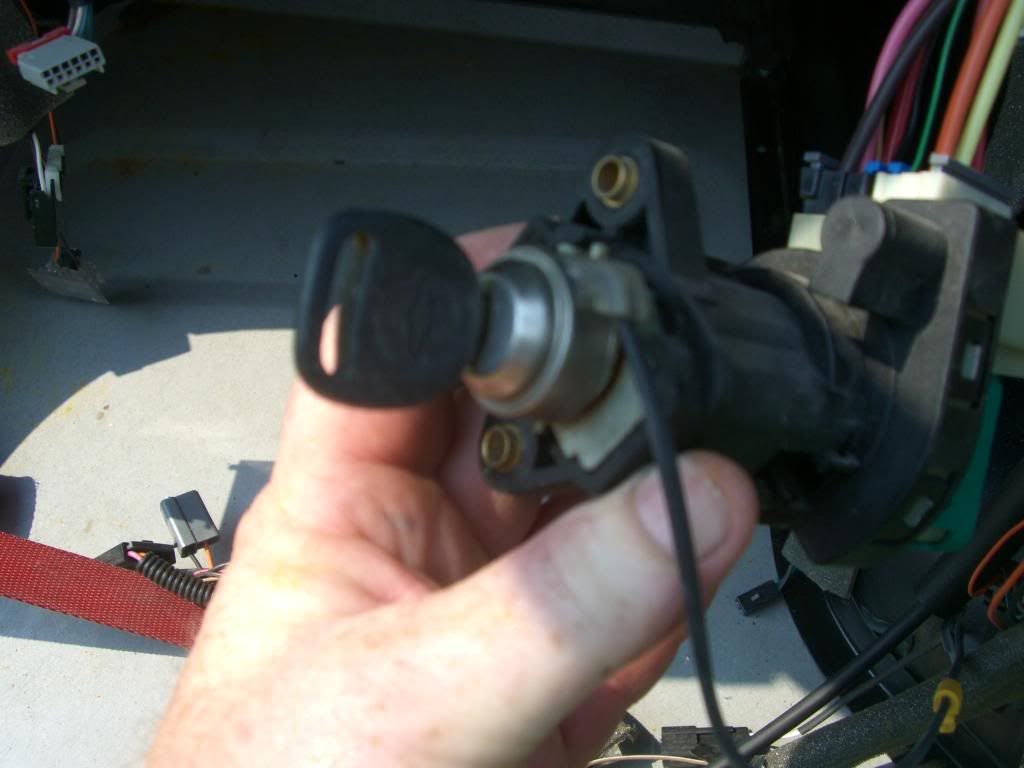
You need to plug the resistor stack into the harness that the sensor plugged into. Once you match the resistance of the pellet with the permanent resistor, the sensor on the switch no longer matters and the BCM is permanently happy.
PM me am e mail address and I will send you the exact value of the pellet reistanceses
BC
and try this:Use an OHM Meter and measure the resistance of your key resistor pellet. Make sure that the contacts on the key are clean and the meter is propely zeroed. Write down the exact value that you read
Purchase some precision resistors from an electronics parts store that you can add in series to match the resistance as close as possible. Add some wires to the resistors. Disconnect the key resistor sensor wiring harness on the ignition switch. Its the small TWO wire harness that covered with a black sheaf. You can see it in this picture:
You need to plug the resistor stack into the harness that the sensor plugged into. Once you match the resistance of the pellet with the permanent resistor, the sensor on the switch no longer matters and the BCM is permanently happy.
PM me am e mail address and I will send you the exact value of the pellet reistanceses
BC
Corvette Stories
The Best of Corvette for Corvette Enthusiasts

5 Best & 5 Worst Corvette Daily Drivers
Joe Kucinski
The Headlights of Every Corvette Generation Explained
Joe Kucinski
5 Best & 5 Most Overrated Corvette Track Packages of All Time!
Joe Kucinski
Every 2027 Corvette Engine Explained
Joe Kucinski
Designer Imagines A Corvette That Looks More Like a Corvette Than the Corvette
Verdad Gallardo
10 Ugly Corvettes That We Still Kinda Love
Joe Kucinski
Top 10 Most Expensive Corvettes Ever Sold on Bring A Trailer
Brett Foote
10 Things Every Corvette Owner Needs (2026 Edition)
Michael S. Palmer
8 Most "Only Corvette Owners Understand" Quirks and Problems
Pouria Savadkouei
Thread Starter
Navigator
Joined: Feb 2011
Posts: 9
Likes: 0
Ok guys, first thing first I want to give a special Thank You to Mr.Bill Curlee for all the help and support that he has given me.
I took the bypass box totally off and ohm'd everything back out and found out that my key was actually ohm'ing out properly(4.74ohms) when taking a measurment at the connector coming off of the key cylinder. I then reconnected the plug and then took a reading directly at the bcm and was only showing 3.04 ohms compared to my keys ohm of 4.74. I then went and got a 4.7ohm resistor, thinking that this is what was causing the car not to start, and installed it into the wire going to the bcm and the car still wouldnt start. I then remeasured the ohms and it was also showing 3.04ohms at the bcm with the 4.7ohm resistor plugged into the harness near the key cylinder. So I then thought to myself that the bcm wasnt recieving the correct reading still so I connected the resistor directly into the bcm plug so that I was sure the the bcm would be seeing 4.7ohms and I still got no start. I even tried to do a relearn and still nothing.
Now, once again, when I use my key fob to lock the doors the alarm automatically goes off until I push unlike on the key fob. So the only way to lock the car is by doing it manually. Has anyone ever had this same problem? Thanks
I took the bypass box totally off and ohm'd everything back out and found out that my key was actually ohm'ing out properly(4.74ohms) when taking a measurment at the connector coming off of the key cylinder. I then reconnected the plug and then took a reading directly at the bcm and was only showing 3.04 ohms compared to my keys ohm of 4.74. I then went and got a 4.7ohm resistor, thinking that this is what was causing the car not to start, and installed it into the wire going to the bcm and the car still wouldnt start. I then remeasured the ohms and it was also showing 3.04ohms at the bcm with the 4.7ohm resistor plugged into the harness near the key cylinder. So I then thought to myself that the bcm wasnt recieving the correct reading still so I connected the resistor directly into the bcm plug so that I was sure the the bcm would be seeing 4.7ohms and I still got no start. I even tried to do a relearn and still nothing.
Now, once again, when I use my key fob to lock the doors the alarm automatically goes off until I push unlike on the key fob. So the only way to lock the car is by doing it manually. Has anyone ever had this same problem? Thanks


Tech Contributor

Joined: Dec 2006
Posts: 10,962
Likes: 29
From: Van Buren Arkansas
Wounded Warrior Escort '11
So, you had 3.04 ohms at the bcm then in-series, you added another 4.7 ohms, so you now have 7.7 ohms and the bcm is expecting 4 ohms...does this sound right to you?
Thread Starter
Navigator
Joined: Feb 2011
Posts: 9
Likes: 0
Yes ohm'd resistor. It ohm'd out at 4.65ohms which shouldnt cause a problem being that my key is 4.74ohms.
dgrant, with key in ignition, Im only getting 3.04 ohms at the bcm plug. When I pull the key out of ignition it ohms out at 8.xxohms(cant remember exact#), then pulled the harness apart at the ignition switch and added my 4.7(4.65actual ohm) and I get the same reading of 3.04ohms at the bcm plug so I installed the resistor directly into the bcm connector to make sure that it was "Now" getting the correct ohms reading at the bcm and I still get no start.
dgrant, with key in ignition, Im only getting 3.04 ohms at the bcm plug. When I pull the key out of ignition it ohms out at 8.xxohms(cant remember exact#), then pulled the harness apart at the ignition switch and added my 4.7(4.65actual ohm) and I get the same reading of 3.04ohms at the bcm plug so I installed the resistor directly into the bcm connector to make sure that it was "Now" getting the correct ohms reading at the bcm and I still get no start.
Tech Contributor
Joined: Jan 2007
Posts: 19,564
Likes: 1,207
From: Dyer, IN
I would like to see exactly how you are installing the resistor at the BCM plug.
Tech Contributor
Joined: Dec 2006
Posts: 10,962
Likes: 29
From: Van Buren Arkansas
Wounded Warrior Escort '11
I agree....how was the resistor installed? If its in series, the resistance is added to the key-chip resistance so now its way out of spec for the BCM. Its starting to sound like someone has hard-wired a 3k ohm resistor in there already somewhere.
Thread Starter
Navigator
Joined: Feb 2011
Posts: 9
Likes: 0
You still have not posted your codes....why? I'm also assuming you are not reading the meter scale correctly, because if you have a #11 key, the resistance value should be 4750 ohms...NOT 4.74 ohms.
What does this mean? Are you saying, that when you measure the resistance at the BCM connector, with the key removed, it reads 8000 ohms? Also, how are you reading the resistance? Are you back probing the connector, or are you removing the connector, and measuring the resistance on the connector pins?
I would like to see exactly how you are installing the resistor at the BCM plug.
What does this mean? Are you saying, that when you measure the resistance at the BCM connector, with the key removed, it reads 8000 ohms? Also, how are you reading the resistance? Are you back probing the connector, or are you removing the connector, and measuring the resistance on the connector pins?
I would like to see exactly how you are installing the resistor at the BCM plug.
Im getting code b2723.
Im reading in kohms and my key pellet measures 4.74kohms(4740)
Unplugged the connector and measured (the pins that go into the bcm on the connector)it with the resistor pushed into the connector to make sure that its getting the proper reading. Connection is now made directly at the bcm. I totally bypassed all the wires from the steering lock along with all the wiring going to the bcm to eliminate any broken wire issues.
Last edited by TTC5CORVETTE; Feb 19, 2011 at 10:47 PM.
Tech Contributor
Joined: Jan 2007
Posts: 19,564
Likes: 1,207
From: Dyer, IN
Lucky,
Im getting code b2723.
Im reading in kohms and my key pellet measures 4.74kohms(4740)
Unplugged the connector and measured (the pins that go into the bcm on the connector)it with the resistor pushed into the connector to make sure that its getting the proper reading. Connection is now made directly at the bcm. I totally bypassed all the wires from the steering lock along with all the wiring going to the bcm to eliminate any broken wire issues.
Im getting code b2723.
Im reading in kohms and my key pellet measures 4.74kohms(4740)
Unplugged the connector and measured (the pins that go into the bcm on the connector)it with the resistor pushed into the connector to make sure that its getting the proper reading. Connection is now made directly at the bcm. I totally bypassed all the wires from the steering lock along with all the wiring going to the bcm to eliminate any broken wire issues.
Tech Contributor
Joined: Jan 2007
Posts: 19,564
Likes: 1,207
From: Dyer, IN
1) One lead on the lock cylinder connector pin A (ppl/wht wire), the other lead on BCM connector C1 pin B2.
2) If that's good, repeat for lock cylinder pin B, and BCM pin A3.
3) If that's good, with the lock cylinder unplugged, put the leads on BCM connector C1, pins A3 and B2. You should read an open, or infinite resistance.
If all these check good, then is sounds like the lock cylinder is adding resistance to the circuit. You could extract the pins from the lock cylinder connector, and install the resistor to the pins, which should give the BCM the correct resistance.