








how do I do a normal wire splice

Thread Starter
Safety Car


Joined: Dec 2011
Posts: 4,704
Likes: 239
From: Redondo Beach CA
 how do I do a normal wire splice
I need to splice on a pigtail for my oil pressure sender. I don't know how it is normally done in automotive work .
I was planning on staggering the cuts , soldering each of the three wires, shrink tube each, then shrink tube the entire joint.
I would like to know what is the normal way to do this attachment in the automotive world. Is it to add a connector, or some particular way this work would be done by a pro mechanic.
I know any interruption in the wiring is a possible trouble spot, so I seek a conventional, proven approach. PLus I want the work easily understood by the next guy. I know it is not a big deal, I am trying to keep out a bunch of homemade touches to my work on the car.
I am trying to have the finished car not say worked on by low information hillbilly when you pop the hood.
Any hillbillies out there, just kidding. Uncle Jed's truck ran great.
I was planning on staggering the cuts , soldering each of the three wires, shrink tube each, then shrink tube the entire joint.
I would like to know what is the normal way to do this attachment in the automotive world. Is it to add a connector, or some particular way this work would be done by a pro mechanic.
I know any interruption in the wiring is a possible trouble spot, so I seek a conventional, proven approach. PLus I want the work easily understood by the next guy. I know it is not a big deal, I am trying to keep out a bunch of homemade touches to my work on the car.
I am trying to have the finished car not say worked on by low information hillbilly when you pop the hood.
Any hillbillies out there, just kidding. Uncle Jed's truck ran great.

Race Director


Joined: Apr 2007
Posts: 11,152
Likes: 890
From: South Western Ontario
Sounds good. I wouldn't bother doing all 3 wires with heatshrink though.
Look for double-wall heatshrink. It'll be more expensive but it has an adhesive inside the will seal the joint. The cheap stuff doesn't really seal very well.
I've seen lots of "pro mechanics" using crimp splices and they're complete crap for use under the hood so don't worry what they'd do.
Look for double-wall heatshrink. It'll be more expensive but it has an adhesive inside the will seal the joint. The cheap stuff doesn't really seal very well.
I've seen lots of "pro mechanics" using crimp splices and they're complete crap for use under the hood so don't worry what they'd do.
Thread Starter
Safety Car
Joined: Dec 2011
Posts: 4,704
Likes: 239
From: Redondo Beach CA
glad I asked. didn't know there is double heat shrink tubing as described. Sounds very useful. Thanks
Mainly concerned with accepted good practice. Don't want any repairs to be less than par.
As it is, the car has been down for a while. Might as well ask for advice, I know any break in a car wire is asking for it.
Plus, if I ever get this car around any hot rod types, don't want my work to expose my lesser qualities.
Mainly concerned with accepted good practice. Don't want any repairs to be less than par.
As it is, the car has been down for a while. Might as well ask for advice, I know any break in a car wire is asking for it.
Plus, if I ever get this car around any hot rod types, don't want my work to expose my lesser qualities.

Drifting

Joined: Mar 2011
Posts: 1,412
Likes: 15
From: Richardson TX
A lot of run of the mill auto shops I've seen like to use wire taps like these:
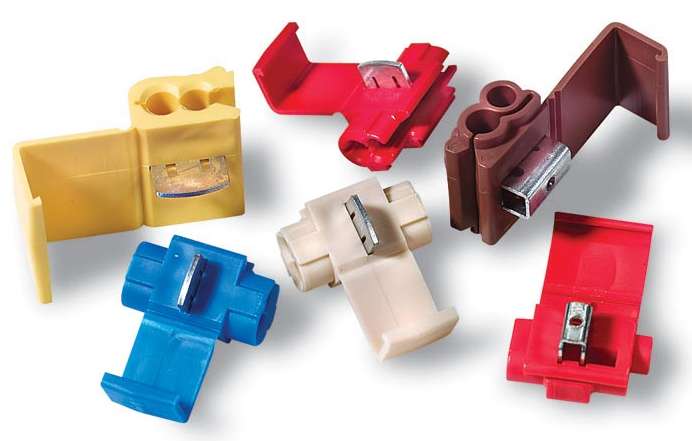
or butt splices. I personally think butt splices are terrible, but they're popular.
I think wire taps are generally reliable, although I personally wouldn't want them on my corvette. On my Jeep, maybe. Solder and heat shrink is definitely the best way to go. I like to cover the wire with wire loom afterwards to keep it looking factory and clean.
or butt splices. I personally think butt splices are terrible, but they're popular.
I think wire taps are generally reliable, although I personally wouldn't want them on my corvette. On my Jeep, maybe. Solder and heat shrink is definitely the best way to go. I like to cover the wire with wire loom afterwards to keep it looking factory and clean.

Racer

Joined: Jun 2012
Posts: 419
Likes: 3
From: North Lauderdale FL
That's the best way to do it. Use a heatshrink with glue inside for the outside piece.

Tech Contributor


Joined: Dec 1999
Posts: 32,910
Likes: 2,402
From: Anthony TX
CI 6,7,8,9,11 Vet
St. Jude Donor '08
Look up western union splice on the Internet.
Makes a great splice. Solder with rosin core solder and insulate the repaired section with the double walled heat-shrink with sealer on the inside. That is what you want.
Do NOT crimp splice any automotive electrical splice. It WILL eventually fail and fail when you need it the most. Any low voltage signal wire requires 100% continuity. Only a soldered splice provides that type of repair.
The service manual has a very detailed write up on wiring repairs and how to do it.
Bill
Makes a great splice. Solder with rosin core solder and insulate the repaired section with the double walled heat-shrink with sealer on the inside. That is what you want.
Do NOT crimp splice any automotive electrical splice. It WILL eventually fail and fail when you need it the most. Any low voltage signal wire requires 100% continuity. Only a soldered splice provides that type of repair.
The service manual has a very detailed write up on wiring repairs and how to do it.
Bill
Corvette Stories
The Best of Corvette for Corvette Enthusiasts

Top 10 Most Expensive Corvettes Ever Sold on Bring A Trailer
Brett Foote
10 Things Every Corvette Owner Needs (2026 Edition)
Michael S. Palmer
8 Most "Only Corvette Owners Understand" Quirks and Problems
Pouria Savadkouei
10 Reasons the C6 Z06 is Still A Performance Benchmark After 20 Years
Joe Kucinski
How Much Horsepower Every Corvette Engine "LOST" in 1972
Joe Kucinski
Top 10 DOs and DON'Ts for Protecting Your Convertible Top!
Michael S. Palmer
Top 10 Most Explosive Corvettes Ever Made: Power-to-Weight Ratio Ranked!
Joe Kucinski
150 hp to 1,250 hp: Every Corvette Generation Compared by the Specs That Matter
Joe Kucinski
8 Coolest Corvette Pace Cars (and Replicas) of All Time
Verdad Gallardo
Burning Brakes

Joined: Sep 2009
Posts: 1,180
Likes: 2
From: Yes it's hot! Arizona
Look up western union splice on the Internet.
Makes a great splice. Solder with rosin core solder and insulate the repaired section with the double walled heat-shrink with sealer on the inside. That is what you want.
Do NOT crimp splice any automotive electrical splice. It WILL eventually fail and fail when you need it the most. Any low voltage signal wire requires 100% continuity. Only a soldered splice provides that type of repair.
The service manual has a very detailed write up on wiring repairs and how to do it.
Bill
Makes a great splice. Solder with rosin core solder and insulate the repaired section with the double walled heat-shrink with sealer on the inside. That is what you want.
Do NOT crimp splice any automotive electrical splice. It WILL eventually fail and fail when you need it the most. Any low voltage signal wire requires 100% continuity. Only a soldered splice provides that type of repair.
The service manual has a very detailed write up on wiring repairs and how to do it.
Bill


Le Mans Master

Joined: Mar 2011
Posts: 6,835
Likes: 302
From: Columbia SC
If you want to have your added wire removable with a connector what I do is: Splice the wire in as you suggest, however, instead of crimping the connector, just pull back on the plastic sleeve (remove it) to expose the metal. Slide on heat shrink and solder your wire into the connector and then heat shrink the connection. I have wired whole cars this way with no failures over 30-40 years.
Drifting

Joined: Feb 2002
Posts: 1,327
Likes: 257
From: Oklahoma City OK
I use the lash splice method myself. If you want to learn about acceptable wiring practices, look up NASA-STD 8739.4 and the NASA workmanship standards. They have a document that is complete with pictures of what to do vs. what not to do. It was very informative.
Last edited by etekberg; May 28, 2013 at 02:59 PM.

Team Owner


Joined: Dec 1999
Posts: 34,873
Likes: 487
From: Lacey WA RVN 68-69
NCM Sinkhole Donor