



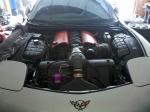


flywheel balance?

Thread Starter
Advanced

Joined: May 2014
Posts: 69
Likes: 8
From: hubert n. carolina

Burning Brakes


Joined: Oct 2004
Posts: 931
Likes: 35
From: Rowlett, Texas

Jim, please be VERY VERY careful when installing a new clutch/FW setup in an early C5 like your '99. You may know, many of the manual trans engines were final-balanced at the factory by installing lead weights into various holes in the flywheel. If this was the case with yours, and you install a perfectly balanced new unit, even a GM OEM part, you could end up with a pretty bad vibration issue. This happened to my almost-new 2000, and the dealer ended up removing and replacing my Clutch/FW 3 times before they finally called a factory guy down to externally balance the unit.
There are tons of data on the forum, plenty by me, that explain the issue.
bottom line: MARK THE POSITION OF YOUR PRESENT FW ON THE CRANK BEFORE REMOVING IT. Then look for the lead weights. If you have any weights, they must be installed on the new FW in the exact same position relative to the crankshaft. If you install an aftermarket clutch/fw, same thing applies - may be best to balance check the new unit and the old FW and MIS-BALANCE the new unit to match the original one.
Many guys have gotten lucky on this and did not have an issue - but if you do then it can be pure Hell to resolve after that original FW position on the crank is lost.
Please do a search on the topic!!!!!!!!!
Cheers,
DG
There are tons of data on the forum, plenty by me, that explain the issue.
bottom line: MARK THE POSITION OF YOUR PRESENT FW ON THE CRANK BEFORE REMOVING IT. Then look for the lead weights. If you have any weights, they must be installed on the new FW in the exact same position relative to the crankshaft. If you install an aftermarket clutch/fw, same thing applies - may be best to balance check the new unit and the old FW and MIS-BALANCE the new unit to match the original one.
Many guys have gotten lucky on this and did not have an issue - but if you do then it can be pure Hell to resolve after that original FW position on the crank is lost.
Please do a search on the topic!!!!!!!!!
Cheers,
DG
Thread Starter
Advanced
Joined: May 2014
Posts: 69
Likes: 8
From: hubert n. carolina
flywheel balance
Jim, please be VERY VERY careful when installing a new clutch/FW setup in an early C5 like your '99. You may know, many of the manual trans engines were final-balanced at the factory by installing lead weights into various holes in the flywheel. If this was the case with yours, and you install a perfectly balanced new unit, even a GM OEM part, you could end up with a pretty bad vibration issue. This happened to my almost-new 2000, and the dealer ended up removing and replacing my Clutch/FW 3 times before they finally called a factory guy down to externally balance the unit.
There are tons of data on the forum, plenty by me, that explain the issue.
bottom line: MARK THE POSITION OF YOUR PRESENT FW ON THE CRANK BEFORE REMOVING IT. Then look for the lead weights. If you have any weights, they must be installed on the new FW in the exact same position relative to the crankshaft. If you install an aftermarket clutch/fw, same thing applies - may be best to balance check the new unit and the old FW and MIS-BALANCE the new unit to match the original one.
Many guys have gotten lucky on this and did not have an issue - but if you do then it can be pure Hell to resolve after that original FW position on the crank is lost.
Please do a search on the topic!!!!!!!!!
Cheers,
DG
There are tons of data on the forum, plenty by me, that explain the issue.
bottom line: MARK THE POSITION OF YOUR PRESENT FW ON THE CRANK BEFORE REMOVING IT. Then look for the lead weights. If you have any weights, they must be installed on the new FW in the exact same position relative to the crankshaft. If you install an aftermarket clutch/fw, same thing applies - may be best to balance check the new unit and the old FW and MIS-BALANCE the new unit to match the original one.
Many guys have gotten lucky on this and did not have an issue - but if you do then it can be pure Hell to resolve after that original FW position on the crank is lost.
Please do a search on the topic!!!!!!!!!
Cheers,
DG
Thanks for the info, Jim

Le Mans Master

Joined: Mar 2011
Posts: 6,835
Likes: 302
From: Columbia SC

Racer

Joined: Jul 2008
Posts: 293
Likes: 8
From: South Bend IN
Are you saying the original f/w is balanced with the rotating ***'y? In which case all f/ws (in my case) have to be done the same way. Could you lead me to somewhere I could look into this further. My wallet won't allow me to do this more than one time. If I end up with a vibration it's I'll be bouncing off walls.
Thanks for the info, Jim
Thanks for the info, Jim
When I bought my 99 FRC it came with a newly installed LS6 clutch. It was the first Corvette I had over owned and even though it was bone stock it had a fair amount of engine vibration to it. I figured it was normal. After I installed my cam the LS6 clutch wouldn't hold, so I had to replace it with an LS7 unit. I do most of my own work and when researching the project came across this flywheel balancing topic. When I removed the LS6 clutch the flywheel had NO weights. Huh. I took my new LS7 flywheel and clutch to a local clutch shop (South Bend Clutch - a pretty well known outfit actually) and they balanced the two units together, indexing them with paint marks for me. That's how I installed the two units and after I buttoned it all back up the car idled almost like my DOHC V6 Explorer engine. Even with the cam in it the engine was smoother than with the old, completely unbalanced LS6 clutch.
If you have weights, move them to the same spot. If you don't, at least balance the assembly you're about to put in.
This is a real thing. Take it seriously if you don't want to be annoyed after your clutch job. ;-)
Kurt
Burning Brakes
Joined: Oct 2004
Posts: 931
Likes: 35
From: Rowlett, Texas
Guys, thanks for the additional comments.
Jim, for more info on the subject, just search "flywheel balancing", "engine vibration", etc; or even under my tag - "'the wrench". I was a pretty strong advocate for checking and being careful of this pitfall after the nightmare I went through back in 2000. I think i was the first "poster boy" for this - my dealership didn't even know about it, even though it's covered in the 2000 service manual.
It seems that the vast majority of the later C5's rarely had noticeable imbalance issues, and really, most of the early ones didn't seem to have either. But every once in awhile one of the guys would get the noticeable vibration after a straight clutch/fw swap.
I guess there might be 3 possible approaches to take, depending on how lucky you feel:
1. Just pop it in and hope for the best - pretty good odds you'll be okay, but........
2. Assume the new unit is zero balanced okay, but carefully inspect the old FW for the weights, and if you find any, pull the weight and add exactly that much weight to the new unit in the exact clocked position relative to the crankshaft.
3. take the full monty approach: have the old clutch/FW balanced checked. have the new clutch/FW balanced checked. If the old unit had imbalance, then unbalance the ne unti the same amount, AND BOLT IT ON THE CRANKSHAFT IN THE EXACT SAME CLOCKED POSITION, so the imbalance is located exactly the same relative to the crank.
I think most guys herein have used option 2 with success.
DG
Jim, for more info on the subject, just search "flywheel balancing", "engine vibration", etc; or even under my tag - "'the wrench". I was a pretty strong advocate for checking and being careful of this pitfall after the nightmare I went through back in 2000. I think i was the first "poster boy" for this - my dealership didn't even know about it, even though it's covered in the 2000 service manual.
It seems that the vast majority of the later C5's rarely had noticeable imbalance issues, and really, most of the early ones didn't seem to have either. But every once in awhile one of the guys would get the noticeable vibration after a straight clutch/fw swap.
I guess there might be 3 possible approaches to take, depending on how lucky you feel:
1. Just pop it in and hope for the best - pretty good odds you'll be okay, but........
2. Assume the new unit is zero balanced okay, but carefully inspect the old FW for the weights, and if you find any, pull the weight and add exactly that much weight to the new unit in the exact clocked position relative to the crankshaft.
3. take the full monty approach: have the old clutch/FW balanced checked. have the new clutch/FW balanced checked. If the old unit had imbalance, then unbalance the ne unti the same amount, AND BOLT IT ON THE CRANKSHAFT IN THE EXACT SAME CLOCKED POSITION, so the imbalance is located exactly the same relative to the crank.
I think most guys herein have used option 2 with success.
DG
Corvette Stories
The Best of Corvette for Corvette Enthusiasts

Top 10 Most Explosive Corvettes Ever Made: Power-to-Weight Ratio Ranked!
Joe Kucinski
150 hp to 1,250 hp: Every Corvette Generation Compared by the Specs That Matter
Joe Kucinski
8 Coolest Corvette Pace Cars (and Replicas) of All Time
Verdad Gallardo
Top 10 Corvette Engines RANKED by Peak Torque (70+ Years of Muscle!)
Joe Kucinski
Corvette ZR1X Will Be Pacing the Indy 500, And Could Probably Race, Too!
Verdad Gallardo
Top 10 Corvettes Coming to Mecum Indy 2026!
Brett Foote
Top 10 C9 Corvette MUST-HAVES to Fix These C8 Generation Flaws!
Michael S. Palmer
10 Revolutionary 'Corvette Firsts' Most People Don't Know
Joe Kucinski
5 Reasons to Upgrade to an LS6-Powered Corvette; 5 Reasons to Stay LT2
Michael S. Palmer
Racer

Joined: Jan 2010
Posts: 296
Likes: 33
From: Virginia Beach VA
The hot balance procedure is real. Here is a good article on a dry sump LS3 build at Wixom. Pictures 27 and 33 reference the balance procedure. Pay close attention to the order of operations, and what all is installed BEFORE the balance procedure is done. Hopefully that will shed some light on what is actually going on. The balance procedure accounts for imbalance made up from ALL the engine/FW/clutch components. Not just the FW. Not just the FW and engine. Not just the FW and PP combo (as many think). It accounts for ALL of them. So trying to match balance the FW only, by transferring balance weights, is a partial approach, and not very accurate.
"STEP 3" from Wrench is the best method to assure you have the same balance as what you started with from stock.
Check it out:
http://www.superchevy.com/how-to/vem...uild/#photo-33
and YES, this is the same procedure that was done for manual transmission C5's .
"STEP 3" from Wrench is the best method to assure you have the same balance as what you started with from stock.
Check it out:
http://www.superchevy.com/how-to/vem...uild/#photo-33
and YES, this is the same procedure that was done for manual transmission C5's .

Tech Contributor


Joined: Dec 1999
Posts: 32,910
Likes: 2,402
From: Anthony TX
CI 6,7,8,9,11 Vet
St. Jude Donor '08
The hot balance procedure is real. Here is a good article on a dry sump LS3 build at Wixom. Pictures 27 and 33 reference the balance procedure. Pay close attention to the order of operations, and what all is installed BEFORE the balance procedure is done. Hopefully that will shed some light on what is actually going on. The balance procedure accounts for imbalance made up from ALL the engine/FW/clutch components. Not just the FW. Not just the FW and engine. Not just the FW and PP combo (as many think). It accounts for ALL of them. So trying to match balance the FW only, by transferring balance weights, is a partial approach, and not very accurate.
"STEP 3" from Wrench is the best method to assure you have the same balance as what you started with from stock.
Check it out:
http://www.superchevy.com/how-to/vem...uild/#photo-33
and YES, this is the same procedure that was done for manual transmission C5's .
"STEP 3" from Wrench is the best method to assure you have the same balance as what you started with from stock.
Check it out:
http://www.superchevy.com/how-to/vem...uild/#photo-33
and YES, this is the same procedure that was done for manual transmission C5's .
 EXCELLENT INFORMATION and a VAST knowledge bank on this issue!
It all boils down to MATCH BALANCING your NEW clutch to the OLD OEM assembly and making sure that you get it clocked back on to the crank in the SAME ORIENTATION!
Last edited by Bill Curlee; Jan 14, 2016 at 12:10 PM.