



Alternator/Voltage issues

Thread Starter
Instructor

Joined: Feb 2008
Posts: 114
Likes: 0
From: elk grove california
 Alternator/Voltage issues
I have a 99 FRC 6 speed. Recently I have been having voltage issues while driving. The volts would constantly jump around between 11.5 and 14.5. The car then sat for 6 weeks and I had to jump the car to start it. when I went to go start the car the next day I couldn't even jump it, so I had the battery tested and was bad, so I replaced it. The car started fine now but the voltage would jump around. Starting at 14.1 it would slowly drop, I had it down to 13.1 after about 10 min of driving so I figured the volt regulator was bad and it wasn't charging well. I bought an alternator from rock auto (this one) http://www.rockauto.com/catalog/more...nid=492&jpid=0
but now the voltage is more stable but wont go above 13.8 and the "charging system fault" code keeps popping up. Here is the picture of my old alternator, I know a lot of people order the wrong one, and I'm not sure if I did. Any help is appreciated, thanks
but now the voltage is more stable but wont go above 13.8 and the "charging system fault" code keeps popping up. Here is the picture of my old alternator, I know a lot of people order the wrong one, and I'm not sure if I did. Any help is appreciated, thanks

Melting Slicks


Joined: Jul 2005
Posts: 2,649
Likes: 863
I recently had a similar problem, while driving the voltage would move from low 14's to 11.8 - 11.9 - 12.9 - then back again. Obviously at the 11.* range the alternator wasn't charging. The percentage of time the alternator was charging was dropping fairly fast.
I pulled the alternator and took it to a local alternator / starter shop. They tested it and confirmed it was toast - they said the diodes in were shot. They also told me to get a new one - that their cost to rebuild was going to be more than a new one ???
After spending more than a little time on this forum - and even more time searching various Internet sites - and checking ground connections and testing continuity of some wires, it seems that I had a bad alternator. So - found that there are two part numbers for the alternators used in the 2002's - my old alternator (P/N 10246534) had been discontinued - the new part number is 10316782. I bought mine from a GM Dealer that sells via the Internet. Bolted it in and it worked perfectly - but - it was NOT cheap (as in a bit over $400 plus shipping). I bought from a GM dealer because there were quite a number of posts here on the C5 Tech forum where rebuilt alternators through the big box auto stores did not work correctly - to be honest there were also a number of posts that they had rebuilt alternators that did work correctly. But in my case - the new GM alternator did fix the problem.
So - in answer to your question - it's entirely possible that your replacement alternator is the problem... Please double check all part numbers for your particular application before dropping any hard cash, but if you do some searching - it appears that the C5 alternators can be rather finicky.
Also thanks to Bill Curlee who's posts on the C5 electrical system had a tremendous amount of very helpful info !!!!
I pulled the alternator and took it to a local alternator / starter shop. They tested it and confirmed it was toast - they said the diodes in were shot. They also told me to get a new one - that their cost to rebuild was going to be more than a new one ???
After spending more than a little time on this forum - and even more time searching various Internet sites - and checking ground connections and testing continuity of some wires, it seems that I had a bad alternator. So - found that there are two part numbers for the alternators used in the 2002's - my old alternator (P/N 10246534) had been discontinued - the new part number is 10316782. I bought mine from a GM Dealer that sells via the Internet. Bolted it in and it worked perfectly - but - it was NOT cheap (as in a bit over $400 plus shipping). I bought from a GM dealer because there were quite a number of posts here on the C5 Tech forum where rebuilt alternators through the big box auto stores did not work correctly - to be honest there were also a number of posts that they had rebuilt alternators that did work correctly. But in my case - the new GM alternator did fix the problem.
So - in answer to your question - it's entirely possible that your replacement alternator is the problem... Please double check all part numbers for your particular application before dropping any hard cash, but if you do some searching - it appears that the C5 alternators can be rather finicky.
Also thanks to Bill Curlee who's posts on the C5 electrical system had a tremendous amount of very helpful info !!!!
Last edited by Purple92; Jan 24, 2016 at 06:25 PM.

1/4 mile/AutoX


Joined: Jun 2014
Posts: 11,442
Likes: 2,189
From: Buffalo Texas
I sure wish you guys would do a little research on this forum before any work on your car,these vettes are not like the old days ,you just can't start changing parts and jumping the C 5 is a NO NO !!!!!
Thread Starter
Instructor
Joined: Feb 2008
Posts: 114
Likes: 0
From: elk grove california
So I installed the old alternator back into the car and the "charge system fault" is gone. Then I unhooked the positive battery cable while the car was running and it didn't shut off. The issue is the volts start at 14.1 when the car starts then jump around from 13.2-14

Le Mans Master

Joined: Mar 2011
Posts: 6,835
Likes: 302
From: Columbia SC

Melting Slicks
Joined: Jan 2009
Posts: 3,275
Likes: 739
From: Miami FL
So I installed the old alternator back into the car and the "charge system fault" is gone. Then I unhooked the positive battery cable while the car was running and it didn't shut off. The issue is the volts start at 14.1 when the car starts then jump around from 13.2-14
Don't disconnect the battery with the engine running! The battery acts as a capacitor to "smooth" out the alternator's "wavy" output and filters surges/spikes. Check this post for more details.
Last edited by GCG; Jan 26, 2016 at 12:14 AM.
Thread Starter
Instructor
Joined: Feb 2008
Posts: 114
Likes: 0
From: elk grove california
Alternator Question
If your alternator's voltage regulator is bad, why don't you just replace the regulator, instead of the whole alternator, to avoid having to deal with those charge system faults? It is also less expensive. Check this post for more info on replacing the regulator.
Don't disconnect the battery with the engine running! The battery acts as a capacitor to "smooth" out the alternator's "wavy" output and filters surges/spikes. Check this post for more details.
Don't disconnect the battery with the engine running! The battery acts as a capacitor to "smooth" out the alternator's "wavy" output and filters surges/spikes. Check this post for more details.
Corvette Stories
The Best of Corvette for Corvette Enthusiasts

Every 2027 Corvette Engine Explained
Joe Kucinski
Designer Imagines A Corvette That Looks More Like a Corvette Than the Corvette
Verdad Gallardo
10 Ugly Corvettes That We Still Kinda Love
Joe Kucinski
Top 10 Most Expensive Corvettes Ever Sold on Bring A Trailer
Brett Foote
10 Things Every Corvette Owner Needs (2026 Edition)
Michael S. Palmer
8 Most "Only Corvette Owners Understand" Quirks and Problems
Pouria Savadkouei
10 Reasons the C6 Z06 is Still A Performance Benchmark After 20 Years
Joe Kucinski
How Much Horsepower Every Corvette Engine "LOST" in 1972
Joe Kucinski
Top 10 DOs and DON'Ts for Protecting Your Convertible Top!
Michael S. Palmer
Melting Slicks
Joined: Jul 2005
Posts: 2,649
Likes: 863
The fact is that anytime the car's voltage while running is higher than the battery voltage when the car is turned off - the alternator is functioning - at least at that one instant in time. You had seen lower voltage on occasion - so it's safe to say the for one reason or another at those times the alternator was not charging. The reason for the no charge condition is the issue - it could be a bad ground, it could be a high resistance connection on pretty much any part of the charging circuit, or it could be the alternator.
As akapounder pointed out - these C5's are electrically very complicated - you can do damage pretty easily, so be careful.
As for why I didn't just replace the regulator in mine - I kind of figured that if the Alternator / Starter specialists thought it was cheaper to replace than rebuild (my alternator was a very low mile OEM unit - and the bearings seemed to be in perfect condition), that was probably pretty good advice. I had taken a look at the time and didn't see any replacement regulators - I've since found one place that may have a replacement regulator - but the way the site reads - I'm not sure if the rectifying diodes are included or not, and since my new alternator seems to be working just fine - rebuilding the old one "just in case" isn't really a very high priority.
Thread Starter
Instructor
Joined: Feb 2008
Posts: 114
Likes: 0
From: elk grove california
Alternator Question
IMHO - I wouldn't take a whole lot of automotive advice from your friend. While what he is saying is technically correct - it's also correct to say that one way to tell a gun is loaded is to put the barrel to your forehead and pull the trigger... That technique your friend recommended would probably be fine for a 1970's vintage car that didn't have any transistors in it except for the radio - but today - if the voltage went high when you disconnected the battery, that could have trashed several rather expensive computers in the car.
The fact is that anytime the car's voltage while running is higher than the battery voltage when the car is turned off - the alternator is functioning - at least at that one instant in time. You had seen lower voltage on occasion - so it's safe to say the for one reason or another at those times the alternator was not charging. The reason for the no charge condition is the issue - it could be a bad ground, it could be a high resistance connection on pretty much any part of the charging circuit, or it could be the alternator.
As akapounder pointed out - these C5's are electrically very complicated - you can do damage pretty easily, so be careful.
As for why I didn't just replace the regulator in mine - I kind of figured that if the Alternator / Starter specialists thought it was cheaper to replace than rebuild (my alternator was a very low mile OEM unit - and the bearings seemed to be in perfect condition), that was probably pretty good advice. I had taken a look at the time and didn't see any replacement regulators - I've since found one place that may have a replacement regulator - but the way the site reads - I'm not sure if the rectifying diodes are included or not, and since my new alternator seems to be working just fine - rebuilding the old one "just in case" isn't really a very high priority.
The fact is that anytime the car's voltage while running is higher than the battery voltage when the car is turned off - the alternator is functioning - at least at that one instant in time. You had seen lower voltage on occasion - so it's safe to say the for one reason or another at those times the alternator was not charging. The reason for the no charge condition is the issue - it could be a bad ground, it could be a high resistance connection on pretty much any part of the charging circuit, or it could be the alternator.
As akapounder pointed out - these C5's are electrically very complicated - you can do damage pretty easily, so be careful.
As for why I didn't just replace the regulator in mine - I kind of figured that if the Alternator / Starter specialists thought it was cheaper to replace than rebuild (my alternator was a very low mile OEM unit - and the bearings seemed to be in perfect condition), that was probably pretty good advice. I had taken a look at the time and didn't see any replacement regulators - I've since found one place that may have a replacement regulator - but the way the site reads - I'm not sure if the rectifying diodes are included or not, and since my new alternator seems to be working just fine - rebuilding the old one "just in case" isn't really a very high priority.

Drifting


Joined: Apr 2007
Posts: 1,517
Likes: 160
From: Lafayette Louisiana

Disconnect Battery and fully charge. Do not Jump start! If you do, very good chance will kill EBCM.
Melting Slicks
Joined: Jan 2009
Posts: 3,275
Likes: 739
From: Miami FL
You have to measure directly at the battery and also check what you have directly at the alternator. The readings should be the same or very close.
The DIC reading is from a point after the ignition switch, so it is affected by how "healthy" the ignition switch's contacts are.
Last edited by GCG; Jan 26, 2016 at 11:19 AM.

Tech Contributor


Joined: Dec 1999
Posts: 32,910
Likes: 2,402
From: Anthony TX
CI 6,7,8,9,11 Vet
St. Jude Donor '08
Like was previously stated,,, This isn't your grand dads 1970 Buick. The charging circuit is a LOT more complicated and cant be treated like cars of past.
Here is the charging circuit:
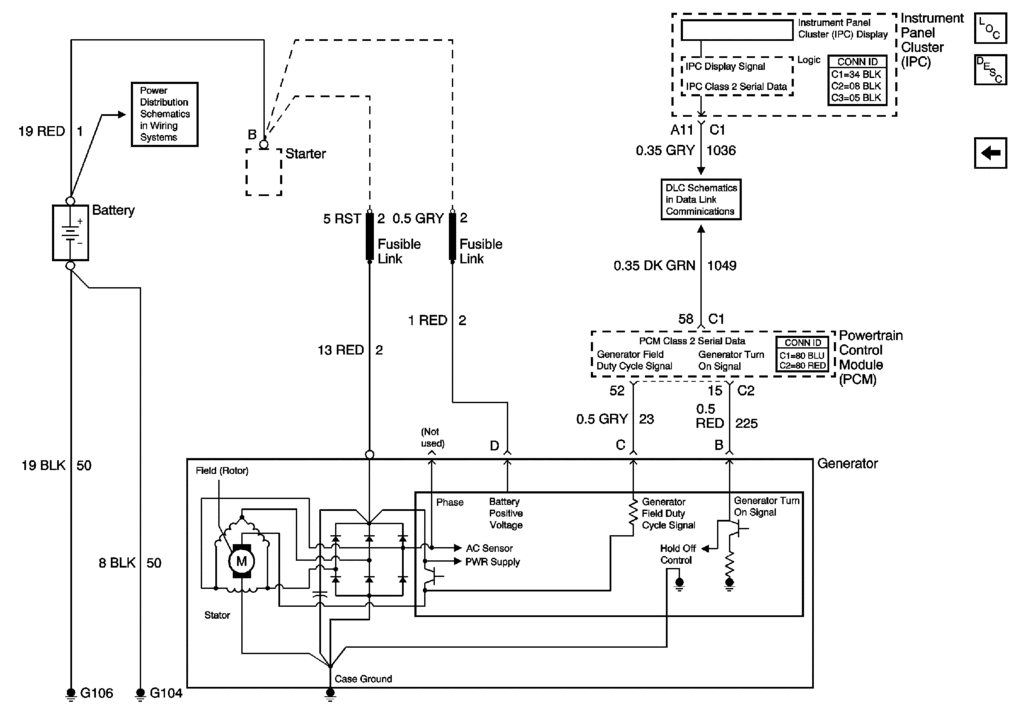
1. The RED (13) wire is the BATT wire. That wire is connected to the battery THROUGH the bolt on the starter SOLENOID main power input terminal. IF,,,,,,,, that solenoid terminal is LOOSE/CORRODED/BROKEN/BURNT,,, you will have **** poor fluctuating or NO charging voltages
2. The RED (1) wire connected to the connector on TOP of the alternator (PIN "D") is the feed back wire that samples the cars battery voltage and tells the REGULATOR what the voltage is so it can adjust.
3. What do you THINK the charging voltage should be??? There is NO set value. Sometimes it can be at 13.8 and sometimes it can be at 14.5. It all depends on what the regulator and PCM determines what it needs to be.
YES,,,,,,,,,,,,,,, THE ONLY WAY to absolutely know what the battery charging voltage is would be to measure it directly on the battery terminals. The DIC voltmeter and IPC Gage does NOT actually tell you what battery terminal voltage is:
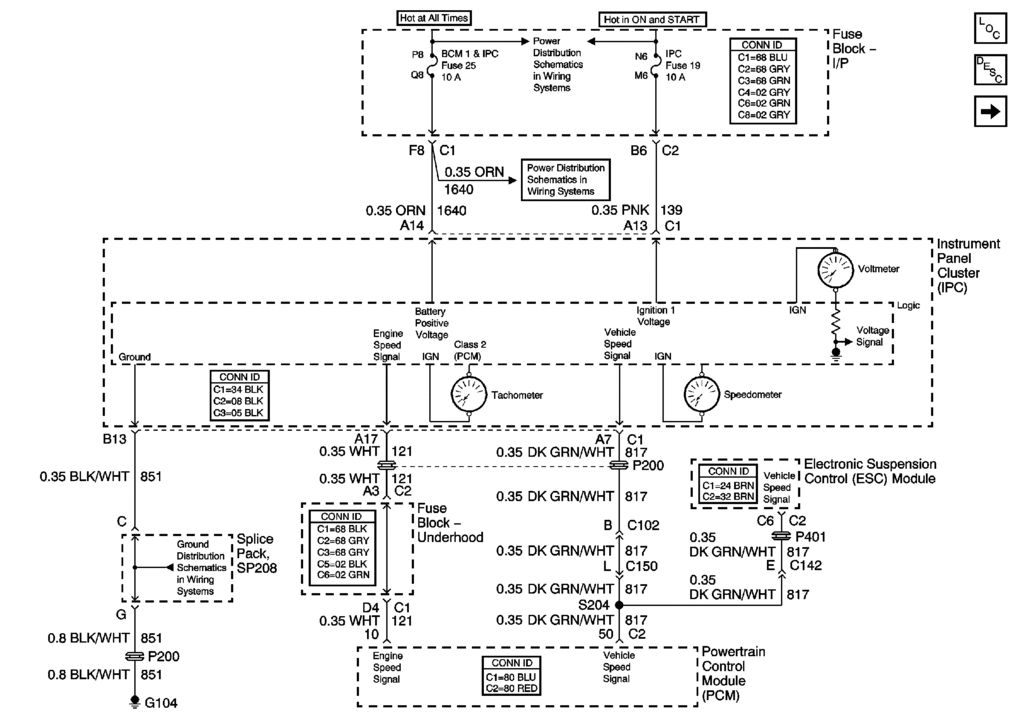
IF, you pull Instrument Panel Fuse box FUSE# 19 , the DIC and IPC voltmeter will NOT register. The feed comes from the "HOT in RUN AND START (ignition switch fed buss) If the contacts in your ignition switch are corroded/burnt/carbon coated, the switch output will be something LESS that battery voltage.
BC
Here is the charging circuit:
1. The RED (13) wire is the BATT wire. That wire is connected to the battery THROUGH the bolt on the starter SOLENOID main power input terminal. IF,,,,,,,, that solenoid terminal is LOOSE/CORRODED/BROKEN/BURNT,,, you will have **** poor fluctuating or NO charging voltages
2. The RED (1) wire connected to the connector on TOP of the alternator (PIN "D") is the feed back wire that samples the cars battery voltage and tells the REGULATOR what the voltage is so it can adjust.
3. What do you THINK the charging voltage should be??? There is NO set value. Sometimes it can be at 13.8 and sometimes it can be at 14.5. It all depends on what the regulator and PCM determines what it needs to be.
YES,,,,,,,,,,,,,,, THE ONLY WAY to absolutely know what the battery charging voltage is would be to measure it directly on the battery terminals. The DIC voltmeter and IPC Gage does NOT actually tell you what battery terminal voltage is:
IF, you pull Instrument Panel Fuse box FUSE# 19 , the DIC and IPC voltmeter will NOT register. The feed comes from the "HOT in RUN AND START (ignition switch fed buss) If the contacts in your ignition switch are corroded/burnt/carbon coated, the switch output will be something LESS that battery voltage.
BC

Melting Slicks

Joined: Nov 2014
Posts: 3,399
Likes: 1,339
From: Havre de Grace Maryland

Team Owner

Joined: May 2001
Posts: 36,836
Likes: 244
From: Dear Karma, I have a list of people you missed.
St. Jude Donor '08-'09-'10-'11-'12-'13-'14-'15-'16
Bill Curlee:
Those that think their indicated voltage should be a certain constant number (or in a very very narrow range of numbers), might need to stop overthinking things.
3. What do you THINK the charging voltage should be??? There is NO set value. Sometimes it can be at 13.8 and sometimes it can be at 14.5. It all depends on what the regulator and PCM determines what it needs to be.
Those that think their indicated voltage should be a certain constant number (or in a very very narrow range of numbers), might need to stop overthinking things.

Team Owner
Joined: May 2001
Posts: 36,836
Likes: 244
From: Dear Karma, I have a list of people you missed.
St. Jude Donor '08-'09-'10-'11-'12-'13-'14-'15-'16
Don't be confused. You can jump start your C5 just like most any other car/truck. Just observe the normal safety precautions and you'll be just fine.
Last edited by LoneStarFRC; Jan 27, 2016 at 08:04 AM. Reason: typo
Team Owner
Joined: May 2001
Posts: 36,836
Likes: 244
From: Dear Karma, I have a list of people you missed.
St. Jude Donor '08-'09-'10-'11-'12-'13-'14-'15-'16
OP:
This particular unit looks to be the correct choice for you UNLESS you go and have your old unit rebuilt.
http://www.rockauto.com/catalog/more...nid=492&jpid=1
This particular unit looks to be the correct choice for you UNLESS you go and have your old unit rebuilt.
http://www.rockauto.com/catalog/more...nid=492&jpid=1
Melting Slicks
Joined: Jan 2009
Posts: 3,275
Likes: 739
From: Miami FL
...1. The RED (13) wire is the BATT wire. That wire is connected to the battery THROUGH the bolt on the starter SOLENOID main power input terminal. IF,,,,,,,, that solenoid terminal is LOOSE/CORRODED/BROKEN/BURNT,,, you will have **** poor fluctuating or NO charging voltages...
...YES,,,,,,,,,,,,,,, THE ONLY WAY to absolutely know what the battery charging voltage is would be to measure it directly on the battery terminals. The DIC voltmeter and IPC Gage does NOT actually tell you what battery terminal voltage is...
...YES,,,,,,,,,,,,,,, THE ONLY WAY to absolutely know what the battery charging voltage is would be to measure it directly on the battery terminals. The DIC voltmeter and IPC Gage does NOT actually tell you what battery terminal voltage is...
and Your alternator may be fine after all. Don't return it as core!!!As previously stated, you have to measure voltage directly at the battery and also check what you have directly at the alternator. The readings should be the same or very close, otherwise it may be what Bill just mentioned in point #1.
Team Owner
Joined: May 2001
Posts: 36,836
Likes: 244
From: Dear Karma, I have a list of people you missed.
St. Jude Donor '08-'09-'10-'11-'12-'13-'14-'15-'16

Thread Starter
Instructor
Joined: Feb 2008
Posts: 114
Likes: 0
From: elk grove california
So I installed the old alt back and all was fine for a week. It rained pretty good here lastnight and I went to go start the car this morning and got one click and nothing. Lights and radio work just fine.