When you click on links to various merchants on this site and make a purchase, this can result in this site earning a commission. Affiliate programs and affiliations include, but are not limited to, the eBay Partner Network.
Ok, maybe not as excessive as the title, but Im having high voltage problems. First time it happened, I don't remember the scenario, but voltage shot up, almost all dash lights and service vehicle soon came on, then the dash turned off but car still drove. When it came back on dic said high voltage and kept turning off and on with 18 volts showing I've read this on another thread and replaced the alternator. Started it up it held 14.5 volts. Drove about 300 miles just fine. Got on an on ramp and got on it, same thing happened, but this time I was able to watch all that was happening. Same thing as earlier, all lights came on, dash shut off but it wasn't just the dash. Headlights were flickering/striking and ac was throbbing. Pulled over and reset all the codes with the car off, and it drove fine.
Anyone have an idea what's going on? I'm out of ideas right now.
Last edited by CorvetteKeithf; Jun 22, 2016 at 09:19 AM.
Yeah, I'll have to do that. Only reason I cleared them was I was in a pretty small shoulder on the turnpike and just wanted to get moving... I'll try to get it to do it again today.
So... assuming it's the alternator DO NOT take your OEM in and exhange it... KEEP the OEM and have it rebuilt... READ the STICKY link below about the alternator....
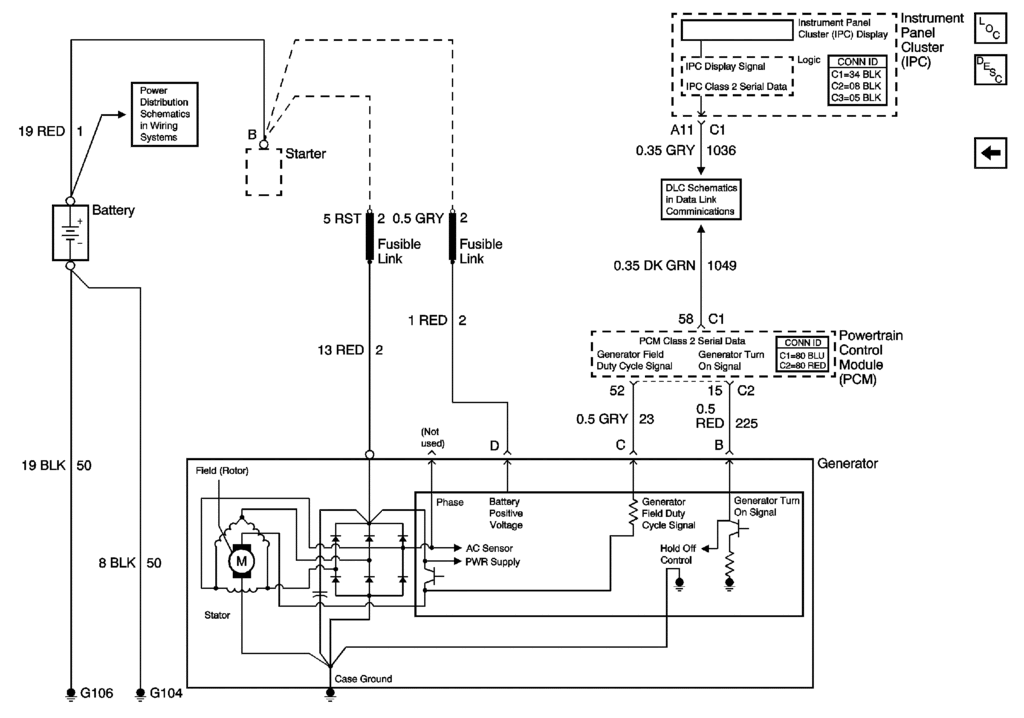
There is a WIRING PATH that goes from the battery POSITIVE terminal to the alternator BATT Terminal and to the alternator regulator connector on top of the alternator. The BATT terminal is the BIG terminal on the back of the alternator under the black boot. The other plug has FOUR small wires. Pin "D" is the feed back SENSE wire!!!!!
The POS wire from the battery goes to the starter solenoid MAIN terminal. From that terminal there is a FUSED wire that goes to the BATT terminal and a smaller fused wire that goes to the PLUG IN CONNECTOR on top of the alternator.
Most of the time this happens, the connection on the SOLENOID is loose or corroded or BURNT! That smaller red wire is a FEED BACK circuit that the alter uses monitor the voltage on the battery / battery buss and that controls the alternator voltage output.
Check the main starter solenoid connection and make sure that the wires are clean and tight..
Bill
If it can sense voltage, it can fail to FULL OUTPUT (as you have seen!)
Last edited by Bill Curlee; Jun 22, 2016 at 03:17 PM.
So it did it right out of work. Started it up, and watched the voltage get to 17 before the dash shut off. Turned it off, checked the codes and got the following:
Pcm-
P0622 H C- generator field control circuit malfunction
P1637 H - generator L terminal circuit
Hvac-
U1160 H- loss of communications with ldcm
Ldcm-
B2282 H- battery #1 fault with dcm
B2284 H- battery #2 fault with dcm
Rdcm-
B2283 H- battery #1 fault with dcm
B2285 H- battery #2 fault with dcm
Scm-
B0851 H- battery #1 out of range
B0856 H- battery #2 out of range
Cleared all the codes, started it back up and it stayed at 14.4 volts and I drove home. This really isn't making sense to me... I read what I could on each of the codes, but I can't find anything that has all of these codes together.
There is a WIRING PATH that goes from the battery POSITIVE terminal to the alternator BATT Terminal and to the alternator regulator connector on top of the alternator. The BATT terminal is the BIG terminal on the back of the alternator under the black boot. The other plug has FOUR small wires. Pin "D" is the feed back SENSE wire!!!!!
The POS wire from the battery goes to the starter solenoid MAIN terminal. From that terminal there is a FUSED wire that goes to the BATT terminal and a smaller fused wire that goes to the PLUG IN CONNECTOR on top of the alternator.
Most of the time this happens, the connection on the SOLENOID is loose or corroded or BURNT! That smaller red wire is a FEED BACK circuit that the alter uses monitor the voltage on the battery / battery buss and that controls the alternator voltage output.
Check the main starter solenoid connection and make sure that the wires are clean and tight..
Bill
If it can sense voltage, it can fail to FULL OUTPUT (as you have seen!)
I replaced the starter about 2 months ago, I'll have to get under and make sure everything's right. I cleaned off the connections, but maybe not well enough.
So it did it right out of work. Started it up, and watched the voltage get to 17 before the dash shut off. Turned it off, checked the codes and got the following:
Pcm-
P0622 H C- generator field control circuit malfunction
P1637 H - generator L terminal circuit
Hvac-
U1160 H- loss of communications with ldcm
Ldcm-
B2282 H- battery #1 fault with dcm
B2284 H- battery #2 fault with dcm
Rdcm-
B2283 H- battery #1 fault with dcm
B2285 H- battery #2 fault with dcm
Scm-
B0851 H- battery #1 out of range
B0856 H- battery #2 out of range
Cleared all the codes, started it back up and it stayed at 14.4 volts and I drove home. This really isn't making sense to me... I read what I could on each of the codes, but I can't find anything that has all of these codes together.
SOoo are you using the DIC to pull codes?
You need clear codes....drive the car... then BEFORE you kill the car pull the codes
I'm still drawing a blank. From my understanding, connection to the battery and starter in this case I feel shouldn't be questioned since the car is displaying the voltage therefore the overvoltage. So it should be telling it not to. So either the voltage regulator or the Pcm (alternator wire to Pcm included), correct? I'm going to try to swap the alternator again, but I bought the clutch less replacement in ohio at O'Reillys and they don't have them in nj. And I can't find a store here that sells the 145a clutch less one.
Last edited by CorvetteKeithf; Jun 26, 2016 at 03:16 PM.
From: Central PA. - - My AR15 identifies as a muzzleloader
I believe in the Beer Fairy
Any time I see crazy intermittent electrical issues, I tend to suspect ground faults. The C5 has tons of ground points, any of which can cause almost any electrical issue known to man. They are tough to diagnose.
From what you're saying, I'd probably be looking at all the ground points anywhere near the charging system to eliminate voltage potential discrepancies the charging system needs to deal with.
Remember when trying to diagnose a system, voltage is a "Potential". When dealing with DC systems where 0Vdc is often (if not almost always) used as a reference, you have issues if 0V isn't 0V. Any sensor that uses an offset for reference will probably be designed such that the potential between 2 points is X, and when either of those, high or low, is not where it is supposed to be, the sensor is now sending bogus info to whatever module is expecting a value.
For example, let's say your voltage regulator in this case uses 0Vdc as it's reference and tries to charge to 14.5Vdc above that. Ok, no issue as long as the ground is a ground. But let's say the ground isn't a good ground and there's a resistance between the ground reference point and the regulator. Well now the regulator might see +4Vdc as ground, and assumes that's 0V. Pow, now it charges to the "Potential" of 14.5V, which in your case of a bad ground, now it's 18.5V because you've got 4V from ground being shown as ground.
My example may not apply exactly to your situation, but this is the way the systems work and you should be aware of this when trying to track down a problem. Yours is probably going to be really tough because without some way to see in real time, what those values are, you may never find the issue. But you might just fix it by making one particular ground point get consistent contact.
I'm not saying this is what your problem is, and my examples are not relevant to all such issues, but I say this stuff to illustrate some of the methods by which these systems work, so you might pick up on things that are otherwise not so intuitive.
Please tell me you never see this overvoltage situation when the car is turned off? Ie: Key on and voltage too high? At least if you only see it when running, you know the alternator is somehow, someway, the culprit. From what I read above, I am not positive you never see this before turning the car on.
I'm still drawing a blank. From my understanding, connection to the battery and starter in this case I feel shouldn't be questioned since the car is displaying the voltage therefore the overvoltage. So it should be telling it not to. So either the voltage regulator or the Pcm (alternator wire to Pcm included), correct? I'm going to try to swap the alternator again, but I bought the clutch less replacement in ohio at O'Reillys and they don't have them in nj. And I can't find a store here that sells the 145a clutch less one.
DUDE I'm telling you IF you haven't read the sticky... You have opened up a can of electrical worms .... GO HAVE YOUR OEM alternator rebuilt IT'S not very expensive and you can check that one OFF the list ...
Any time I see crazy intermittent electrical issues, I tend to suspect ground faults. The C5 has tons of ground points, any of which can cause almost any electrical issue known to man. They are tough to diagnose.
From what you're saying, I'd probably be looking at all the ground points anywhere near the charging system to eliminate voltage potential discrepancies the charging system needs to deal with.
Remember when trying to diagnose a system, voltage is a "Potential". When dealing with DC systems where 0Vdc is often (if not almost always) used as a reference, you have issues if 0V isn't 0V. Any sensor that uses an offset for reference will probably be designed such that the potential between 2 points is X, and when either of those, high or low, is not where it is supposed to be, the sensor is now sending bogus info to whatever module is expecting a value.
For example, let's say your voltage regulator in this case uses 0Vdc as it's reference and tries to charge to 14.5Vdc above that. Ok, no issue as long as the ground is a ground. But let's say the ground isn't a good ground and there's a resistance between the ground reference point and the regulator. Well now the regulator might see +4Vdc as ground, and assumes that's 0V. Pow, now it charges to the "Potential" of 14.5V, which in your case of a bad ground, now it's 18.5V because you've got 4V from ground being shown as ground.
My example may not apply exactly to your situation, but this is the way the systems work and you should be aware of this when trying to track down a problem. Yours is probably going to be really tough because without some way to see in real time, what those values are, you may never find the issue. But you might just fix it by making one particular ground point get consistent contact.
I'm not saying this is what your problem is, and my examples are not relevant to all such issues, but I say this stuff to illustrate some of the methods by which these systems work, so you might pick up on things that are otherwise not so intuitive.
Please tell me you never see this overvoltage situation when the car is turned off? Ie: Key on and voltage too high? At least if you only see it when running, you know the alternator is somehow, someway, the culprit. From what I read above, I am not positive you never see this before turning the car on.
Reads battery voltage anytime car is off. I'll check the grounds real good. I've only had the car a couple months, so I don't even know where they are though.
DUDE I'm telling you IF you haven't read the sticky... You have opened up a can of electrical worms .... GO HAVE YOUR OEM alternator rebuilt IT'S not very expensive and you can check that one OFF the list ...
I replaced the alternator before I looked at any forums thinking it was like any other car. So the oem one is now a core 😧
Any time I see crazy intermittent electrical issues, I tend to suspect ground faults. The C5 has tons of ground points, any of which can cause almost any electrical issue known to man. They are tough to diagnose.
From what you're saying, I'd probably be looking at all the ground points anywhere near the charging system to eliminate voltage potential discrepancies the charging system needs to deal with.
Remember when trying to diagnose a system, voltage is a "Potential". When dealing with DC systems where 0Vdc is often (if not almost always) used as a reference, you have issues if 0V isn't 0V. Any sensor that uses an offset for reference will probably be designed such that the potential between 2 points is X, and when either of those, high or low, is not where it is supposed to be, the sensor is now sending bogus info to whatever module is expecting a value.
For example, let's say your voltage regulator in this case uses 0Vdc as it's reference and tries to charge to 14.5Vdc above that. Ok, no issue as long as the ground is a ground. But let's say the ground isn't a good ground and there's a resistance between the ground reference point and the regulator. Well now the regulator might see +4Vdc as ground, and assumes that's 0V. Pow, now it charges to the "Potential" of 14.5V, which in your case of a bad ground, now it's 18.5V because you've got 4V from ground being shown as ground.
My example may not apply exactly to your situation, but this is the way the systems work and you should be aware of this when trying to track down a problem. Yours is probably going to be really tough because without some way to see in real time, what those values are, you may never find the issue. But you might just fix it by making one particular ground point get consistent contact.
I'm not saying this is what your problem is, and my examples are not relevant to all such issues, but I say this stuff to illustrate some of the methods by which these systems work, so you might pick up on things that are otherwise not so intuitive.
Please tell me you never see this overvoltage situation when the car is turned off? Ie: Key on and voltage too high? At least if you only see it when running, you know the alternator is somehow, someway, the culprit. From what I read above, I am not positive you never see this before turning the car on.
Also, if loose ground was the problem, why is it everytime it happens, I pull over shut it off, clear the codes, start it up, and its fine? Makes me think it'should computer related.
From: Central PA. - - My AR15 identifies as a muzzleloader
I believe in the Beer Fairy
Thanks 8VETTE7 for the links, saved me a little time.
Originally Posted by CorvetteKeithf
Also, if loose ground was the problem, why is it everytime it happens, I pull over shut it off, clear the codes, start it up, and its fine? Makes me think it'should computer related.
I could type here indefinitely about why this is possible and give hypothetical examples. It's no different than a loose battery cable and a car that will start one time and not another. Sometimes there's 'enough' contact, other times there isn't. And it doesn't have to be an on/off situation. Something as simple as a weak connection creates a resistance between two points, and you've got a variation in voltage. That is more readily seen when dealing with higher currents, but 'high' is a relative thing depending upon the size of the conductors. It really is electricity 101. Look at how a resistor affects a circuit.
Check the voltage on terminal D of the connector. The alternator won't work right if that terminal doesn't have the same voltage as the battery reads.
The PCM DOES NOT control the charging voltage. It just tells the alternator to turn-on and monitors it's operation.
If you yanked the L and F wires that go to the PCM out of the connector (red and grey in B and C) and connected a test light between the battery positive post and terminal B, the alternator would still energize and charge just fine.
I agree... Use an OHM Meter and read the wire at pin D to the solenoid. See if its compromised. That wire has an inline fuse link and they can and sometimes do cause issues.










 2004 having Seizures