




I need help to diagnose this engine issue
Thread Starter
Advanced

Joined: Dec 2016
Posts: 52
Likes: 22
From: Springfield PA
 I need help to diagnose this engine issue
I need help to diagnose this engine issue. At low revs under load the car chokes sputters and lugs. However under as the revs increase it backfires and snap crackle and pop pop pops. Do we know why this is? As you can see the check engine light is on. Just took it out from winter hibernation.
Last edited by Always_a_rhythm; Apr 2, 2018 at 08:45 PM.

Administrator


Joined: Mar 2001
Posts: 368,415
Likes: 24,798
From: In a parallel universe. Currently own 2014 Stingray Coupe.
C7 of the Year - Modified Finalist 2021
MO Events Coordinator
St. Jude Co-Organizer
St. Jude Donor '03 thru '26
NCM Sinkhole Donor
CI 5, 8 & 11 Veteran
Moved to C5 Tech.
Thread Starter
Advanced
Joined: Dec 2016
Posts: 52
Likes: 22
From: Springfield PA
OK.
These are the codes I got. Are they all history codes?
10-PCM P0300 H
A0-LDCM B2264 H
A0-LDCM V1064 H
A1-RDCM B2265 H
A1-RDCM V1064 H
B0-RFA V1000 H
B0-RFA V1064 H
These are the codes I got. Are they all history codes?
10-PCM P0300 H
A0-LDCM B2264 H
A0-LDCM V1064 H
A1-RDCM B2265 H
A1-RDCM V1064 H
B0-RFA V1000 H
B0-RFA V1064 H
Last edited by Always_a_rhythm; Apr 3, 2018 at 08:17 AM. Reason: Removing video that didn't work anyway. Codes are listed here.
Thread Starter
Advanced
Joined: Dec 2016
Posts: 52
Likes: 22
From: Springfield PA
No C codes.
I cleared all the H codes and drove it again.
Still has the problem.
But the check engine light flashed only for a moment then went out. I assume it will come on again tomorrow during my commute.
I checked codes again, but nothing right now. Assume I will have a code again by tomorrow.
Could it be 4 month old gas causing a problem? Seems worse than that almost like one of the cylinders isn't firing. A fouled spark plug or something. I'm just guessing though.
I cleared all the H codes and drove it again.
Still has the problem.
But the check engine light flashed only for a moment then went out. I assume it will come on again tomorrow during my commute.
I checked codes again, but nothing right now. Assume I will have a code again by tomorrow.
Could it be 4 month old gas causing a problem? Seems worse than that almost like one of the cylinders isn't firing. A fouled spark plug or something. I'm just guessing though.
Corvette Stories
The Best of Corvette for Corvette Enthusiasts

Top 10 Most Expensive Corvettes Ever Sold on Bring A Trailer
Brett Foote
10 Things Every Corvette Owner Needs (2026 Edition)
Michael S. Palmer
8 Most "Only Corvette Owners Understand" Quirks and Problems
Pouria Savadkouei
10 Reasons the C6 Z06 is Still A Performance Benchmark After 20 Years
Joe Kucinski
How Much Horsepower Every Corvette Engine "LOST" in 1972
Joe Kucinski
Top 10 DOs and DON'Ts for Protecting Your Convertible Top!
Michael S. Palmer
Top 10 Most Explosive Corvettes Ever Made: Power-to-Weight Ratio Ranked!
Joe Kucinski
150 hp to 1,250 hp: Every Corvette Generation Compared by the Specs That Matter
Joe Kucinski
8 Coolest Corvette Pace Cars (and Replicas) of All Time
Verdad Gallardo
Thread Starter
Advanced
Joined: Dec 2016
Posts: 52
Likes: 22
From: Springfield PA
OK after clearing the codes last night the check engine light came on again during my commute.
Only one code was showing:
10-PCM P0300H
Only one code was showing:
10-PCM P0300H
Last edited by Always_a_rhythm; Apr 3, 2018 at 08:26 AM.
Thread Starter
Advanced
Joined: Dec 2016
Posts: 52
Likes: 22
From: Springfield PA
Most codes will show as H or History when the engine is NOT running. That is because the majority of codes are set while the engine is running and when you turn OFF the engine to pull codes the codes get changed from C to H. Codes set while the engine is running cannot by definition be C when the engine is OFF.
You can pull codes with the engine running. To do so use the RESET button to clear all messages from the DIC. Then pull the codes a normal. Do this when you have the CEL set while driving and you will see the code responsible for the CEL. P0300 is engine misfire and that definitely will set the CEL.
If the fuel tank was not full during storage and you did not treat the fuel with a stabilizer, condensation could have easily formed and be the cause of the P0300.
You can pull codes with the engine running. To do so use the RESET button to clear all messages from the DIC. Then pull the codes a normal. Do this when you have the CEL set while driving and you will see the code responsible for the CEL. P0300 is engine misfire and that definitely will set the CEL.
If the fuel tank was not full during storage and you did not treat the fuel with a stabilizer, condensation could have easily formed and be the cause of the P0300.
Great to know about pulling code while the car is running. I didn't know that. I did get the P0300 code.
For the fuel tank, I put the car into storage with about 3/4 tank of gas. I didn't add fuel stabilizer or anything during the winter. Maybe that's it. Do you recommend using HEET or other condensation removal additive?
Thread Starter
Advanced
Joined: Dec 2016
Posts: 52
Likes: 22
From: Springfield PA

Melting Slicks


Joined: Feb 2001
Posts: 2,804
Likes: 358
From: Northville, MI
There are many causes for the P0300 code--random misfires.
This may be due to a vacuum leak, but it can also be caused by dirty fuel injectors, a weak fuel pump (low fuel pressure) or a faulty fuel pressure regulator. It can also be caused by ignition misfire due to worn or fouled spark plugs, bad spark plug wires, or weak ignition coil. If you have removed the engine covers, then also check the fuel injector connections. Start one by one to find the problem, if not that then check the spark plug wires to make sure they are seated correctly. A P0300 usually occurs when more than one cylinder is misfiring on an engine bank.
This may be due to a vacuum leak, but it can also be caused by dirty fuel injectors, a weak fuel pump (low fuel pressure) or a faulty fuel pressure regulator. It can also be caused by ignition misfire due to worn or fouled spark plugs, bad spark plug wires, or weak ignition coil. If you have removed the engine covers, then also check the fuel injector connections. Start one by one to find the problem, if not that then check the spark plug wires to make sure they are seated correctly. A P0300 usually occurs when more than one cylinder is misfiring on an engine bank.

Burning Brakes


Joined: Feb 2013
Posts: 904
Likes: 296
From: Sacramento, California
You could try some water remover like HEET and see if it helps. P0300 is a random misfire code meaning it's not just 1 cylinder misfiring, but several randomly. When you get a specific cylinder misfire you will get a code like P0301 (cylinder 1), P0302 (cylinder 2), etc. I had a similar problem when I first bought my car and it turned out to be old plug wires and the spark plug gaps were too big. New plugs and wires solved that problem. If the water remover doesn't work, check the plugs and wires. Another possibility is that a wiring harness for the coils near the back of the heads might have damage (exposed wiring) which would cause it to randomly ground out some of the coils from making contact with the metal bracket.
Steve
Steve

Tech Contributor

Joined: Dec 1999
Posts: 32,910
Likes: 2,402
From: Anthony TX
CI 6,7,8,9,11 Vet
St. Jude Donor '08
P-0300 IS A RANDOM MISFIRE DTC.... I would start by removing the plug wires and examining each wire for damage. Check each wire end to end with an OHM Meter and see if any are way out of spec. OEM wires are 250-750 ohms. All should be well with in that range.
also check the wires in the dark and make the car misfire. Look and listen for the fire works (sparks and arcs )
BC
also check the wires in the dark and make the car misfire. Look and listen for the fire works (sparks and arcs )
BC
Thread Starter
Advanced
Joined: Dec 2016
Posts: 52
Likes: 22
From: Springfield PA
Thank you everyone for the help.
I will be getting and putting in a bottle of HEET tonight and letting you know the updates.
It seems like changing spark plugs and wires is a pain on the C5. But that will be my next action if I can't get it to run right.
Cheers!
I will be getting and putting in a bottle of HEET tonight and letting you know the updates.
It seems like changing spark plugs and wires is a pain on the C5. But that will be my next action if I can't get it to run right.
Cheers!
Thread Starter
Advanced
Joined: Dec 2016
Posts: 52
Likes: 22
From: Springfield PA
ISO-HEET went into it yesterday around 5pm.
I drove it home and let it sit overnight.
On today's morning commute to work I still have some misfires, but they're about half as frequent. Still lugs a bit (less than before) under load at low revs. If I drive is gently it doesn't misfire or lug at all.
I have just over half a tank of gas. I intend to run it down to a quarter, fill with new gas and put another bottle of HEET in. See if that eliminates the problem.
I'm thinking due to the random Misfire code P0300 that it must be the gas rather than a specific wire or plug that's not performing as intended.
Race Director


Joined: Apr 2017
Posts: 10,247
Likes: 888
From: Hickory NC
2025 C5 of the Year Finalist - Modified
2022 C5 of the Year Finalist - Modified
2020 C5 of the Year Finalist - Modified
St. Jude Donor '17 thru '26
I had a P0300 code recently. Unfortunately, the DIC will not (or at least I couldn't find how to) provide the specific cylinder or cylinders. Anyhow - when I used a plug in diagnostic it indicated cylinder 1. Pulled and replaced the wire (didn't have my ohm meter where I was), and still got the code. Pulled the plug and it looked good. Replaced the coil and still had the code. Looked at the plug again and finally found a very slight crack that was almost too small to see but could feel it with my fingernail (great test tool  ). Replaced the plug and ran great. Hopefully yours will prove to be that simple in the long run, too!
). Replaced the plug and ran great. Hopefully yours will prove to be that simple in the long run, too!
Tech Contributor
Joined: Dec 1999
Posts: 32,910
Likes: 2,402
From: Anthony TX
CI 6,7,8,9,11 Vet
St. Jude Donor '08
I had a P0300 code recently. Unfortunately, the DIC will not (or at least I couldn't find how to) provide the specific cylinder or cylinders. Anyhow - when I used a plug in diagnostic it indicated cylinder 1. Pulled and replaced the wire (didn't have my ohm meter where I was), and still got the code. Pulled the plug and it looked good. Replaced the coil and still had the code. Looked at the plug again and finally found a very slight crack that was almost too small to see but could feel it with my fingernail (great test tool ). Replaced the plug and ran great. Hopefully yours will prove to be that simple in the long run, too!
). Replaced the plug and ran great. Hopefully yours will prove to be that simple in the long run, too!Made a hell of a misfire under load and you would have thought the engine was going to fall out from under the car..

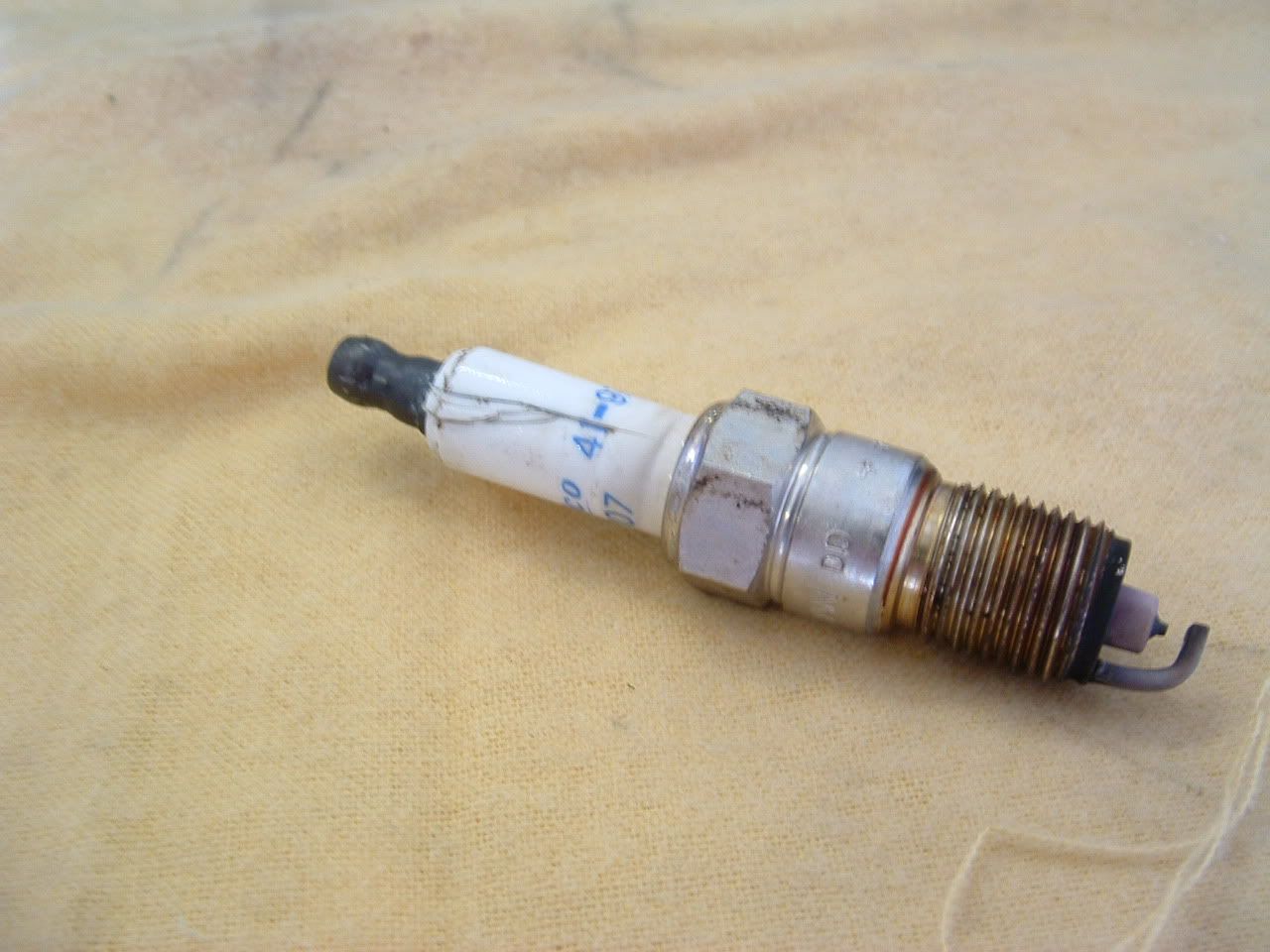
All it takes is a very small crack or a very small defect somewhere in the secondary ignition path.
Bill
Last edited by Bill Curlee; Apr 4, 2018 at 04:37 PM.
Thread Starter
Advanced
Joined: Dec 2016
Posts: 52
Likes: 22
From: Springfield PA
P-0300 IS A RANDOM MISFIRE DTC.... I would start by removing the plug wires and examining each wire for damage. Check each wire end to end with an OHM Meter and see if any are way out of spec. OEM wires are 250-750 ohms. All should be well with in that range.
also check the wires in the dark and make the car misfire. Look and listen for the fire works (sparks and arcs )
BC
also check the wires in the dark and make the car misfire. Look and listen for the fire works (sparks and arcs )
BC
I drove the car out to a less populated area and had the wife rev the engine.
Hooollleeeyy ****.

I had sparks and arcs all over the place.
Looked like a big consistent arc off of cylinder 8 and some smaller arcs off of cylinders 1, 3 and 5.
I don't remember this issue before storage, so I'm not really sure what happened. I am relatively confident that the sparks and wires have never been changed so maybe they just finally degraded after 17 years.
Seems like an afternoon job to change over the sparks and wires is in my future.
Turns out it may not have been the gas after all.