




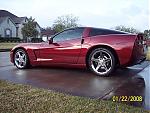
New 08 Split Chrome Wheels

Le Mans Master


Joined: Oct 2005
Posts: 6,503
Likes: 2
From: Oklahoma City OK

Former Vendor
Joined: Nov 2007
Posts: 2,386
Likes: 0
From: Port Orange Florida www.atomicautostore.com

I have (1) set of Factory Reproduction C6 Sizes Factory Offsets 18X8.5/19X10 Chrome Split Spokes with center caps & lugs for $780.00 Delivered. Your stock TPMS will fit.

Regards,
Jimmy P.
Last edited by Atomic Autosports; Mar 25, 2008 at 06:03 PM.

Burning Brakes

Joined: Nov 2004
Posts: 765
Likes: 0
From: York Pa

Team Owner


Joined: Jan 2007
Posts: 22,136
Likes: 23
From: In the woods looking for my thrown putter.
St. Jude Donor '13, '15
Le Mans Master
Joined: Oct 2005
Posts: 6,503
Likes: 2
From: Oklahoma City OK
Thread Starter
Melting Slicks


Joined: Apr 2006
Posts: 2,804
Likes: 0
From: South HOUSTON TEXAS
St. Jude Donor '03-'04-'05-'06-'07-'08-'09
Yes, this is true GM Does not offer the split spoke wheel in Chrome.
The GM silver split spoke wheels are getting Chromed, and are sold for $400 - $500 more than the split chrome reproduction wheels.
Thread Starter
Melting Slicks
Joined: Apr 2006
Posts: 2,804
Likes: 0
From: South HOUSTON TEXAS
St. Jude Donor '03-'04-'05-'06-'07-'08-'09
Thread Starter
Melting Slicks
Joined: Apr 2006
Posts: 2,804
Likes: 0
From: South HOUSTON TEXAS
St. Jude Donor '03-'04-'05-'06-'07-'08-'09
Corvette Stories
The Best of Corvette for Corvette Enthusiasts

Top 10 Most Expensive Corvettes Ever Sold on Bring A Trailer
Brett Foote
10 Things Every Corvette Owner Needs (2026 Edition)
Michael S. Palmer
8 Most "Only Corvette Owners Understand" Quirks and Problems
Pouria Savadkouei
10 Reasons the C6 Z06 is Still A Performance Benchmark After 20 Years
Joe Kucinski
How Much Horsepower Every Corvette Engine "LOST" in 1972
Joe Kucinski
Top 10 DOs and DON'Ts for Protecting Your Convertible Top!
Michael S. Palmer
Top 10 Most Explosive Corvettes Ever Made: Power-to-Weight Ratio Ranked!
Joe Kucinski
150 hp to 1,250 hp: Every Corvette Generation Compared by the Specs That Matter
Joe Kucinski
8 Coolest Corvette Pace Cars (and Replicas) of All Time
Verdad Gallardo
Drifting

Joined: Jun 2007
Posts: 1,425
Likes: 0
From: OKC OK
Chrome plating is an acid process!
Former Vendor
Joined: Nov 2007
Posts: 2,386
Likes: 0
From: Port Orange Florida www.atomicautostore.com
Hello
Nevre heard of how chrome could hurt a wheel. As for weight the chrome adds about 2 lbs. I posted the actual weight back in November and will see if I can find them. If someone has stock wheel without tires let me know the weights and I will weigh the ones I have in stock.
Regards,
Jimmy P.
Nevre heard of how chrome could hurt a wheel. As for weight the chrome adds about 2 lbs. I posted the actual weight back in November and will see if I can find them. If someone has stock wheel without tires let me know the weights and I will weigh the ones I have in stock.
Regards,
Jimmy P.


Former Vendor
Joined: Nov 2007
Posts: 2,386
Likes: 0
From: Port Orange Florida www.atomicautostore.com

Drifting
Joined: Feb 2007
Posts: 1,537
Likes: 1
From: Southlake Texas
Examples of hydrogen embrittlement are cracking of weldments or hardened steels when exposed to conditions, which inject hydrogen into the component. Presently this phenomenon is not completely understood and hydrogen embrittlement detection, in particular, seems to be one of the most difficult aspects of the problem. Hydrogen embrittlement does not affect all metallic materials equally. The most vulnerable are high-strength steels, titanium alloys and aluminum alloys.
Aluminum alloys are susceptible to hydrogen embrittlement, although the face centered cubic microstructure means that the transport of hydrogen is slower than in high strength steels, and hence the crack growth rate may be lower. The cracking is normally intergranular. As with steels, the susceptibility becomes more severe as the strength of the alloy is increased. Any environments that can provide hydrogen can lead to SCC of susceptible alloys, ranging from humid air to salt solutions (used in plating)."
EDIT:
Your information is not correct. GM requires significant evaluation and testing before they will approve a wheel for production. They were worried about strength and possible failures after chrome plating these wheels due to the spoke design and dimensions. That does not mean they will crack, just that GM was concerned about the possibility and decided not to play at this time.
Last edited by WHT; Mar 26, 2008 at 04:11 AM.

Pro

Joined: Mar 2004
Posts: 596
Likes: 0
From: St. Louis MO
Just curious and not trying to be a smart a$$ but do you work for GM, on their wheel R and D team, or know someone who works in that area? I ask this as you seem to offer a lot of interesting info regarding chroming and GM's take on it. Or, is this just your personal knowledge on this?
Thanks
Thanks

Race Director


Joined: Sep 2007
Posts: 16,557
Likes: 2,108
From: Peoria/Phoenix AZ
C6 of Year Finalist (performance mods) 2019
Race Director
Joined: Sep 2007
Posts: 16,557
Likes: 2,108
From: Peoria/Phoenix AZ
C6 of Year Finalist (performance mods) 2019
Hello
Nevre heard of how chrome could hurt a wheel. As for weight the chrome adds about 2 lbs. I posted the actual weight back in November and will see if I can find them. If someone has stock wheel without tires let me know the weights and I will weigh the ones I have in stock.
Regards,
Jimmy P.
Nevre heard of how chrome could hurt a wheel. As for weight the chrome adds about 2 lbs. I posted the actual weight back in November and will see if I can find them. If someone has stock wheel without tires let me know the weights and I will weigh the ones I have in stock.
Regards,
Jimmy P.
GM requires significant evaluation and testing before they will approve a wheel for production. They were worried about strength and possible failures after chrome plating these wheels due to the spoke design and dimensions. That does not mean they will crack, just that GM was concerned about the possibility and decided not to play at this time.
Le Mans Master
Joined: Oct 2005
Posts: 6,503
Likes: 2
From: Oklahoma City OK
"The embrittlement of metal or alloy by atomic hydrogen involves the ingress of hydrogen into a component, an event that can seriously reduce the ductility and load-bearing capacity, cause cracking and catastrophic brittle failures at stresses below the yield stress of susceptible materials. Hydrogen embrittlement occurs in a number of forms but the common features are an applied tensile stress and hydrogen dissolved in the metal.
Examples of hydrogen embrittlement are cracking of weldments or hardened steels when exposed to conditions, which inject hydrogen into the component. Presently this phenomenon is not completely understood and hydrogen embrittlement detection, in particular, seems to be one of the most difficult aspects of the problem. Hydrogen embrittlement does not affect all metallic materials equally. The most vulnerable are high-strength steels, titanium alloys and aluminum alloys.
Aluminum alloys are susceptible to hydrogen embrittlement, although the face centered cubic microstructure means that the transport of hydrogen is slower than in high strength steels, and hence the crack growth rate may be lower. The cracking is normally intergranular. As with steels, the susceptibility becomes more severe as the strength of the alloy is increased. Any environments that can provide hydrogen can lead to SCC of susceptible alloys, ranging from humid air to salt solutions (used in plating)."
EDIT:
Your information is not correct. GM requires significant evaluation and testing before they will approve a wheel for production. They were worried about strength and possible failures after chrome plating these wheels due to the spoke design and dimensions. That does not mean they will crack, just that GM was concerned about the possibility and decided not to play at this time.
Examples of hydrogen embrittlement are cracking of weldments or hardened steels when exposed to conditions, which inject hydrogen into the component. Presently this phenomenon is not completely understood and hydrogen embrittlement detection, in particular, seems to be one of the most difficult aspects of the problem. Hydrogen embrittlement does not affect all metallic materials equally. The most vulnerable are high-strength steels, titanium alloys and aluminum alloys.
Aluminum alloys are susceptible to hydrogen embrittlement, although the face centered cubic microstructure means that the transport of hydrogen is slower than in high strength steels, and hence the crack growth rate may be lower. The cracking is normally intergranular. As with steels, the susceptibility becomes more severe as the strength of the alloy is increased. Any environments that can provide hydrogen can lead to SCC of susceptible alloys, ranging from humid air to salt solutions (used in plating)."
EDIT:
Your information is not correct. GM requires significant evaluation and testing before they will approve a wheel for production. They were worried about strength and possible failures after chrome plating these wheels due to the spoke design and dimensions. That does not mean they will crack, just that GM was concerned about the possibility and decided not to play at this time.
Not to disagree but GM has been known to make bad decisions in the past, I'm sure you are aware of the polished C5 thin spoke rims and the major problem they had of cracking. All cracked Rims that I saw were stock OE polished and regular thin spokes.
Thread Starter
Melting Slicks
Joined: Apr 2006
Posts: 2,804
Likes: 0
From: South HOUSTON TEXAS
St. Jude Donor '03-'04-'05-'06-'07-'08-'09
 They look great, thanks
Thread Starter
Melting Slicks
Joined: Apr 2006
Posts: 2,804
Likes: 0
From: South HOUSTON TEXAS
St. Jude Donor '03-'04-'05-'06-'07-'08-'09
"The embrittlement of metal or alloy by atomic hydrogen involves the ingress of hydrogen into a component, an event that can seriously reduce the ductility and load-bearing capacity, cause cracking and catastrophic brittle failures at stresses below the yield stress of susceptible materials. Hydrogen embrittlement occurs in a number of forms but the common features are an applied tensile stress and hydrogen dissolved in the metal.
Examples of hydrogen embrittlement are cracking of weldments or hardened steels when exposed to conditions, which inject hydrogen into the component. Presently this phenomenon is not completely understood and hydrogen embrittlement detection, in particular, seems to be one of the most difficult aspects of the problem. Hydrogen embrittlement does not affect all metallic materials equally. The most vulnerable are high-strength steels, titanium alloys and aluminum alloys.
Aluminum alloys are susceptible to hydrogen embrittlement, although the face centered cubic microstructure means that the transport of hydrogen is slower than in high strength steels, and hence the crack growth rate may be lower. The cracking is normally intergranular. As with steels, the susceptibility becomes more severe as the strength of the alloy is increased. Any environments that can provide hydrogen can lead to SCC of susceptible alloys, ranging from humid air to salt solutions (used in plating)."
EDIT:
Your information is not correct. GM requires significant evaluation and testing before they will approve a wheel for production. They were worried about strength and possible failures after chrome plating these wheels due to the spoke design and dimensions. That does not mean they will crack, just that GM was concerned about the possibility and decided not to play at this time.
Examples of hydrogen embrittlement are cracking of weldments or hardened steels when exposed to conditions, which inject hydrogen into the component. Presently this phenomenon is not completely understood and hydrogen embrittlement detection, in particular, seems to be one of the most difficult aspects of the problem. Hydrogen embrittlement does not affect all metallic materials equally. The most vulnerable are high-strength steels, titanium alloys and aluminum alloys.
Aluminum alloys are susceptible to hydrogen embrittlement, although the face centered cubic microstructure means that the transport of hydrogen is slower than in high strength steels, and hence the crack growth rate may be lower. The cracking is normally intergranular. As with steels, the susceptibility becomes more severe as the strength of the alloy is increased. Any environments that can provide hydrogen can lead to SCC of susceptible alloys, ranging from humid air to salt solutions (used in plating)."
EDIT:
Your information is not correct. GM requires significant evaluation and testing before they will approve a wheel for production. They were worried about strength and possible failures after chrome plating these wheels due to the spoke design and dimensions. That does not mean they will crack, just that GM was concerned about the possibility and decided not to play at this time.
 Dang this info makes me afraid to go over a 100 MPH with these wheels under me.
Are you a scientist?