







Ranger Method?

Thread Starter
Drifting


Joined: Nov 2011
Posts: 1,777
Likes: 309
From: Long Island, N.Y.
 Ranger Method?
I have an 07 with 8500 miles on the clock. I was thinking it is time to possibly do the clutch fluid. Should I do it now or wait? Is there an instruction video I need to watch? I am mechanically inclined so I have no problem doing it. I just want to see it or read about. Tried going to the how-to part but I didn't see anything on it. Or maybe I wasn't looking hard enough. lol
LMK.
Thanks,
Paul
LMK.
Thanks,
Paul

Melting Slicks


Joined: Jul 2004
Posts: 2,721
Likes: 149
From: North Carolina
There are a couple of videos on youtube. Just search ranger clutch and corvette or any combination thereof and you should find it.
Simple process. Once you do it the first time and get clear fluid (can take a quite a few cycles), then it is a pretty simple 5-minute procedure every few months to maintain it.
Simple process. Once you do it the first time and get clear fluid (can take a quite a few cycles), then it is a pretty simple 5-minute procedure every few months to maintain it.

Race Director


Joined: Oct 2005
Posts: 14,999
Likes: 200
From: Bay Area Ca.
Just take the extra time to protect the fender paint. A mishap will be big deal.
I have been doing the method for 8 yrs now and my fluid is always clear. 5,000 yearly miles with maybe 3 changes a year. I do not even change the fluid more than once per session. The first time it took two change cycles. If neglected do not be surprised if it takes a few cycles to stay clear the first time.
I have been doing the method for 8 yrs now and my fluid is always clear. 5,000 yearly miles with maybe 3 changes a year. I do not even change the fluid more than once per session. The first time it took two change cycles. If neglected do not be surprised if it takes a few cycles to stay clear the first time.

Melting Slicks


Joined: Jun 2013
Posts: 2,311
Likes: 251
From: Baltimore Maryland
I just did it for the first time on my 13 GS with 5,000 miles. Followed the YouTube video. Used Prestone Dot 4 brake fluid. Very easy. The fluid does look much cleaner now, but as far as I can tell my car is shifting exactly the same . . . which was already great. Good luck.

Racer

Joined: Jan 2010
Posts: 289
Likes: 13
From: San Jose CA
Review the maintenance schedule in your owners manual. Even with a low mileage car, you should be changing all the fluids. GM recommends a coolant change at five years. GM recommends The clutch fluid change at a regular maintenance service every two years. Following the Ranger method will make this an easy maintenance item, and most don't wait for the two year interval. It is easy to bleed the brake fluid, so bleed the brake fluid. and you should be good. Looks like smokinZ51 posted the ranger video for you. good luck and many here can help you with your questions.

Le Mans Master

Joined: Jan 2006
Posts: 6,642
Likes: 450
From: Texarkana Texas
I don't track my car at all, but I do change the clutch fluid every couple of months regularly. Takes just a few minutes, not expensive, easy, and hopefully, makes my clutch last longer.
Corvette Stories
The Best of Corvette for Corvette Enthusiasts

Top 10 Most Expensive Corvettes Ever Sold on Bring A Trailer
Brett Foote
10 Things Every Corvette Owner Needs (2026 Edition)
Michael S. Palmer
8 Most "Only Corvette Owners Understand" Quirks and Problems
Pouria Savadkouei
10 Reasons the C6 Z06 is Still A Performance Benchmark After 20 Years
Joe Kucinski
How Much Horsepower Every Corvette Engine "LOST" in 1972
Joe Kucinski
Top 10 DOs and DON'Ts for Protecting Your Convertible Top!
Michael S. Palmer
Top 10 Most Explosive Corvettes Ever Made: Power-to-Weight Ratio Ranked!
Joe Kucinski
150 hp to 1,250 hp: Every Corvette Generation Compared by the Specs That Matter
Joe Kucinski
8 Coolest Corvette Pace Cars (and Replicas) of All Time
Verdad Gallardo
Safety Car


Joined: Jan 2011
Posts: 4,959
Likes: 526
I just can't go without my 2-cents worth on these fluid change threads...lOL. To change the fluids every 2 years or so is about the same as when they use to tell you to change your oil every 3000 miles.....absolutely a waste of time and $$$$....well...there ya have it.....

Safety Car
Joined: Jul 2006
Posts: 4,792
Likes: 98
From: Marlborough Ma
I just can't go without my 2-cents worth on these fluid change threads...lOL. To change the fluids every 2 years or so is about the same as when they use to tell you to change your oil every 3000 miles.....absolutely a waste of time and $$$$....well...there ya have it.....


Team Owner

Joined: Jun 2005
Posts: 46,295
Likes: 2,596
From: Northern, VA
St. Jude Donor '15
"In honor of jpee"
But, like buggy whips, some will insist nothing has changed and still use the buggy whip in their car to give it extra power.


Safety Car
Joined: Jan 2011
Posts: 4,959
Likes: 526
Well inquiring minds do want to know. What makes the clutch fluid turn black so quickly in a new vette ? And am also curious on how changing the fluid will make the clutch last longer ?

Instructor
Joined: Jun 2015
Posts: 242
Likes: 21
From: St. Louis MO

Race Director


Joined: Dec 2013
Posts: 12,502
Likes: 3,631
In the new vets, the black pigement in the rubber seals leaches out, and will turn the fluid black. This is not a problem, but can mask the real problem next instead.
When you are using the clutch, the slave yclinder had a U shaped rubber plunger part that is riding on and inner and outer surfaces to push the throw out bearing forward to depress the clutch as you push in on the pedal.
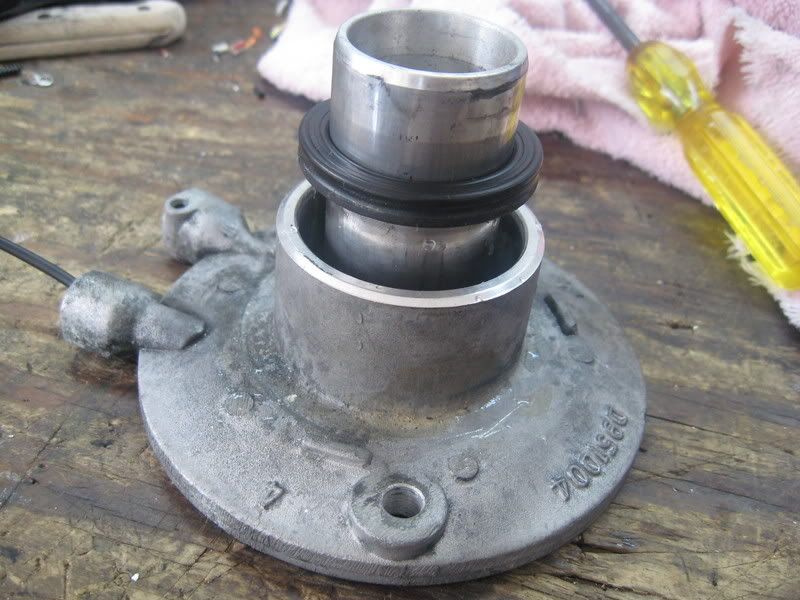
The problem is clutch dust get in front of the U plunger piece on the surface walls, it rides over the clutch dust, and clutch dust gets into the fluid this way isntead.
Note, the inside of the bell housing is littered with clutch dust from using the clutch. There are some air vent passages to allow some of the dust to blow out, but even with this, not uncommon to have a 1/8" thick layer of clutch dust on all the surfaces in the bell housing static areas (like on the slave cylinder parts).
Since the clutch dust is abrasive, it end up wearing out the slave cylinder rubber seals quicker, and in regards to the master cylinder that is plastic (including it seal walls), really wears it out quickly when in the fluid instead.
So really, the game plan to have the clutch cylinder walls (and seal) last as long a possible, you want to do fluid changes on the fluid to try to keep is clear as your base line instead.
So you start with the ranger method with clutch pumps for the first few times, then from there, start to just suck the fluid out and replace it in the tank every few weeks until is stays clear, then every few months after point next. Hence after the first fluid change doing the ranger method, you driving the car and using the clutch will do the pumps for you instead, and just a mater of watching the fluid color to see if it time to change the fluid out in the tank.
Note: clutch dust in the lines is a know problem, and GM calls out for the clutch fluid lines to be power bleed every two years to deal with the problem that way instead. The glitch, the bleed valve on the slave is a monster to get at since it at the top front of the bell housing, and what should be a easy process, became a nightmare with having to remove exhaust tubes to get to the bleed valve instead. So by staying in front of the dust problem via ranger bleeding, it saves you hundreds every few years of having GM power bleed the system instead.
https://www.corvetteforum.com/forums...-pictures.html
Last edited by Dano523; Feb 28, 2016 at 07:30 PM.
Thread Starter
Drifting
Joined: Nov 2011
Posts: 1,777
Likes: 309
From: Long Island, N.Y.
Thanks ya'll I haven't had a chance yet. I will n Let you all know the scoop.
BTW...
A friend of mine disagrees with the ranger method. Doesn't believe in changing it at all!
BTW...
A friend of mine disagrees with the ranger method. Doesn't believe in changing it at all!

Burning Brakes

Joined: Jul 2001
Posts: 1,010
Likes: 48
From: LONG ISLAND ny
Paul you might also "look up " a video of ranger at the dragstrip. He is in the top 10 on the fast list for his C5 Z06 and in his C6 Z06 . He drives his Vette harder than most guys on the forum. I think his advice on preventive maintenance should be consider as his cars where dead stock and lasted for years. Just my 2 cents. But after you check your fluid in your car< i think it will convince you. My car was new and fluid was black after 2k miles. I have been doing it on all my vettes since 1998 and never had to replace the clutch. The oldest went 80k
Last edited by KABAL182; Feb 28, 2016 at 09:33 PM.
Safety Car
Joined: Jan 2011
Posts: 4,959
Likes: 526
Two part'er realy.
In the new vets, the black pigement in the rubber seals leaches out, and will turn the fluid black. This is not a problem, but can mask the real problem next instead.
When you are using the clutch, the slave yclinder had a U shaped rubber plunger part that is riding on and inner and outer surfaces to push the throw out bearing forward to depress the clutch as you push in on the pedal.
The problem is clutch dust get in front of the U plunger piece on the surface walls, it rides over the clutch dust, and clutch dust gets into the fluid this way isntead.
Note, the inside of the bell housing is littered with clutch dust from using the clutch. There are some air vent passages to allow some of the dust to blow out, but even with this, not uncommon to have a 1/8" thick layer of clutch dust on all the surfaces in the bell housing static areas (like on the slave cylinder parts).
Since the clutch dust is abrasive, it end up wearing out the slave cylinder rubber seals quicker, and in regards to the master cylinder that is plastic (including it seal walls), really wears it out quickly when in the fluid instead.
So really, the game plan to have the clutch cylinder walls (and seal) last as long a possible, you want to do fluid changes on the fluid to try to keep is clear as your base line instead.
So you start with the ranger method with clutch pumps for the first few times, then from there, start to just suck the fluid out and replace it in the tank every few weeks until is stays clear, then every few months after point next. Hence after the first fluid change doing the ranger method, you driving the car and using the clutch will do the pumps for you instead, and just a mater of watching the fluid color to see if it time to change the fluid out in the tank.
Note: clutch dust in the lines is a know problem, and GM calls out for the clutch fluid lines to be power bleed every two years to deal with the problem that way instead. The glitch, the bleed valve on the slave is a monster to get at since it at the top front of the bell housing, and what should be a easy process, became a nightmare with having to remove exhaust tubes to get to the bleed valve instead. So by staying in front of the dust problem via ranger bleeding, it saves you hundreds every few years of having GM power bleed the system instead.
https://www.corvetteforum.com/forums...-pictures.html
In the new vets, the black pigement in the rubber seals leaches out, and will turn the fluid black. This is not a problem, but can mask the real problem next instead.
When you are using the clutch, the slave yclinder had a U shaped rubber plunger part that is riding on and inner and outer surfaces to push the throw out bearing forward to depress the clutch as you push in on the pedal.
The problem is clutch dust get in front of the U plunger piece on the surface walls, it rides over the clutch dust, and clutch dust gets into the fluid this way isntead.
Note, the inside of the bell housing is littered with clutch dust from using the clutch. There are some air vent passages to allow some of the dust to blow out, but even with this, not uncommon to have a 1/8" thick layer of clutch dust on all the surfaces in the bell housing static areas (like on the slave cylinder parts).
Since the clutch dust is abrasive, it end up wearing out the slave cylinder rubber seals quicker, and in regards to the master cylinder that is plastic (including it seal walls), really wears it out quickly when in the fluid instead.
So really, the game plan to have the clutch cylinder walls (and seal) last as long a possible, you want to do fluid changes on the fluid to try to keep is clear as your base line instead.
So you start with the ranger method with clutch pumps for the first few times, then from there, start to just suck the fluid out and replace it in the tank every few weeks until is stays clear, then every few months after point next. Hence after the first fluid change doing the ranger method, you driving the car and using the clutch will do the pumps for you instead, and just a mater of watching the fluid color to see if it time to change the fluid out in the tank.
Note: clutch dust in the lines is a know problem, and GM calls out for the clutch fluid lines to be power bleed every two years to deal with the problem that way instead. The glitch, the bleed valve on the slave is a monster to get at since it at the top front of the bell housing, and what should be a easy process, became a nightmare with having to remove exhaust tubes to get to the bleed valve instead. So by staying in front of the dust problem via ranger bleeding, it saves you hundreds every few years of having GM power bleed the system instead.
https://www.corvetteforum.com/forums...-pictures.html