




Funny Question

Drifting


Joined: Aug 2016
Posts: 1,273
Likes: 205
From: Kansas City MO

My brother was in the same trade as I and being 7 years younger, he didn't want to work until he was as old as I was at retirement. He was born and raised in San Diego. The only way he could retire early was to leave California. He sold his house and moved to Ozark Mo. about 12 years age. He realized it was easier to be debt free there than it is in So. Cal.
My next major purchase is actually a lake home at Lake of the Ozarks. It is a fantastic area.

Team Owner

Joined: Mar 2014
Posts: 21,631
Likes: 1,144
From: Below the bottom of Berby Hollow, NYS
Well said. These "Financial Advisers" crack me up. Just like in the commercials their attempt to "Advise" you is almost comical. Almost all of them start out with the same question...."What do you want to get out of retirement?"....HUH...."I would like to have as much F#$%ING money as I can".....DUH.....:
It was a bit shocking and I couldn't answer it because I thought it was a dumb question. I view it as: At a safe withdrawal rate from my portfolio of 3-4%, it will produce $X per year. I have to fit my retired life around that number, making whatever lifestyle adjustments -- if any -- so I'm not withdrawing more than that. I look at it backwards from the way the "experts" do.
Team Owner
Joined: Mar 2014
Posts: 21,631
Likes: 1,144
From: Below the bottom of Berby Hollow, NYS
You are so right. When the wife and I went to the bank to withdraw money to pay off our mortgage, the advisor tried to talk us in to letting him invest it instead. He said you need a write off. I asked if he would guarantee in writing that I would earn 3.375% with absolutely no risk. That was our mortgage interest rate at the time. He said he couldn't do that. I said quit wasting our time then and issue a cashiers check.
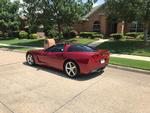
Although I had wanted a Corvette for a long time, I couldn't justify buying it until 4 and a half years ago. One month after my 74th birthday.
Although I had wanted a Corvette for a long time, I couldn't justify buying it until 4 and a half years ago. One month after my 74th birthday.
1) The people who use it almost never know what it means;
2) It seems the only people who DO know what it means are the IRS, CPAs, and us lowly self-employed people.


Race Director


Joined: Mar 2010
Posts: 16,897
Likes: 5,363
From: T-Town WA
2016 C6 of Year Finalist
Ah, bruzee, you are un-American. When you walk in to buy a car the salesperson's first question is "How much can you afford in monthly payments". Not what do you want to spend for the car, just what you can afford monthly. Over the years I bought a car or two on a 36 month contract and it made me nervous. Now folks buy 'em on a 72 month contract. 
Team Owner
Joined: Mar 2014
Posts: 21,631
Likes: 1,144
From: Below the bottom of Berby Hollow, NYS
Ah, bruzee, you are un-American. When you walk in to buy a car the salesperson's first question is "How much can you afford in monthly payments". Not what do you want to spend for the car, just what you can afford monthly. Over the years I bought a car or two on a 36 month contract and it made me nervous. Now folks buy 'em on a 72 month contract.
To me, when trading a vehicle in, the first thing I want to know is the cash difference between my vehicle and the new one. If you don't establish that first, then you don't really know where you're going. A year and a half ago when I was shopping for a new truck, one salesman didn't even know what I meant. I wasted an hour with him and left.

Safety Car

Joined: Oct 2015
Posts: 4,128
Likes: 616
From: St Louis Area IL

Burning Brakes


Joined: Dec 2017
Posts: 946
Likes: 248
From: Deshler Nebraska
Farmer
Have been scotch all my life. wanted to go southin the winter for a few months, but my in laws need looking after.
First corvette, 2012 gs. Had a 911 P for 3 years in the 1980s, not comfortable on long trip. 64 years old.. Corvette very comf..
First corvette, 2012 gs. Had a 911 P for 3 years in the 1980s, not comfortable on long trip. 64 years old.. Corvette very comf..
Corvette Stories
The Best of Corvette for Corvette Enthusiasts

Top 10 Most Expensive Corvettes Ever Sold on Bring A Trailer
Brett Foote
10 Things Every Corvette Owner Needs (2026 Edition)
Michael S. Palmer
8 Most "Only Corvette Owners Understand" Quirks and Problems
Pouria Savadkouei
10 Reasons the C6 Z06 is Still A Performance Benchmark After 20 Years
Joe Kucinski
How Much Horsepower Every Corvette Engine "LOST" in 1972
Joe Kucinski
Top 10 DOs and DON'Ts for Protecting Your Convertible Top!
Michael S. Palmer
Top 10 Most Explosive Corvettes Ever Made: Power-to-Weight Ratio Ranked!
Joe Kucinski
150 hp to 1,250 hp: Every Corvette Generation Compared by the Specs That Matter
Joe Kucinski
8 Coolest Corvette Pace Cars (and Replicas) of All Time
Verdad Gallardo
Team Owner
Joined: Mar 2014
Posts: 21,631
Likes: 1,144
From: Below the bottom of Berby Hollow, NYS
It worked for me in the late 90's and early 2000's in northern California when I was doing IT contracting. I was making excess and crazy money. I bought the most expensive home I could find so I could write off the interest and and property taxes. It saved me tens of thousands in Federal taxes. Even after claiming the most exemptions that I could, I was still getting refund checks of $40,000. I sold that house three years later, and cleared $199,000 after paying the realtor commissions, all tax free. I did a lot of the work on 1099 and corp-to-corp. It allowed me to put away huge amounts in a SEP account for retirement, and pay cash for Mercedes and other vehicles. I was given good advice from others who were doing this. It worked for them, and it worked for me. All the things I bought 18 years ago, I mostly still have except the Mercedes, which I sold. I still have two other vehicles that I bought back then. They don't have too many miles on them and they still run fine, so I kept them. I went into a partnership on a Cessna, which I also still have. I don't waste money or trade up on vehicles just to keep up with the Jones's.


Melting Slicks

Joined: Jul 2016
Posts: 2,452
Likes: 495
From: Clearwater, Florida
I just turned 30 last week ( ) and bought my Z06 last year. Bought my previous base C6 when I was 28. I'm a Software QA Engineer.
) and bought my Z06 last year. Bought my previous base C6 when I was 28. I'm a Software QA Engineer.
Last edited by Frankie15; Jul 20, 2018 at 10:33 PM.

Thread Starter
Burning Brakes
Joined: Apr 2013
Posts: 759
Likes: 78
From: New Jersey
Work for government. Got my first C6 at age 35 bought outright. On my second one. TBH, if you can budget right you can afford anything with financing. Own 2 homes now, 1 fully paid for that I rent out for extra income.
I would suggest only getting what you need and can afford first and build up equity and funds. Good sound financial planning and management is key to getting what you want and increasing what you can afford.
I would suggest only getting what you need and can afford first and build up equity and funds. Good sound financial planning and management is key to getting what you want and increasing what you can afford.

Racer

Joined: Jan 2017
Posts: 450
Likes: 94
From: Glendale Arizona



Team Owner

Joined: Apr 2013
Posts: 26,243
Likes: 4,362
From: Chirper Island
Ah, bruzee, you are un-American. When you walk in to buy a car the salesperson's first question is "How much can you afford in monthly payments". Not what do you want to spend for the car, just what you can afford monthly. Over the years I bought a car or two on a 36 month contract and it made me nervous. Now folks buy 'em on a 72 month contract.
Never negotiate according to the the monthly payment. Only the end price.
If you get the price you determine is fair, and they offer you 0% or up to a couple of percent, you'd be silly to pay cash (providing you are investing). Always have at least one financing option locked in before showing up to the dealer. They will always try to top the deal you already have, Take it (the "done deal" after the buy back to the credit union or bank, and they will try to top that) Give me a 72 month contract at 0.9%? Awesome!
Trading in? That's a separate issue. Which may or may not be part of the whole after the first two are determined.
I love car shopping. I just wish I had more money to do it more often.
Instructor
Joined: Jun 2018
Posts: 102
Likes: 46

Team Owner
Joined: Mar 2014
Posts: 21,631
Likes: 1,144
From: Below the bottom of Berby Hollow, NYS
Last year he took in $200,000 in widget sales. His expenses for raw plastic, tooling, incidental machinery, wages for some part-time help, maintenance, utilities, bookkeeping, advertising, sales expenses, office supplies, etc. amounted to $140,000.
So he goes to the local bar, gets shitfaced, and starts squawking about how great his business was because he got a $140,000 "write off!" The other drunks were quite impressed, became his instant buddies, and they closed the place up -- Joe gladly picking up the tab.
But, of course, 200k minus 140k leaves him with $60,000 left over. This is what he is taxed on. The $140k is gone with the wind, spent in order to produce the $60k. So after taxes he is left with maybe $40k in his pocket on December 31. But . . . but he got a huge "write-off"! So what? The money was spent, it's gone, otherwise he wouldn't be able to "write it off."
So let's say Bob also has a widget company down the road from Joe's. Bob's a lot smarter than Joe, puts in more hours, and always has an eye for doing things cheaper and more efficiently. He also has $200k in sales but only has $100k in expenses. So on December 31 he is taxed on $100k, leaving him with, let's say, $65k in his pocket.
Which guy would you rather be: Joe with the big "write-off" and $40k in his pocket after taxes or Bob, with the smaller "write-off" and $65k in his pocket after taxes?
You cannot spend yourself into prosperity. The government has not yet figured out how to tax you on money you legitimately spent. If they did, no business could survive more than a couple of years.
The principle is the same for individuals. You can get a huge mortgage and a bigger house than you really want (as you said you did) and have thousands in interest "write-offs" per year. But you still have to pay that interest to the bank, along with the principle, for a bigger house than you really want. All those dollars are gone, out of your pocket and into the bank's. The amount you save on taxes will be a fraction of the interest you paid.
A legitimate "write-off" is money that was spent, it's gone. The only exception that I can think of off-hand is putting money into a tax-deferred retirement plan. But the money is out of reach, you cannot use it, and you WILL be taxed on it when you start withdrawing it ("deferred").
Something like that anyway, as I see it.
If there are any REAL accountants here I will gladly stand corrected.Sorry for vomiting all over this thread.
Blame it on Batman! He first used the term "write-off!" 

Burning Brakes
Joined: Apr 2015
Posts: 1,106
Likes: 192
From: El Cajon Ca.
It worked for me in the late 90's and early 2000's in northern California when I was doing IT contracting. I was making excess and crazy money. I bought the most expensive home I could find so I could write off the interest and and property taxes. It saved me tens of thousands in Federal taxes. Even after claiming the most exemptions that I could, I was still getting refund checks of $40,000. I sold that house three years later, and cleared $199,000 after paying the realtor commissions, all tax free. I did a lot of the work on 1099 and corp-to-corp. It allowed me to put away huge amounts in a SEP account for retirement, and pay cash for Mercedes and other vehicles. I was given good advice from others who were doing this. It worked for them, and it worked for me. All the things I bought 18 years ago, I mostly still have except the Mercedes, which I sold. I still have two other vehicles that I bought back then. They don't have too many miles on them and they still run fine, so I kept them. I went into a partnership on a Cessna, which I also still have. I don't waste money or trade up on vehicles just to keep up with the Jones's.
Burning Brakes
Joined: Apr 2015
Posts: 1,106
Likes: 192
From: El Cajon Ca.
I have a friend in the home mortgage business who re-refinanced my loan with no points or fees each time interest rates dropped. I took equity out only twice, but that was for home improvement.
I'm not wealthy because I've never been willing to take financial risks.