




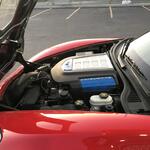




No antiseize on plug threads
Team Owner


Joined: Nov 2007
Posts: 24,035
Likes: 2,342
From: Gilbert AZ

But the plugs we are talking about are not steel, they have an trivalent coating built into the plugs. Antisieze in this case only causes issues, especially if too much is used, you can actually cause spark issues since they ground through the plug.
https://www.ngkplugpro.ca/content/co...SparkPlugs.pdf
https://www.ngkplugpro.ca/content/co...SparkPlugs.pdf

Safety Car


Joined: Jan 2011
Posts: 4,959
Likes: 526
 . I thought the "wax - on - wax off" and the "change your brake fluid every 6 months" experts were confused. A "release agent" on your plugs threads.....that sounds like a Tide laundry detergent commercial...LOL. ....and "never change your plugs while the engines hot".....chit....I found out years ago that if you have enough room to do it without burning your hands then the plugs come out a heck of a lot easier and never had an issue doing it that way. And no anti seize.......yes to anti seize......over torque......under torque......In the immortal words of that great coach Vinny Lombardi while standing on the sidelines....."What the hells going on out there??".....
 .....: woohoo:
Instructor


Joined: Aug 2010
Posts: 192
Likes: 4
From: Lillington NC
as many times as i have had to remove both oem and aftermarket plugs on all types of cars and them being stuck or tight AF, i will continue to do it my way, tiny bit of antiseize and snug lol
I've never had a misfire due to antiseize, and only one untimely failed plug in 30 years, during racing, at full throttle and stuff
I've never had a misfire due to antiseize, and only one untimely failed plug in 30 years, during racing, at full throttle and stuff
Last edited by TonyFaub; Dec 14, 2019 at 07:18 PM.

Drifting

Joined: Sep 2014
Posts: 1,924
Likes: 392
From: Atlanta - - - - - Save the manuals
.......I've seen a lot of these pre coated spark plugs, I still add antiseize. The real trick is not to overtighten your plugs! Finger tight, then a quarter turn. If it dries out and gets a little stiffer, no big deal because you didnt go nuts with the torque from the get go. The coated ones are likely a godsend for a monkey with an impact gun, but irrelevant if you do things properly.
Antiseize - you don't have to use it, but it can't hurt and might help.
"Finger tight, then a quarter turn" - I don't know if this is the correct spec, but an initial torque and then a tighten angle should give you the correct "tightness" regardless of whether the threads are only clean or lubricated for the spark plug you are using.
Last edited by Dutch08; Dec 14, 2019 at 04:46 PM.

Le Mans Master


Joined: Aug 2007
Posts: 8,735
Likes: 413
From: WV
You can use all the information above when you get around 80,000 to 100,000 miles on the plugs in the car... There is no way that you need plugs at 47,500 miles.. Most of us that pull the plugs at around 100,000 miles say they still look good... Why waste your money , save your money and buy a case of Corona....WW
.
.
.
.
.
.
.
.
.
.
.
.
Last edited by WW7; Dec 15, 2019 at 10:12 AM.
Team Owner
Joined: Nov 2007
Posts: 24,035
Likes: 2,342
From: Gilbert AZ
After reading all the threads to date, I think ..
Antiseize - you don't have to use it, but it can't hurt and might help.
"Finger tight, then a quarter turn" - I don't know if this is the correct spec, but an initial torque and then a tighten angle should give you the correct "tightness" regardless of whether the threads are only clean or lubricated for the spark plug you are using.
Antiseize - you don't have to use it, but it can't hurt and might help.
"Finger tight, then a quarter turn" - I don't know if this is the correct spec, but an initial torque and then a tighten angle should give you the correct "tightness" regardless of whether the threads are only clean or lubricated for the spark plug you are using.
Corvette Stories
The Best of Corvette for Corvette Enthusiasts

Top 10 Most Expensive Corvettes Ever Sold on Bring A Trailer
Brett Foote
10 Things Every Corvette Owner Needs (2026 Edition)
Michael S. Palmer
8 Most "Only Corvette Owners Understand" Quirks and Problems
Pouria Savadkouei
10 Reasons the C6 Z06 is Still A Performance Benchmark After 20 Years
Joe Kucinski
How Much Horsepower Every Corvette Engine "LOST" in 1972
Joe Kucinski
Top 10 DOs and DON'Ts for Protecting Your Convertible Top!
Michael S. Palmer
Top 10 Most Explosive Corvettes Ever Made: Power-to-Weight Ratio Ranked!
Joe Kucinski
150 hp to 1,250 hp: Every Corvette Generation Compared by the Specs That Matter
Joe Kucinski
8 Coolest Corvette Pace Cars (and Replicas) of All Time
Verdad Gallardo


Pro

Joined: Sep 2017
Posts: 675
Likes: 195
From: Green Oak Township, Michigan
If you are a real car guy......and not someone who goes to stealers.....someone who throws their cars up on jack stands in 15 minutes or less......someone who is not afraid to tackle mechanical problems........Someone who was born before 1950......Then you know in your mind and in your heart what you can do and what you cant do on a car. No forum is going to tell you otherwise. .....Have a nice Christmas everyone.....





Race Director

Joined: Jul 2005
Posts: 12,045
Likes: 3,588
From: Central MO
If you are the type of person who leaves plugs in for 100k miles you might be in for a nasty surprise when you try to take them out. I prefer to add a light coating of antiseize as a little added peace of mind.
I generally change plugs at 50k to keep things running properly without any concerns. Again, cheap insurance for peace of mind when on the road. Heard reports that F-150 3.5 ecoboost was hard on plugs; I recently noticed a little stumbling and longer crank at cold start so I pulled mine at 30k miles. The reports were correct, but you had to look closely to see it. The center electrode firing into the ground strap had worn a quite deep crater, greatly increasing the effective plug gap. New plugs resolved the cold start stumbling.
I generally change plugs at 50k to keep things running properly without any concerns. Again, cheap insurance for peace of mind when on the road. Heard reports that F-150 3.5 ecoboost was hard on plugs; I recently noticed a little stumbling and longer crank at cold start so I pulled mine at 30k miles. The reports were correct, but you had to look closely to see it. The center electrode firing into the ground strap had worn a quite deep crater, greatly increasing the effective plug gap. New plugs resolved the cold start stumbling.

Drifting
Joined: Sep 2014
Posts: 1,924
Likes: 392
From: Atlanta - - - - - Save the manuals
After reading all the threads to date, I think ..
Antiseize - you don't have to use it, but it can't hurt and might help.
"Finger tight, then a quarter turn" - I don't know if this is the correct spec, but an initial torque and then a tighten angle should give you the correct "tightness" regardless of whether the threads are only clean or lubricated for the spark plug you are using.
Antiseize - you don't have to use it, but it can't hurt and might help.
"Finger tight, then a quarter turn" - I don't know if this is the correct spec, but an initial torque and then a tighten angle should give you the correct "tightness" regardless of whether the threads are only clean or lubricated for the spark plug you are using.
It can cause overtorquing, and depending on the antisieze used, less spark performance or misfires because the plug can't properly ground through the excessive antisieze. The opposite is true, following the manufactures suggestion and letting the built in coating do its work can't hurt, antisieze can only hurt.

Le Mans Master

Joined: Dec 2005
Posts: 6,999
Likes: 1,685
From: Southeast TX
I won't install a spark plug without anti-seize. Been doing that for 50 years. Just a little dab will do ya' on LS plugs. On bigger industrial engines, I coat the plugs liberally.
I bought a used GMC 4.8L pickup with 120K miles on it. About half of the plugs came out really difficult. Probably original plugs. The new ones got a little dab of anti-seize.
If you're not a mullet, there's no down side to using it. Yes, it's slightly easier to over torque them. The next time I use a torque wrench installing spark plugs will be the first time. And yes, you can glob it on there and possibly foul plugs. Again, if you're not a mullet.....
I bought a used GMC 4.8L pickup with 120K miles on it. About half of the plugs came out really difficult. Probably original plugs. The new ones got a little dab of anti-seize.
If you're not a mullet, there's no down side to using it. Yes, it's slightly easier to over torque them. The next time I use a torque wrench installing spark plugs will be the first time. And yes, you can glob it on there and possibly foul plugs. Again, if you're not a mullet.....


Race Director

Joined: Oct 2012
Posts: 17,386
Likes: 6,527
From: Melbourne, FL
Good point!!! Antisieze is not a conductor. ( The nerd in me just checked with my ohm meter.) But the correct torque angle is designed to give you the correct torque with or without lubrication as I understand it, since it is based on bolt stretch not resistance to torque.
Race Director
Joined: Jul 2005
Posts: 12,045
Likes: 3,588
From: Central MO
Do our car plugs really have crush washers? I don't remember a car/truck I owned that had them in multiple tens of years, if ever. They all had tapered seats. My 1966 Farmall 706, however, had them.
Team Owner
Joined: Nov 2007
Posts: 24,035
Likes: 2,342
From: Gilbert AZ
As for washers, if it is factory yes. Heads on my car don't use a washer plug, so in my case with Brodix heads, no they are not washer plugs.

Race Director
Joined: Sep 2007
Posts: 16,557
Likes: 2,108
From: Peoria/Phoenix AZ
C6 of Year Finalist (performance mods) 2019
This thread has lots of good and lots of bad info. The problem is telling the difference between the two. If you have doubts, follow the manufacturer's advice.