




ERL SuperDeck 6bolt

Former Vendor
Joined: Nov 2008
Posts: 146
Likes: 0
From: Virginia Beach Virginia

lets do some comparing between the rhs and the erl
lets start from the top
erl uses a stock casting made from 319 alum vs. the rhs using 356 alum with chilled mains-the 356 is a much stronger alum and the chilled mains are alot stronger and denser
the rhs comes with billet main caps with 7/16 ARP2000 studs
the rhs has priority main oiling- this is an incredible benefit over the std ls oiling that the mains have to get oil from the lifter galley-if something happens to a lifter, the metal will go straight to the main bearing creating much more damage.
the rhs will accept a 60mm roller cam bearing without alot extra work to the oil galleys.
the rhs will accept lifter bushings without having to worry about restricting the oil to the mains. plus there is much more material around the lifters for more strength.
the rhs has the raised cam which makes for a shorter pushrod and better valvetrain stability.
the rhs has provisions for early cam sensor and knock sensors.
let's look at the price
erl $3800.00 -including core block price
you get a fully machined block
rhs $4500.00-
you get a block that needs honed and decked at the most
also get, rear cover,front cam plate,all the plugs and dowel pins for the block-+you don't need a main girdle.
as far as being tested- we have pushed a couple of these blocks to over 1000rwhp on pump gas in street cars-0 issues.
We are currently building 3 2000+ hp builds using RHS blocks-if i didn't feel they wouldn't work i would not use them.
As far as going 200 in the 1/4 mile,last time i checked Mike Brown who went that 200 with the erl is going to a RHS block for this year.
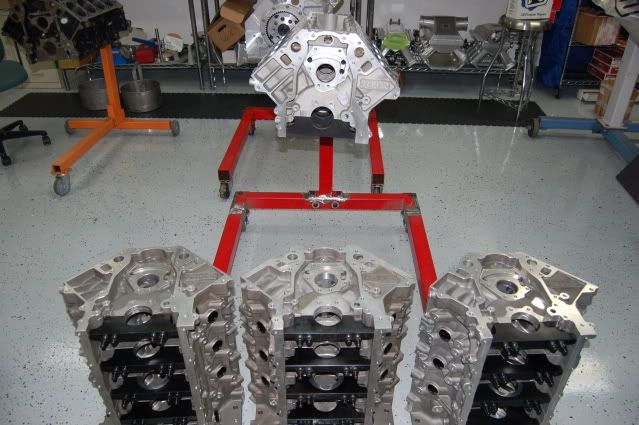
as you can see from this picture-it's pretty obvious what i believe in.
lets start from the top
erl uses a stock casting made from 319 alum vs. the rhs using 356 alum with chilled mains-the 356 is a much stronger alum and the chilled mains are alot stronger and denser
the rhs comes with billet main caps with 7/16 ARP2000 studs
the rhs has priority main oiling- this is an incredible benefit over the std ls oiling that the mains have to get oil from the lifter galley-if something happens to a lifter, the metal will go straight to the main bearing creating much more damage.
the rhs will accept a 60mm roller cam bearing without alot extra work to the oil galleys.
the rhs will accept lifter bushings without having to worry about restricting the oil to the mains. plus there is much more material around the lifters for more strength.
the rhs has the raised cam which makes for a shorter pushrod and better valvetrain stability.
the rhs has provisions for early cam sensor and knock sensors.
let's look at the price
erl $3800.00 -including core block price
you get a fully machined block
rhs $4500.00-
you get a block that needs honed and decked at the most
also get, rear cover,front cam plate,all the plugs and dowel pins for the block-+you don't need a main girdle.
as far as being tested- we have pushed a couple of these blocks to over 1000rwhp on pump gas in street cars-0 issues.
We are currently building 3 2000+ hp builds using RHS blocks-if i didn't feel they wouldn't work i would not use them.
As far as going 200 in the 1/4 mile,last time i checked Mike Brown who went that 200 with the erl is going to a RHS block for this year.
as you can see from this picture-it's pretty obvious what i believe in.
Last edited by Shawn @ Va Speed; Jan 17, 2011 at 07:56 PM.

Premium Supporting Vendor


Joined: Oct 2004
Posts: 23,599
Likes: 1,225
From: Providing the most proven supercharger kits for your C5/6/7 609-752-0321
We still use stock front covers, but they have to be modified for the raised cam position. Not a big deal if you have the equipment to modify it, but many shops do not weld aluminum in house etc, so we made a bunch of them since we are in the middle of several RHS builds now anyway.
Nice write up Shawn.

Le Mans Master


Joined: Oct 2001
Posts: 5,577
Likes: 3
From: Southern Maryland Maryland
ERL Block certainly has its place in the market. If I were building a mile motor, it would have a RHS block, Billet CCW Crank and aluminum rods at a BARE MININUM. Drag setups and mile setups are 2 complete different monsters.
PT
PT

Safety Car


Joined: Mar 2006
Posts: 4,448
Likes: 4
From: Sarasota Florida
St. Jude Donor '06
Aluminum rods? Curious as to why for a Mile motor.

Thread Starter
Le Mans Master
Joined: Oct 2003
Posts: 8,863
Likes: 86
From: PA
St. Jude Donor '08

Former Vendor
Joined: Jun 2006
Posts: 1,622
Likes: 3
From: Dallas TX
We still use stock front covers, but they have to be modified for the raised cam position. Not a big deal if you have the equipment to modify it, but many shops do not weld aluminum in house etc, so we made a bunch of them since we are in the middle of several RHS builds now anyway.
Nice write up Shawn.
Nice write up Shawn.
Good point, I forget since we do it daily

I agree, nice comparison Shawn!

Former Vendor
Joined: Nov 2008
Posts: 146
Likes: 0
From: Virginia Beach Virginia
glad i could help out.
I don't want anybody to think that I am putting down the ERL, because i'm def not. Like Phil said, everything has it's place in the market, and the ERL def does. I just feel people should make decisions based off of facts instead of second hand and biased info.
I don't want anybody to think that I am putting down the ERL, because i'm def not. Like Phil said, everything has it's place in the market, and the ERL def does. I just feel people should make decisions based off of facts instead of second hand and biased info.
Corvette Stories
The Best of Corvette for Corvette Enthusiasts

Top 10 Most Expensive Corvettes Ever Sold on Bring A Trailer
Brett Foote
10 Things Every Corvette Owner Needs (2026 Edition)
Michael S. Palmer
8 Most "Only Corvette Owners Understand" Quirks and Problems
Pouria Savadkouei
10 Reasons the C6 Z06 is Still A Performance Benchmark After 20 Years
Joe Kucinski
How Much Horsepower Every Corvette Engine "LOST" in 1972
Joe Kucinski
Top 10 DOs and DON'Ts for Protecting Your Convertible Top!
Michael S. Palmer
Top 10 Most Explosive Corvettes Ever Made: Power-to-Weight Ratio Ranked!
Joe Kucinski
150 hp to 1,250 hp: Every Corvette Generation Compared by the Specs That Matter
Joe Kucinski
8 Coolest Corvette Pace Cars (and Replicas) of All Time
Verdad Gallardo
Le Mans Master
Joined: Oct 2001
Posts: 5,577
Likes: 3
From: Southern Maryland Maryland
Try to minimize crank flex through a lighter rotating assembly. Its tougher to build a motor to last 20 seconds at 40# of boost than it is to build a motor for 6 seconds. From 5 seconds into the run to 7 seconds, EGT temps and heat rise quickly.
Last edited by Phil97SVT; Jan 18, 2011 at 09:48 AM.
Le Mans Master
Joined: Oct 2001
Posts: 5,577
Likes: 3
From: Southern Maryland Maryland
Turbo motors build a tremendous amount of heat and temperature in the combustion chamber, a good thick reflective coating on the dome and a anti friction coating on the skirts. With a quality thick reflective coating it eliminates the need for oil squirters which alot of the import guys think are a bad idea.
Former Vendor
Joined: Nov 2008
Posts: 146
Likes: 0
From: Virginia Beach Virginia
Turbo motors build a tremendous amount of heat and temperature in the combustion chamber, a good thick reflective coating on the dome and a anti friction coating on the skirts. With a quality thick reflective coating it eliminates the need for oil squirters which alot of the import guys think are a bad idea.
just too add to that thought Phil, the ERL has a really thick iron sleeve-that is great for strength but it dissipates heat ALOT slower than a thinner iron sleeve with aluminum backer. The extra heat in the cylinder plays havoc on the pistons.

Le Mans Master
Joined: Oct 2007
Posts: 6,149
Likes: 11
From: Greater Detroit Metro MI, when I'm not travelling.
Turbo motors build a tremendous amount of heat and temperature in the combustion chamber, a good thick reflective coating on the dome and a anti friction coating on the skirts. With a quality thick reflective coating it eliminates the need for oil squirters which alot of the import guys think are a bad idea.
Ceramic coatings look fantastic on paper but I have yet to hear about a major race team using them. One potential downside is that with a thermal barrier on your piston you will be forcing more heat on the head and valves. No free lunch here.
Safety Car


Joined: Mar 1999
Posts: 3,611
Likes: 182
From: Toronto, Canada
I was just wondering, can't the valves and chambers also be coated to match the piston crown?
Premium Supporting Vendor
Joined: Oct 2004
Posts: 23,599
Likes: 1,225
From: Providing the most proven supercharger kits for your C5/6/7 609-752-0321
Le Mans Master
Joined: Oct 2007
Posts: 6,149
Likes: 11
From: Greater Detroit Metro MI, when I'm not travelling.
I've never seen it, but I am told it is possible. Assuming that is the case, the proper way to do it would be to coat the pistons, the head and the valves, that way most of the heat would go into the exhaust. That'd be specially helpful on a turbo car since the added exhaust heat energy would help spool.
Former Vendor
Joined: Nov 2008
Posts: 146
Likes: 0
From: Virginia Beach Virginia
Those aluminum rods will indeed reduce crank flex, but how many engines have you seen fail from crank flex, as opposed to how many engines have you seen snap a connecting rod? In my experience the rods are usually the weak link, and aluminum fatigues and creeps much quicker than steel; you usually see aluminum rods on drag race engines that get rebuilt regularly, because their number of cycles to failure is drastically lower than that of steel.
while you may see alot of aluminum rods break in top fuel engines, it generally isn't because the rod in fatigued, it is usually caused by fuel hydro-lock when the plugs fails to fire the cylinder. Steel rods wouldn't even hold up in that environment. The only times i have seen an aluminum rod itself fail was either because they were in fact used too long-usually 10-20 times their intended usage or when the rod bolts were over torqued causing the threads in the rods to pull.
Le Mans Master
Joined: Oct 2001
Posts: 5,577
Likes: 3
From: Southern Maryland Maryland
Repled below...
Those aluminum rods will indeed reduce crank flex, but how many engines have you seen fail from crank flex, as opposed to how many engines have you seen snap a connecting rod? In my experience the rods are usually the weak link, and aluminum fatigues and creeps much quicker than steel; you usually see aluminum rods on drag race engines that get rebuilt regularly, because their number of cycles to failure is drastically lower than that of steel.
IMO, wearing out the #3 and feathering the #2 and 4 main bearing is essentially having a failure. Most aluminum rods go 100 - 125 passes possibly more if the rod is spec'd accordingly in a 1/4 mile setup. I could be wrong but using steel rods tied to the high RPM and the sustained load of a texas mile car would almost guarantee you crank flex at the top end the food chain. Having known Nick's past he doesn't plan on building a pu&&y motor.
I didn't know that. As a former Subaru guy (I know more about EJ series motors than LS motors), I can tell you that oil squirters are used on all the race subaru engines, both factory (22B, Type R and Type RA) and are seen as a big advantage.
Ceramic coatings look fantastic on paper but I have yet to hear about a major race team using them. One potential downside is that with a thermal barrier on your piston you will be forcing more heat on the head and valves. No free lunch here.
You could very well be right about the road race engines but dont they make about 1/2 the horsepower at most of one of the texas mile cars? We're talking about cars that make 250-400hp vs 1800-2800hp.
IMO, wearing out the #3 and feathering the #2 and 4 main bearing is essentially having a failure. Most aluminum rods go 100 - 125 passes possibly more if the rod is spec'd accordingly in a 1/4 mile setup. I could be wrong but using steel rods tied to the high RPM and the sustained load of a texas mile car would almost guarantee you crank flex at the top end the food chain. Having known Nick's past he doesn't plan on building a pu&&y motor.
I didn't know that. As a former Subaru guy (I know more about EJ series motors than LS motors), I can tell you that oil squirters are used on all the race subaru engines, both factory (22B, Type R and Type RA) and are seen as a big advantage.
Ceramic coatings look fantastic on paper but I have yet to hear about a major race team using them. One potential downside is that with a thermal barrier on your piston you will be forcing more heat on the head and valves. No free lunch here.
You could very well be right about the road race engines but dont they make about 1/2 the horsepower at most of one of the texas mile cars? We're talking about cars that make 250-400hp vs 1800-2800hp.
Le Mans Master
Joined: Oct 2007
Posts: 6,149
Likes: 11
From: Greater Detroit Metro MI, when I'm not travelling.
Why do you think something that works for road racing wouldn't be good for a mile car (not bashing you, just trying to understand your reasoning)?
Last edited by PowerLabs; Jan 18, 2011 at 06:23 PM.
Pro

Joined: Jan 2008
Posts: 710
Likes: 2
From: St. Louis Mo
those coatings work, We have a ford Mustang in town here, that runs a 2.3 liter 4 cyclinder. I grew up with his dad and him, and they have done TONS of research with that setup. It currently makes upwords of 1000 hp, at the crank, and the coatings work according to him. they have been working on this car setup for YEARS, and have tried everything they can. This motor sees 38 pounds of boost.
I have personally seen in a BBC the piston crown coating actually keep a piston from melting through (this piston went from a dome to a dish, literally). the reflective coating put in the chamber and on the piston crown keep the heat in the cumbustion chamber where it belongs.
I have been using skirt coating on my motors for 15 years, and now it is standered on alot of factory motors. I also believe in Bearing coatings, they are a proven way to help keep friction down.
I am really glad to have seen this thread take a + turn, as I am about 2 months from building a 440ci FI motor, and i have been going back and forth between RHS and ERL. this thread is helping alot.
I have personally seen in a BBC the piston crown coating actually keep a piston from melting through (this piston went from a dome to a dish, literally). the reflective coating put in the chamber and on the piston crown keep the heat in the cumbustion chamber where it belongs.
I have been using skirt coating on my motors for 15 years, and now it is standered on alot of factory motors. I also believe in Bearing coatings, they are a proven way to help keep friction down.
I am really glad to have seen this thread take a + turn, as I am about 2 months from building a 440ci FI motor, and i have been going back and forth between RHS and ERL. this thread is helping alot.
Le Mans Master
Joined: Oct 2007
Posts: 6,149
Likes: 11
From: Greater Detroit Metro MI, when I'm not travelling.
those coatings work, We have a ford Mustang in town here, that runs a 2.3 liter 4 cyclinder. I grew up with his dad and him, and they have done TONS of research with that setup. It currently makes upwords of 1000 hp, at the crank, and the coatings work according to him. they have been working on this car setup for YEARS, and have tried everything they can. This motor sees 38 pounds of boost.
I think that the coatings should work. It makes sense that they would from an engineering standpoint. But the reason I brought that up is because race teams don't use them, and they have unlimited budgets + enormous motivation to use anything that would give them an edge...
Agreed. And piston skirt coatings (low friction polymeric coatings) work so well that, as you pointed out, it has become standard on a lot of OEM engines too. I don't know if any OEM uses coated bearings but I know a lot of race teams do.