




$11.97 C6 Catch Can

Thread Starter
Safety Car

Joined: Dec 2004
Posts: 3,565
Likes: 5
From: stafford country, va. Avatar: Me on turn 3 @ Bristol (The World's Fastest Half-Mile)

Originally Posted by Dave68
What did you mount it to? ....
Thread Starter
Safety Car
Joined: Dec 2004
Posts: 3,565
Likes: 5
From: stafford country, va. Avatar: Me on turn 3 @ Bristol (The World's Fastest Half-Mile)
here's my latest pics.
this one shows both catch cans and an inline fuel filter installed into the pcv system.

this is a close-up of the inline fuel filter, it is the last filter before the 'air' enter the intake.

i'm not sure if you can see it but there two drops of oil in that filter.
this is a close-up of the HD Husky multi-purpose filter. this is my main pcv catch-can. i am not using the 'stone' filter that came with the filter. I created an 'air seperator' of sorts, using a 35 mm. film canister, some screen and a 1/32 drill bit.

you may be able to see the 'nipple' on the bottom of the can. that is the 'drain', i placed a cap on the nipple just to help seal the bottom end of the can.
the larger HD husky can was something like $19.97.
this one shows both catch cans and an inline fuel filter installed into the pcv system.
this is a close-up of the inline fuel filter, it is the last filter before the 'air' enter the intake.
i'm not sure if you can see it but there two drops of oil in that filter.
this is a close-up of the HD Husky multi-purpose filter. this is my main pcv catch-can. i am not using the 'stone' filter that came with the filter. I created an 'air seperator' of sorts, using a 35 mm. film canister, some screen and a 1/32 drill bit.
you may be able to see the 'nipple' on the bottom of the can. that is the 'drain', i placed a cap on the nipple just to help seal the bottom end of the can.
the larger HD husky can was something like $19.97.
Last edited by Zig; Nov 13, 2006 at 08:06 AM.

Drifting

Joined: Jul 2003
Posts: 1,796
Likes: 1
From: Annandale VA
Here is a really nice billet aluminum catch can from Mike Norris. A little pricey, but it's good looking, comes with a mounting bracket, and is a lot less than the AMD unit.
http://forums.corvetteforum.com/show....php?t=1543809
http://forums.corvetteforum.com/show....php?t=1543809
Race Director


Joined: Dec 2000
Posts: 19,304
Likes: 85
From: San Diego CA
Here's another hint: A general-purpose compressed air filter is not intended to remove oil from air. Often, these types of filters are designed to remove moisture and particles that can damage, say, air cylinders. To remove oil, a coalescing filter is best. Choose a low-pressure, low flow type that is reated for 175 degrees F or higher (no polycarbonate bowl). More info to come.......

Tech Contributor


Joined: Jul 2002
Posts: 14,950
Likes: 264
From: St. Louis, MO
St. Jude Donor '08
Originally Posted by Dave68
Here's another hint: A general-purpose compressed air filter is not intended to remove oil from air. Often, these types of filters are designed to remove moisture and particles that can damage, say, air cylinders. To remove oil, a coalescing filter is best. Choose a low-pressure, low flow type that is reated for 175 degrees F or higher (no polycarbonate bowl). More info to come.......
I'm toying with what type to use on my LS2.
Thread Starter
Safety Car
Joined: Dec 2004
Posts: 3,565
Likes: 5
From: stafford country, va. Avatar: Me on turn 3 @ Bristol (The World's Fastest Half-Mile)
Originally Posted by Dave68
Here's another hint: A general-purpose compressed air filter is not intended to remove oil from air. Often, these types of filters are designed to remove moisture and particles that can damage, say, air cylinders. To remove oil, a coalescing filter is best. Choose a low-pressure, low flow type that is reated for 175 degrees F or higher (no polycarbonate bowl). More info to come.......
as comparison, remember the 'standard pcv' valve found on other vehicles. it's simply a metal case with a vacuum regulated spring loaded valve, nothing fancy.
granted, i did remove the filter element that came with the 'filter' and created a 'seperator of sorts' in it's place.
the most basic version of a catch-can is the 'steel wool' version.
take a coffee can, put two holes in it, plumb an inbound and an outbound line, fill the can with steel wool, and you've got the most basic of catch-cans.
that being said, i'm still interested in seeing what you are working on. who knows it may be better, cheaper and more efficient.

Race Director
Joined: Dec 2000
Posts: 19,304
Likes: 85
From: San Diego CA
Originally Posted by Joe_G
Dave, you seem to be a plastic expert. Do you think the use of this filter, with stone attached, could cause a blockage in the system due to a clogged stone after a while, and in turn, cause me to blow out a front seal on the track during a HPDE event?
I'm toying with what type to use on my LS2.
I'm toying with what type to use on my LS2.
 If the filtering element becomes blocked, there would probably be a noticable drop in idle speed. Try pinching the hose and listening for that drop. I am not sure if a clogged filter can cause a seal blowout - it would be similar to having a clogged PCV.
I'm guess ing that GM didn't use a real catch can for a couple of reasons:
1) Most people don't want to drain oil and replace filter elements often and
2) A fully closed system that needs no maintenance would have to filter unburned fuel out of the oil. Expensive and complicated are not welcome when a budget is tight.
Some of the more expensive coalescing filters have built-in differential pressure "gauges" that change color when the filter is getting clogged. Unfortunately, these filters are intended for high-pressure applications and are very inefficient when used under automotive conditions.
i understand your point but i'm working from the theory that a catch-can doesn't need to be overly complicated nor be able to filter everything.
as comparison, remember the 'standard pcv' valve found on other vehicles. it's simply a metal case with a vacuum regulated spring loaded valve, nothing fancy.
granted, i did remove the filter element that came with the 'filter' and created a 'seperator of sorts' in it's place.
the most basic version of a catch-can is the 'steel wool' version.
take a coffee can, put two holes in it, plumb an inbound and an outbound line, fill the can with steel wool, and you've got the most basic of catch-cans..
granted, i did remove the filter element that came with the 'filter' and created a 'seperator of sorts' in it's place.
the most basic version of a catch-can is the 'steel wool' version.
take a coffee can, put two holes in it, plumb an inbound and an outbound line, fill the can with steel wool, and you've got the most basic of catch-cans..
that being said, i'm still interested in seeing what you are working on. who knows it may be better, cheaper and more efficient.

Last edited by Dave68; Nov 13, 2006 at 11:14 PM.
Corvette Stories
The Best of Corvette for Corvette Enthusiasts

Top 10 Most Expensive Corvettes Ever Sold on Bring A Trailer
Brett Foote
10 Things Every Corvette Owner Needs (2026 Edition)
Michael S. Palmer
8 Most "Only Corvette Owners Understand" Quirks and Problems
Pouria Savadkouei
10 Reasons the C6 Z06 is Still A Performance Benchmark After 20 Years
Joe Kucinski
How Much Horsepower Every Corvette Engine "LOST" in 1972
Joe Kucinski
Top 10 DOs and DON'Ts for Protecting Your Convertible Top!
Michael S. Palmer
Top 10 Most Explosive Corvettes Ever Made: Power-to-Weight Ratio Ranked!
Joe Kucinski
150 hp to 1,250 hp: Every Corvette Generation Compared by the Specs That Matter
Joe Kucinski
8 Coolest Corvette Pace Cars (and Replicas) of All Time
Verdad Gallardo
Thread Starter
Safety Car
Joined: Dec 2004
Posts: 3,565
Likes: 5
From: stafford country, va. Avatar: Me on turn 3 @ Bristol (The World's Fastest Half-Mile)
Originally Posted by Dave68
.... Still, it may not be for those who drive 12,000 miles a year - we'll see.


Drifting
Joined: May 2005
Posts: 1,254
Likes: 0
From: Ft. Liquordale Florida
I wouldn't mind draining a catchcan as often as I check my oil (or more). I'd certainly mind it less than the cloud of smoke when I launch at full boost.
As I may have commented earlier in the thread - when magnuson disassembled the blower to upgrade the case, there was a significant amount of oil found in the intake. This is not from blowby - so one can only assume it came from the pvc or breather end of the system. Crankcase pressures can be significantly higher in blown applications.
I'm just looking for a way to keep this OUT of my A/F mixture. I'm no tree-hugger, I'd be just as happy to drain it on the highway (ducks and runs for cover) - but really...
If the $11.99 can isn't the ticket, is there a REASONABLY PRICED, commercially AVAILABLE system that is?
Rick
As I may have commented earlier in the thread - when magnuson disassembled the blower to upgrade the case, there was a significant amount of oil found in the intake. This is not from blowby - so one can only assume it came from the pvc or breather end of the system. Crankcase pressures can be significantly higher in blown applications.
I'm just looking for a way to keep this OUT of my A/F mixture. I'm no tree-hugger, I'd be just as happy to drain it on the highway (ducks and runs for cover) - but really...
If the $11.99 can isn't the ticket, is there a REASONABLY PRICED, commercially AVAILABLE system that is?
Rick
Thread Starter
Safety Car
Joined: Dec 2004
Posts: 3,565
Likes: 5
From: stafford country, va. Avatar: Me on turn 3 @ Bristol (The World's Fastest Half-Mile)
Originally Posted by SickRick
I wouldn't mind draining a catchcan as often as I check my oil (or more). ...
If the $11.99 can isn't the ticket, is there a REASONABLY PRICED, commercially AVAILABLE system that is?
Rick
If the $11.99 can isn't the ticket, is there a REASONABLY PRICED, commercially AVAILABLE system that is?
Rick
it has been my understanding that the hd 'catch-can' has been used on numerous vehicles, of all sorts of makes and models, not just vettes.
the only thing you can do is some searching, a little research and decide if it will work for you, yes, you will need to maintain it, but then again you will have new maintenance requirements for just about anything you add.
Drifting
Joined: Jul 2003
Posts: 1,796
Likes: 1
From: Annandale VA
Originally Posted by SickRick
If the $11.99 can isn't the ticket, is there a REASONABLY PRICED, commercially AVAILABLE system that is?
Rick
Rick

Team Owner


Joined: May 2004
Posts: 26,345
Likes: 232
From: SoCal
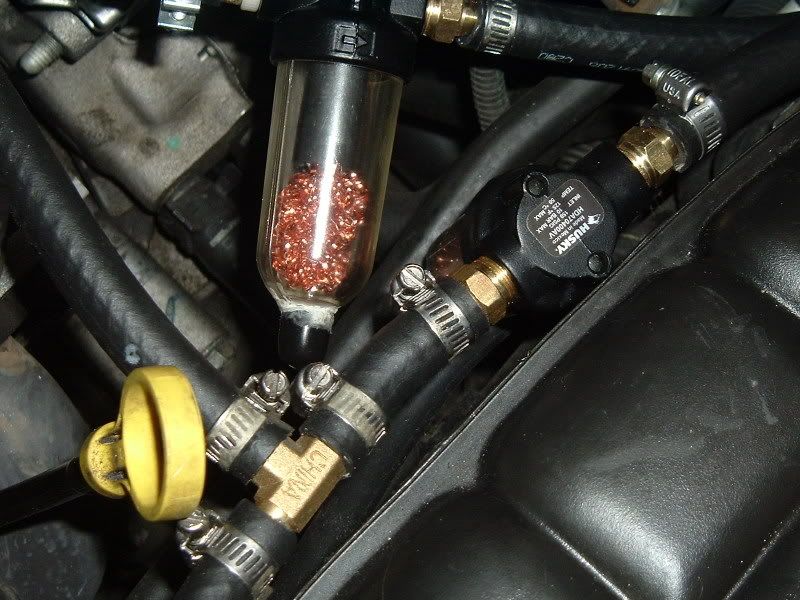
Ok....so I was worried about the stone clogging up with oil so I removed it and modified it. I really don't see how this thing can leak air....it threads in and there is a rubber O-ring. The vacuum is going to take the path of least restistance...but I put a little dialectric grease on the threads anyways (don't ask me why I used the grease cause I don't know). I also siliconed the bottom valve closed with the rubber fitting the filter comes with.
I have not seen any large volumes of oil. But I wanted to do something to make it difficult for VAPORS to pass thru. So I put a 3/8" hose where the stone was. And some copper mesh like material below that. The path is down thru hole/into hose/thru mesh/and then hopefull just clean air all the way back to the top and out.
Here is a picture:
DH
I have not seen any large volumes of oil. But I wanted to do something to make it difficult for VAPORS to pass thru. So I put a 3/8" hose where the stone was. And some copper mesh like material below that. The path is down thru hole/into hose/thru mesh/and then hopefull just clean air all the way back to the top and out.
Here is a picture:
DH



Thread Starter
Safety Car
Joined: Dec 2004
Posts: 3,565
Likes: 5
From: stafford country, va. Avatar: Me on turn 3 @ Bristol (The World's Fastest Half-Mile)
Originally Posted by Dirty Howie
... The path is down thru hole/into hose/thru mesh/and then hopefull just clean air all the way back to the top and out.
DH
DH
imo, using the can first then the mesh should cause the excess to enter the can and be sucked through the mesh instead of being pushed through it.
if the airflow enters the mesh first, it potentially could fill up the inside of the mesh before you can see it, that's imo the problem with the stones when installed using the opposite flow install.
otherwise, cool, any larger engine bay pics ?
Team Owner
Joined: May 2004
Posts: 26,345
Likes: 232
From: SoCal
Originally Posted by Zig
i probably would have had used the flow direction of into the can then through the mesh then up and out.
imo, using the can first then the mesh should cause the excess to enter the can and be sucked through the mesh instead of being pushed through it.
if the airflow enters the mesh first, it potentially could fill up the inside of the mesh before you can see it, that's imo the problem with the stones when installed using the opposite flow install.
otherwise, cool, any larger engine bay pics ?
imo, using the can first then the mesh should cause the excess to enter the can and be sucked through the mesh instead of being pushed through it.
if the airflow enters the mesh first, it potentially could fill up the inside of the mesh before you can see it, that's imo the problem with the stones when installed using the opposite flow install.
otherwise, cool, any larger engine bay pics ?
If the flow went into the can first then the hose which sits on top of the mesh would suck the oil right off of it. Plus if the jar should fill up with more than 1 inch of oil the hose would be sucking straight oil !!!!!
This way the oil vapors get a chance to flow down the hose, condense on the mesh and then have to be pulled off and sucked all the way to the top of the jar. Plus the thing would have to completely fill up with oil before it could be sucked into the intake.
I spent a lot of time brain storming this before I hooked it up !!!!!!
....... at least 5 minutes
DH

Le Mans Master

Joined: Mar 2002
Posts: 5,955
Likes: 161
From: PNW
Elite Engineering's catch can will fit the LS2 also. Cost is much more, but by the time you spend weeks screwing around with all this clap trap you'd probably be ahead if ya just bought one already designed for the car.  And it looks about 100 times better.
And it looks about 100 times better.

Race Director

Joined: Mar 2005
Posts: 10,399
Likes: 26
From: Austin Texas
I've done some research on the PCV system and have found out that the PCV is just one part of a system designed to relieve crankcase pressure.
Motors have always had crankcase pressure relief, originally just by breathers. Then the pollution police got involved since they were horrified that all those motors were dumping oil fumes directly into the atmosphere. So, instead of a breather we now had a one way valve that only allowed the gases to go into the intake manifold after the throttle body. Turns out that won't work, we also need "make up" air into the crankcase to replace the air removed by the line to the intake, the crankcase doesn't like negative pressure any more than it likes positive pressure.
Seems like most systems I was familiar with have 2 lines for crankcase pressure control, one before the throttle body for make up clean air and one to the intake manifold after the throttle body (with a valve) dumping the dirty air into the combustion chamber. The C6 apparently has one line from the valve cover to before the throttle body and one line from the valley cover to after the throttle body. Just a continuous line to equalize pressure?
On the systems I am familiar with a catch can on the make up air side won't trap much oil, a catch can on the intake manifold side will catch a lot of the oil fumes before they get to the combustion chambers. On our cars is the make up air side the line from the passenger side valve cover to before the throttle body? The intake manifold side must be the line from the valley cover to after the throttlebody.. Looks like both lines will produce oil fumes with the valve cover side dumping them before the throttle body and the valley cover side dumping after the throttle body. Looks like the line on the valley cover side is comparable to the intake manifold side I'm familiar with. Which side needs a catch can? Both? Has anybody tried both locations? Results?
I haven't added a catch can to my C6 yet but tried a number of different setups on my SRT4 and proved to myself that the intake manifold side (valley cover?) produced at least 10 times the oil that the make up air side did. I ended up with an air compressor mini filter on just the intake manifold side that gathered an ounce of oil every 1,000 miles of hard driving.
Motors have always had crankcase pressure relief, originally just by breathers. Then the pollution police got involved since they were horrified that all those motors were dumping oil fumes directly into the atmosphere. So, instead of a breather we now had a one way valve that only allowed the gases to go into the intake manifold after the throttle body. Turns out that won't work, we also need "make up" air into the crankcase to replace the air removed by the line to the intake, the crankcase doesn't like negative pressure any more than it likes positive pressure.
Seems like most systems I was familiar with have 2 lines for crankcase pressure control, one before the throttle body for make up clean air and one to the intake manifold after the throttle body (with a valve) dumping the dirty air into the combustion chamber. The C6 apparently has one line from the valve cover to before the throttle body and one line from the valley cover to after the throttle body. Just a continuous line to equalize pressure?
On the systems I am familiar with a catch can on the make up air side won't trap much oil, a catch can on the intake manifold side will catch a lot of the oil fumes before they get to the combustion chambers. On our cars is the make up air side the line from the passenger side valve cover to before the throttle body? The intake manifold side must be the line from the valley cover to after the throttlebody.. Looks like both lines will produce oil fumes with the valve cover side dumping them before the throttle body and the valley cover side dumping after the throttle body. Looks like the line on the valley cover side is comparable to the intake manifold side I'm familiar with. Which side needs a catch can? Both? Has anybody tried both locations? Results?
I haven't added a catch can to my C6 yet but tried a number of different setups on my SRT4 and proved to myself that the intake manifold side (valley cover?) produced at least 10 times the oil that the make up air side did. I ended up with an air compressor mini filter on just the intake manifold side that gathered an ounce of oil every 1,000 miles of hard driving.