




Lowering info................
Intermediate

Joined: Aug 2007
Posts: 45
Likes: 0
From: Banning CA
 Lowering '05 Vette
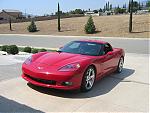
I did, as I stated, have my Vette raised back and I don't scrape in my drive now. Alignment not necessary per Corvette West in Anaheim. They have a lowering kit for $40 but it is only 4 bolts with a large washer like head. Some say alignment needed if you raise or lower. Wheels do stop the hitting big dips but could also catch. Good luck.
Drifting


Joined: Nov 2005
Posts: 1,745
Likes: 35
From: Turlock CA
Lowering per se doesn't shorten the wheel travel as you are not altering the spring only its contact point. Travel, however, may be limited by the car being low enough to bottom which stops further wheel movement.
The sway bar is not preloaded unless you dramatically lower one side and not the other. Dropping the car evenly simply moves the sway bar arms up as the bar rotates in its mounting.
Corner weighting shouldn't be affected unless you lower a corner an uneven amount from the height where your corner weighting was best. If when corner-weighting preload is placed on the sway bars adjustable endlinks are available to correct the problem.
--Dan

Racer


Joined: Mar 2007
Posts: 400
Likes: 1
I agree with you:
-lowering does not shorten your wheel travel, is not like cuting or placing a smaller coils, thats when your wheel travel is shorter. the vette setup is different.
-no effect on the swaybar.
-lower to the ground, center of gravity is also lower to the ground, better handling.
-you will need an alingment.
-I can not even imagine raise my vette, thats insane buy a hummer if you need something tall
-I lowered mine 2 inches front and back, I only scrape the front air dam.
and drive careful. (no fat chicks)
-lowering does not shorten your wheel travel, is not like cuting or placing a smaller coils, thats when your wheel travel is shorter. the vette setup is different.
-no effect on the swaybar.
-lower to the ground, center of gravity is also lower to the ground, better handling.
-you will need an alingment.
-I can not even imagine raise my vette, thats insane
buy a hummer if you need something tall-I lowered mine 2 inches front and back, I only scrape the front air dam.
and drive careful. (no fat chicks)

Race Director

Joined: Mar 2005
Posts: 10,399
Likes: 26
From: Austin Texas
May I disagree.
Lowering per se doesn't shorten the wheel travel as you are not altering the spring only its contact point. Travel, however, may be limited by the car being low enough to bottom which stops further wheel movement.
The sway bar is not preloaded unless you dramatically lower one side and not the other. Dropping the car evenly simply moves the sway bar arms up as the bar rotates in its mounting.
Corner weighting shouldn't be affected unless you lower a corner an uneven amount from the height where your corner weighting was best. If when corner-weighting preload is placed on the sway bars adjustable endlinks are available to correct the problem.
--Dan
Lowering per se doesn't shorten the wheel travel as you are not altering the spring only its contact point. Travel, however, may be limited by the car being low enough to bottom which stops further wheel movement.
The sway bar is not preloaded unless you dramatically lower one side and not the other. Dropping the car evenly simply moves the sway bar arms up as the bar rotates in its mounting.
Corner weighting shouldn't be affected unless you lower a corner an uneven amount from the height where your corner weighting was best. If when corner-weighting preload is placed on the sway bars adjustable endlinks are available to correct the problem.
--Dan
2. The sway bar is unloaded only at stock height, once you lower the car (raise the wheel in the wheel well) you are loading the sway bar. the sway bar end links are a fixed length determined at stock height.
3. Corner weighting is done by lowering or raising diagonal corners until you get as close as you can to 50/50 F to R. If you change the height of any corner you change the corner weights. I haven't seen any posts by guys with lowered cars that bothered to get adjustable end links. Most corner weighted cars have un-equal heights at the corners, they are corner weighted for handling, not appearance. Corner weight for handling, lower for looks.
Extreme case scenario; Base suspension car lowered to the max with Z51 rear sway bar and heavy aftermarket wheels/tires and no alignment or corner weighting =
1. Noticeable negative camber (and caster and toe changes).
2. Gross oversteer caused by the stiff rear sway bar and poor alignment.
3. Handling degraded by the unbalanced wheel/tire weight, poor alignment specs and uneven corner weights.
4. Extreme tire wear.
Believe it or not; Chevy has a reason for the different sway bar/ shock /wheel tire packages. They are PACKAGES, not individual parts just for looks. If you change one piece of the package you change the complete package.

Le Mans Master<br><img src="/forums/images/ranks/5k-6k.gif" border="0">
Joined: May 2007
Posts: 5,404
Likes: 1
St. Jude Donor '08-'09
1. Lowering does shorten wheel travel, read your statement above. wheel travel is xx inches, you lower by 1 inch the wheel travel (upwards only) is shortened by 1 inch (xx - 1 inch).
2. The sway bar is unloaded only at stock height, once you lower the car (raise the wheel in the wheel well) you are loading the sway bar. the sway bar end links are a fixed length determined at stock height.
3. Corner weighting is done by lowering or raising diagonal corners until you get as close as you can to 50/50 F to R. If you change the height of any corner you change the corner weights. I haven't seen any posts by guys with lowered cars that bothered to get adjustable end links. Most corner weighted cars have un-equal heights at the corners, they are corner weighted for handling, not appearance. Corner weight for handling, lower for looks.
Extreme case scenario; Base suspension car lowered to the max with Z51 rear sway bar and heavy aftermarket wheels/tires and no alignment or corner weighting =
1. Noticeable negative camber (and caster and toe changes).
2. Gross oversteer caused by the stiff rear sway bar and poor alignment.
3. Handling degraded by the unbalanced wheel/tire weight, poor alignment specs and uneven corner weights.
4. Extreme tire wear.
Believe it or not; Chevy has a reason for the different sway bar/ shock /wheel tire packages. They are PACKAGES, not individual parts just for looks. If you change one piece of the package you change the complete package.
2. The sway bar is unloaded only at stock height, once you lower the car (raise the wheel in the wheel well) you are loading the sway bar. the sway bar end links are a fixed length determined at stock height.
3. Corner weighting is done by lowering or raising diagonal corners until you get as close as you can to 50/50 F to R. If you change the height of any corner you change the corner weights. I haven't seen any posts by guys with lowered cars that bothered to get adjustable end links. Most corner weighted cars have un-equal heights at the corners, they are corner weighted for handling, not appearance. Corner weight for handling, lower for looks.
Extreme case scenario; Base suspension car lowered to the max with Z51 rear sway bar and heavy aftermarket wheels/tires and no alignment or corner weighting =
1. Noticeable negative camber (and caster and toe changes).
2. Gross oversteer caused by the stiff rear sway bar and poor alignment.
3. Handling degraded by the unbalanced wheel/tire weight, poor alignment specs and uneven corner weights.
4. Extreme tire wear.
Believe it or not; Chevy has a reason for the different sway bar/ shock /wheel tire packages. They are PACKAGES, not individual parts just for looks. If you change one piece of the package you change the complete package.
Also, oversteer can be caused by the front anti-sway bar, not the rear.
-Ben
Melting Slicks


Joined: Sep 2004
Posts: 3,488
Likes: 27
From: Long Island NY

I agree... in a lowered car, your travel will be limited... that is once the bottom of the car slams down on the road surface (due to a slight crest or other road imperfection). Forget suspension geometry, for street driving, your travel becomes limited by the road itself. In real world street conditions, you cannot expect the road surface to be dead flat all the time, that is totally unrealistic. Car can't go any lower once you pancake on the ground.
If there is any disagreement here, we need to then, from now on, simply denote whether we are talking about the realm of controlled professional racing conditions (track use), or show use (trailering the car to car shows), or actual street use... VERY different things.
Even the Nurburgring... which is a race track, though it does tend to emulate a typical country mountain backroad in some sections... in a few spots the suspension gets heavily compressed while on a bumpy tight curve... car also catches a bit of air in a few spots... imagine running a lowered C6 through there
... you'd never make it. So again, before lowering, you must ask yourself the question, am I going to drive this car on the STREET, or am I going to merely trailer it to shows or race it only on a perfectly flat race track.
Just last night I was forced to go through a construction zone that had manhole covers sticking way up plus other serious dips and crests (it's a crime that they leave the road that way, but they do... that's reality). Then after getting through that, I nearly hit a bunch of tire bits (failed re-tread) on the highway, stuff that might have just made it under a slightly raised C6 but never would have passed under a lowered C6... I'm just calling it as I see and experience it.
Point is to merely be AWARE of the realistic dangers before lowering. You don't want to learn the hard way.

Corvette Stories
The Best of Corvette for Corvette Enthusiasts

Top 10 Most Expensive Corvettes Ever Sold on Bring A Trailer
Brett Foote
10 Things Every Corvette Owner Needs (2026 Edition)
Michael S. Palmer
8 Most "Only Corvette Owners Understand" Quirks and Problems
Pouria Savadkouei
10 Reasons the C6 Z06 is Still A Performance Benchmark After 20 Years
Joe Kucinski
How Much Horsepower Every Corvette Engine "LOST" in 1972
Joe Kucinski
Top 10 DOs and DON'Ts for Protecting Your Convertible Top!
Michael S. Palmer
Top 10 Most Explosive Corvettes Ever Made: Power-to-Weight Ratio Ranked!
Joe Kucinski
150 hp to 1,250 hp: Every Corvette Generation Compared by the Specs That Matter
Joe Kucinski
8 Coolest Corvette Pace Cars (and Replicas) of All Time
Verdad Gallardo
Drifting
Joined: Nov 2005
Posts: 1,745
Likes: 35
From: Turlock CA
1. Lowering does shorten wheel travel, read your statement above. wheel travel is xx inches, you lower by 1 inch the wheel travel (upwards only) is shortened by 1 inch (xx - 1 inch).
2. The sway bar is unloaded only at stock height, once you lower the car (raise the wheel in the wheel well) you are loading the sway bar. the sway bar end links are a fixed length determined at stock height.
3. Corner weighting is done by lowering or raising diagonal corners until you get as close as you can to 50/50 F to R. If you change the height of any corner you change the corner weights. I haven't seen any posts by guys with lowered cars that bothered to get adjustable end links. Most corner weighted cars have un-equal heights at the corners, they are corner weighted for handling, not appearance. Corner weight for handling, lower for looks.
2. The sway bar is unloaded only at stock height, once you lower the car (raise the wheel in the wheel well) you are loading the sway bar. the sway bar end links are a fixed length determined at stock height.
3. Corner weighting is done by lowering or raising diagonal corners until you get as close as you can to 50/50 F to R. If you change the height of any corner you change the corner weights. I haven't seen any posts by guys with lowered cars that bothered to get adjustable end links. Most corner weighted cars have un-equal heights at the corners, they are corner weighted for handling, not appearance. Corner weight for handling, lower for looks.
2. Sorry, but you're wrong. Move the F (or R) wheels up and down together and the swaybar has no effect and no preload. You can see this by unbolting your endlinks and rotating the bar in its mounts up and down. Static height doesn't matter. If the swaybar were keyed to remain in a fixed (rotational) location you would be correct.
3. I said it wouldn't be affected IF each corner were lowered the same amount. Most cars are not corner-weighted but those that are know to check the swaybars, too. Corner weighting often requires adjustable length endlinks to remove swaybar preload caused by having the wheels at difference heights. Non-corner-weighted cars do not need adjustable links (see #2.) Check over in the Autocross/Roadrace forum for further information. You'll also see that cars are lowered for handling as well as looks.
--Dan
Racer
Joined: Mar 2007
Posts: 400
Likes: 1
lets get this clear: wheel travel won't be affected because:
-we are not changing the preload, height, or placement of the leaf spring.
-the leaf spring does not change position, the only part of the suspension that changes posistion (goes up) is the A arms, and thats beacuse the bolts are shorten, the distance betwen the leaf spring and the base of the botton A arm is closer now
-it may look like we have less wheel travel because the tire sits closer to the fender, but the reality is that the tire still travels normally inside the fender.
-youll get a uneven tire wear if you dont do an aligment.
-we are not changing the preload, height, or placement of the leaf spring.
-the leaf spring does not change position, the only part of the suspension that changes posistion (goes up) is the A arms, and thats beacuse the bolts are shorten, the distance betwen the leaf spring and the base of the botton A arm is closer now
-it may look like we have less wheel travel because the tire sits closer to the fender, but the reality is that the tire still travels normally inside the fender.
-youll get a uneven tire wear if you dont do an aligment.
Race Director
Joined: Mar 2005
Posts: 10,399
Likes: 26
From: Austin Texas
Maybe the wheel travel misunderstanding is just terminology;
We have xx inches of wheel travel stock, 1/2 of the travel is compression, 1/2 the travel is extension. When you lower the car by 1 inch you shorten the upwards wheel travel (compression)by 1 inch, the wheel is 1 inch closer to the upper bump stop. Downward travel (extension)should remain the same.
Corner weighting;
Nobody has posted yet that they lowered the car for corner weighting, the posts are all about lowering the rear as much as they can without weighting the car. I agree that IF you accept that stock corner weighting is correct AND you lower each corner exactly the same amount AND change sway bar end links that the stock corner weighting won't change.
Rear sway bar;
Prove the load to yourself. With the car setting normally check the tension on the rear sway bar end links. then jack up the wheels OR jack up the frame of the car and check the tension on the end links again. Keep in mind that the sway bar load is supposed to be neutral at resting ride height. Any independent suspension needs neutral load at normal ride height for correct handing, when you change ride height you change sway bar load. Even Pep Boys sells different length end links!
My car was corner weighted (at stock ride height) at 53% F and 47% rear with me in the car and a 1/4 tank of gas. The guy that did the corner weighting said it was excellent for a factory car and that to change the corner weight would require a new alignment and possibly adjustable end links for the sway bars. Since my car is a street driver and the height was OK for me I passed on the corner weight changes and had an alignment done to the middle of the factory specs with no + or - allowances.
It's your personal choice, lower for appearance with out changing anything else, lower for handling with all the attendant changes required or leave the car at the stock ride height and the excellent stock handling. My personal choice (and the reasons for it) shouldn't change your reasons or your choice.
We have xx inches of wheel travel stock, 1/2 of the travel is compression, 1/2 the travel is extension. When you lower the car by 1 inch you shorten the upwards wheel travel (compression)by 1 inch, the wheel is 1 inch closer to the upper bump stop. Downward travel (extension)should remain the same.
Corner weighting;
Nobody has posted yet that they lowered the car for corner weighting, the posts are all about lowering the rear as much as they can without weighting the car. I agree that IF you accept that stock corner weighting is correct AND you lower each corner exactly the same amount AND change sway bar end links that the stock corner weighting won't change.
Rear sway bar;
Prove the load to yourself. With the car setting normally check the tension on the rear sway bar end links. then jack up the wheels OR jack up the frame of the car and check the tension on the end links again. Keep in mind that the sway bar load is supposed to be neutral at resting ride height. Any independent suspension needs neutral load at normal ride height for correct handing, when you change ride height you change sway bar load. Even Pep Boys sells different length end links!
My car was corner weighted (at stock ride height) at 53% F and 47% rear with me in the car and a 1/4 tank of gas. The guy that did the corner weighting said it was excellent for a factory car and that to change the corner weight would require a new alignment and possibly adjustable end links for the sway bars. Since my car is a street driver and the height was OK for me I passed on the corner weight changes and had an alignment done to the middle of the factory specs with no + or - allowances.
It's your personal choice, lower for appearance with out changing anything else, lower for handling with all the attendant changes required or leave the car at the stock ride height and the excellent stock handling. My personal choice (and the reasons for it) shouldn't change your reasons or your choice.
Drifting
Joined: Nov 2005
Posts: 1,745
Likes: 35
From: Turlock CA
Rear sway bar;
Prove the load to yourself. With the car setting normally check the tension on the rear sway bar end links. then jack up the wheels OR jack up the frame of the car and check the tension on the end links again. Keep in mind that the sway bar load is supposed to be neutral at resting ride height. Any independent suspension needs neutral load at normal ride height for correct handing, when you change ride height you change sway bar load. Even Pep Boys sells different length end links!
Prove the load to yourself. With the car setting normally check the tension on the rear sway bar end links. then jack up the wheels OR jack up the frame of the car and check the tension on the end links again. Keep in mind that the sway bar load is supposed to be neutral at resting ride height. Any independent suspension needs neutral load at normal ride height for correct handing, when you change ride height you change sway bar load. Even Pep Boys sells different length end links!
--Dan