






question about Torco additive

Safety Car


Joined: Nov 2007
Posts: 4,537
Likes: 1,405
From: Bethesda MD

Advanced

Joined: Aug 2005
Posts: 85
Likes: 0

I have made over 300 passes in this car at the dragstrip, and a good majority of them were with Torco. I used to mix 5 gallons of F&L 110 octane unleaded with 4 gallons of 91 pump gas. I changed to mixing 9 gallons of 91 with one 32oz can of torco.
With that said, I was able to run more timing without knock sensor activity running the Torco. The car also ran slightly faster down the strip because of it.
Seems like a win/win to me. Cheaper than race gas, and performs better.

Team Owner

Joined: Aug 2003
Posts: 38,314
Likes: 35
These are the picture you were talking about. I guess its from a Subaru.
Found them in this link.
http://forums.corvetteforum.com/show...post1562238647


Found them in this link.
http://forums.corvetteforum.com/show...post1562238647
Aside from AZ 91 Octane, this is the only culprit for a sub 30k mile engine. I would never use the stuff..."
Whatever he was using here certainly left a mess.
Incidentally, that thread
http://forums.corvetteforum.com/show....php?t=1906302
is one of the most informative threads on octane boosters on this forum.

Last edited by '06 Quicksilver Z06; Jan 15, 2008 at 08:17 PM.
Racer
Joined: Dec 2003
Posts: 454
Likes: 0
From: Double Oak TX
[QUOTE=glad2hver;1563625550]Notice many here us it. I've always thought that these additives weren't really effective, however, many here seem to support this one.
Anyone here against its use? Assuming that the car is set up to require higher octane fuel.
I've always used race fuel in my last car when it called for higher than pump octane. But if this stuff works I'd give it a go. That is, after any future mods are made.
Thanks all[/QUOTE
Had a hot tune that would cause denotation at low rpm and found adding a certain octane booster would help while others didn't. Some really do work!!
My experience however on a dyno is timing does help, but the A/F ratio really was what made the most difference. If you go into the professional dyno simulation programs (not dyno 2000, the expensive ones done by engineers and racers) they show very little gain on top via timing at higher rpm, but most gains on the lower end.
Let's see what a real dyno says. Hope it really does make it worthwhile. Time for a dyno session to put a spring track tune on my hot rod and was planning on trying Torco to see if there was any real power to be had via higher octane.
I will tell ya what I know…. http://www.dragracingonline.com/burksblast/x_1-2.html
The man blew threw a ton of money. I’d never heard of the person even though I’d grown up in MI pretty close to where Evan Knoll lives and followed drag racing my whole life. My assumption he was an old company floating to the top of the heap something like Lucas oil and it was my ignorance.
After reading this, I personally feel bad for the guy as it’s obious he had a dream, on the same hand…pretty fricken stupid to **** away that much money. Pretty sad story when it’s all said n done.
Anyone here against its use? Assuming that the car is set up to require higher octane fuel.
I've always used race fuel in my last car when it called for higher than pump octane. But if this stuff works I'd give it a go. That is, after any future mods are made.
Thanks all[/QUOTE
Had a hot tune that would cause denotation at low rpm and found adding a certain octane booster would help while others didn't. Some really do work!!
My experience however on a dyno is timing does help, but the A/F ratio really was what made the most difference. If you go into the professional dyno simulation programs (not dyno 2000, the expensive ones done by engineers and racers) they show very little gain on top via timing at higher rpm, but most gains on the lower end.
Let's see what a real dyno says. Hope it really does make it worthwhile. Time for a dyno session to put a spring track tune on my hot rod and was planning on trying Torco to see if there was any real power to be had via higher octane.
I will tell ya what I know…. http://www.dragracingonline.com/burksblast/x_1-2.html
The man blew threw a ton of money. I’d never heard of the person even though I’d grown up in MI pretty close to where Evan Knoll lives and followed drag racing my whole life. My assumption he was an old company floating to the top of the heap something like Lucas oil and it was my ignorance.
After reading this, I personally feel bad for the guy as it’s obious he had a dream, on the same hand…pretty fricken stupid to **** away that much money. Pretty sad story when it’s all said n done.
Team Owner
Joined: Aug 2003
Posts: 38,314
Likes: 35
Had a hot tune that would cause denotation at low rpm and found adding a certain octane booster would help while others didn't. Some really do work!!
My experience however on a dyno is timing does help, but the A/F ratio really was what made the most difference. If you go into the professional dyno simulation programs (not dyno 2000, the expensive ones done by engineers and racers) they show very little gain on top via timing at higher rpm, but most gains on the lower end.
Let's see what a real dyno says. Hope it really does make it worthwhile. Time for a dyno session to put a spring track tune on my hot rod and was planning on trying Torco to see if there was any real power to be had via higher octane.
I will tell ya what I know…. http://www.dragracingonline.com/burksblast/x_1-2.html
The man blew threw a ton of money. I’d never heard of the person even though I’d grown up in MI pretty close to where Evan Knoll lives and followed drag racing my whole life. My assumption he was an old company floating to the top of the heap something like Lucas oil and it was my ignorance.
After reading this, I personally feel bad for the guy as it’s obious he had a dream, on the same hand…pretty fricken stupid to **** away that much money. Pretty sad story when it’s all said n done.
My experience however on a dyno is timing does help, but the A/F ratio really was what made the most difference. If you go into the professional dyno simulation programs (not dyno 2000, the expensive ones done by engineers and racers) they show very little gain on top via timing at higher rpm, but most gains on the lower end.
Let's see what a real dyno says. Hope it really does make it worthwhile. Time for a dyno session to put a spring track tune on my hot rod and was planning on trying Torco to see if there was any real power to be had via higher octane.
I will tell ya what I know…. http://www.dragracingonline.com/burksblast/x_1-2.html
The man blew threw a ton of money. I’d never heard of the person even though I’d grown up in MI pretty close to where Evan Knoll lives and followed drag racing my whole life. My assumption he was an old company floating to the top of the heap something like Lucas oil and it was my ignorance.
After reading this, I personally feel bad for the guy as it’s obious he had a dream, on the same hand…pretty fricken stupid to **** away that much money. Pretty sad story when it’s all said n done.
 Wow. Interesting read. Thanks for posting it.

Melting Slicks

Joined: Aug 2005
Posts: 3,398
Likes: 2
But if you think adding Torco is better than mixing actual race gas in with pump gas for better final mix properties (its not just the octane numbers that are important here) then you just keep telling yourself that. 
Here is a past thread on Torco and my testing results on it with our octane engines and other testing properties when mixing it with pump gas. Enjoy the reading... I personally wouldn't run the stuff in my lawnmower but for someone looking to cut corners and save costs rather than using a true racing higher octane gasoline go for it.
http://forums.corvetteforum.com/show...ighlight=torco
Here is a past thread on Torco and my testing results on it with our octane engines and other testing properties when mixing it with pump gas. Enjoy the reading... I personally wouldn't run the stuff in my lawnmower but for someone looking to cut corners and save costs rather than using a true racing higher octane gasoline go for it.
http://forums.corvetteforum.com/show...ighlight=torco
Last edited by Topless; Jan 16, 2008 at 12:26 AM.
Corvette Stories
The Best of Corvette for Corvette Enthusiasts

5 Best & 5 Worst Corvette Daily Drivers
Joe Kucinski
The Headlights of Every Corvette Generation Explained
Joe Kucinski
5 Best & 5 Most Overrated Corvette Track Packages of All Time!
Joe Kucinski
Every 2027 Corvette Engine Explained
Joe Kucinski
Designer Imagines A Corvette That Looks More Like a Corvette Than the Corvette
Verdad Gallardo
10 Ugly Corvettes That We Still Kinda Love
Joe Kucinski
Top 10 Most Expensive Corvettes Ever Sold on Bring A Trailer
Brett Foote
10 Things Every Corvette Owner Needs (2026 Edition)
Michael S. Palmer
8 Most "Only Corvette Owners Understand" Quirks and Problems
Pouria Savadkouei
Race Director


Joined: Nov 2000
Posts: 11,221
Likes: 899
From: CA
2017 C5 of the Year Finalist
St. Jude Donor '08
I have probably put 10 gallons of the stuff through my LS1, and just swapped the 241 heads for 317's a few weekends back. While there was a little bit of a tan color in there, there was certainly no extra build up. The engine has 17k miles, and about 15k of them were with a Maggie bolted on top.
I have made over 300 passes in this car at the dragstrip, and a good majority of them were with Torco. I used to mix 5 gallons of F&L 110 octane unleaded with 4 gallons of 91 pump gas. I changed to mixing 9 gallons of 91 with one 32oz can of torco.
With that said, I was able to run more timing without knock sensor activity running the Torco. The car also ran slightly faster down the strip because of it.
Seems like a win/win to me. Cheaper than race gas, and performs better.
I have made over 300 passes in this car at the dragstrip, and a good majority of them were with Torco. I used to mix 5 gallons of F&L 110 octane unleaded with 4 gallons of 91 pump gas. I changed to mixing 9 gallons of 91 with one 32oz can of torco.
With that said, I was able to run more timing without knock sensor activity running the Torco. The car also ran slightly faster down the strip because of it.
Seems like a win/win to me. Cheaper than race gas, and performs better.

This mirrors my experience!!
For me it's also been a win/win!!! I too mix 9 gallons of Torco with one quart in my C5! I use a 12 gallon to one quart mix in my C6!
I've had heads off, motors out and plugs checked. They all had some tan color, but no other assotiated problems.
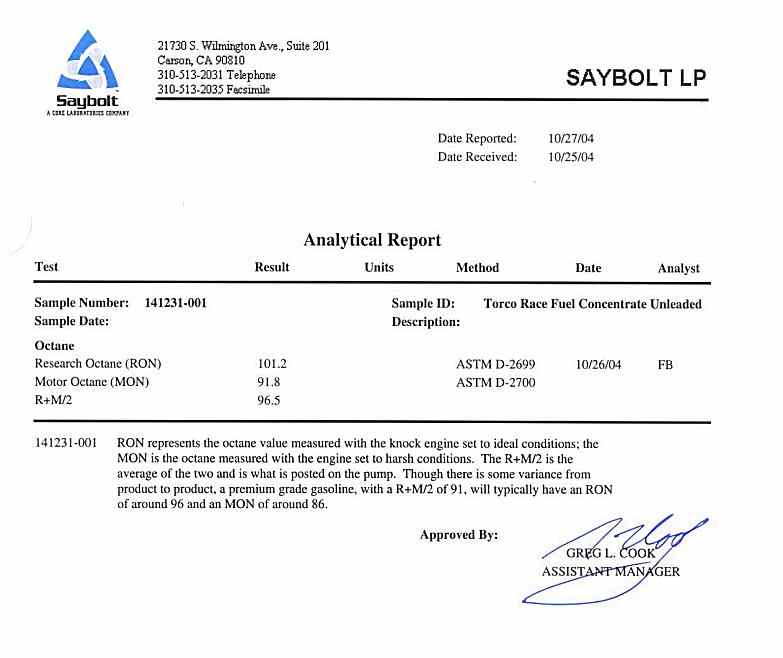
The lab test I had done at Core labs showed that the R+M/2=96.5 for a 10 gallon 91/one quart torco mix!
Team Owner
Joined: Aug 2003
Posts: 38,314
Likes: 35
But if you think adding Torco is better than mixing actual race gas in with pump gas for better final mix properties (its not just the octane numbers that are important here) then you just keep telling yourself that.
Here is a past thread on Torco and my testing results on it with our octane engines and other testing properties when mixing it with pump gas. Enjoy the reading... I personally wouldn't run the stuff in my lawnmower but for someone looking to cut corners and save costs rather than using a true racing higher octane gasoline go for it.
http://forums.corvetteforum.com/show...ighlight=torco
Here is a past thread on Torco and my testing results on it with our octane engines and other testing properties when mixing it with pump gas. Enjoy the reading... I personally wouldn't run the stuff in my lawnmower but for someone looking to cut corners and save costs rather than using a true racing higher octane gasoline go for it.
http://forums.corvetteforum.com/show...ighlight=torco
Thanks for the links. Very interesting and informative reading.
One of the things I also found interesting, and informative with regard to testing and interpreting test results, was the imput by Glass Slipper in the prior thread related on this subject.
He breaks it down into plain and easy to follow facts,in this very informative post, which should be required reading for anyone wanting to objectively look at test results, and explains in a bit further detail, octane points vs octane number:
http://forums.corvetteforum.com/show...post1563525028
Other posts in that same thread discuss the reddish tan residue, both seen in, and discussed in this current/present thread, and the significance of the residue with regard to the presence of MMT. It also points to other links discussing this potential correlation. An example of such a link is here.
Simply put, any product leaving behind any sort of residue after it is burned, has to have something in it which is causing it to leave behind said residue. There had to have been something in whatever was being burned in that Subaru engine which left behind that tan residue.
GM advises against the use of MMT containing fuels in any of their vehicles. See section 5-6 of your owners manual.
Last edited by '06 Quicksilver Z06; Jan 16, 2008 at 02:42 AM.

Advanced
Joined: Aug 2005
Posts: 85
Likes: 0
But if you think adding Torco is better than mixing actual race gas in with pump gas for better final mix properties (its not just the octane numbers that are important here) then you just keep telling yourself that.
Here is a past thread on Torco and my testing results on it with our octane engines and other testing properties when mixing it with pump gas. Enjoy the reading... I personally wouldn't run the stuff in my lawnmower but for someone looking to cut corners and save costs rather than using a true racing higher octane gasoline go for it.
http://forums.corvetteforum.com/show...ighlight=torco
Here is a past thread on Torco and my testing results on it with our octane engines and other testing properties when mixing it with pump gas. Enjoy the reading... I personally wouldn't run the stuff in my lawnmower but for someone looking to cut corners and save costs rather than using a true racing higher octane gasoline go for it.
http://forums.corvetteforum.com/show...ighlight=torco
You can do all the numbers testing you want. MY OWN real world results have shown me that it works great in MY application.

Former Vendor
Joined: May 2005
Posts: 3,749
Likes: 4
From: Valencia Ca
I won't speculate on your interst in these Joel/Torco threads but I'll ask - are you a detractor of Torco or a supporter. If you are a detractor please enlighten us with any fact based information (not rhetoric, speculation or third hand photos) and provide some hard, written proof of the chemical breakdown of Torco and some factually supportive evidence that Torco does harm an engine.
Last edited by C_Williams@RPM; Jan 16, 2008 at 11:13 AM.
Safety Car


Joined: Sep 2006
Posts: 3,922
Likes: 4
From: Cheektowaga NY
St. Jude Donor '08


Safety Car
Joined: Sep 2006
Posts: 3,922
Likes: 4
From: Cheektowaga NY
St. Jude Donor '08
Former Vendor
Joined: May 2005
Posts: 3,749
Likes: 4
From: Valencia Ca
However, I thought you were convinced you'd not need any additive so what's the worry?

Safety Car
Joined: Sep 2006
Posts: 3,922
Likes: 4
From: Cheektowaga NY
St. Jude Donor '08

More like a general question that someone may ask when they see this thread,pictures and links.

Safety Car
Joined: Sep 2006
Posts: 3,922
Likes: 4
From: Cheektowaga NY
St. Jude Donor '08