




DeWitts dual fan module

Thread Starter
Le Mans Master


Joined: Jan 2003
Posts: 8,596
Likes: 19
From: Portland Oregon
 DeWitts dual fan module
Anyone using the DeWitts replacement dual fan module? If so what was done to run the fans? I was told to just connect the power leads to the existing fan controller but I am unsure if that would work seeing how the OE fan was made to run at variable speeds from the variable speed controller that is controlled by the PCM.

Melting Slicks


Joined: May 2008
Posts: 2,377
Likes: 18
From: Fresno Ca
I'm also looking into this mod. 
It is a dual fan, flat paddles, and almost double the factory cfm at 2760. Keep in mind, this is only designed to fit our Direct Fit radiator.
We now have a wiring schematic that allows you to run the fans directly from the ECM and no aftermarket switch. Since the factory fan plug will not handle the amperage, you will have to cut it off and splice wires. The fan utilize two heavy duty relays (included) to introduce the power to the fans, so aftermarket wire harnesses are still necessary.

http://www.dewitts.com/pages/product...asp?ProdID=427
We now have a wiring schematic that allows you to run the fans directly from the ECM and no aftermarket switch. Since the factory fan plug will not handle the amperage, you will have to cut it off and splice wires. The fan utilize two heavy duty relays (included) to introduce the power to the fans, so aftermarket wire harnesses are still necessary.
http://www.dewitts.com/pages/product...asp?ProdID=427
Last edited by cencalc6; Sep 28, 2010 at 10:10 PM.
Thread Starter
Le Mans Master
Joined: Jan 2003
Posts: 8,596
Likes: 19
From: Portland Oregon
I was told to connect both of the DeWitts fan motors to the existing fan motor controller. But what worries me that having two motors will increase the current load by a considerable amount. I have already heard of fan controllers going bad just because the PCM calibration was set so that the stock fan comes on early and runs longer. There has been a few cases of the fan controller failing which causes oveheating. So I am hesitant about connecting additional load to the controller. I have years of experience with large AC Drives in the pulp and paper industry and connecting more current load than the drive can handle is a no no. If those fans motors are atypical fan motors they can have as much as 40 amps of in rush current and 20+ while running at full speed. Plus the OE motors are a PWM device, and I am not so sure that the DeWitts motors are rated for this type of duty.
Melting Slicks
Joined: May 2008
Posts: 2,377
Likes: 18
From: Fresno Ca
I was told to connect both of the DeWitts fan motors to the existing fan motor controller.But what worries me that having two motors will increase the current load by a considerable amount. I have already heard of fan controllers going bad just because the PCM calibration was set so that the stock fan comes on early and runs longer. There has been a few cases of the fan controller failing which causes oveheating. So I am hesitant about connecting additional load to the controller. I have years of experience with large AC Drives in the pulp and paper industry and connecting more current load than the drive can handle is a no no. If those fans motors are atypical fan motors they can have as much as 40 amps of in rush current and 20+ while running at full speed. Plus the OE motors are a PWM device, and I am not so sure that the DeWitts motors are rated for this type of duty.

Thread Starter
Le Mans Master
Joined: Jan 2003
Posts: 8,596
Likes: 19
From: Portland Oregon
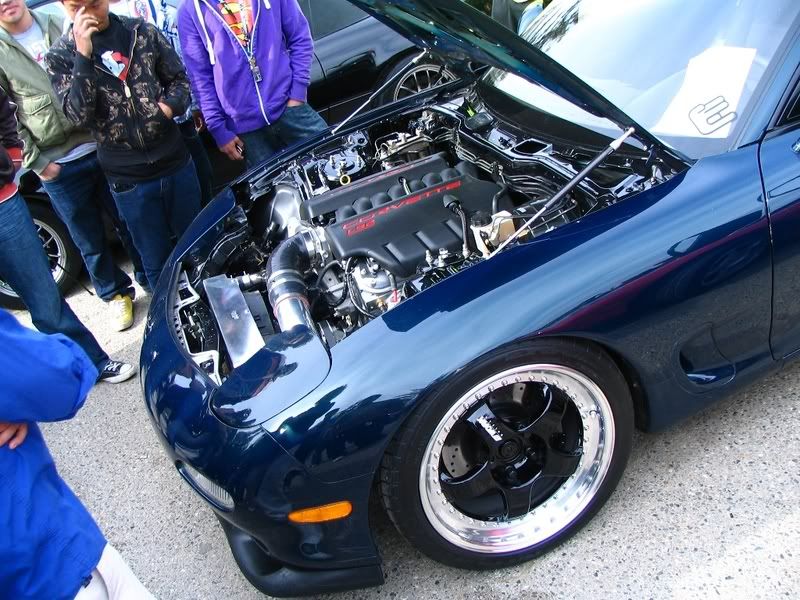
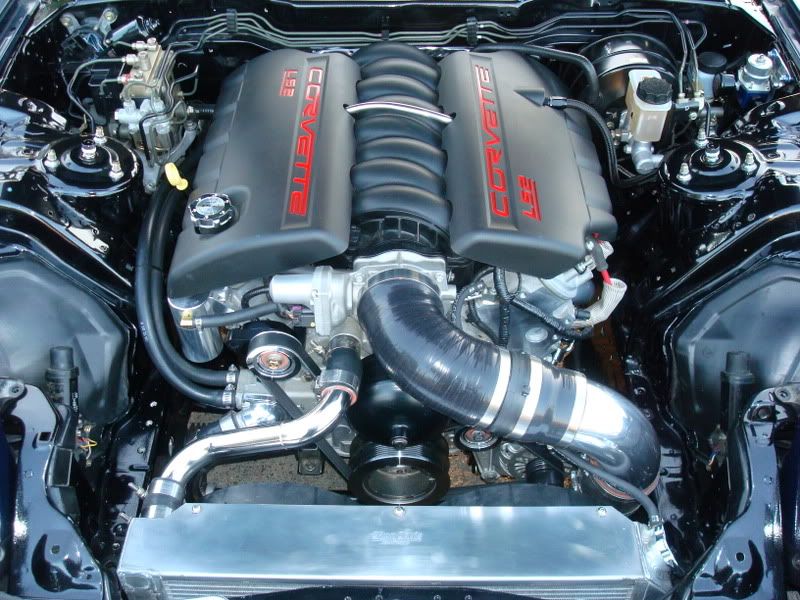
Here's a pic of my old 93 Mazda RX-7 powered by a LS2... I ran a dual SPAL fan setup and it was troublefree kept my car under 190's in 100+ degree HEAT....2 signal wires Hi and Low from the PCM/ECU to a couple relays,12V switched power Straight from the Battery and 30amp fuses Did the trick.I might give this a try and hopefully I dont screw something up
Melting Slicks
Joined: May 2008
Posts: 2,377
Likes: 18
From: Fresno Ca
On the RX-7 I was using a E40 PCM 24X reluctor wheel.I Do have the pinouts for that.But unfortunately I'm having trouble looking for my E38 pinouts.... I need look in the morning and see what I have. I did a quick search and I found somebody saying that on X1 connector (Grey connector on the PCM) that pinout 58= Low speed and 17= High speed but I'm not sure.

Former Vendor
Joined: Jan 2000
Posts: 5,593
Likes: 631
From: Brighton
I was told to connect both of the DeWitts fan motors to the existing fan motor controller. But what worries me that having two motors will increase the current load by a considerable amount. I have already heard of fan controllers going bad just because the PCM calibration was set so that the stock fan comes on early and runs longer. There has been a few cases of the fan controller failing which causes oveheating. So I am hesitant about connecting additional load to the controller. I have years of experience with large AC Drives in the pulp and paper industry and connecting more current load than the drive can handle is a no no. If those fans motors are atypical fan motors they can have as much as 40 amps of in rush current and 20+ while running at full speed. Plus the OE motors are a PWM device, and I am not so sure that the DeWitts motors are rated for this type of duty.
http://www.dewitts.com/pages/product...asp?ProdID=255
This provides you with full power to the fans and each one is independantly protected with a 30amp fuse. You can then use the sensor wire from the old fan plug to signal the relays on/off in pwm mode. I have a schematic at work and I'll get it uploaded to our website tomorrow.
Thread Starter
Le Mans Master
Joined: Jan 2003
Posts: 8,596
Likes: 19
From: Portland Oregon
On the RX-7 I was using a E40 PCM 24X reluctor wheel.I Do have the pinouts for that.But unfortunately I'm having trouble looking for my E38 pinouts.... I need look in the morning and see what I have. I did a quick search and I found somebody saying that on X1 connector (Grey connector on the PCM) that pinout 58= Low speed and 17= High speed but I'm not sure.
Corvette Stories
The Best of Corvette for Corvette Enthusiasts

Top 10 Most Expensive Corvettes Ever Sold on Bring A Trailer
Brett Foote
10 Things Every Corvette Owner Needs (2026 Edition)
Michael S. Palmer
8 Most "Only Corvette Owners Understand" Quirks and Problems
Pouria Savadkouei
10 Reasons the C6 Z06 is Still A Performance Benchmark After 20 Years
Joe Kucinski
How Much Horsepower Every Corvette Engine "LOST" in 1972
Joe Kucinski
Top 10 DOs and DON'Ts for Protecting Your Convertible Top!
Michael S. Palmer
Top 10 Most Explosive Corvettes Ever Made: Power-to-Weight Ratio Ranked!
Joe Kucinski
150 hp to 1,250 hp: Every Corvette Generation Compared by the Specs That Matter
Joe Kucinski


