










Clutch Pedal - Need some help.

Thread Starter
Pro


Joined: Aug 2010
Posts: 551
Likes: 12
From: Nebraska
 Clutch Pedal - Need some help.
Over the weekend I was at a low speed autocross event and when I pushed in the clutch pedal to shift it stayed on the floor and would not come up. I checked the fluid level and it was fine. Another Corvette owner at the event told to manually "pump" the clutch pedal, but that didn't help. The car is a 2013 Grand Sport M6 w/ 1600 miles. I trailered the car to the local dealer from whom I purchased it. They said the clutch fluid was contaminated and probably damaged any part in the clutch assembly that has any rubber or plastic.
Has anyone heard of this happen before?
I had not opened the cap on the clutch pedal reservoir until this happened. Any possibility other than bad fluid from the factory?
THANKS
Has anyone heard of this happen before?
I had not opened the cap on the clutch pedal reservoir until this happened. Any possibility other than bad fluid from the factory?
THANKS

Melting Slicks

Joined: Oct 2010
Posts: 2,220
Likes: 16
From: Sugarhill Ga
since you are under warranty it won't cost you to find out. clutch fluid on a new car turn brown QUICKLY from the reaction with the rubber parts. after a few times of changing it, the fluid will remain cleaner longer. hopefully the dealer will change both the slave & master cylinders.
good luck
good luck

Race Director


Joined: Dec 2006
Posts: 12,391
Likes: 2,910
From: Fort Worth, Texas
Would the pedal not return if you pulled it up? It's common with an organic clutch and the design of the factory slave for clutch dust to get past the seals and contaminate the fluid. When driven aggressively you have to maintain the fluid by using the Ranger method, see the sticky at the top of the forum for details.
Tech Contributor


Joined: Jul 2002
Posts: 14,950
Likes: 264
From: St. Louis, MO
St. Jude Donor '08
You all might like this thread.
http://forums.corvetteforum.com/c5-t...cs-inside.html
http://forums.corvetteforum.com/c5-t...cs-inside.html
After tons of speculation on Slave and how much fluid it contains and does it leach black from the rubber...
I have taken my old slave apart to prove once and for all the Slave contains VERY little fluid at all and does leach black from the rubber.
Ok here is a shot of the full slave.

Here is the Slave disassembled without the throwout bearing but just the Plastic plunger that rests on top of the thick rubber piston that the fluid pushes on. The inside edge of the plastic piston is all that makes contact with the rubber piston in the picture below.

Understand that this setup is the reverse of what one would expect. A hard aluminum piston with a rubber seal around it. In this case the piston IS the rubber seal. Here is the seal pulled up
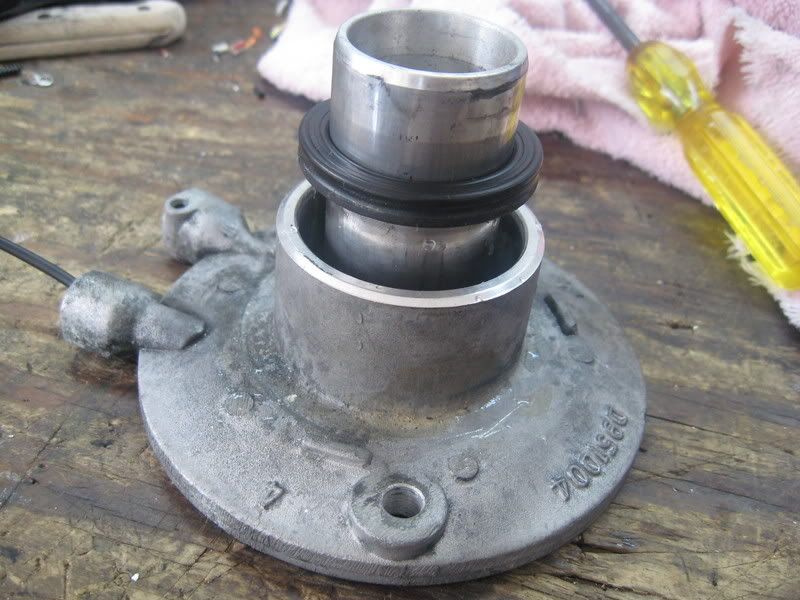
Here is proof that the black leaching is from the piston.

Here a shot of the size of the hole that the fluid enters. Its the same on both sides and it opens to a small channel under the rubber piston

Here is a pice of wire showing the entry point of the fluid.

Now for the question, how much fluid does the slave hold? EXACTLY 2 TABLESPOONS. Yes I used wifeys cooking measuring spoon.
I filled the whole thing up with water and plugged the holes.

I poured it out into a plastic dixie cup..to further demonstrate how little there is.

There you have it.. There is no more magic in the slave...the curtain has been pulled aside...
I have taken my old slave apart to prove once and for all the Slave contains VERY little fluid at all and does leach black from the rubber.
Ok here is a shot of the full slave.
Here is the Slave disassembled without the throwout bearing but just the Plastic plunger that rests on top of the thick rubber piston that the fluid pushes on. The inside edge of the plastic piston is all that makes contact with the rubber piston in the picture below.
Understand that this setup is the reverse of what one would expect. A hard aluminum piston with a rubber seal around it. In this case the piston IS the rubber seal. Here is the seal pulled up
Here is proof that the black leaching is from the piston.
Here a shot of the size of the hole that the fluid enters. Its the same on both sides and it opens to a small channel under the rubber piston
Here is a pice of wire showing the entry point of the fluid.
Now for the question, how much fluid does the slave hold? EXACTLY 2 TABLESPOONS. Yes I used wifeys cooking measuring spoon.
I filled the whole thing up with water and plugged the holes.
I poured it out into a plastic dixie cup..to further demonstrate how little there is.
There you have it.. There is no more magic in the slave...the curtain has been pulled aside...
Race Director
Joined: Dec 2006
Posts: 12,391
Likes: 2,910
From: Fort Worth, Texas
Tech Contributor
Joined: Jul 2002
Posts: 14,950
Likes: 264
From: St. Louis, MO
St. Jude Donor '08
Something else that I don't think was mentioned being that was a C5 slave and GM did add a rubber sleeve to the new C6 slave to try and keep the fluid cleaner which I think helps, but only to a certain extent. Something I've noticed from my experience of running 10 different clutches and 5 different kinds of friction is my fluid hardly ever discolors running a different compound friction material other than stock organic disc that dusts the most.
I think my thought below typed 6 years years ago is valid...Chris what do you think about this?
I know from personal experience that fresh fluid fixes this. No question about it. And it only seems to happen after a hard launch with some clutch slippage and attendant heat, or after a high rpm run on a high HP car with perhaps a marginal clamping force clutch that is slipping imperceptably to the driver but none the less is slipping and causing the heat.
But it just seems odd to me that boiling the fluid causes the opposite of what happens when you boil the brake fluid - boil brake fluid, foot to the floor like air in the lines and no brakes. The pedal comes up...but now that I think of it, a bit slowly. Boil clutch fluid, you'd expect to not be able to disengage the clutch... but you can disengage it, the pedal just doesn't come up after you do so! I'm not an engineer so maybe I'm just an idiot on this. But doesn't that seem odd to you too?
I suppose....thinking while typing here.... that perhaps the PP diaphragm on a high rpm shift DOES push back on the slave, as designed (this makes sense as the clutch is fully engaged when this happens, and not slipping, so the clutch is indeed engaged properly - this contradicts the overcentering theory, which would result in the clutch slipping which it does not when this happens), and the slave, with boiled fluid, compresses the air bubbles instead of moving the fluid back to master as designed. And thus the pedal does not come up. After you physically use your foot to transfer the fluid by pulling up the clutch pedal, it works properly again. I'm sure the cr&p in the fluid trying to pass through that tiny orifice Chuck shows above doesn't help any in the fluid transfer so fresh fluid would help there also.
But it just seems odd to me that boiling the fluid causes the opposite of what happens when you boil the brake fluid - boil brake fluid, foot to the floor like air in the lines and no brakes. The pedal comes up...but now that I think of it, a bit slowly. Boil clutch fluid, you'd expect to not be able to disengage the clutch... but you can disengage it, the pedal just doesn't come up after you do so! I'm not an engineer so maybe I'm just an idiot on this. But doesn't that seem odd to you too?
I suppose....thinking while typing here.... that perhaps the PP diaphragm on a high rpm shift DOES push back on the slave, as designed (this makes sense as the clutch is fully engaged when this happens, and not slipping, so the clutch is indeed engaged properly - this contradicts the overcentering theory, which would result in the clutch slipping which it does not when this happens), and the slave, with boiled fluid, compresses the air bubbles instead of moving the fluid back to master as designed. And thus the pedal does not come up. After you physically use your foot to transfer the fluid by pulling up the clutch pedal, it works properly again. I'm sure the cr&p in the fluid trying to pass through that tiny orifice Chuck shows above doesn't help any in the fluid transfer so fresh fluid would help there also.
Corvette Stories
The Best of Corvette for Corvette Enthusiasts

Top 10 Most Expensive Corvettes Ever Sold on Bring A Trailer
Brett Foote
10 Things Every Corvette Owner Needs (2026 Edition)
Michael S. Palmer
8 Most "Only Corvette Owners Understand" Quirks and Problems
Pouria Savadkouei
10 Reasons the C6 Z06 is Still A Performance Benchmark After 20 Years
Joe Kucinski
How Much Horsepower Every Corvette Engine "LOST" in 1972
Joe Kucinski
Top 10 DOs and DON'Ts for Protecting Your Convertible Top!
Michael S. Palmer
Top 10 Most Explosive Corvettes Ever Made: Power-to-Weight Ratio Ranked!
Joe Kucinski
150 hp to 1,250 hp: Every Corvette Generation Compared by the Specs That Matter
Joe Kucinski
8 Coolest Corvette Pace Cars (and Replicas) of All Time
Verdad Gallardo
Race Director
Joined: Dec 2006
Posts: 12,391
Likes: 2,910
From: Fort Worth, Texas
That's because you don't have any material left on the disc Joe lol, j/k but seriously one day there are going to be sparks coming out from under your car
On a serious note, when daily driving at slow speeds there isn't as much material removed nor is it distributed as much imho. I actually already looked back at your post that you referenced and agree with what you said back then. The clutch is still clamping, but maybe not as well as I believe the heat affects the springs.
On a serious note, when daily driving at slow speeds there isn't as much material removed nor is it distributed as much imho. I actually already looked back at your post that you referenced and agree with what you said back then. The clutch is still clamping, but maybe not as well as I believe the heat affects the springs.
Thread Starter
Pro
Joined: Aug 2010
Posts: 551
Likes: 12
From: Nebraska
Thanks for all of the feedback. Answers to a couple of the questions: There was no fluid under the car. The fluid was full but but pretty dark in color.
The dealer has ordered the parts and I'll post how it all works out.
Thanks everyone for your feedback!
The dealer has ordered the parts and I'll post how it all works out.
Thanks everyone for your feedback!