



Diffuser performance

Thread Starter
Drifting


Joined: Mar 2011
Posts: 1,448
Likes: 56
From: Bath NC
 Diffuser performance
I'm looking for info showing performance of the various rear diffusers on the market. I have seen some that look cosmetic and some that look to have form and function. Does anyone have hard evidence as to which ones perform the best.
Cheers
Roger
Cheers
Roger

Former Vendor
Joined: Aug 2005
Posts: 16,897
Likes: 412
From: Lewisville TX
St. Jude Donor '03-'04-'05-'06-'07-'08-'09-'10-'11-'12-'13
I have only seen a few come through the shop here, and while they might straighten out the air going under the car at the back, I don't see any of them actually doing much for downforce as they do not have that many braces for install on them.
The hardest part with them is that you would have to all but close out the top section of it, but on a street car you have the mufflers to deal with and cooling of the diff and trans.
The ALMS car had a full close out on the bottom of it, and a very rule restricted rear aero on the car (I won't call it a diffuser as there wasn't much there), but you really have to fight cooling of the drivetrain at that point and watch out the exhaust doesn't over heat everything.
The hardest part with them is that you would have to all but close out the top section of it, but on a street car you have the mufflers to deal with and cooling of the diff and trans.
The ALMS car had a full close out on the bottom of it, and a very rule restricted rear aero on the car (I won't call it a diffuser as there wasn't much there), but you really have to fight cooling of the drivetrain at that point and watch out the exhaust doesn't over heat everything.
Thread Starter
Drifting
Joined: Mar 2011
Posts: 1,448
Likes: 56
From: Bath NC
Anthony,
I agree with what you say. I think the key is how much I can open up the space between the road and the bottom of the car. The more distance I can create, the more down force I'll get because of dropped air pressure. So the larger the void the more DF. I even relocated the small vacuum pot on the right side of the car to allow my foil shape to extend higher.So that leaves, How much can I clean up the air flow underneath. In F1 and other sanctions, The center of the rear axle is the limit to how far a diffuser can extend forward. I'll be behind that point by a few inches. And I've found a way to really clean up the air around the mufflers and keep the factory units in place. And my mold will let me keep the foil all the way across if I chose to remove the mufflers.
The trans cooler is my biggest concern at this point. But I know I can address that with a larger or remote unit.
I wish I had all the necessary telemetry to tell me how well its working. I guess a few runs at the track will at least give me "Seat of the Pants" info.
Cheers
I agree with what you say. I think the key is how much I can open up the space between the road and the bottom of the car. The more distance I can create, the more down force I'll get because of dropped air pressure. So the larger the void the more DF. I even relocated the small vacuum pot on the right side of the car to allow my foil shape to extend higher.So that leaves, How much can I clean up the air flow underneath. In F1 and other sanctions, The center of the rear axle is the limit to how far a diffuser can extend forward. I'll be behind that point by a few inches. And I've found a way to really clean up the air around the mufflers and keep the factory units in place. And my mold will let me keep the foil all the way across if I chose to remove the mufflers.
The trans cooler is my biggest concern at this point. But I know I can address that with a larger or remote unit.
I wish I had all the necessary telemetry to tell me how well its working. I guess a few runs at the track will at least give me "Seat of the Pants" info.
Cheers
Former Vendor
Joined: Aug 2005
Posts: 16,897
Likes: 412
From: Lewisville TX
St. Jude Donor '03-'04-'05-'06-'07-'08-'09-'10-'11-'12-'13
Anthony,
I agree with what you say. I think the key is how much I can open up the space between the road and the bottom of the car. The more distance I can create, the more down force I'll get because of dropped air pressure. So the larger the void the more DF. I even relocated the small vacuum pot on the right side of the car to allow my foil shape to extend higher.So that leaves, How much can I clean up the air flow underneath. In F1 and other sanctions, The center of the rear axle is the limit to how far a diffuser can extend forward. I'll be behind that point by a few inches. And I've found a way to really clean up the air around the mufflers and keep the factory units in place. And my mold will let me keep the foil all the way across if I chose to remove the mufflers.
The trans cooler is my biggest concern at this point. But I know I can address that with a larger or remote unit.
I wish I had all the necessary telemetry to tell me how well its working. I guess a few runs at the track will at least give me "Seat of the Pants" info.
Cheers
I agree with what you say. I think the key is how much I can open up the space between the road and the bottom of the car. The more distance I can create, the more down force I'll get because of dropped air pressure. So the larger the void the more DF. I even relocated the small vacuum pot on the right side of the car to allow my foil shape to extend higher.So that leaves, How much can I clean up the air flow underneath. In F1 and other sanctions, The center of the rear axle is the limit to how far a diffuser can extend forward. I'll be behind that point by a few inches. And I've found a way to really clean up the air around the mufflers and keep the factory units in place. And my mold will let me keep the foil all the way across if I chose to remove the mufflers.
The trans cooler is my biggest concern at this point. But I know I can address that with a larger or remote unit.
I wish I had all the necessary telemetry to tell me how well its working. I guess a few runs at the track will at least give me "Seat of the Pants" info.
Cheers
Safety Car


Joined: May 2011
Posts: 3,582
Likes: 46
From: va
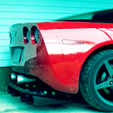
Most of the diffusers on the market are copies of each other and based off the lines of the original valence. The valence acts as a parachute on the rear of the car. By removing the rear valence and trimming the fender liners youll free up the air in the rear. I have done this and it works - for free (it also exposes the suspension and tires making the car look more aggressive).

EDIT:
trimmed rear end:

carbon diffuser (in progress):

EDIT:
trimmed rear end:
carbon diffuser (in progress):
Last edited by el es tu; Dec 30, 2013 at 11:38 PM.

Race Director


Joined: Aug 2005
Posts: 13,592
Likes: 187
From: Hudson WI
NCM Sinkhole Donor
Most of the diffusers on the market are copies of each other and based off the lines of the original valence. The valence acts as a parachute on the rear of the car. By removing the rear valence and trimming the fender liners youll free up the air in the rear. I have done this and it works - for free (it also exposes the suspension and tires making the car look more aggressive).
Corvette Stories
The Best of Corvette for Corvette Enthusiasts

150 hp to 1,250 hp: Every Corvette Generation Compared by the Specs That Matter
Joe Kucinski
8 Coolest Corvette Pace Cars (and Replicas) of All Time
Verdad Gallardo
Top 10 Corvette Engines RANKED by Peak Torque (70+ Years of Muscle!)
Joe Kucinski
Corvette ZR1X Will Be Pacing the Indy 500, And Could Probably Race, Too!
Verdad Gallardo
Top 10 Corvettes Coming to Mecum Indy 2026!
Brett Foote
Top 10 C9 Corvette MUST-HAVES to Fix These C8 Generation Flaws!
Michael S. Palmer
10 Revolutionary 'Corvette Firsts' Most People Don't Know
Joe Kucinski
5 Reasons to Upgrade to an LS6-Powered Corvette; 5 Reasons to Stay LT2
Michael S. Palmer
2027 Corvette vs The World: Every C8 vs Its Closest Competitor
Joe Kucinski
Thread Starter
Drifting
Joined: Mar 2011
Posts: 1,448
Likes: 56
From: Bath NC
Here is where I have started. I built a wooden buck to create a fiberglass foil shape. The fiberglass piece will be the beginning of the fiberglass master pattern. The pattern is what the mold will be made from. And of course, from the mold, I can make as many as I want. The build should be interesting to those not familiar with the process.


Last edited by rabrooks; Dec 31, 2013 at 05:30 PM.
Thread Starter
Drifting
Joined: Mar 2011
Posts: 1,448
Likes: 56
From: Bath NC
I'm ready to lay on the fiberglass to get the foil for initial fit. I may get to that tomorrow
The right of this pic is the tray going under the cradle, to the left is the foil shape to create the down force.

The right of this pic is the tray going under the cradle, to the left is the foil shape to create the down force.
Thread Starter
Drifting
Joined: Mar 2011
Posts: 1,448
Likes: 56
From: Bath NC
I am looking for help from anyone on the east coast interested in the results of this project that can offer a way or the equipment to measure my results. I suppose a sort of electronic scale with remote read out, attached to the suspension and body can give info differentiating from static (0) to straight-a-way speed deltas. From this we can tell if I have created a work of art or a piece of crap.
But that is not my expertise. Please chime in if this is your world. Any help is appreciated.
Wind tunnel access would be way cool, along with the telemetry. Any college students or interns got access?
But that is not my expertise. Please chime in if this is your world. Any help is appreciated.
Wind tunnel access would be way cool, along with the telemetry. Any college students or interns got access?
Safety Car
Joined: May 2011
Posts: 3,582
Likes: 46
From: va
nice start
nasa langley rents out their windtunnel facility for race teams to test, however the cost is a few thousand per hour
here is the link to some software called foilsim - you can download it or use the web version: http://www.grc.nasa.gov/WWW/K-12/FoilSim/index.html
good luck!
EDIT:
web version:http://www.grc.nasa.gov/WWW/k-12/airplane/foil3.html
this wont give you exact values, but will at lest give you an idea of what shape/angle you want to use for the part
other software:
Openfoam http://www.openfoam.com/
Solidworks https://www.solidworks.com/
Autodesk http://www.autodesk.com/products/aut...amily/overview
nasa langley rents out their windtunnel facility for race teams to test, however the cost is a few thousand per hour
here is the link to some software called foilsim - you can download it or use the web version: http://www.grc.nasa.gov/WWW/K-12/FoilSim/index.html
good luck!
EDIT:
web version:http://www.grc.nasa.gov/WWW/k-12/airplane/foil3.html
this wont give you exact values, but will at lest give you an idea of what shape/angle you want to use for the part
other software:
Openfoam http://www.openfoam.com/
Solidworks https://www.solidworks.com/
Autodesk http://www.autodesk.com/products/aut...amily/overview
Last edited by el es tu; Jan 6, 2014 at 08:30 AM.
Thread Starter
Drifting
Joined: Mar 2011
Posts: 1,448
Likes: 56
From: Bath NC
Ok so I've had a few set backs. The way I see it. I've been tuned up and should be good for another 50 years. Since my last post and since the last time I worked on this rear diffuse, I have had back surgery, then I got Shingles in my back then two weeks ago, I had a fricking heart attack. Ok I'm done with the couch and doctors. On with the show.
I waxed the wooden buck and layed it up with one super thick layer of structural fiberglass. If the weather will let me, I'll go to the shop tomorrow and pull the fiberglass part off the buck. I'll save the fiberglass part for later because I'm going to build another wooden buck for another diffuser shape. This new shape is the one that will get finished first. Based on the education I got from Jason, The new shape will provide more downforce and less turbulence. The old shape will provide some downforce but not as much as the new shape. So the first one will be for us track guys and the second one will be more the street guys part as it will be more aesthetically pleasing. No pictures today but maybe a few tomorrow.
I waxed the wooden buck and layed it up with one super thick layer of structural fiberglass. If the weather will let me, I'll go to the shop tomorrow and pull the fiberglass part off the buck. I'll save the fiberglass part for later because I'm going to build another wooden buck for another diffuser shape. This new shape is the one that will get finished first. Based on the education I got from Jason, The new shape will provide more downforce and less turbulence. The old shape will provide some downforce but not as much as the new shape. So the first one will be for us track guys and the second one will be more the street guys part as it will be more aesthetically pleasing. No pictures today but maybe a few tomorrow.
Safety Car
Joined: May 2011
Posts: 3,582
Likes: 46
From: va
Here's a thread on concave vs convex diffuser shaping (great reading for a stuck in the house snow day):
http://www.f1technical.net/forum/vie...hp?f=6&t=10943
http://www.f1technical.net/forum/vie...hp?f=6&t=10943

Melting Slicks

Joined: Dec 2009
Posts: 3,411
Likes: 40
From: Smallingerland Friesland, Netherlands
APR Performance - Tech Articles, diffusers
And, because areo optimization involves the balance of the total package:
APR Performance - Adjustable Wings Overview (see links to Related Tech Articles, right bottom of page)
APR Performance - Tech Articles, air foils (a.k.a. "wings")
Katech Performance - Windtunnel Data Report
And, because areo optimization involves the balance of the total package:
APR Performance - Adjustable Wings Overview (see links to Related Tech Articles, right bottom of page)
APR Performance - Tech Articles, air foils (a.k.a. "wings")
Katech Performance - Windtunnel Data Report
Thread Starter
Drifting
Joined: Mar 2011
Posts: 1,448
Likes: 56
From: Bath NC
Here's a thread on concave vs convex diffuser shaping (great reading for a stuck in the house snow day):
http://www.f1technical.net/forum/vie...hp?f=6&t=10943
http://www.f1technical.net/forum/vie...hp?f=6&t=10943
Thread Starter
Drifting
Joined: Mar 2011
Posts: 1,448
Likes: 56
From: Bath NC
I got the first foil off the table today.
The new foil shape is going to be more convex over its entire length rather than compound shaped as the pictures above show.
The Link el es tu suggested was full of good info. Although it applied mostly to the FI crowd, the CFD testing and the shape they used, seemed to better fit our cars than the F1 cars. The new shape will be an average of 11 degrees but will start out less than that and end up more than that. The idea is to keep the boundry layer from breaking away from the surface and to get enough shape (angle upward) at the very rear of the diffuser to help with turbulence in the pocket directly behind the car.
Here's a pic of the design shape that tested out the best. You'll have to use a little imagination to see how it will be under our cars. By the way, this new shape is better suited for dealing with our exhaust arrangement.
This is air velocity and flow shape.

The gray part represents the car. You can see how the air flows under it and then the rear shape creates the clean flow and down force.

This pic is of the actual down force location and amount
Anyone with knowledge of air foil and fluid dynamics please chime in. I always want to learn.
The new foil shape is going to be more convex over its entire length rather than compound shaped as the pictures above show.
The Link el es tu suggested was full of good info. Although it applied mostly to the FI crowd, the CFD testing and the shape they used, seemed to better fit our cars than the F1 cars. The new shape will be an average of 11 degrees but will start out less than that and end up more than that. The idea is to keep the boundry layer from breaking away from the surface and to get enough shape (angle upward) at the very rear of the diffuser to help with turbulence in the pocket directly behind the car.
Here's a pic of the design shape that tested out the best. You'll have to use a little imagination to see how it will be under our cars. By the way, this new shape is better suited for dealing with our exhaust arrangement.
This is air velocity and flow shape.
The gray part represents the car. You can see how the air flows under it and then the rear shape creates the clean flow and down force.
This pic is of the actual down force location and amount
Anyone with knowledge of air foil and fluid dynamics please chime in. I always want to learn.
Last edited by rabrooks; Feb 1, 2014 at 04:01 PM.
Drifting
Joined: May 2008
Posts: 1,505
Likes: 7
From: Jacksonville FL
FWIW I've been 185 in my car and had no issues with the rear downforce. The front of the car gets a little light but that was more of the poor road condition and suspension setup. I myself and more concerned with the front of the car than the rear.
Thread Starter
Drifting
Joined: Mar 2011
Posts: 1,448
Likes: 56
From: Bath NC
As for the front getting light, you can add a splitter if you don't have one. If you do, it can be tuned by adding surface area. Or you can add side skirts.
One thing we try to do is to keep the car balanced in DF. As you might expect, too much rear DF can lighten the front and cause it to push badly thru the corner.
Katech did some studies with their components. It's very interesting to see how each component changes the working forces. Take a look at this link to see the amazing differences each little aero piece makes
http://www.katechengines.com/street_...a%20report.pdf
Check out the chart on the link