When you click on links to various merchants on this site and make a purchase, this can result in this site earning a commission. Affiliate programs and affiliations include, but are not limited to, the eBay Partner Network.
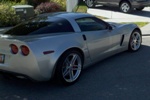
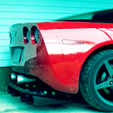
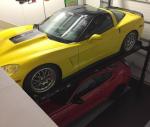
Okay... Will try to keep this short. I have a supercharged 2008 base coupe with a rear widebody conversion and OEM Z06 rims. The rear tire is stock Z06 size and the fronts are my C6 base sized tires stretched across the wider Z06 rim. I am debating whether or not to do the front conversion on my car and was thinking of just leaving the front as stock base model for cost savings. However, I WOULD like to upgrade my brakes. I don't need anything for a race track, but I would like to find the best bang for the buck on replacing my stockers that will give me the MOST stopping power and still fit under stock sized rims. If I can do this, I may just buy some reproduction wheels for the front in the stock C6 size and offset and leave it alone otherwise. Can I get SIGNIFICANTLY better braking with this setup without spending a ton of money? Will just buying slotted rotors and better pads alone make a huge difference? I would love to put the cost of doing the front widebody conversion towards some coilovers or something. Any help is appreciated. Thanks.
St. Jude Donor '03-'04-'05-'06-'07-'08-'09-'10-'11-'12-'13
Depends on what you want to get out of the car.
If you just want better stopping power, better tires and better brake pads and you can get the car to darn near throw you through the window. Of course depending on how aggressive you go with the pad there are trade offs like dust and noise.
Pads and tires are the only parts that actually touch. So pad compound and tire compound are going to be the biggest factors in how quickly the car can stop.......calipers, cooling ducts, rotors are all going to matter in how many times you can hammer the brake pedal to the floor.
That being said....BBK's are not really there for 'performance' so much as they are for repeatability. Sure those 14" rotors and 6 piston calipers are a killer look, but all of that hardware is there to make sure you hit those same braking point markers at the end of your session on track as you did at the start.
So if you are after a better look for the car as well as a little better performance there are some Wilwood kits that should fit under the wheels with a small spacer. Most of the bigger kits like StopTech and Brembo are not going to clear a stock wheel.
I wish more people would understand that. I got crap over putting the base rear brakes on my z06 with upgraded pads. Car stops just as good, fronts do most of the work, and car never sees a road course so I don't need to stop 160 to 0 ten times in a row. Base rear brakes are more than enough to stop.
Okay... Will try to keep this short. I have a supercharged 2008 base coupe with a rear widebody conversion and OEM Z06 rims. The rear tire is stock Z06 size and the fronts are my C6 base sized tires stretched across the wider Z06 rim. I am debating whether or not to do the front conversion on my car and was thinking of just leaving the front as stock base model for cost savings. However, I WOULD like to upgrade my brakes. I don't need anything for a race track, but I would like to find the best bang for the buck on replacing my stockers that will give me the MOST stopping power and still fit under stock sized rims. If I can do this, I may just buy some reproduction wheels for the front in the stock C6 size and offset and leave it alone otherwise. Can I get SIGNIFICANTLY better braking with this setup without spending a ton of money? Will just buying slotted rotors and better pads alone make a huge difference? I would love to put the cost of doing the front widebody conversion towards some coilovers or something. Any help is appreciated. Thanks.
the cheapest thing to go with is just pads and fluid - the rotors add cost - you will drop weight from the car, but considering that they are something that get tossed so often most on budgets stick with cheap base rotors (napa sells c5 rotors which are the same dimensions as the c6 base for significantly less, and you get better cooling since each corner is a different casting vs the one sided casting of the c6 rotors)
if you can put up with the noise and dust, hawk HP+ or DTC30 will work well on the street as both come up to operating temp quickly. The dtc30 has a bit more heat resistance and torque so Id go with that, but the HP+ makes a huge improvement in torque over the factory crap pads...
cheapest place Ive found for pads is KNS brakes
Wilwood forged narrow superlights are cheap and will fit they include lines calipers pads and two piece rotors
TCE has the best pricing on these - something like 1400 per axle http://www.tceperformanceproducts.co...te-c6/kits-36/
If you go with these wilwoods, note that the pads that come in the kits are not that aggressive, but you may be able to get the vendor to swap them out for something better
Pads are the answer, just like all above mention. Big brakes on the street are merely bling. Race pads on the street are actually dangerous, due to lack of friction at low temps.
The Hawk HP+ that el es tu noted will give good performance for one hard stop from 30 mph or 130 mph. Of course, the tires must be up to the task, which means your base size tires on Z06 wheels will be your next problem. Get the Z06 replicas to match the tires if that's the look you want.
I would just go Carbotech pads stock calipers and Castrol SRF fluid plenty of stopping power for the street or track. This combo may have some noise on the street but, it WORKS!!
Run XP10 front $201 Rear XP8 $158.
CASTROL SRF The SRF is the absolute best brake fluid on the market, period. If you want the best the Castrol SRF is it. Due to it's extremely high dry & wet boiling points. Dry: 310°C (590°F)
Wet: 270°C (518°F) 1 Liter $79.95
Really just wanting more stopping power. I will be honest and tell a story. First... My car is supercharged, pipes, exhaust...putting about 540 to the rear wheels... Anyway... I was, perhaps, going a bit too fast on the freeway once..okay...WAY too fast... I went to hit the brakes and I could just feel them fading! I could have STOOD on them with all of my weight and I don't think the car would have halted any more quickly.. Came up behind traffic in front of me much too fast and I was afraid I would not stop in time. To be honest..it kinda freaked me out a bit. So.... Since then, I have decided that before I make the care capable of going any faster, I should make sure I can stop it well! I don't do track days and I don't race except for the occasional "street battle"...lol.... So I don't need 6 piston Brembos...... I just want something that is quite a bit more capable than stock and it would be a bonus if I could fit them behind stock offset C6 base wheels. If I can do that, then I can just go with Z06 repros on the front and forget about the front widebody conversion as I was only doing it to accommodate the bigger Z06 front rims...which I was only doing to make room for bigger front brakes...lol. Hope this is a clearer picture. Thanks so much to everyone so far and any additional comments are welcome.. Cheers...
Is this typical? Stock brakes will fade on a single high speed stop? Does it matter if you have the larger Z51 brakes? I was just getting ready to put the autozone gold ceramic pads on the car because I am tired of the brake dust. I never race but on occasion do go faster than I should. Are they more likely to fade on an isolated high speed stop than stock?
Is this typical? Stock brakes will fade on a single high speed stop? Does it matter if you have the larger Z51 brakes? I was just getting ready to put the autozone gold ceramic pads on the car because I am tired of the brake dust. I never race but on occasion do go faster than I should. Are they more likely to fade on an isolated high speed stop than stock?
Take a look at that nice graph that el es tu posted. Notice how the working heat range is for OEM pads. Once you exceed that range, you will lose stopping power. IIRC the heat range for ceramics is less than OEM. The larger J55 rotors on the Z51 option will heat the pads a little quicker at the same pressure, since the swept area is greater.
It also depends on how fast is your idea of high speed. With the J9L base brakes, I finish the 1/4 mi at high 120's and can easily make the first turn-off at 600 ft without fade and with OEM pads.
Since you don't race, it might be a good idea to find a deserted road to test the stopping distance from maybe 100. If you are at high speed, you should allow extra space to slow down prior to hitting the brakes. The OP didn't allow enough space for safety, hence this thread.
Is this typical? Stock brakes will fade on a single high speed stop? Does it matter if you have the larger Z51 brakes? I was just getting ready to put the autozone gold ceramic pads on the car because I am tired of the brake dust. I never race but on occasion do go faster than I should. Are they more likely to fade on an isolated high speed stop than stock?
No this is not typical but still not a good idea to do multiple high speed stops back to back because they will fade. The ceramic pad you are looking to put on will fade in 1 or2 high speed stops back to back. The Carbotech 1521 is a low dust pad and will be fine for what your doing with no fade but obviously a lot more expensive front and rear total would be $263.00 If interested let me know.
Carbotech™ Bobcat 1521™ The Carbotech Bobcat 1521™ is our high performance street compound that is our most successful compound. The Bobcat compound is known for its awesome release and modulation, along with unmatched rotor friendliness. Like our AX™ & XP™ line of compounds, Bobcat 1521™ is a Ceramic based friction material offering minimal rotor damage and non-corrosive dust. Bobcat 1521™ offers outstanding performance, even when cold, low dusting and low noise with an excellent initial bite. This compound’s virtually perfect linear torque production provides incredible braking force without ABS intervention. Bobcat 1521™ operating range starts out at ambient and goes up to 900°F. Bobcat 1521™ is suitable for ALL street cars, perfect for your tow vehicle, police cruiser. The Bobcat 1521™ compound has been found to last two-three times longer than OE pads you can purchase at a dealership or national retailer. That’s one of the beauties of Carbotech Ceramic brake compounds. Bobcat 1521™ is NOT recommended for any track use.
Really just wanting more stopping power. I will be honest and tell a story. First... My car is supercharged, pipes, exhaust...putting about 540 to the rear wheels... Anyway... I was, perhaps, going a bit too fast on the freeway once..okay...WAY too fast... I went to hit the brakes and I could just feel them fading! I could have STOOD on them with all of my weight and I don't think the car would have halted any more quickly.. Came up behind traffic in front of me much too fast and I was afraid I would not stop in time. To be honest..it kinda freaked me out a bit. So.... Since then, I have decided that before I make the care capable of going any faster, I should make sure I can stop it well! I don't do track days and I don't race except for the occasional "street battle"...lol.... So I don't need 6 piston Brembos...... I just want something that is quite a bit more capable than stock and it would be a bonus if I could fit them behind stock offset C6 base wheels. If I can do that, then I can just go with Z06 repros on the front and forget about the front widebody conversion as I was only doing it to accommodate the bigger Z06 front rims...which I was only doing to make room for bigger front brakes...lol. Hope this is a clearer picture. Thanks so much to everyone so far and any additional comments are welcome.. Cheers...
All you need than is GOOD pads Like run XP8 front and 1521 rear this will stop the car all day long.
Carbotech™ XP8™
A high torque brake compound with a wide operating temperature range of 200°F-1250°F+ (93°C to 676°C+). Carbotech™ XP8™ is the first of our racing compounds. Good initial bite at race temperatures, high coefficient of friction, excellent modulation and release characteristics. Extremely high fade resistance and very rotor friendly. Perfect for track day use with any tire and can still be driven safely to and from the track. Carbotech™ does NOT recommended XP8™ as a daily driven street pad due to elevated levels of dust and noise. Carbotech™ XP8™ is a great compound on the front & rear of most open wheel and sports racers.
I'll add two of the common Wilwood graphs to this.
Keep in mind these graphs are good for comparing what was tested by the specific manufacture more than comparing one brand to another. But still give you a good idea of how each falls against it's own family of compounds and temp ranges.
These represent the primary pads TCE stocks for the Wilwood listings. There are however additional compounds offered. Many of them have similar characteristics so the cart gets a bit messy. These handle a wide range of uses and represent the bulk of what I sell.
__________________ TCE
Your one stop...for Wilwood Brakes! 480.967.7901
Take a look at that nice graph that el es tu posted. Notice how the working heat range is for OEM pads. Once you exceed that range, you will lose stopping power. IIRC the heat range for ceramics is less than OEM. The larger J55 rotors on the Z51 option will heat the pads a little quicker at the same pressure, since the swept area is greater.
It also depends on how fast is your idea of high speed. With the J9L base brakes, I finish the 1/4 mi at high 120's and can easily make the first turn-off at 600 ft without fade and with OEM pads.
Since you don't race, it might be a good idea to find a deserted road to test the stopping distance from maybe 100. If you are at high speed, you should allow extra space to slow down prior to hitting the brakes. The OP didn't allow enough space for safety, hence this thread.
The OP was talking a "hypothetical" range of around 160-ish... Obviously probably expecting too much from stock C6 brakes, hence the post. I was surprised that previously unused brakes (first real use during the drive, no previous hard braking) were so inadequate. Just trying to find the most economic fix that will fit under stock sized front rims if possible.....
I still did not understand if you have z51 or not, regardless these are the steps I would do:
1) confirm condition of your braking system, color of liquid, wear on pads wear on rotors and check for leaks on the lines particularly by the caliper.
---> replace parts that show excessive ware
Next step for improvement:
2) Replace break fluid with DOT4 GM (you might still have DOT3 in there??) or DOT4 race fluids
3) replace pads following some of the charts shown here
4) braided hoses
That is all you need.. actually you can use the above for SCCA short road corse and be fine
OP.........both the base wheel and ZO6 wheel are 18" on the front so clearance is not an issue. Choosing the right pad is. If you are going to do a lot of high speed runs then you will benefit from a six pot setup obviously.
The OP was talking a "hypothetical" range of around 160-ish... Obviously probably expecting too much from stock C6 brakes, hence the post. I was surprised that previously unused brakes (first real use during the drive, no previous hard braking) were so inadequate. Just trying to find the most economic fix that will fit under stock sized front rims if possible.....
Originally Posted by jenablist
I still did not understand if you have z51 or not, regardless these are the steps I would do:
1) confirm condition of your braking system, color of liquid, wear on pads wear on rotors and check for leaks on the lines particularly by the caliper.
---> replace parts that show excessive ware
Next step for improvement:
2) Replace break fluid with DOT4 GM (you might still have DOT3 in there??) or DOT4 race fluids
3) replace pads following some of the charts shown here
4) braided hoses
That is all you need.. actually you can use the above for SCCA short road corse and be fine
I would make sure that you've got the pads bedded in correctly. If you haven't done this, your first hard braking experience will cause some out-gassing of the pads which will cause significantly reduced braking until that's done. There should be a procedure for this in the manual.
That being said, the last time I was out on track, with ACDelco pads (factory), I way overshot my braking zone on the first real lap that I did. This was mostly because even the factory pads weren't up to temp, and neither were the tires (Michelin PSS, stock base sizes). This was a similar scenario to what you described: ~160 mph, needed to get down to maybe 50-60 max for turn 1. I hadn't been on track for a few months, and the whole temp thing sort of skipped my mind... Fortunately for me there was plenty of runoff that connected to a later portion of the track. You don't get that on the interstate.
Just be aware that most brake/tire packages won't be at optimal temp when you really need them at 160 on the street. I do my share of stupid stuff too, but you just need to be mindful of the fact that street driving doesn't produce the proper temps for even stock pads/tires to decelerate you to near the speed of other vehicles in a timely manner. I love a good blast down the Mexican raceways, but chances are that if you have to put the pedal to the floor to avoid an accident, you're cutting it a bit close. If you're not lucky, you'll either trip ABS because the tires just can't get enough traction, or your pads just won't produce enough grip for a second or two.
Also make sure there isn't air in any of your brake lines, and as others suggested ensure that it isn't too discolored. Moisture will accumulate over time and that will substantially decrease the boiling point of the fluid, which will cause your pedal to go to the floor without any real braking effect after a little heat buildup. Still not an issue for a single stop, but something to be mindful of.
I would recommend spending a little cash to get out to your nearest road course and take a chance to really learn how the car is going to behave at those speeds. It's really the only place you can do that without significantly risking your/others lives. Just make sure not to drive the same way on the way back home like I always seem to do (boy 50 seems a lot slower than 160.....)
My car is NOT a Z51...just base all around except for the rear widebody and the Z06 stock rims. From what I am gathering.... It would seem that I can leave my front end body stuff alone and I think I am planning to change out my Z06 stock front rims for some replicas that match but are stock base front width (someone had mentioned the fronts were the same regarding clearance..yes, same diameter, but 1" wider than base and different offset). I was only considering using the Z06 front wheels (and corresponding widebody front) to accommodate Z06 brakes..but it sounds like I can get significantly better braking without going too crazy overboard. Lots of excellent ideas on here to work with. Fluid is a little dark, so I am going to start with fluid, pads and lines...then consider some drilled or slotted rotors if I don't see enough of a difference. I loved the advice on the track and I will have to see what is around me for options on a long straight to test my braking both before and after. Any additional opinions are welcome as well... Cheers...







 Best C6 Brake Upgrade WITHOUT Changing Wheels?