High torque and DCTs
Safety Car


Joined: Nov 2002
Posts: 4,168
Likes: 1,336
From: FLL Florida

The DCT in the PGT3 adds 70lbs to the wrong place on this car plus another 30lbs to steer the back wheels to keep it tame.
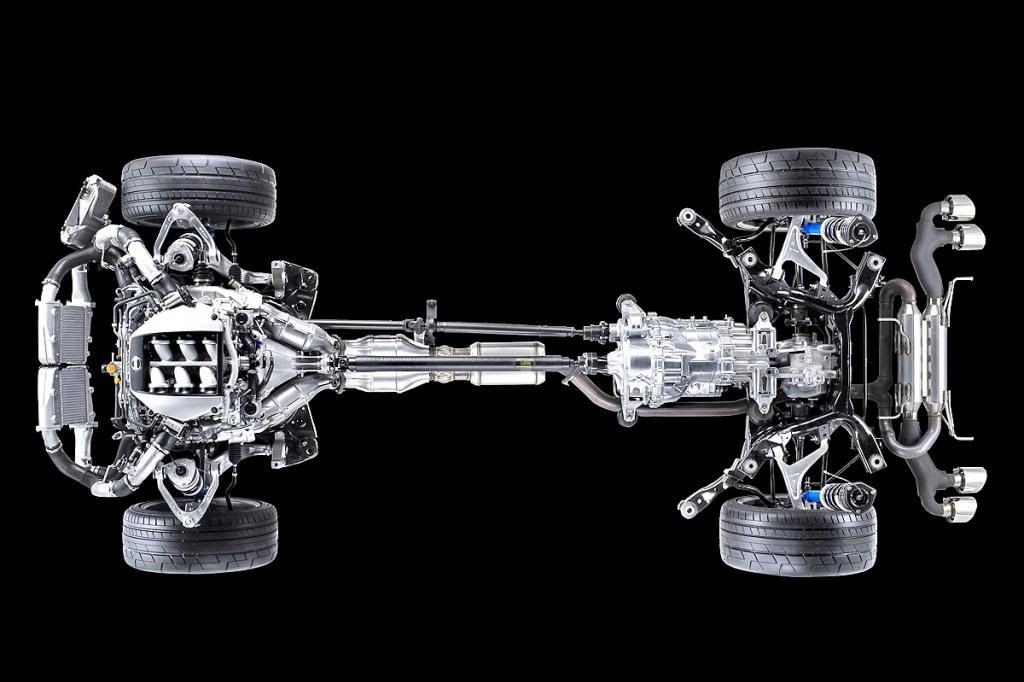
Here is the GTR layout. Wonder why the car is so heavy?
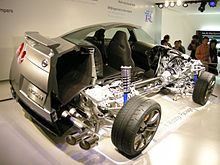
This is the GTR Xmission. A fragile unit that is plagued with problems. Don't keep it beyond the guarantee period. A clumbsy bit of engineering that needs plenty electronic intervention to keep it alive. Plenty lemon law claims.

It is not strong enough for the GTR but won't even fit in the ZR1 chassis which is close to the C7 design. AWD???

You could put the clutches behind the gearbox like in this Ferarri FF and add 100 to 150lbs.
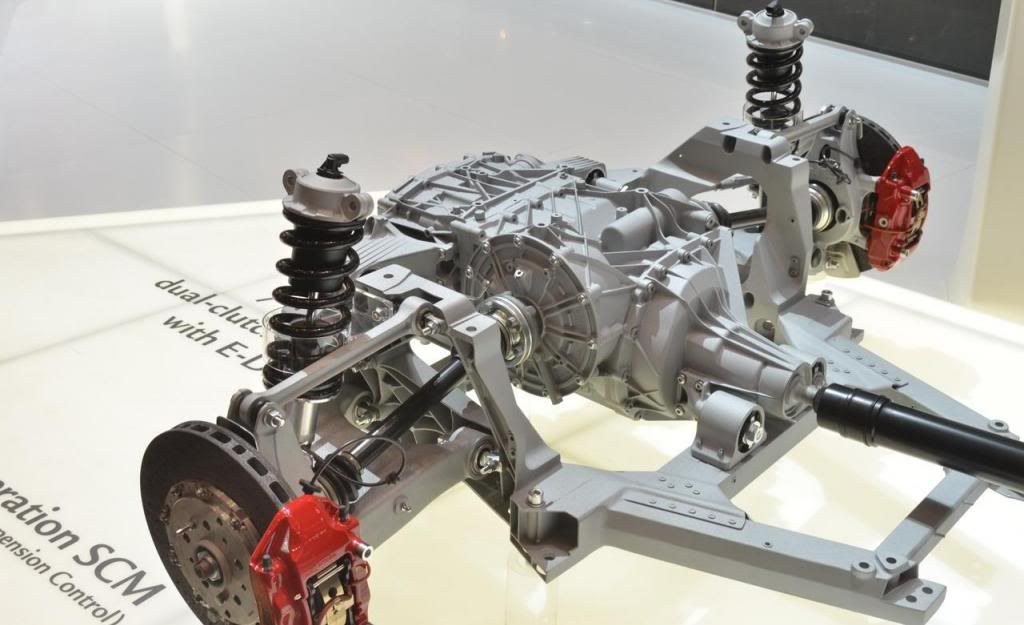
You can add the FFs front wheel drive system if you can find the space, another 150lbs.

Careful what you wish for. check what Corvettes do arounf the Ring again.
Here is the GTR layout. Wonder why the car is so heavy?


This is the GTR Xmission. A fragile unit that is plagued with problems. Don't keep it beyond the guarantee period. A clumbsy bit of engineering that needs plenty electronic intervention to keep it alive. Plenty lemon law claims.

It is not strong enough for the GTR but won't even fit in the ZR1 chassis which is close to the C7 design. AWD???

You could put the clutches behind the gearbox like in this Ferarri FF and add 100 to 150lbs.

You can add the FFs front wheel drive system if you can find the space, another 150lbs.

Careful what you wish for. check what Corvettes do arounf the Ring again.
Last edited by Shaka; Aug 1, 2013 at 08:43 AM.

Melting Slicks


Joined: Aug 2003
Posts: 2,245
Likes: 2,176
From: Cary NC
Just as a point of fact I have not driven the 2012 or 2103 to confirm this point. But I do remember reading this awhile ago about a software fix to the A6 6L80 transmission that increased the shift times to equal or close to a DCT.
http://www.vetteweb.com/tech/vemp_12...lickety_shift/
I have my C7 on order with the A6 and I'll find out for sure when it is built. I can't wait to give it a try.
http://www.vetteweb.com/tech/vemp_12...lickety_shift/
I have my C7 on order with the A6 and I'll find out for sure when it is built. I can't wait to give it a try.
Good article. GM has realized the need for an improved auto for some time now. Only problem I see with the staged upshifts is that there is no mention of a similar algorithm for the downshift. Probably not a big deal for some, but for others it would be noticeable, especially those who track their cars. For example, if the clutch fill time is already reduced in anticipation of an upshift, what happens when you jab the brakes and hit a quick downshift instead?
.

Thread Starter
Racer

Joined: Mar 2012
Posts: 446
Likes: 1
From: Christiansburg VA
Good article. GM has realized the need for an improved auto for some time now. Only problem I see with the staged upshifts is that there is no mention of a similar algorithm for the downshift. Probably not a big deal for some, but for others it would be noticeable, especially those who track their cars. For example, if the clutch fill time is already reduced in anticipation of an upshift, what happens when you jab the brakes and hit a quick downshift instead?
.
.
Safety Car
Joined: Nov 2002
Posts: 4,168
Likes: 1,336
From: FLL Florida
Corvette Stories
The Best of Corvette for Corvette Enthusiasts

Every 2027 Corvette Engine Explained
Joe Kucinski
Designer Imagines A Corvette That Looks More Like a Corvette Than the Corvette
Verdad Gallardo
10 Ugly Corvettes That We Still Kinda Love
Joe Kucinski
Top 10 Most Expensive Corvettes Ever Sold on Bring A Trailer
Brett Foote
10 Things Every Corvette Owner Needs (2026 Edition)
Michael S. Palmer
8 Most "Only Corvette Owners Understand" Quirks and Problems
Pouria Savadkouei
10 Reasons the C6 Z06 is Still A Performance Benchmark After 20 Years
Joe Kucinski
How Much Horsepower Every Corvette Engine "LOST" in 1972
Joe Kucinski
Top 10 DOs and DON'Ts for Protecting Your Convertible Top!
Michael S. Palmer
Safety Car
Joined: Nov 2002
Posts: 4,168
Likes: 1,336
From: FLL Florida
There is a world wide race going on to build the ultimate slush box. There are great tranny shops that will build you a fast changing auto that will beat any stick and DCT. Maybe not for iddy biddy engines.
This an American designed and built ZF 9 spped that will be used for a number of high performance cars.

The dual clutch technology requires to many parts, to input shafts and sometimes a split output or counter shaft. Heavy and expensive and unreliable. People suggest that this is the way of the future. No way. Look how compact and light you can get an auto these days. Short shafts can take much more torque and there is no redundancy in the tranny. Epi cyclic gear combos have the same drag as constant mesh.
Torque converters have advanced to such a degree that they smaller and lighter with their own internal clutch packs.
You simply can't make clutches work like fluid without a lot of wear.
The DCT was designed in the 30s for heavy armored vehicles to get thru sand and mud. They were heavy then, and they are heavy now.
Tadge said they have been working on a 4 speed auto that gives damn near DCT shift performance. The market requires at least 6 speeds. Also, it must pass GM's 100 hour durability tests.
ZF CEO Stefan Sommer as saying nine speeds are the “natural limit.” In Sommer’s words, “There is no hard line, but you have to consider the law of diminishing returns. The question is whether adding even more gears makes sense.”
That sentiment is echoed by Julio Caspari, president of ZF’s North American division, who believes that the race for more gears is driven by marketing and not engineering. As proof, Caspari says that there’s only an 11-percent gap in efficiency between today’s most-efficient gearboxes and a theoretically perfect ideal.
We’d be the first to point out that more gears equal more complexity, higher cost and, potentially, more points of failure. Unless someone can conclusively prove that ten speeds are better than nine, we say let’s turn our attention to other areas, like making more power from less displacement.
This an American designed and built ZF 9 spped that will be used for a number of high performance cars.

The dual clutch technology requires to many parts, to input shafts and sometimes a split output or counter shaft. Heavy and expensive and unreliable. People suggest that this is the way of the future. No way. Look how compact and light you can get an auto these days. Short shafts can take much more torque and there is no redundancy in the tranny. Epi cyclic gear combos have the same drag as constant mesh.
Torque converters have advanced to such a degree that they smaller and lighter with their own internal clutch packs.
You simply can't make clutches work like fluid without a lot of wear.
The DCT was designed in the 30s for heavy armored vehicles to get thru sand and mud. They were heavy then, and they are heavy now.
Tadge said they have been working on a 4 speed auto that gives damn near DCT shift performance. The market requires at least 6 speeds. Also, it must pass GM's 100 hour durability tests.
ZF CEO Stefan Sommer as saying nine speeds are the “natural limit.” In Sommer’s words, “There is no hard line, but you have to consider the law of diminishing returns. The question is whether adding even more gears makes sense.”
That sentiment is echoed by Julio Caspari, president of ZF’s North American division, who believes that the race for more gears is driven by marketing and not engineering. As proof, Caspari says that there’s only an 11-percent gap in efficiency between today’s most-efficient gearboxes and a theoretically perfect ideal.
We’d be the first to point out that more gears equal more complexity, higher cost and, potentially, more points of failure. Unless someone can conclusively prove that ten speeds are better than nine, we say let’s turn our attention to other areas, like making more power from less displacement.
Advanced
Joined: Aug 2007
Posts: 79
Likes: 11
I like having more gears. Mechanical advantage for acceleration and big overdrives for fuel economy.
IIRC the original trans that came in the first model years of the GTR was garbage but since then they've improved it. Not to mention AMS's GTR broke into the 7's recently. It is using upgraded components from John Shepherd though.
IIRC the original trans that came in the first model years of the GTR was garbage but since then they've improved it. Not to mention AMS's GTR broke into the 7's recently. It is using upgraded components from John Shepherd though.

Melting Slicks
Joined: Dec 2006
Posts: 2,694
Likes: 106
Before anything, if GM was using a ZF 8-speed tranny, I don't think anybody would be complaining. Having said that, I believe Mercedes has the ultimate solution: the size and reliability of a planetary-gear automatic transmission, but with wet clutches instead of a power and weight-sapping converter.
They still do. But it was actually released on the California first, with the same complaint, even though it's more of a GT car. Have many miles on a 2010 Cali, and it feels boring. A friend has a 430 F1, and even though it shifts slower, it's a lot more fun, sounds like a manual driven by an expert, you get a big push at every shift, like a manual, and it blips the throttle on downshifts, which sounds awesome with the valves permanently opened. The only instance where the DCT beats the F1 is it jerks less when starting slow, like in heavy traffic. The F1 is actually the same Graziano manual transmission but with an electro-hydraulic clutch actuator and gear changer. VERY complex and heavy.
To me it does. In fact, I'd put that limit at 8 myself. Any more and you might as well get a lighter CVT, because it'd feel basically the same (which is 'like crap' to me  ).
).
).


Melting Slicks
Joined: Aug 2003
Posts: 2,245
Likes: 2,176
From: Cary NC
A slow(er) down-shift I don't think would be a bad thing. Consider how much a botched downshift on a manual upsets the rear of the car for reference. The key is to have a throttle blip associated with the downshift to make it as smooth as possible, regardless of the time it takes to complete it. If memory serves correctly, when Ferrari released their DCT for the 458, some owners complained that it was "too smooth" with no jerk on up or down-shifts, as it was tuned to keep the rear planted under heavy acceleration and braking.
.

Instructor

Joined: Nov 2007
Posts: 173
Likes: 7
There is a world wide race going on to build the ultimate slush box. There are great tranny shops that will build you a fast changing auto that will beat any stick and DCT. Maybe not for iddy biddy engines.
This an American designed and built ZF 9 spped that will be used for a number of high performance cars.
The dual clutch technology requires to many parts, to input shafts and sometimes a split output or counter shaft. Heavy and expensive and unreliable. People suggest that this is the way of the future. No way. Look how compact and light you can get an auto these days. Short shafts can take much more torque and there is no redundancy in the tranny. Epi cyclic gear combos have the same drag as constant mesh.
Torque converters have advanced to such a degree that they smaller and lighter with their own internal clutch packs.
You simply can't make clutches work like fluid without a lot of wear.
The DCT was designed in the 30s for heavy armored vehicles to get thru sand and mud. They were heavy then, and they are heavy now.
Tadge said they have been working on a 4 speed auto that gives damn near DCT shift performance. The market requires at least 6 speeds. Also, it must pass GM's 100 hour durability tests.
ZF CEO Stefan Sommer as saying nine speeds are the “natural limit.” In Sommer’s words, “There is no hard line, but you have to consider the law of diminishing returns. The question is whether adding even more gears makes sense.”
That sentiment is echoed by Julio Caspari, president of ZF’s North American division, who believes that the race for more gears is driven by marketing and not engineering. As proof, Caspari says that there’s only an 11-percent gap in efficiency between today’s most-efficient gearboxes and a theoretically perfect ideal.
We’d be the first to point out that more gears equal more complexity, higher cost and, potentially, more points of failure. Unless someone can conclusively prove that ten speeds are better than nine, we say let’s turn our attention to other areas, like making more power from less displacement.
This an American designed and built ZF 9 spped that will be used for a number of high performance cars.
The dual clutch technology requires to many parts, to input shafts and sometimes a split output or counter shaft. Heavy and expensive and unreliable. People suggest that this is the way of the future. No way. Look how compact and light you can get an auto these days. Short shafts can take much more torque and there is no redundancy in the tranny. Epi cyclic gear combos have the same drag as constant mesh.
Torque converters have advanced to such a degree that they smaller and lighter with their own internal clutch packs.
You simply can't make clutches work like fluid without a lot of wear.
The DCT was designed in the 30s for heavy armored vehicles to get thru sand and mud. They were heavy then, and they are heavy now.
Tadge said they have been working on a 4 speed auto that gives damn near DCT shift performance. The market requires at least 6 speeds. Also, it must pass GM's 100 hour durability tests.
ZF CEO Stefan Sommer as saying nine speeds are the “natural limit.” In Sommer’s words, “There is no hard line, but you have to consider the law of diminishing returns. The question is whether adding even more gears makes sense.”
That sentiment is echoed by Julio Caspari, president of ZF’s North American division, who believes that the race for more gears is driven by marketing and not engineering. As proof, Caspari says that there’s only an 11-percent gap in efficiency between today’s most-efficient gearboxes and a theoretically perfect ideal.
We’d be the first to point out that more gears equal more complexity, higher cost and, potentially, more points of failure. Unless someone can conclusively prove that ten speeds are better than nine, we say let’s turn our attention to other areas, like making more power from less displacement.

Race Director


Joined: Nov 2003
Posts: 16,069
Likes: 4,151
From: Bergen county NJ
This may be sImiliar to what gm is planning for DCT convertor combination for future transmissions
Scroll down to see the convertor dct in real life..ldifferent application but reviews have been positive with regards to fun to drive relevance.
Scroll down to see the convertor dct in real life..ldifferent application but reviews have been positive with regards to fun to drive relevance.
Race Director
Joined: Nov 2003
Posts: 16,069
Likes: 4,151
From: Bergen county NJ

Le Mans Master

Joined: Nov 2004
Posts: 5,886
Likes: 371
From: Cape Coral FL
The new GT3 trans. And quotes from Porsche..lol.
At Porsche we all love to shift gears manually, but what we love even more is being the fastest.”
Still, it’s a relief to note that we’re not dealing with any ordinary “Porsche Doppelkupplung” in this instance; instead it’s the amped-up adrenaline junkie of the family, the one that achieves top speed in top gear and packs closer ratios. It’s easy enough to say that shift times are down to just 100 milliseconds, but do you know what that means? The GT3 comes with Sport and Race Track transmission modes, and in the latter the up-changes are so fast it’s almost as if the car is prepared to break itself in the effort to please you.
Literally, it’s like an electric handclap – BAM – and you’re accelerating hard into the next gear. Porsche calls this a “lightning shift”, and the process is supercharged by a “torque overshoot” feature that hurls the engine into the new ratio. Down-changes are similarly dispensed with no pause and no mercy; you get exactly what you want at exactly the right time.
Techno, techno, techno, techno…
Even the paddleshifters have a 50% shorter action in the GT3, but if you do crave greater interaction you can always use the lever – which works superbly with Porsche’s ambitious but successful attempt to replicate the feel of a sequential racing transmission.
This combination of supersonic engine and whip-crack gearbox is utterly mesmerizing. If the manual transmission has got to die, this is surely the way it wants to go – vanquished to the point of irrelevance. But this wouldn’t be a GT3 without a chassis that also does extraordinary things to your nerve endings, and this car is in no mood to disappoint.
At Porsche we all love to shift gears manually, but what we love even more is being the fastest.”
Still, it’s a relief to note that we’re not dealing with any ordinary “Porsche Doppelkupplung” in this instance; instead it’s the amped-up adrenaline junkie of the family, the one that achieves top speed in top gear and packs closer ratios. It’s easy enough to say that shift times are down to just 100 milliseconds, but do you know what that means? The GT3 comes with Sport and Race Track transmission modes, and in the latter the up-changes are so fast it’s almost as if the car is prepared to break itself in the effort to please you.
Literally, it’s like an electric handclap – BAM – and you’re accelerating hard into the next gear. Porsche calls this a “lightning shift”, and the process is supercharged by a “torque overshoot” feature that hurls the engine into the new ratio. Down-changes are similarly dispensed with no pause and no mercy; you get exactly what you want at exactly the right time.
Techno, techno, techno, techno…
Even the paddleshifters have a 50% shorter action in the GT3, but if you do crave greater interaction you can always use the lever – which works superbly with Porsche’s ambitious but successful attempt to replicate the feel of a sequential racing transmission.
This combination of supersonic engine and whip-crack gearbox is utterly mesmerizing. If the manual transmission has got to die, this is surely the way it wants to go – vanquished to the point of irrelevance. But this wouldn’t be a GT3 without a chassis that also does extraordinary things to your nerve endings, and this car is in no mood to disappoint.