







Handling Redux
Thread Starter
Racer


Joined: Mar 2002
Posts: 281
Likes: 0
From: Westerville OH
 Handling Redux
On 5/21/14 I wrote about a problem with the rear end of the car darting to the right when encountering a bump or dip in the road at highway speeds. Well, I finally have a resolution.
After waiting what semed like an eternity the dealer finally received the meter and tool to measure the rear caster. I took it in to the dealer and they checked alignment and said the rear toe was out of spec. I asked the mechanic about the rear caster and his response was "it was ok". I again asked what the rear caster measured and he gave me the same response. I immediately was suspicious that he never measured it or adjusted the rear caster. And that is specifically what I brought the car in to be checked. I waited for over a month for the dealer to obtain the digital angle gauge and adaptor. I drove the car home and it exhibited the same problem, the rear kicked to the right on encountering a dip or bump in the road.
So, I called my favorite Corvette mechanic. He was able to borrow a digital angle gauge and adaptor and I took it in to him this morning. He was able to measure the rear castor at +3.2 on the rear left and -1.9 on the rear right. Numerous adjustments of the rear camber, toe and caster and he was able to get the rear caster on both sides to -0.3 on both sides. The specification is 0.0 to -0.8. Took the beauty for a test drive and the problem was gone. No more rear kicking to the right. A shout out to Corvette Care in Columbus Ohio!!!!!!!!!
Sorry for being such a long post, but despite some of the earlier projections that the problem was related to bad suspension parts it really did come down to the rear caster being way off.
If anyone gets an alignment done on this car make sure they check the rear caster. If it is off it will cause many headaches. And my final assessment is that the dealer mechanic did not do his job even though that is what I specifically wanted checked.
After waiting what semed like an eternity the dealer finally received the meter and tool to measure the rear caster. I took it in to the dealer and they checked alignment and said the rear toe was out of spec. I asked the mechanic about the rear caster and his response was "it was ok". I again asked what the rear caster measured and he gave me the same response. I immediately was suspicious that he never measured it or adjusted the rear caster. And that is specifically what I brought the car in to be checked. I waited for over a month for the dealer to obtain the digital angle gauge and adaptor. I drove the car home and it exhibited the same problem, the rear kicked to the right on encountering a dip or bump in the road.
So, I called my favorite Corvette mechanic. He was able to borrow a digital angle gauge and adaptor and I took it in to him this morning. He was able to measure the rear castor at +3.2 on the rear left and -1.9 on the rear right. Numerous adjustments of the rear camber, toe and caster and he was able to get the rear caster on both sides to -0.3 on both sides. The specification is 0.0 to -0.8. Took the beauty for a test drive and the problem was gone. No more rear kicking to the right. A shout out to Corvette Care in Columbus Ohio!!!!!!!!!
Sorry for being such a long post, but despite some of the earlier projections that the problem was related to bad suspension parts it really did come down to the rear caster being way off.
If anyone gets an alignment done on this car make sure they check the rear caster. If it is off it will cause many headaches. And my final assessment is that the dealer mechanic did not do his job even though that is what I specifically wanted checked.
Thread Starter
Racer
Joined: Mar 2002
Posts: 281
Likes: 0
From: Westerville OH
Thread Starter
Racer
Joined: Mar 2002
Posts: 281
Likes: 0
From: Westerville OH

Drifting


Joined: Sep 2013
Posts: 1,505
Likes: 13
For the front suspension machines use a method to measure that uses a gauge attached to the front wheels that measures the difference in camber as the wheels are rotated through left and right full lock. It eliminates any issues with proper verticle placement of the gauge on a suspension component and allows one measuring device to measure both camber and caster.
Because the rear suspension doesn't steer those conventional alignment adapters can't measure rear caster so a stand alone gauge is attached to the suspension knuckle to measure this angle.
Corvette Stories
The Best of Corvette for Corvette Enthusiasts

Top 10 Most Expensive Corvettes Ever Sold on Bring A Trailer
Brett Foote
10 Things Every Corvette Owner Needs (2026 Edition)
Michael S. Palmer
8 Most "Only Corvette Owners Understand" Quirks and Problems
Pouria Savadkouei
10 Reasons the C6 Z06 is Still A Performance Benchmark After 20 Years
Joe Kucinski
How Much Horsepower Every Corvette Engine "LOST" in 1972
Joe Kucinski
Top 10 DOs and DON'Ts for Protecting Your Convertible Top!
Michael S. Palmer
Top 10 Most Explosive Corvettes Ever Made: Power-to-Weight Ratio Ranked!
Joe Kucinski
150 hp to 1,250 hp: Every Corvette Generation Compared by the Specs That Matter
Joe Kucinski
8 Coolest Corvette Pace Cars (and Replicas) of All Time
Verdad Gallardo
Safety Car

Joined: Nov 2002
Posts: 4,168
Likes: 1,336
From: FLL Florida
The caster angle as viewed from the side is a line drawn from the upper and lower ball joint. If viewd from the back it is called ball joint inclination.
In most cases, the wheel bearing is placed on this line toward the bottom ball joint. This minimizes caster trail or lead. In the case of ball joint inclination, the scrub radius is determined. Indy and LeMans cars place the wheel bearing ahead of this line.
Upper and lower wishbones or A arms comes with inherent problems with many load couples. Michelin came up with a suspension for F1 cars(OPT) which was promptly banned. CAD designed modern multilink suspensions are the result.
Due to the differing lengths of the upper and lower A arms, the steering arm will cause toe changes during the travel of the suspension. Each application will require specific geometry. Bump and droop toe is optimized for roll oversteer or understeer. Generally, the included radius keeps toe neutral or zero thru normal conditions. Porsche is masterful at attempting to defy physics in their 911 with clever suspension geometry.
The mere fact that the rear has an upper and lower ball joint, it will have a castor angle. Corvette has decided to make this zero. Since the rear wheels don't steer the car, caster stability is not necessary.
Should there be a discrepancy,(OP's data) the caster trail or lead is insufficient to cause a steering moment unlike the front.
The Corvette engineers made a very compliant suspension, IE: Lots of pitch and roll. Control that severely, and you will get adverse binding couples. Race cars are different, because of minimum suspension travel. Few manufacturers can optimize the friction circle at each corner like C7 does. A very complicated science.

Last edited by Shaka; Jul 17, 2014 at 09:54 AM. Reason: added picture
Thread Starter
Racer
Joined: Mar 2002
Posts: 281
Likes: 0
From: Westerville OH
Unbeknownst the the OP, was that his shocks were replaced as per recall which fixed the problem. A broken shock/s caused the problem.
The caster angle as viewed from the side is a line drawn from the upper and lower ball joint. If viewd from the back it is called ball joint inclination.
In most cases, the wheel bearing is placed on this line toward the bottom ball joint. This minimizes caster trail or lead. In the case of ball joint inclination, the scrub radius is determined. Indy and LeMans cars place the wheel bearing ahead of this line.
Upper and lower wishbones or A arms comes with inherent problems with many load couples. Michelin came up with a suspension for F1 cars(OPT) which was promptly banned. CAD designed modern multilink suspensions are the result.
Due to the differing lengths of the upper and lower A arms, the steering arm will cause toe changes during the travel of the suspension. Each application will require specific geometry. Bump and droop toe is optimized for roll oversteer or understeer. Generally, the included radius keeps toe neutral or zero thru normal conditions. Porsche is masterful at attempting to defy physics in their 911 with clever suspension geometry.
The mere fact that the rear has an upper and lower ball joint, it will have a castor angle. Corvette has decided to make this zero. Since the rear wheels don't steer the car, caster stability is not necessary.
Should there be a discrepancy,(OP's data) the caster trail or lead is insufficient to cause a steering moment unlike the front.
The Corvette engineers made a very compliant suspension, IE: Lots of pitch and roll. Control that severely, and you will get adverse binding couples. Race cars are different, because of minimum suspension travel. Few manufacturers can optimize the friction circle at each corner like C7 does. A very complicated science.
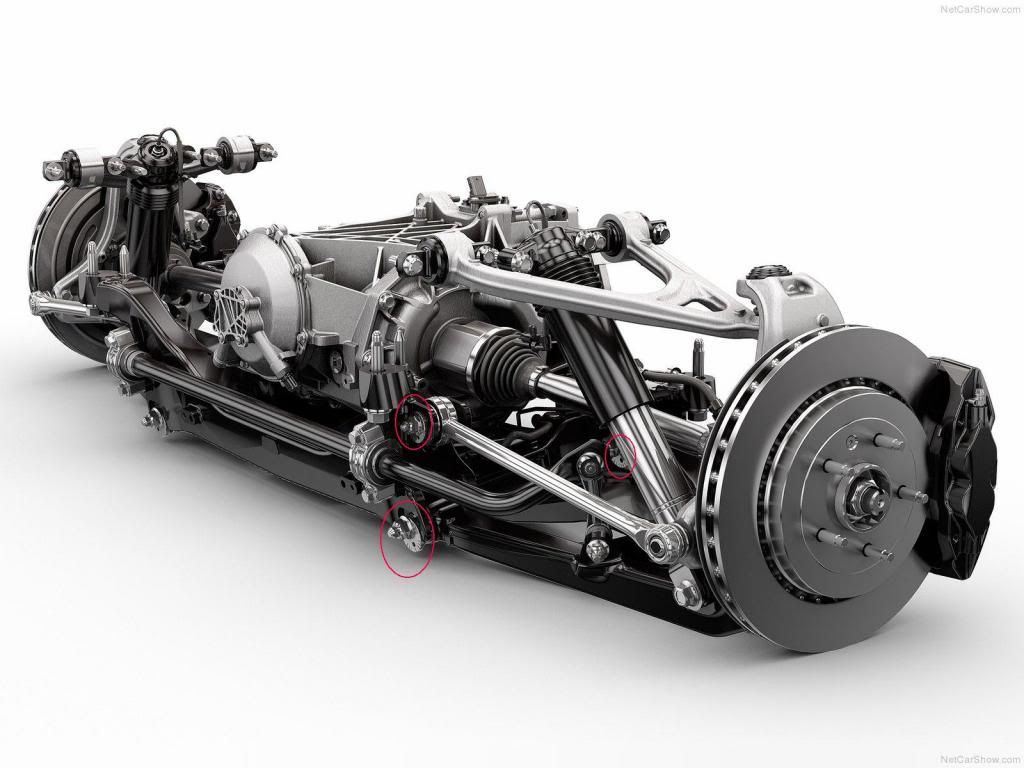
The caster angle as viewed from the side is a line drawn from the upper and lower ball joint. If viewd from the back it is called ball joint inclination.
In most cases, the wheel bearing is placed on this line toward the bottom ball joint. This minimizes caster trail or lead. In the case of ball joint inclination, the scrub radius is determined. Indy and LeMans cars place the wheel bearing ahead of this line.
Upper and lower wishbones or A arms comes with inherent problems with many load couples. Michelin came up with a suspension for F1 cars(OPT) which was promptly banned. CAD designed modern multilink suspensions are the result.
Due to the differing lengths of the upper and lower A arms, the steering arm will cause toe changes during the travel of the suspension. Each application will require specific geometry. Bump and droop toe is optimized for roll oversteer or understeer. Generally, the included radius keeps toe neutral or zero thru normal conditions. Porsche is masterful at attempting to defy physics in their 911 with clever suspension geometry.
The mere fact that the rear has an upper and lower ball joint, it will have a castor angle. Corvette has decided to make this zero. Since the rear wheels don't steer the car, caster stability is not necessary.
Should there be a discrepancy,(OP's data) the caster trail or lead is insufficient to cause a steering moment unlike the front.
The Corvette engineers made a very compliant suspension, IE: Lots of pitch and roll. Control that severely, and you will get adverse binding couples. Race cars are different, because of minimum suspension travel. Few manufacturers can optimize the friction circle at each corner like C7 does. A very complicated science.
Shocks were not replaced as claimed by Shaka. The recall does not include my VIN. I have no idea where this came from. I was watching the entire time the rear alignment was done. And the caster was adjusted to nearly zero on both sides. Unbeknownst to me????
Last edited by JSibert; Jul 18, 2014 at 09:33 PM.


Safety Car
Joined: Nov 2002
Posts: 4,168
Likes: 1,336
From: FLL Florida
Oh, so you seem to know a lot about suspensions. Pray tell, oh wise one, with the specs our friend JS was presented and you have obviously studied, describe what turning forces there could possibly be at the back of his car to cause it to swerve on a straight road after a 'bump' on this said road? Describe how correcting the out of spec settings would solve his 'problem'. I thank you in advance.
Thread Starter
Racer
Joined: Mar 2002
Posts: 281
Likes: 0
From: Westerville OH
Oh, so you seem to know a lot about suspensions. Pray tell, oh wise one, with the specs our friend JS was presented and you have obviously studied, describe what turning forces there could possibly be at the back of his car to cause it to swerve on a straight road after a 'bump' on this said road? Describe how correcting the out of spec settings would solve his 'problem'. I thank you in advance.
The problem was solved and no shocks were replaced. Is there some reason you said that "unbeknownst to OP" that my shocks were replaced? I am trying to understand what prompted you to proffer this statement.

Racer
Joined: Jan 2016
Posts: 281
Likes: 28
From: CA
I have a 2014 non z51 with magnetic control and I feel this at highway speeds as well. I have spoken to a few dealerships in the area I hope showing them this will help fix the issue.
Racer
Joined: Jan 2016
Posts: 281
Likes: 28
From: CA
Experiencing the same issue. took mine in today and was told alignment checked out. I asked for alignment and caster info hopefully they provide it as I will be picking up the vehicle tomorrow. I was told this vehicle comes with no rear sway bar making it feel like that? sounds like a joke to me.

Safety Car
Joined: Jan 2015
Posts: 3,941
Likes: 499
From: Northern Virginia
Oh, so you seem to know a lot about suspensions. Pray tell, oh wise one, with the specs our friend JS was presented and you have obviously studied, describe what turning forces there could possibly be at the back of his car to cause it to swerve on a straight road after a 'bump' on this said road? Describe how correcting the out of spec settings would solve his 'problem'. I thank you in advance.
Negative Caster
Negative caster is when the steering axis is “behind” the vertical. This is generally only found on older vehicles due to tire technology, chassis dynamics, and other reasons. Modern vehicles do not use negative caster. It will lighten the steering effort but also increases the tendency for the car to wander down the road.
Special Note – Regardless of what caster setting you use, make sure that your caster is symmetrical. Running a different amount of caster on one side will cause the car to pull towards the side with less caster.
Negative caster is when the steering axis is “behind” the vertical. This is generally only found on older vehicles due to tire technology, chassis dynamics, and other reasons. Modern vehicles do not use negative caster. It will lighten the steering effort but also increases the tendency for the car to wander down the road.
Special Note – Regardless of what caster setting you use, make sure that your caster is symmetrical. Running a different amount of caster on one side will cause the car to pull towards the side with less caster.
Last edited by meyerweb; Jan 6, 2016 at 05:31 PM.

Race Director


Joined: Jul 2007
Posts: 10,961
Likes: 2,643
From: Texas Hill Country
There is no pull or noticeable issue with driving. This is after hitting a large enough bump to unload the rear suspension. When it happens, it wiggles side to side rather than just unloading straight up and down.
Racer
Joined: Jan 2016
Posts: 281
Likes: 28
From: CA
I am experiencing the exact same thing. Feels a little loose on bumps and long turns. I will be taking mine in to a frame and alignment shop to have it checked. I hope that will fix the issue as others have reported. I will also be adding z51 sway bars and lowering the max the stock bolts allow.