




Installing a recirc line from carb.
Thread Starter
Le Mans Master


Joined: Oct 2002
Posts: 7,098
Likes: 378
From: Las Vegas - Just stop perpetuating myths please.
 Installing a recirc line from carb.
Posted this in the C3 section. Just thought i should share this with the engines mods group. Recently completed my fuel line system for my Carter fuel pump without the vapor return connection. So i installed a recircing line at the Qjet inlet with a flow limiting 0.040" orifice. First problem was my Harbor Frieght 3/8" tubing bender.  Discovered it was too slopy because the bender was made to fit 3/8" i.d. tubing and not tight enough for 3/8" o.d. tubing that i use. Not to knock HF as the strength and finish was good enough for me and would have been fine for larger tube. I dug up my old General tri size bender and it worked great. Tight 180* bends easily.
I've found that some brake line is better quality/for fuel line use than others. After several attemps at a 90* bend with some green colored stuff from Auto Zone i found it continued to flatten instead of bend round as needed. Bought some 3/8" brake line from NAPA/Carcraft and it bent up just fine.
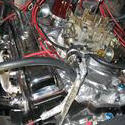
So i updated my pix in my sig to show off my new lines. Or use this link <http://www.cardomain.com/id/cardo0>. I built a 1/4" return line by drilling, taping, JB Welded in a brass bushing (and tee) into the Qjet inlet (thats a lars rebuilt Qjet BTW ). Both lines are covered with Home Depot plumbing insulation glued on with 3M weatherstrip adhesive. The return has a 0.040" orifice installed to act as recirc to maintain fresh/cool fuel and constant press and connects to the old vapor return line to fuel tank. The new Carter fuel pump didn't have a vapor return fitting and now i won't need one.
Pix don't show much of the polished Edelbrock wtr pmp but its a great match for the polished Edel Performer Air-Gap.
I think i have it the way i want it for now and will see how it works out. BTW that can on the right side of installed inlet tee (no not the fuel filter) is my Holley electric fuel press sensor. I should know what my inlet press is at any time from the drivers seat.
Just have to fix the oil in drivers wtr jacket crisis first.
Yea i wanted an all steel fuel line also and read lar's post <http://www.corvettefaq.com/c3/HowtoBuildaFuelLine.DOC>. But when i started collecting parts the special line required for that type of filter is a special order from my Chevy dealer and subsitute small pieces with correct type bulge & flair with O-ring are $15 each at Auto Zone - bad bends and mistakes would become expensive fast. That special filter was'nt cheap (but not really too expensive either). At less than $5 for 5 ft of 3/8" steel brake line i could afford plenty of mistakes. I'm think'n the lars design might be great for a high fuel pressure application and worth the expense then. I submitted to using 2 short pieces of flex in a visable location. That steel line by lars is a great piece but i'm a bit cheaper and for my plans the 2 short pieces of flex will be just fine as thier both visable and not in contact with any metal. And i may change my fuel lines again when i install my A/C compressor. I had planned to use a larger FRAM filter but submitted here to for lack of a good brace/bracket for the heavy filter housing. And the FRAM has 3/8" NPT ports that will allow hard line plumbing entirely. I need to install the compressor first
  to sort things out.
Oh BTW use double flairs where needed but i was able to use the double flares that came on the brake line and just bulge the open ends for a good seal with the flex. And for the rubber flex tubing ends i was able to bulb the end by just starting a double flair - not finishing/completing the die stroke/press. Works great to seal the tube with a clamp behind the bulb and looks like commercial made fuel line. Thought i should add that the flares are all doubles and that steel tube flares much better if cutting the tube with a hack saw rather than disk/circle type tubing cutter. Using the normal disk type tubing cutter seems to work harden the steel tubing end and i had many crack while trying to double flare. So what i learned works best was to cut tubing with a hack saw then file square to clean end. This left the metal soft enough to double flare. And to replace a bad/unwanted flare trim far enough away to remove the hardened steel end. BTW i stumbled onto the new mini-hacksaws (Home Depot, etc.) that work great for small work and fit in the tool box.
Good luck and have fun bending up ur car (lines). cardo0
Discovered it was too slopy because the bender was made to fit 3/8" i.d. tubing and not tight enough for 3/8" o.d. tubing that i use. Not to knock HF as the strength and finish was good enough for me and would have been fine for larger tube. I dug up my old General tri size bender and it worked great. Tight 180* bends easily.I've found that some brake line is better quality/for fuel line use than others. After several attemps at a 90* bend with some green colored stuff from Auto Zone i found it continued to flatten instead of bend round as needed. Bought some 3/8" brake line from NAPA/Carcraft and it bent up just fine.
So i updated my pix in my sig to show off my new lines. Or use this link <http://www.cardomain.com/id/cardo0>. I built a 1/4" return line by drilling, taping, JB Welded in a brass bushing (and tee) into the Qjet inlet (thats a lars rebuilt Qjet BTW
). Both lines are covered with Home Depot plumbing insulation glued on with 3M weatherstrip adhesive. The return has a 0.040" orifice installed to act as recirc to maintain fresh/cool fuel and constant press and connects to the old vapor return line to fuel tank. The new Carter fuel pump didn't have a vapor return fitting and now i won't need one.Pix don't show much of the polished Edelbrock wtr pmp but its a great match for the polished Edel Performer Air-Gap.
I think i have it the way i want it for now and will see how it works out. BTW that can on the right side of installed inlet tee (no not the fuel filter) is my Holley electric fuel press sensor. I should know what my inlet press is at any time from the drivers seat.
Just have to fix the oil in drivers wtr jacket crisis first.
Yea i wanted an all steel fuel line also and read lar's post <http://www.corvettefaq.com/c3/HowtoBuildaFuelLine.DOC>. But when i started collecting parts the special line required for that type of filter is a special order from my Chevy dealer and subsitute small pieces with correct type bulge & flair with O-ring are $15 each at Auto Zone - bad bends and mistakes would become expensive fast.
That special filter was'nt cheap (but not really too expensive either). At less than $5 for 5 ft of 3/8" steel brake line i could afford plenty of mistakes. I'm think'n the lars design might be great for a high fuel pressure application and worth the expense then. I submitted to using 2 short pieces of flex in a visable location. That steel line by lars is a great piece but i'm a bit cheaper and for my plans the 2 short pieces of flex will be just fine as thier both visable and not in contact with any metal. And i may change my fuel lines again when i install my A/C compressor. I had planned to use a larger FRAM filter but submitted here to for lack of a good brace/bracket for the heavy filter housing. And the FRAM has 3/8" NPT ports that will allow hard line plumbing entirely. I need to install the compressor first to sort things out.Oh BTW use double flairs where needed but i was able to use the double flares that came on the brake line and just bulge the open ends for a good seal with the flex. And for the rubber flex tubing ends i was able to bulb the end by just starting a double flair - not finishing/completing the die stroke/press. Works great to seal the tube with a clamp behind the bulb and looks like commercial made fuel line.
Thought i should add that the flares are all doubles and that steel tube flares much better if cutting the tube with a hack saw rather than disk/circle type tubing cutter. Using the normal disk type tubing cutter seems to work harden the steel tubing end and i had many crack while trying to double flare. So what i learned works best was to cut tubing with a hack saw then file square to clean end. This left the metal soft enough to double flare. And to replace a bad/unwanted flare trim far enough away to remove the hardened steel end. BTW i stumbled onto the new mini-hacksaws (Home Depot, etc.) that work great for small work and fit in the tool box. Good luck and have fun bending up ur car (lines).
cardo0

Race Director


Joined: Sep 2000
Posts: 17,298
Likes: 33
From: The Top of Utah
That sounds like a neat, well thought out system. Just one comment. Did you ever consider a flow through fuel pressure regulator? I would be concerned the the .040" "pill" on the return line could provide varying pressures or volume with different pump output, and under different demands. The "pill" in the return line is how the A/F ratio was adjusted on the old mechanical injection systems. Nice job.
RACE ON!!!
RACE ON!!!
Thread Starter
Le Mans Master
Joined: Oct 2002
Posts: 7,098
Likes: 378
From: Las Vegas - Just stop perpetuating myths please.
Good question.
Originally Posted by CFI-EFI
That sounds like a neat, well thought out system. Just one comment. Did you ever consider a flow through fuel pressure regulator? I would be concerned the the .040" "pill" on the return line could provide varying pressures or volume with different pump output, and under different demands. The "pill" in the return line is how the A/F ratio was adjusted on the old mechanical injection systems. Nice job.
RACE ON!!!
RACE ON!!!
The orifice acts like a controlled leak to reduce inlet pressure at idle. Also provides fresh/cooler fuel to carb to prevent vapor lock. Only downside is the returning fuel creates extra vapor in fuel tank when spilling into top connection - which could be fixed too if needed/a problem. Now if the orifice is too large it could reduce fuel press and flow but reading from Doe Roe's book on Qjets a 0.040" -0.060" is just fine.
cardo0
Race Director
Joined: Sep 2000
Posts: 17,298
Likes: 33
From: The Top of Utah
I didn't make myself clear. My suggestion would replace the jet with the flow through regulator. It would maintain a more constant pressure, I think, and still allow the excess fuel to return to the tank. Being in the return line, there would be no obstruction ahead of the regulator, except the carb.
RACE ON!!!
RACE ON!!!
Pro

Joined: Oct 2004
Posts: 510
Likes: 5
From: Pipe Creek TX
Originally Posted by CFI-EFI
I didn't make myself clear. My suggestion would replace the jet with the flow through regulator. It would maintain a more constant pressure, I think, and still allow the excess fuel to return to the tank. Being in the return line, there would be no obstruction ahead of the regulator, except the carb.
RACE ON!!!
RACE ON!!!
I'm with you, a by-pass regulator works with out question.

Le Mans Master


Joined: Oct 2000
Posts: 8,897
Likes: 1,357
From: Santa Ana CA
Originally Posted by cardo0
I built a 1/4" return line by drilling, taping, JB Welded in a brass bushing (and tee) into the Qjet inlet (thats a lars rebuilt Qjet BTW ). cardo0
). cardo0To really get the most out of it, how about coming over and letting Lars personally tune it for you on Jan 14? See postings for the Tuning 4 Beer OC tour under Pacific Events, below.
Thread Starter
Le Mans Master
Joined: Oct 2002
Posts: 7,098
Likes: 378
From: Las Vegas - Just stop perpetuating myths please.
Flow through reg?
Originally Posted by CFI-EFI
I didn't make myself clear. My suggestion would replace the jet with the flow through regulator. It would maintain a more constant pressure, I think, and still allow the excess fuel to return to the tank. Being in the return line, there would be no obstruction ahead of the regulator, except the carb.
RACE ON!!!
RACE ON!!!
Sounds like u mean some kind of reverse acting regulator and i don't know of any availble. I've heard of a vacuum operated fuel reg but never have seen one. But it was pretty cheap and easy to drill a 0.040" hole for an orifice - plugged and drilled my brass Tee. Yea there's more than one way to do this so lets hear it if u want to describe it here.

How's that by-pass reg work? I'd like to see 1 of them as i can't figure that either.
Ok i'll describe mine first. That little Holley is just a small vlv that gets seated by a diaphram with fuel press on 1 side against spring press that's trying to open it. Now that diaphram and spring are designed for the operating pressures we need and some adjustment is provided to change the tension on the spring for the desired opening press/set point. And just swaping inlets for outlets won't make it a reverse acting reg either. A reverse acting would need to close the vlv and stop recirc when inlet press low then open and flow fuel when inlet press hi at idle. And i wanted continuous flow to prevent vapor lock from a heated fuel line. Really the fuel pumps are suppose to be self regulating and an inline reg is just added restriction if the pmp is doing its job right.
 The recirc orifice should help smooth the press out with a continuous flow.
  Well at least i'll a in car elec press gauge to watch this. cardo0
Corvette Stories
The Best of Corvette for Corvette Enthusiasts

Top 10 Most Expensive Corvettes Ever Sold on Bring A Trailer
Brett Foote
10 Things Every Corvette Owner Needs (2026 Edition)
Michael S. Palmer
8 Most "Only Corvette Owners Understand" Quirks and Problems
Pouria Savadkouei
10 Reasons the C6 Z06 is Still A Performance Benchmark After 20 Years
Joe Kucinski
How Much Horsepower Every Corvette Engine "LOST" in 1972
Joe Kucinski
Top 10 DOs and DON'Ts for Protecting Your Convertible Top!
Michael S. Palmer
Top 10 Most Explosive Corvettes Ever Made: Power-to-Weight Ratio Ranked!
Joe Kucinski
150 hp to 1,250 hp: Every Corvette Generation Compared by the Specs That Matter
Joe Kucinski
8 Coolest Corvette Pace Cars (and Replicas) of All Time
Verdad Gallardo
Thread Starter
Le Mans Master
Joined: Oct 2002
Posts: 7,098
Likes: 378
From: Las Vegas - Just stop perpetuating myths please.
Originally Posted by toddalin
To really get the most out of it, how about coming over and letting Lars personally tune it for you on Jan 14? See postings for the Tuning 4 Beer OC tour under Pacific Events, below.
 Jan 14? My vette will most likely still be on jacks or with the heads off just to reseal the head bolts.
BTW did u read my post? lars already tuned my Qjet - he rebuilt it for me and removed the choke - tuned it too. For only $100 its kinda like theft. Take a look Todd.www.cardomain.com/id/cardo0 Looks great don't it?
Have a good time and go easy on the bear.  cardo0
Pro
Joined: Oct 2004
Posts: 510
Likes: 5
From: Pipe Creek TX
cardo0- You are kinda right; a reverse flow regulator. They look just like your Holley reg; but the inlet is up top with the unrestricted outlet ; then the regulated return is out the bottom. These usually need the same size line in as out,depending on pump pressure. I use 30 lb. dead head pressure at the carb with a #10 line ; the by-pass regulates it at 7 lbs. by the amount it lets go back to the tank.. I use Barry Grant by-pass reg's on all my race cars. Jegs and Summit both sell them.
Race Director
Joined: Sep 2000
Posts: 17,298
Likes: 33
From: The Top of Utah
Originally Posted by cardo0
Guess i don't know what a flow through reg is...
Yea there's more than one way to do this so lets hear it if u want to describe it here.
How's that by-pass reg work? I'd like to see 1 of them as i can't figure that either.
cardo0
Yea there's more than one way to do this so lets hear it if u want to describe it here.
How's that by-pass reg work? I'd like to see 1 of them as i can't figure that either.
cardo0
RACE ON!!!
Le Mans Master
Joined: Oct 2000
Posts: 8,897
Likes: 1,357
From: Santa Ana CA
Originally Posted by cardo0
Jan 14? My vette will most likely still be on jacks or with the heads off just to reseal the head bolts. BTW did u read my post? lars already tuned my Qjet - he rebuilt it for me and removed the choke - tuned it too. For only $100 its kinda like theft. Take a look Todd.www.cardomain.com/id/cardo0 Looks great don't it?
Have a good time and go easy on the bear. cardo0Right, he tuned the carb, but did he tune it on the engine to the engine??? There's a difference. Also, this would let him get into your distributor.
A $100 for a rebuild is not bad at all. I had a carb shop do my '70 Q-jet some time back and recall it being about $150 with R/R, and it made a HUGE difference. Anywho, you're certainly welcome to come by and meet Lars and maybe learn something.
Last edited by toddalin; Dec 6, 2004 at 12:14 PM.

Team Owner


Joined: Apr 1999
Posts: 21,953
Likes: 1,445
From: Reno Nevada
2024 C3 of the Year Finalist- Modified
none of the pressure regulators will work. When we tried one turned down to the most small flow just squirts the gas out and it could never get up to 2 pounds on the fuel log.
We put different Holley jets to a 1/4 output line off the rear of the fuel log until it maintained a steady 7 psi to Holley Carb Shop racing 950 cfm for a BBC I think that the jet size we ended up with was something like a #68 or something close.
We put different Holley jets to a 1/4 output line off the rear of the fuel log until it maintained a steady 7 psi to Holley Carb Shop racing 950 cfm for a BBC I think that the jet size we ended up with was something like a #68 or something close.
Thread Starter
Le Mans Master
Joined: Oct 2002
Posts: 7,098
Likes: 378
From: Las Vegas - Just stop perpetuating myths please.
Originally Posted by gkull
none of the pressure regulators will work. When we tried one turned down to the most small flow just squirts the gas out and it could never get up to 2 pounds on the fuel log.
We put different Holley jets to a 1/4 output line off the rear of the fuel log until it maintained a steady 7 psi to Holley Carb Shop racing 950 cfm for a BBC I think that the jet size we ended up with was something like a #68 or something close.
We put different Holley jets to a 1/4 output line off the rear of the fuel log until it maintained a steady 7 psi to Holley Carb Shop racing 950 cfm for a BBC I think that the jet size we ended up with was something like a #68 or something close.
I found a #68 Holley jet has a 0.070" dia orific. So if i need more flow to reduce static press at idle i'll just drill the hole bigger. I know jets have an accurate taper and flow different than just a 0.070" hole but i'll just make small changes at a time.
Thanks gkull.
cardo0
Team Owner
Joined: Apr 1999
Posts: 21,953
Likes: 1,445
From: Reno Nevada
2024 C3 of the Year Finalist- Modified
Years ago I bought the Holley jet box and it has everything from like 50 -100 in just sizes plus everything else i have aquired over the years.
Anyway I drilled out the 1/4 flared fitting so a holley jet would fit in. Easy to pop in and out. My buddy did a nice pro loooking job of routing new stainless lines to some big Holley pump and he was always having boiling gas coming out of the vent tubes on a hot summer day. Often when it was idling at a stop light.
The routing of the return line solved the problem. 67 427 Camero that is fast
Anyway I drilled out the 1/4 flared fitting so a holley jet would fit in. Easy to pop in and out. My buddy did a nice pro loooking job of routing new stainless lines to some big Holley pump and he was always having boiling gas coming out of the vent tubes on a hot summer day. Often when it was idling at a stop light.
The routing of the return line solved the problem. 67 427 Camero that is fast
Thread Starter
Le Mans Master
Joined: Oct 2002
Posts: 7,098
Likes: 378
From: Las Vegas - Just stop perpetuating myths please.
Thanks for the info SG4206.
Originally Posted by SG4206
cardo0- You are kinda right; a reverse flow regulator. They look just like your Holley reg; but the inlet is up top with the unrestricted outlet ; then the regulated return is out the bottom. These usually need the same size line in as out,depending on pump pressure. I use 30 lb. dead head pressure at the carb with a #10 line ; the by-pass regulates it at 7 lbs. by the amount it lets go back to the tank.. I use Barry Grant by-pass reg's on all my race cars. Jegs and Summit both sell them.
 This is what they use to run hi-flow elec pumps at higher press and maintian low enough needle and seat press. Though i'll never use that much fuel it is nice to know how its down. After reading Holleys website tech tips on fuel press they recommend increasing press for hi-po mtrs with larger carb - i think Holley really is saying the hi-op mtrs need more fuel flow and higher press is 1 way to get it.
For a sb street mtr i think i can tweek in the recirc with/for what i use. And i really like how mine reaches/flows through the carb inlet. Once i removed the stock filter and looked at how restrictive it was i wanted to use 1 of the larger aftermarkets. I'm guessing that Holley has done the home work and that filter i installed should be an improvement. But it didn't have NPT ends for hard line plumbing and i looked to the carb for NPT connection. Since i also had a Holley electric press gauge to install i just drilled out a plug in the Qjet inlet and threaded that NPT. JB Welded a Brass bushing in and i had a great place for a Tee - kinda all came together nicely.
All this line fuel modifying took a buch of time but i feel its just so much better than stock and that it will save my butt some hot day up on a desert fwy. Or maybe from leaning out at the end of the 1/4 mi.
Happy trails.
 cardo0
